A skull in Pot 2: the Teouma Lapita cemetery, Vanuatu, 2004 to 2020

TL;DR — Teouma, on Efate in Vanuatu, held 68 Lapita graves, one with a skull inside a pot; DNA from three of its women showed little to no Papuan ancestry in 2016.
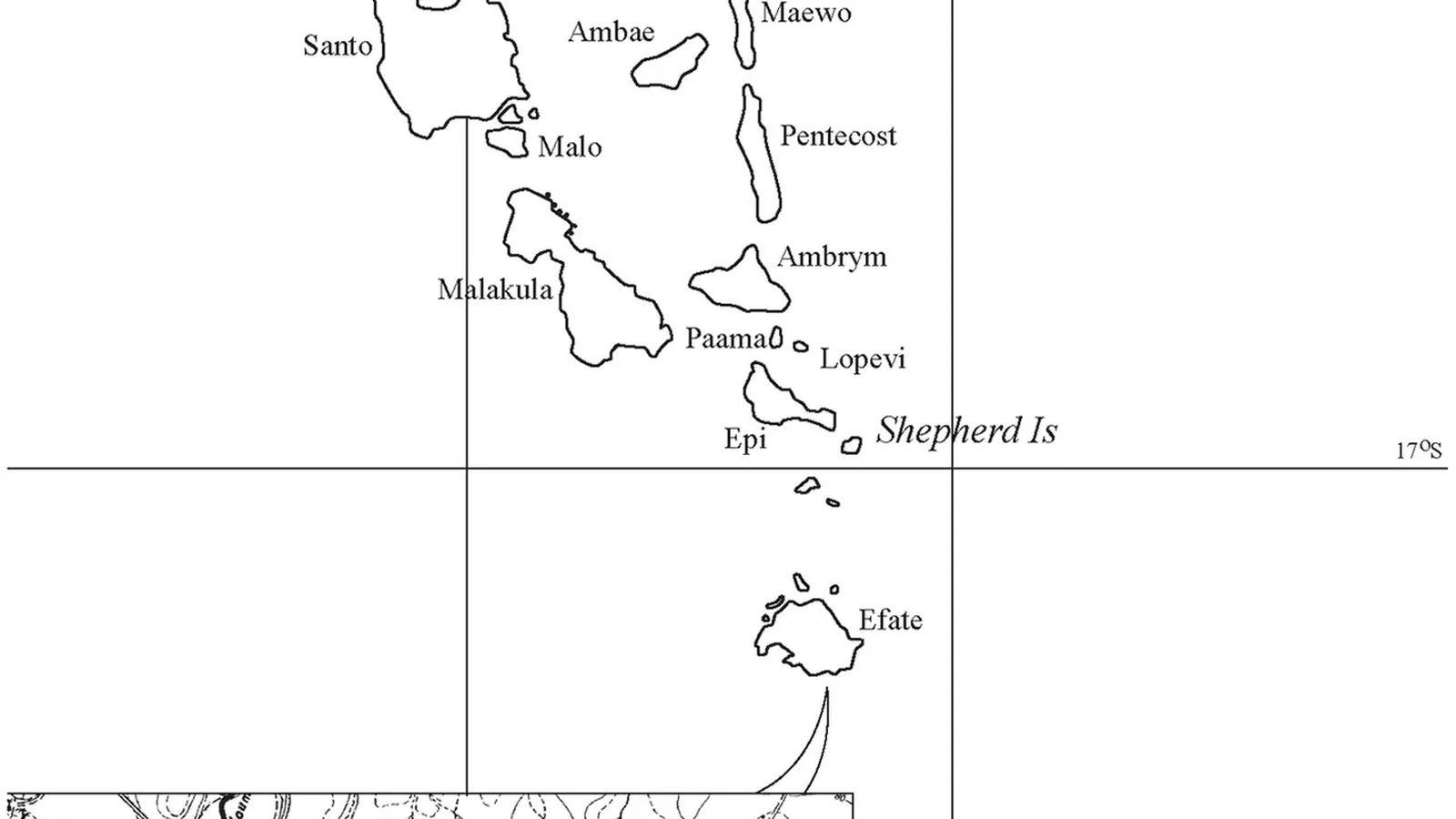
“In January 2004 the Teouma Lapita site was discovered on the southeast coast of Efate, Vanuatu.” So begins a 2007 report whose authors include Stuart Bedford and Matthew Spriggs of the Australian National University and Ralph Regenvanu and Takaronga Kuautonga of the Vanuatu Cultural Centre. The pottery that led them there had been “exposed during quarrying some four months previously,” during earthmoving for a prawn farm. Six field seasons followed, and in 2014 Rebecca Kinaston and colleagues described the site as “the largest burial assemblage (n = 68 inhumations) of Lapita period humans ever discovered.” One pot held a human skull under an inverted dish. Bones from the cemetery supplied the ancient DNA published in Nature on October 3, 2016, and three papers in 2018 and 2020 traced what became of the population.
Quick facts
- When
- About 3000 BP (burials) · January 2004 (site identified, sherds exposed by quarrying some four months earlier) · 2004 to 2006 and later (six field seasons) · 2013 (temper study) · March 5, 2014 (isotope study) · October 3, 2016 (Nature ancient DNA paper) · February 27 and 28, 2018 (two follow-up papers) · October 15, 2020 (third Current Biology paper)
- Where
- Teouma Bay, southeast Efate, Vanuatu, on an uplifted reef terrace about eight meters above sea level and 800 meters from the shore; conservation at the Australian Museum, Sydney
- Who
- Stuart Bedford and Matthew Spriggs (Australian National University); Ralph Regenvanu and Takaronga Kuautonga (Vanuatu Cultural Centre); Colin Macgregor and Michael Sietz (Australian Museum); Rebecca Kinaston; Frédérique Valentin; William R. Dickinson; Pontus Skoglund, Mark Lipson, Cosimo Posth and David Reich (ancient DNA)
- Outcome
- Sixty-eight graves holding around 100 people, with adult skulls removed after decomposition and one skull placed inside a carinated pot under an inverted dish. Genome-wide DNA from three women published in 2016 showed little to no Papuan ancestry; papers in 2018 dated a later Papuan arrival to about 2500 to 2300 BP, and a 2020 paper doubled the Teouma sample
Eight meters above the sea, 800 meters from it
The cemetery sits on the northeastern side of Teouma Bay, on the edge of an uplifted reef terrace about eight meters above sea level and 800 meters from the shore. When the first settlers arrived it was a low promontory at the water’s edge; uplift has since carried it inland. The dead were laid in shallow graves cut into a layer of volcanic ash that had fallen shortly before people came, and later about 50 centimeters of settlement refuse sealed them. Kinaston’s paper dates the main cemetery to the earliest Lapita phase in Vanuatu, about 3000 BP, on the radiocarbon scale that counts years before AD 1950.
At the start of the 2004 excavation Madame Monvoisin, who held the lease on the farm, handed over sherds she had gathered from a workshop on the property. A 2020 paper by Mark Lipson, Spriggs and others counts six field seasons in all and “up to 68 burial features.”
Pot 2, a Conus ring and a dish for a lid
Kinaston’s team gave the total as “Sixty-eight graves, which contained single and multiple interments of around one hundred individuals,” and wrote that the rite involved “the removal of bones and, in one case, cremation.” Frédérique Valentin and colleagues set out the pattern in the Proceedings of the National Academy of Sciences in 2016: “inhumation was temporary; bones, including skulls and mandibles, were removed from burials postdecomposition and redeposited at the site.” What survived of the heads was “seven skulls in secondary deposits” in the caches B10, B17 and B30, and a caption records that “bone collection B30 lies on the lower limbs of without-skull burial B44.” The heads had been taken back out of the ground once the flesh was gone.
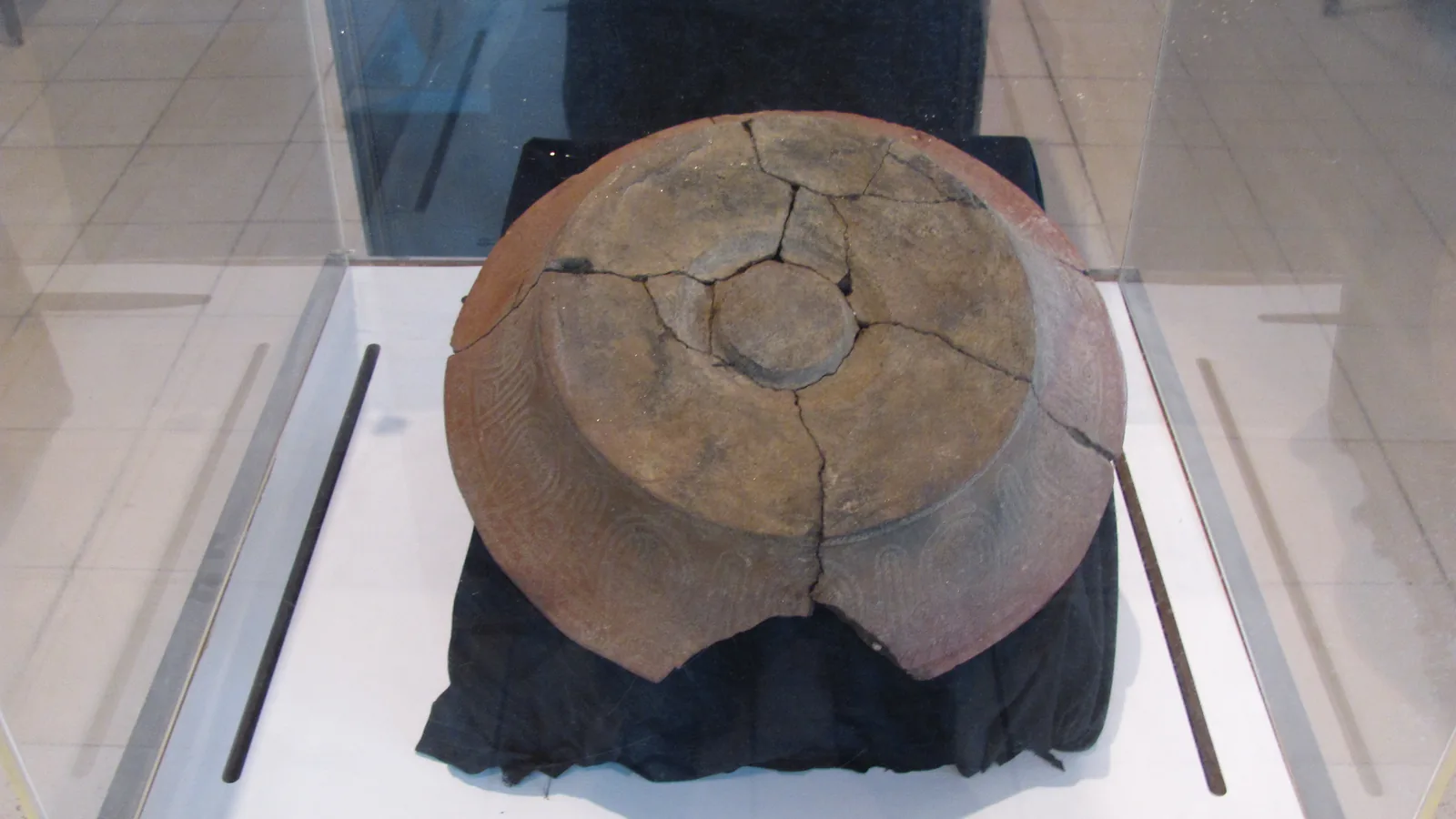
One skull went into a pot. The 2007 report reads: “Pot 2, a carinated vessel, contained a complete skull that sat on top of a broken Conus sp. ring. The flat-bottomed dish had been turned upside down and placed directly on top of Pot 2, acting as a lid.” The pot later broke at its carination and collapsed onto the skull; from the break the authors concluded that no soil had been packed in before the dish went on. Four carinated vessels and the dish were restored at the Australian Museum in Sydney, and four of the five had gone back to the Vanuatu Cultural Centre by 2007; an undecorated pot stand was also recovered. The dish carries a double face motif repeated around its full circumference, the faces joined by an extra “nose” filled with impressed circles; the authors called the alternating arrangement “thus far unique,” while adding that its uniqueness “may be simply related to the fragmentary nature of most Lapita sherd collections.”
Dickinson's thin sections: 100 of 112 pots from Efate
William R. Dickinson of the University of Arizona, with Bedford and Spriggs, published a petrographic study of the reconstructed pots in the Journal of Pacific Archaeology in 2013. The result: “100 of 112 Teouma vessels were made using indigenous Efate temper sands,” three came from elsewhere in Vanuatu, and “nine derive from New Caledonia ~500 km away to the southwest.” Twelve of the pots, by their sand, had been made on other islands.
Reef fish, turtle and free-range pigs: the 2014 isotope study
Kinaston’s diet study appeared in PLoS ONE on March 5, 2014. They measured carbon, nitrogen and sulfur isotopes in bone collagen from 49 Teouma adults against a baseline of 98 modern plants and animals and 71 prehistoric animal bones from the site. The human values, the authors wrote, showed protein from “a mixture of reef fish and inshore organisms and a variety of higher trophic marine (e.g. marine turtle) and terrestrial animals (e.g. domestic animals and fruit bats).” The pigs and chickens had eaten mainly land plants, yet their nitrogen values ran higher than a plant diet allows, which the authors read as food “such as insects or human fecal matter” and as a sign that the animals ranged free. Men carried a higher nitrogen value than women, 12.7 per mil against 11.6; Kinaston’s team suggested labor specialization or unequal food distribution.
"Little to no Papuan ancestry": from October 3, 2016, to October 15, 2020
Pontus Skoglund, David Reich and a team at Harvard Medical School extracted DNA from the petrous bones of three Teouma individuals: B30A, dated 2990 to 2740 BP (lab code Wk-22657); B10B, 3000 to 2750 BP (Poz-81126); and B17, 3110 to 2780 BP (Wk-21026). All three were female. A fourth came from Talasiu in Tonga, dated 2680 to 2340 BP. It stated the expectation it overturned: “Most analyses have interpreted the minimum of twenty-five percent Papuan ancestry in the region today as evidence that the first humans to reach Remote Oceania, including Polynesia, were derived from population mixtures near New Guinea.” The four ancient people had “little to no Papuan ancestry,” and the authors named their population the “First Remote Oceanians.” Nature published it on October 3, 2016.
In Current Biology on February 28, 2018, Lipson, Skoglund and colleagues added 14 ancient individuals from Efate and Epi and found that “people of almost entirely Papuan ancestry arrived in Vanuatu by around 2300 BP.” One new sample, a man coded “TeoQE” for Teouma Quarry Edge, had been “displaced during quarrying activities before controlled archaeological excavations began at the site in 2004.” A day earlier, on February 27, Cosimo Posth and colleagues reported in Nature Ecology & Evolution a Papuan expansion “starting ~2,500 years before present” and “almost complete replacement of Lapita-Austronesian by Near Oceanian ancestry.” Yet “incoming Papuan languages did not replace Austronesian languages.” Posth’s group described the process as “incremental and complex, with repeated migrations and sex-biased admixture.”
Lipson and Spriggs returned to Teouma with four more individuals, “thus doubling the sample size available from that site,” and found once more that almost all of their ancestry came from the First Remote Oceanian source. Current Biology published that paper on October 15, 2020.
Key facts
- The Teouma site was found in January 2004 on the southeast coast of Efate, after sherds were “exposed during quarrying some four months previously” (Bedford et al. 2007); the quarrying was for a prawn farm (Kinaston et al. 2014).
- The cemetery lies on an uplifted reef terrace about eight meters above sea level and 800 meters from the sea, on the northeastern side of Teouma Bay (Bedford et al. 2007).
- Six field seasons revealed “up to 68 burial features” (Lipson et al. 2020); Kinaston et al. give 68 graves and around 100 individuals, all dated to the earliest Lapita phase in Vanuatu, about 3000 BP.
- Skulls and mandibles were removed after decomposition and redeposited; seven skulls survive in the caches B10, B17 and B30, and cache B30 lay on the legs of the headless burial B44 (Valentin et al., PNAS).
- Pot 2 “contained a complete skull that sat on top of a broken Conus sp. ring,” with the flat-bottomed dish inverted on top as a lid (Bedford et al. 2007).
- Temper sands show 100 of 112 reconstructed vessels were made on Efate, three elsewhere in Vanuatu and nine in New Caledonia, about 500 kilometers away (Dickinson, Bedford and Spriggs, 2013).
- Isotopes from 49 adults point to reef fish, inshore foods, turtle, domestic animals and fruit bats; men averaged 12.7 per mil in nitrogen against 11.6 for women (Kinaston et al. 2014).
- Three Teouma women, B30A, B10B and B17, had “little to no Papuan ancestry” (Skoglund et al., Nature, October 3, 2016); Papuan ancestry arrived “by around 2300 BP” (Lipson et al. 2018) and the 2020 paper doubled the Teouma DNA sample.
FAQ
What was found inside Pot 2 at Teouma?
A complete human skull resting on a broken Conus shell ring, inside a carinated Lapita vessel. A flat-bottomed decorated dish had been placed upside down on the pot as a lid. The pot later broke at its carination and collapsed onto the skull.
How many people were buried at the Teouma Lapita cemetery?
Kinaston and colleagues counted 68 graves holding single and multiple burials of around 100 individuals; Lipson and colleagues in 2020 gave "up to 68 burial features." The 68 counts graves, not people.
What did the Teouma ancient DNA show in 2016?
Three women from the cemetery, dated between about 3110 and 2740 BP, carried little to no Papuan ancestry. Skoglund and colleagues concluded that the Papuan share found in all Pacific islanders arrived with later migrations, which the 2018 papers dated to about 2500 to 2300 BP.
Sources
- Bedford, S., Spriggs, M., Regenvanu, R., Macgregor, C., Kuautonga, T. and Sietz, M., "The excavation, conservation and reconstruction of Lapita burial pots from the Teouma site, Efate, Central Vanuatu," in Oceanic Explorations: Lapita and Western Pacific Settlement, Terra Australis 26 (ANU E Press, 2007), chapter 14 (PDF).
- Kinaston, R., Buckley, H., Valentin, F., Bedford, S., Spriggs, M., Hawkins, S. and Herrscher, E., "Lapita Diet in Remote Oceania: New Stable Isotope Evidence from the 3000-Year-Old Teouma Site, Efate Island, Vanuatu," PLoS ONE 9(3), e90376, March 5, 2014 (PubMed Central, PMC3944017).
- Valentin, F., Détroit, F., Spriggs, M. J. T. and Bedford, S., "Early Lapita skeletons from Vanuatu show Polynesian craniofacial shape: Implications for Remote Oceanic settlement and Lapita origins," Proceedings of the National Academy of Sciences 113(2), 292–297 (PubMed Central, PMC4720332).
- Dickinson, W. R., Bedford, S. and Spriggs, M., "Petrography of Temper Sands in 112 Reconstructed Lapita Pottery Vessels from Teouma (Efate): Archaeological Implications and Relations to Other Vanuatu Tempers," Journal of Pacific Archaeology 4(2), 2013, pp. 1–20 (abstract page).
- Skoglund, P., Posth, C., Sirak, K., Spriggs, M., Valentin, F., Bedford, S. et al., "Genomic insights into the peopling of the Southwest Pacific," Nature 538, 510–513, October 3, 2016 (author manuscript, PubMed Central, PMC5515717, with Extended Data Table 1).
- Lipson, M., Skoglund, P., Spriggs, M., Valentin, F., Bedford, S., Shing, R. et al., "Population Turnover in Remote Oceania Shortly After Initial Settlement," Current Biology 28(7), 1157–1165, February 28, 2018 (author manuscript, PubMed Central, PMC5882562, with sample notes).
- Posth, C., Nägele, K., Colleran, H., Valentin, F., Bedford, S., Kami, K. W., Shing, R. et al., "Language continuity despite population replacement in Remote Oceania," Nature Ecology & Evolution 2, 731–740, February 27, 2018 (author manuscript, PubMed Central, PMC5868730).
- Lipson, M., Spriggs, M. et al., "Three phases of ancient migration shaped the ancestry of human populations in Vanuatu," Current Biology 30(24), 4846–4856, October 15, 2020 (author manuscript, PubMed Central, PMC7755836).
Cite this article
- APA
- Our Earth's History. (2026, September 22). A skull in Pot 2: the Teouma Lapita cemetery, Vanuatu, 2004 to 2020. Our Earth's History. https://ourearthshistory.com/oceania/ancient/teouma-lapita-cemetery-vanuatu-2004-sixty-eight-graves-skull-in-a-pot/
- Chicago
- Our Earth's History. “A skull in Pot 2: the Teouma Lapita cemetery, Vanuatu, 2004 to 2020.” Our Earth's History, September 22, 2026. https://ourearthshistory.com/oceania/ancient/teouma-lapita-cemetery-vanuatu-2004-sixty-eight-graves-skull-in-a-pot/.
- MLA
- “A skull in Pot 2: the Teouma Lapita cemetery, Vanuatu, 2004 to 2020.” Our Earth's History, 22 Sep. 2026, https://ourearthshistory.com/oceania/ancient/teouma-lapita-cemetery-vanuatu-2004-sixty-eight-graves-skull-in-a-pot/.
Text licensed CC BY-NC-ND 4.0. Found an error? Tell us.