Seventeen heads, five to fifty tons: the Olmec portraits in basalt
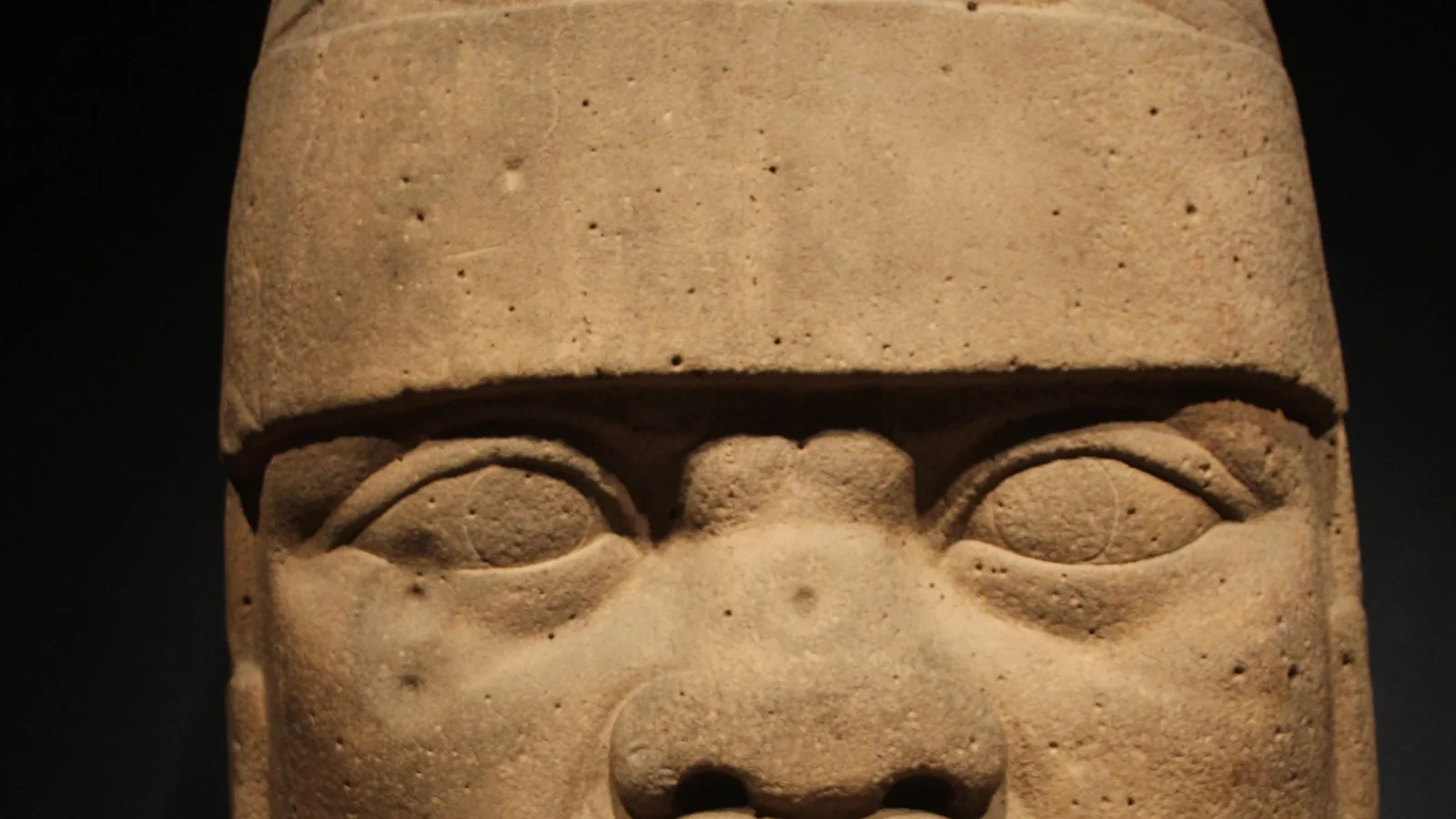

TL;DR — Seventeen Olmec colossal heads, five to 50 tons each, were carved from Tuxtlas basalt between 1400 and 400 BC; they now sit in seven museums and a town square.
Seventeen colossal Olmec heads are known, ten from San Lorenzo, four from La Venta and three from Tres Zapotes and nearby, each weighing from five to 50 tons. Together they weigh about 300 tons, by the count of Ann Cyphers, an archaeologist at the National Autonomous University of Mexico (UNAM). The first came to light in 1862 on the Hueyapan sugar estate in the Tuxtlas district of Veracruz, when a farmhand clearing a field took its curved crown for the bottom of an upturned iron cauldron. José María Melgar y Serrano, an antiquities dealer from nearby San Andrés Tuxtla, published it in 1869 as “Notable escultura antigua,” writing that “what impressed me most was the Ethiopian type it represents,” a reading that Cyphers wrote has since been invalidated by mitochondrial DNA from Olmec burials at San Lorenzo. Matthew Stirling of the Smithsonian dug out eight heads between 1938 and 1946. Cyphers reads them as portraits of individual rulers, carved on and off over about a thousand years.
Quick facts
- When
- 1862 (first head found at Hueyapan) · 1869 (Melgar's article) · 1938, 1940, 1945–46 (Stirling's seasons) · May 1994 (tenth San Lorenzo head) · carving dated 1400–1200, 1200–1000 and 1000–400 BC (Cyphers)
- Where
- San Lorenzo Tenochtitlán and Tres Zapotes in southern Veracruz and La Venta in Tabasco, on the Gulf coast of what is now Mexico; the basalt came from the Sierra de los Tuxtlas
- Who
- José María Melgar y Serrano, antiquities dealer, 1862–69; Matthew and Marion Stirling of the Smithsonian's Bureau of American Ethnology; Ann Cyphers of UNAM and the San Lorenzo Tenochtitlán Archaeological Project; Rebecca González Lauck at La Venta
- Outcome
- 17 heads known, 10 from San Lorenzo, 4 from La Venta and 3 from Tres Zapotes and nearby, weighing from five to 50 tons each and about 300 tons together; seven are in Xalapa, two in Mexico City, and the Cobata head stands in a town square
An iron cauldron that turned out to be a face
The laborer at Hueyapan was cutting brush for a milpa, a cornfield cleared by burning, when he struck what looked like one of the big round pans used to boil down cane juice, lying face down. Melgar went out to the head in 1862, possibly, Cyphers wrote, with the idea of buying or selling it.
His article of 1869 appeared in the bulletin of the Mexican Society of Geography and Statistics. In Cyphers’s transcription, here in English, he called the piece “without exaggeration a magnificent sculpture” and went on: “what impressed me most was the Ethiopian type it represents; I reflected that there had undoubtedly been blacks in this country.” Cyphers wrote that the racial classification behind those words, common in the 19th century, does not hold. The anthropologist Enrique Villamar Becerril reported that two well-preserved Olmec-period burials dug by the San Lorenzo Tenochtitlán Archaeological Project yielded mitochondrial DNA; Cyphers wrote that the study invalidated Melgar’s hypothesis. One word of his survived. Melgar called the sculpture colossal, and on that point, Cyphers wrote, he was right.
Stirling's eight heads, 1938 to 1946
As director of the Bureau of American Ethnology at the Smithsonian, Matthew Stirling set up a research program on the Gulf coast. In 1938 he and his wife Marion went to see the head Melgar had described, opened excavations at the site, now called Tres Zapotes, and dug it out in full.
At La Venta in 1940 the rainforest had swallowed the head that Frans Blom and Oliver La Farge of Tulane had seen in the 1920s. While Stirling was uncovering it, a boy arrived and said he had seen “stones” near his father’s cornfield. In 1945 Stirling reached San Lorenzo, where a village named Tenochtitlán had stood since a flood on the Río Chiquito in 1936 drove families onto the island’s high ground. In a day and a half he found 11 sculptures, four of them colossal heads, and he returned in 1946 for a fifth head. Before 1960, by Cyphers’s tally, 11 heads were known: two at Tres Zapotes, four at La Venta and five at San Lorenzo. Five more turned up at San Lorenzo, and one at Rancho La Cobata near Tres Zapotes.
Digging at La Venta under Stirling in 1942 and 1943, and again in 1955, opened Complex A, whose five massive offerings and more than 30 smaller ones, close to 3,000 objects, set the picture of the Olmec for half a century, according to Rebecca González Lauck of the National Institute of Anthropology and History (INAH).
Basalt from the Tuxtlas, carved over a thousand years
The heads were not made all at once. Cyphers dated the carving of the first two to between 1400 and 1200 BC, another eight to between 1200 and 1000 BC, and the rest to contexts of 1000 to 400 BC. The oldest is Head 8 of San Lorenzo, buried on purpose inside the east platform of the ceremonial precinct when it was raised. Every head lacks a neck, which tells Cyphers they were never parts of full figures; the backs were dressed flat.
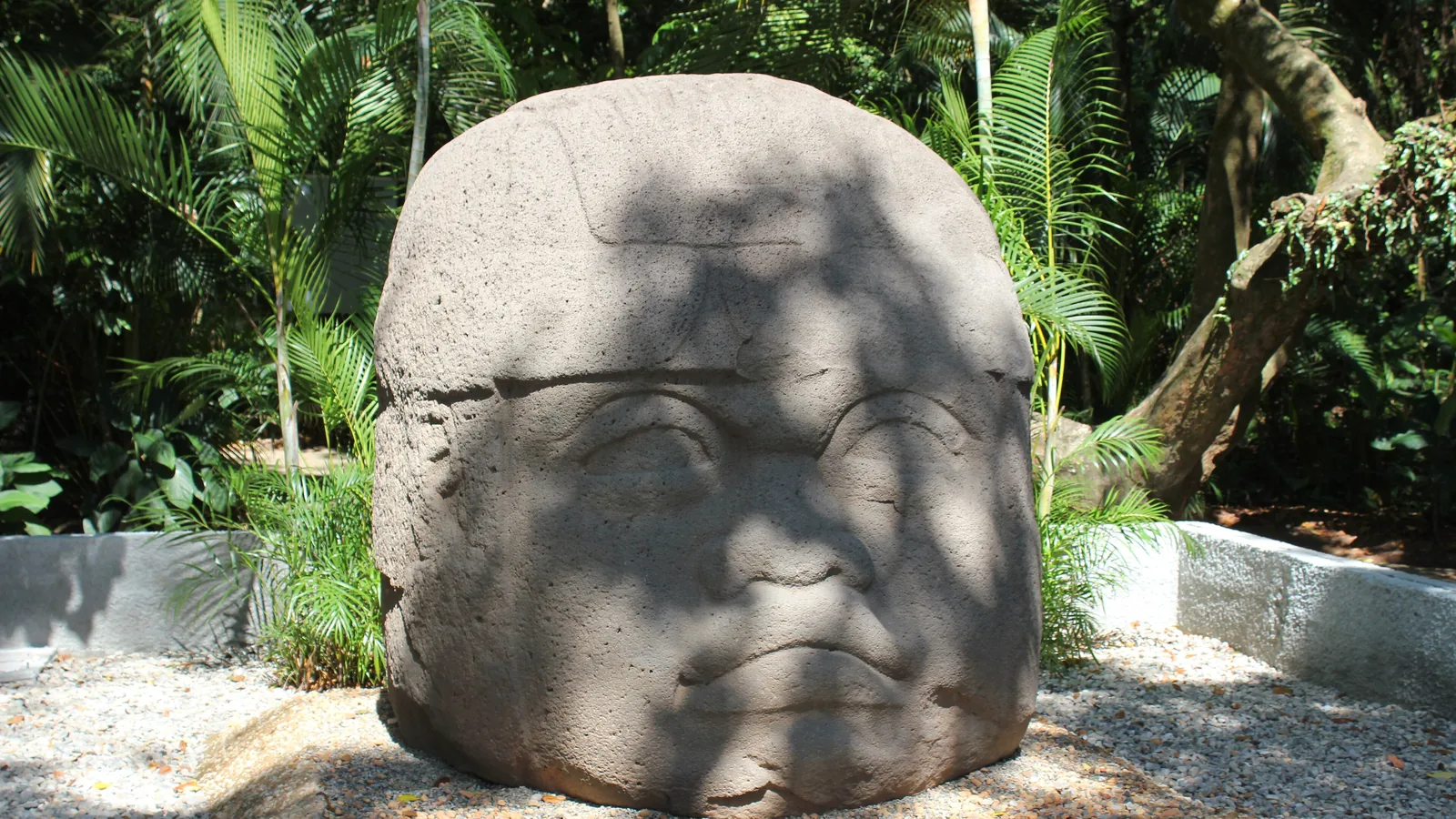
The stone is basalt from the Sierra de los Tuxtlas. Cyphers wrote that bringing it to the capitals cost time and labor, and that its birth inside a volcano gave it a sacred origin, a hill with a mouth to the underworld. Head 1 of San Lorenzo, called El Rey because it is the tallest there, stands 2.85 meters high. Head 1 of La Venta, 2.41 meters high, is the tallest at that site and the second heaviest of all, after the Cobata head, which is the largest.
Rulers, headdresses and recycled thrones
Cyphers argued against the older view of idealized, generic faces: these are portraits of particular people, ancestral rulers and heads of dynasties, and she cited the art historian Beatriz de la Fuente on the family likeness among the heads of each site. The headdress carries the identification. An emblem sits on the headgear of 14 of the 17 heads, birds’ feet or heads most often, then cords. Readings differ. On Head 2 of La Venta, Stirling saw a bow of ribbon where later scholars saw two leaves.
Many heads are drilled with holes, three on Head 1 of San Lorenzo and 27 on Head 3, which Cyphers’s catalogue lists as ancient mutilations. Some scars have another cause. Head 2 of San Lorenzo was cut from a large throne with a niche in its front, and the arc of that niche is still visible above the right ear because the head was never finished; Head 7 was also a recut throne.
.jpg)
Where the heads are now, and the last one found
Seven of the San Lorenzo heads are in the Museo de Antropología de Xalapa and two in the Gulf coast hall of the Museo Nacional de Antropología in Mexico City. Of the four from La Venta, three stand in the Parque-Museo La Venta in Villahermosa and one in the city’s Museo Regional de Antropología Carlos Pellicer. The two from Tres Zapotes are in the village’s community museum and in the Museo Tuxteco at Santiago Tuxtla, and the Cobata head is in that town’s main square. In 1996 a 13-ton head from San Lorenzo left Mexico for the first time, for the exhibition Olmec Art of Ancient Mexico at the National Gallery of Art in Washington.
One head never left the region. In May 1994 the San Lorenzo Tenochtitlán Archaeological Project found the tenth colossal head of the site, Monument 10, 1.81 meters high; five more sculptures followed in 1995 from a workshop where Olmec carvers recut old stone. Monument 10 is in the community museum of Tenochtitlán.
Key facts
- Seventeen colossal heads are known: 10 from San Lorenzo, four from La Venta and three from Tres Zapotes and its surroundings (Cyphers, 2018).
- Each weighs from five to 50 tons; the 17 together weigh about 300 tons (Cyphers, 2020).
- Cyphers dated the first two heads to 1400–1200 BC, eight to 1200–1000 BC and the rest to contexts of 1000–400 BC.
- The first head was found in 1862 on the Hueyapan estate; José María Melgar y Serrano published it in 1869 as “Notable escultura antigua.”
- Matthew Stirling excavated at Tres Zapotes from 1938, La Venta in 1940 and San Lorenzo in 1945–46, recording eight heads; 11 were known before 1960.
- Head 1 of San Lorenzo, El Rey, is 2.85 meters high; the Cobata head is the largest and Head 1 of La Venta the second heaviest.
- Head 2 of San Lorenzo was recut from a throne with a front niche and left unfinished; Head 1 carries three drill holes and Head 3 has 27.
- Monument 10 of San Lorenzo was found in May 1994 and stays in the community museum of Tenochtitlán; seven heads are in Xalapa and two in Mexico City.
FAQ
How many Olmec colossal heads are there?
Seventeen, by Ann Cyphers's count: ten at San Lorenzo, four at La Venta, two at Tres Zapotes and one at Rancho La Cobata nearby. Eleven were known before 1960; the last was found at San Lorenzo in May 1994.
Who do the Olmec heads portray?
Cyphers reads them as portraits of individual rulers, with an emblem on the headdress of 14 of the 17 that may have named the ruler or his line. Beatriz de la Fuente saw a family likeness among the heads of each site.
Where can the Olmec heads be seen?
Seven are in the Museo de Antropología de Xalapa and two in the Museo Nacional de Antropología in Mexico City; three La Venta heads are in the Parque-Museo La Venta in Villahermosa and one in the Carlos Pellicer museum there. The Cobata head stands in the main square of Santiago Tuxtla.
Sources
- Ann Cyphers (UNAM), "Arqueología de las cabezas colosales," "El buscador de cabezas olmecas" and "Una cabeza colosal," Arqueología Mexicana, special editions 94 (December 2020) and 104 (August 2022): the 1862 find, Melgar's 1869 article and Stirling's seasons.
- Ann Cyphers, "Una tradición milenaria" and the catalogue entries for the heads of San Lorenzo (1, 2, 3, 6, 10) and La Venta (1, 2), Arqueología Mexicana, special edition 94 (December 2020): dates, weights, dimensions, the Tuxtlas basalt and the recycled thrones.
- Ann Cyphers, "Gobierno y cosmos. Cabezas colosales y tronos" and "Museos de la ruta olmeca," Arqueología Mexicana 150 (March–April 2018), and "San Lorenzo, Veracruz," Arqueología Mexicana 19 (May–June 1996): the count of 17, the museums and the May 1994 find.
- Enrique Villamar Becerril (ENAH), "Estudios de ADN y el origen de los olmecas," Arqueología Mexicana 150 (March–April 2018): the mitochondrial DNA study of Olmec burials from San Lorenzo.
- Rebecca B. González Lauck (INAH), "El Complejo A. La Venta, Tabasco," Arqueología Mexicana 87 (September–October 2007): the offerings of Complex A.
- National Gallery of Art, Washington, "Olmec Art of Ancient Mexico," past exhibition, 1996: the 13-ton head from San Lorenzo.
- Universidad Veracruzana, Museo de Antropología de Xalapa (MAX), museum site.
Cite this article
- APA
- Our Earth's History. (2026, September 22). Seventeen heads, five to fifty tons: the Olmec portraits in basalt. Our Earth's History. https://ourearthshistory.com/americas/ancient/olmec-colossal-heads-san-lorenzo-la-venta/
- Chicago
- Our Earth's History. “Seventeen heads, five to fifty tons: the Olmec portraits in basalt.” Our Earth's History, September 22, 2026. https://ourearthshistory.com/americas/ancient/olmec-colossal-heads-san-lorenzo-la-venta/.
- MLA
- “Seventeen heads, five to fifty tons: the Olmec portraits in basalt.” Our Earth's History, 22 Sep. 2026, https://ourearthshistory.com/americas/ancient/olmec-colossal-heads-san-lorenzo-la-venta/.
Text licensed CC BY-NC-ND 4.0. Found an error? Tell us.