Tablets from Ras Shamra, 1929: Schaeffer, Bauer and Ugarit's alphabet
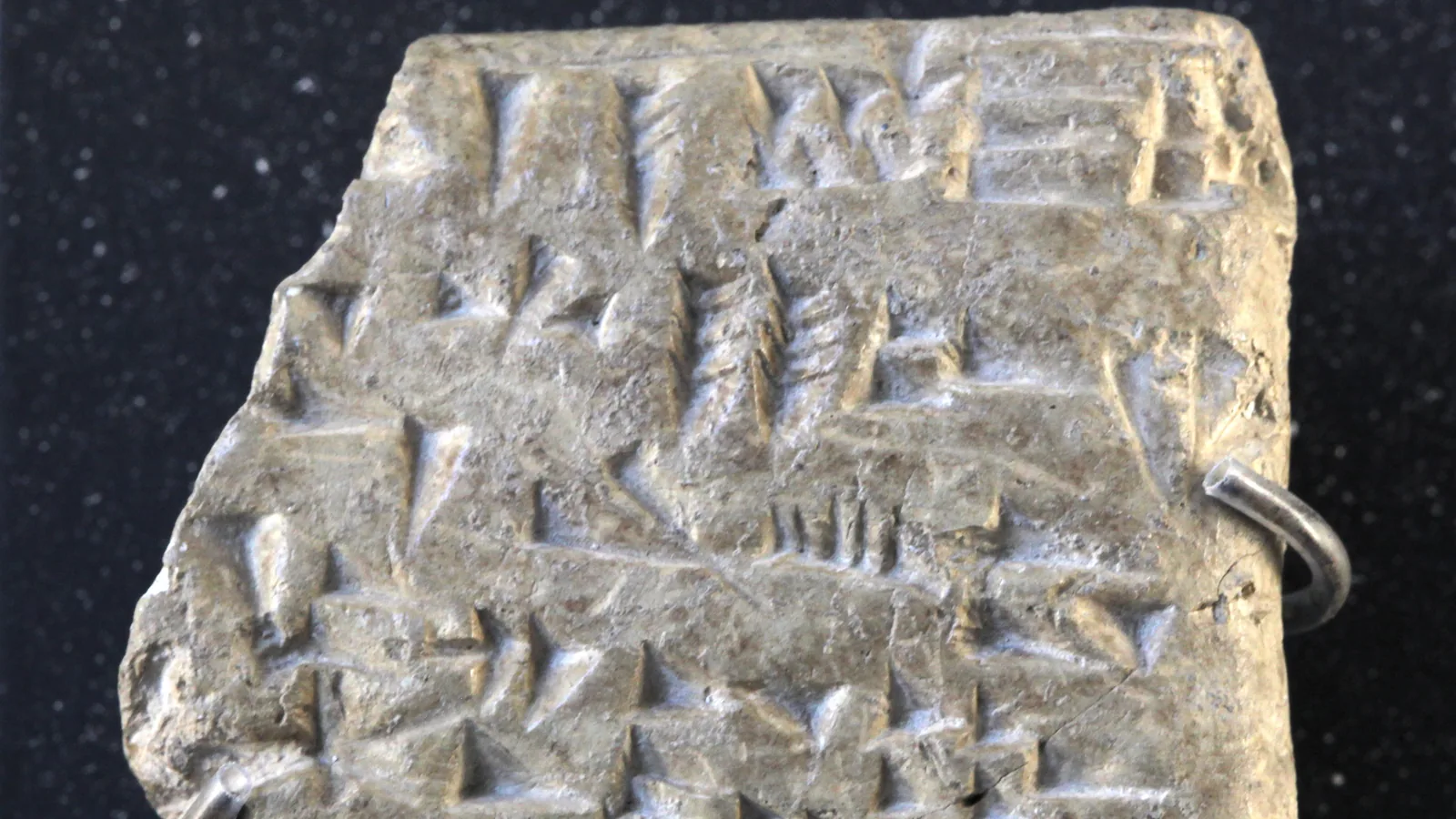

TL;DR — Claude Schaeffer found alphabetic cuneiform tablets at Ras Shamra in May 1929, and by May 1930 Hans Bauer had read about 20 of their signs.
In March 1928 a local man ploughing his field near the sandy shore of the cove of Minet el-Beida, on the Syrian coast, lifted a slab that covered an underground passage ending in a corbel-vaulted burial chamber. Claude F.-A. Schaeffer described the find in his report to the Académie des Inscriptions et Belles-Lettres, read on August 9, 1929. His first season moved from the cove to the mound of Ras Shamra, ancient Ugarit, and in May 1929 produced the first tablets in a cuneiform alphabet. A year later the Académie heard that Hans Bauer of Halle had read about 20 of the signs.
Quick facts
- When
- March 1928 (tomb found near Minet el-Beida) · March 30 and April 2, 1929 (Schaeffer's arrival and first digging, in his 1929 report) · May 1929 (first alphabetic tablet) · May 23, 1930 (Bauer's decipherment reported to the Académie) · 1986 (letter RS 86.2230 found)
- Where
- The cove of Minet el-Beida and the mound of Ras Shamra, ancient Ugarit, on the Syrian coast
- Who
- Claude F.-A. Schaeffer; Georges Chenet; René Dussaud; Hans Bauer; Ch. Virolleaud; Emile Forrer; Sylvie Lackenbacher; Jacques Freu; Annie Caubet
- Outcome
- The tablets of 1929 carried a cuneiform alphabet of 26 or 27 signs by the Académie's count of 1930, 29 by Schaeffer's of 1979; Bauer read about 20 of them. Jacques Freu placed the destruction of Ugarit after 1195 BC, probably not before 1190 BC
March 30, 1929: seven camels to Minet el-Beida
The Académie gave Schaeffer the mission on the proposal of René Dussaud, curator of Oriental antiquities at the Louvre, and the archaeologist Georges Chenet went with him. A caravan of seven camels carried the equipment to Minet el-Beida, where the team arrived on March 30, 1929. Digging began on Tuesday, April 2. Within three days the workmen had found what Schaeffer took to be a cemetery.
Fifty years later Schaeffer, writing as C. F. A. Schaeffer-Forrer, gave a different start. His introduction to Ras Shamra 1929–1979, coordinated by Marguerite Yon, reads “je m’y rendais dès février 1929,” which puts his arrival in February. The same text calls the tomb of 1928 “une tombe anciennement pillée” and says it located a port of the 14th and 13th centuries BC.
Schaeffer's burnt stones on the mound of Ras Shamra
On the summit of the mound Schaeffer found large fire-blackened stones with a bronze dagger, twisted by the heat, wedged between them. He dated the dagger to the 15th or 14th century BC. In 1979 he wrote that he had believed at first that he had found the palace of Ugarit; later work showed the stones to be the base of the tower of the temple of Baal.
Under the threshold of a building near that tower the team found a hoard of 74 bronze weapons and tools marked with triangular signs. Soon afterward, in May 1929, in an ash layer one meter down, the diggers lifted the first tablet with a long cuneiform text. Schaeffer assigned it to the library of the high priest of the temple. His description of the script in 1979 gave a count: “Rédigée en un système d’écriture de 29 signes, elle révélait le premier et le plus ancien alphabet alors connu.” He called it the first and oldest alphabet then known.
"26 ou 27 caractères" at the Académie, May 23, 1930
At the session of May 23, 1930, with Dussaud presiding, the Académie heard that the texts found by Schaeffer and Chenet the year before had been deciphered by Professor Hans Bauer of Halle. Ch. Virolleaud had restored and copied the tablets and was the first to recognize the language as Semitic. Bauer identified it as a northern dialect of Phoenician whose vocabulary differed considerably from that of Byblos, Sidon and Tyre.
The report’s count of the signs differed from the one Schaeffer gave half a century later: “Sur les 26 ou 27 caractères différents qui constituent cette écriture cunéiforme, M. Bauer a pu en déterminer une vingtaine.” The 1930 report also took the script to be an imitation of the Phoenician alphabet made in the 12th century BC.
Dussaud also presented three large tablets from the new season, identified by the Assyriologist Emile Forrer, among them a Sumerian–Mitannian bilingual vocabulary.
In the royal palace, archives in two scripts
Sylvie Lackenbacher of the CNRS described the palace archives in 2008, in volume XVII of the Ras Shamra-Ougarit series. The West archive, found under the palace entrance and its portico, held “moins de 80 documents, essentiellement administratifs ou économiques, dans les deux écritures mais en grande majorité en alphabétique.” The datable pieces there came mostly from the second half of the 13th century BC, from the end of the reign of Ammistamru II onward. The East archive held official letters, among them one in Ugaritic from the king to the queen mother Šarelli and the letter of the Hittite queen Puduhepa. The West archive also kept school, literary and religious texts in both scripts, “ceux en écriture syllabique étant musicaux et en hourrite.”
Annie Caubet of the Louvre surveyed the music of Ugarit for the Académie in 1987. She wrote that the large bibliography on the subject concentrated almost entirely on one Hurrian text with Babylonian-style musical notation. E. Laroche first published it in Ugaritica V (Paris, 1968); H. G. Güterbock, R. Vitale and M. Duchesne-Guillemin followed in 1970, 1982 and 1984. Caubet also worked from objects and words: bronze cymbals and ivory clappers identified in 1961, and the word knr, a lyre, related to Hebrew kinnôr. A text found in 1961 on the southern acropolis, RS 24.252, names in Dennis Pardee’s translation the knr, the tambourine (tp), cymbals (msltm) and ivory clappers (mrqdm).
Afif Bahnassi, head of Syria’s directorate of antiquities and museums, dated the notation in his foreword of 1979: “Elles remontent au 14e s. avant notre ère, c’est à dire mille ans avant les travaux de Pythagore.” He added that Professor Kilmer had shown the music of Ras Shamra to use the diatonic scale.
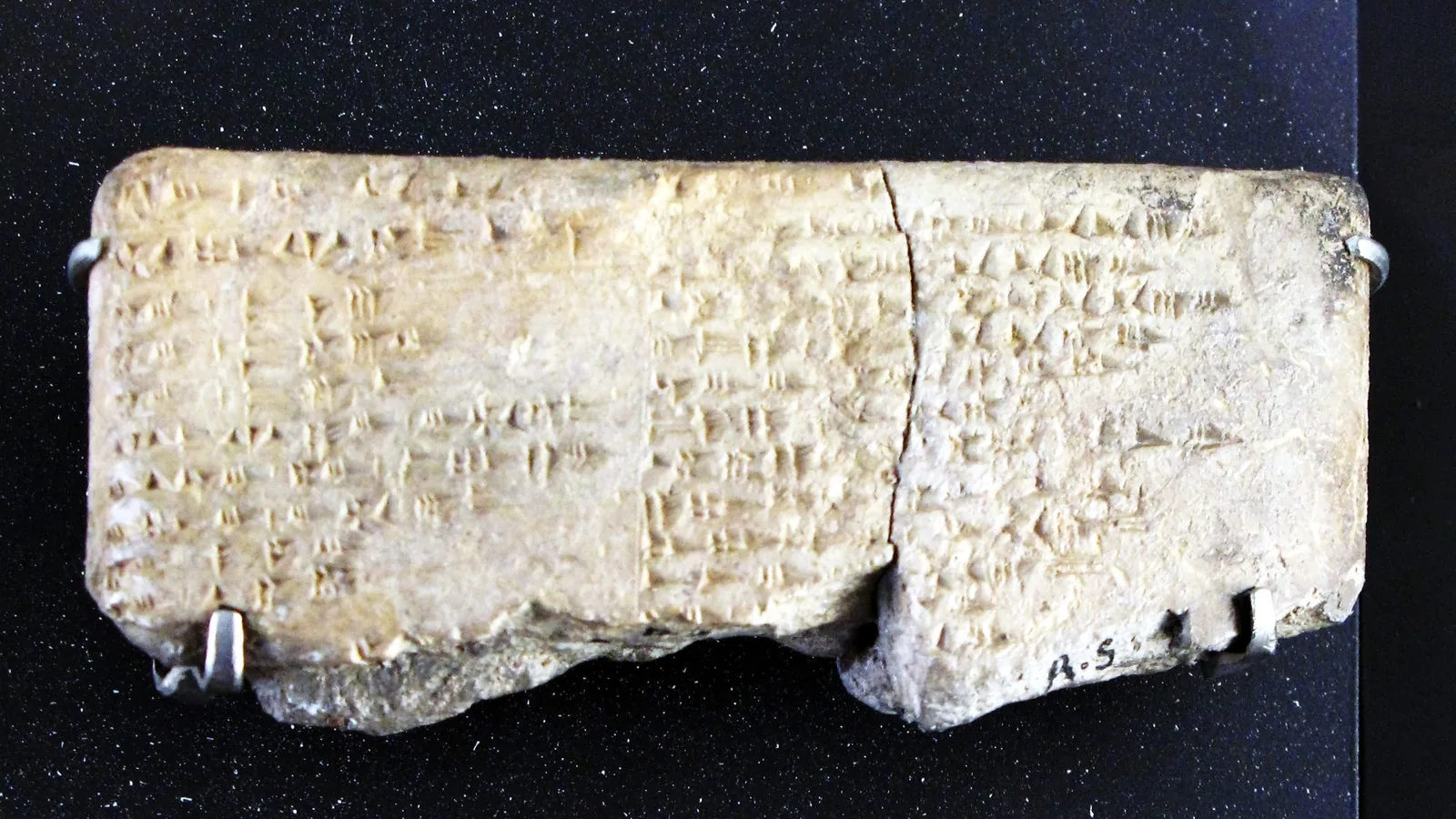

RS 86.2230, a letter to the last king
In 1986 excavators in the southern area of Ras Shamra found the tablet numbered RS 86.2230. Jacques Freu published it in Syria in 1988 as a letter of state to ʿAmmurapi, the last king of Ugarit, from Beya, chief of the bodyguard of the Great King, the king of Egypt. Freu argued that Beya was Bay, the chancellor who held power under the pharaoh Siptah. He wrote that “Ugarit et Alasiya étaient alors en butte aux premiers assauts des « Peuples de la Mer »,” Alasiya being Cyprus, and he did not name the city’s destroyers.
The Egyptian dates set Freu against I. Singer, writing in Hethitica VIII in 1987, and G. A. Lehmann, in Ugarit-Forschungen 11 in 1979, who had placed the end of Ugarit 15 to 20 years before Ramesses III’s victory in his eighth year. Lackenbacher, 20 years after Freu, noted how few objects lay with the palace tablets and proposed that the palace had been partly emptied or looted at or after the city’s fall. Freu’s conclusion, printed in 1988, moved the date of the destruction later: “Il faut donc abaisser la date de la destruction d’Ugarit après 1195, sans doute pas avant 1190.”
Key facts
- In March 1928 a man ploughing near the cove of Minet el-Beida lifted a slab over a passage leading to a vaulted tomb (Schaeffer, Syria, 1929).
- Schaeffer’s 1929 report gives his arrival as March 30, 1929 and the first digging as April 2; his introduction of 1979 says he went there “dès février 1929.”
- René Dussaud proposed Schaeffer for the mission, the Académie des Inscriptions et Belles-Lettres entrusted it to him, and Georges Chenet went with him.
- In May 1929 the first tablet with a long alphabetic cuneiform text came from an ash layer one meter down, near the temple of Baal (Schaeffer, 1979).
- The Académie’s report of May 23, 1930 counted “26 ou 27 caractères” and said Hans Bauer had determined about 20; Schaeffer wrote in 1979 of a system of 29 signs.
- Sylvie Lackenbacher counted fewer than 80 documents in the palace’s West archive, mostly administrative or economic and mostly alphabetic (2008).
- Annie Caubet wrote in 1987 that studies of Ugaritic music concentrated almost entirely on one Hurrian text with Babylonian-style notation, first published by E. Laroche in 1968.
- Letter RS 86.2230, found in 1986, led Jacques Freu to place the destruction of Ugarit after 1195 BC, probably not before 1190 BC (Syria, 1988).
FAQ
Who found the Ugarit alphabet tablets?
Claude F.-A. Schaeffer, leading a French mission with Georges Chenet, found the first alphabetic cuneiform tablet at Ras Shamra in May 1929. Hans Bauer of Halle deciphered much of the script, building on the copies of Ch. Virolleaud, who first recognized the language as Semitic; his result was reported to the Académie des Inscriptions et Belles-Lettres on May 23, 1930.
How many signs does the Ugarit alphabet have?
The counts differ by date. The Académie's report of 1930 spoke of 26 or 27 different characters, of which Bauer had determined about 20. Schaeffer, in his introduction of 1979, described a writing system of 29 signs.
When was Ugarit destroyed?
Annie Caubet described Ugarit in 1987 as a kingdom that disappeared at the beginning of the 12th century BC. Jacques Freu, working from the letter RS 86.2230 and Egyptian dates, argued in 1988 for a date after 1195 BC and probably not before 1190 BC, later than the dates given by I. Singer and G. A. Lehmann.
Sources
- Claude F.-A. Schaeffer, "Les fouilles de Minet-el-Beida et de Ras Shamra (campagne du printemps 1929). Rapport sommaire," Syria 10 (1929), pp. 285–297.
- Comptes rendus des séances de l'Académie des Inscriptions et Belles-Lettres 74/2 (1930), séance du 23 mai, "Déchiffrement des textes de Ras Shamra par M. Bauer," pp. 130–131.
- Sylvie Lackenbacher (CNRS), "Quelques remarques à propos des archives du Palais royal d'Ougarit," in Valérie Matoïan (ed.), Le mobilier du Palais royal d'Ougarit, Ras Shamra-Ougarit XVII (Lyon, 2008), pp. 281–290.
- Jacques Freu (Faculté des Lettres, Nice), "La tablette RS 86.2230 et la phase finale du royaume d'Ugarit," Syria 65/3 (1988), pp. 395–398.
- Annie Caubet, "La musique à Ougarit," Comptes rendus des séances de l'Académie des Inscriptions et Belles-Lettres 131/4 (1987), pp. 731–754.
- C. F. A. Schaeffer-Forrer, "Introduction," and Afif Bahnassi, "Avant-Propos," in Ras Shamra 1929–1979, Mission archéologique de Ras Shamra, coordinated by Marguerite Yon (1979), pp. 5–9.
Cite this article
- APA
- Song Letter. (2026, September 29). Tablets from Ras Shamra, 1929: Schaeffer, Bauer and Ugarit's alphabet. Our Earth's History. https://ourearthshistory.com/west-asia/ancient/ugarit-ras-shamra-1929-schaeffer-alphabet-tablets/
- Chicago
- Song Letter. “Tablets from Ras Shamra, 1929: Schaeffer, Bauer and Ugarit's alphabet.” Our Earth's History, September 29, 2026. https://ourearthshistory.com/west-asia/ancient/ugarit-ras-shamra-1929-schaeffer-alphabet-tablets/.
- MLA
- Song Letter. “Tablets from Ras Shamra, 1929: Schaeffer, Bauer and Ugarit's alphabet.” Our Earth's History, 29 Sep. 2026, https://ourearthshistory.com/west-asia/ancient/ugarit-ras-shamra-1929-schaeffer-alphabet-tablets/.
Get the week in history
One email a week: the new articles, and what was happening elsewhere at the same moment. Free, no ads, unsubscribe any time. How we handle your email.
Text licensed CC BY-NC-ND 4.0. Found an error? Tell us.