Room L.2769 at Ebla and the palace archive found in 1975
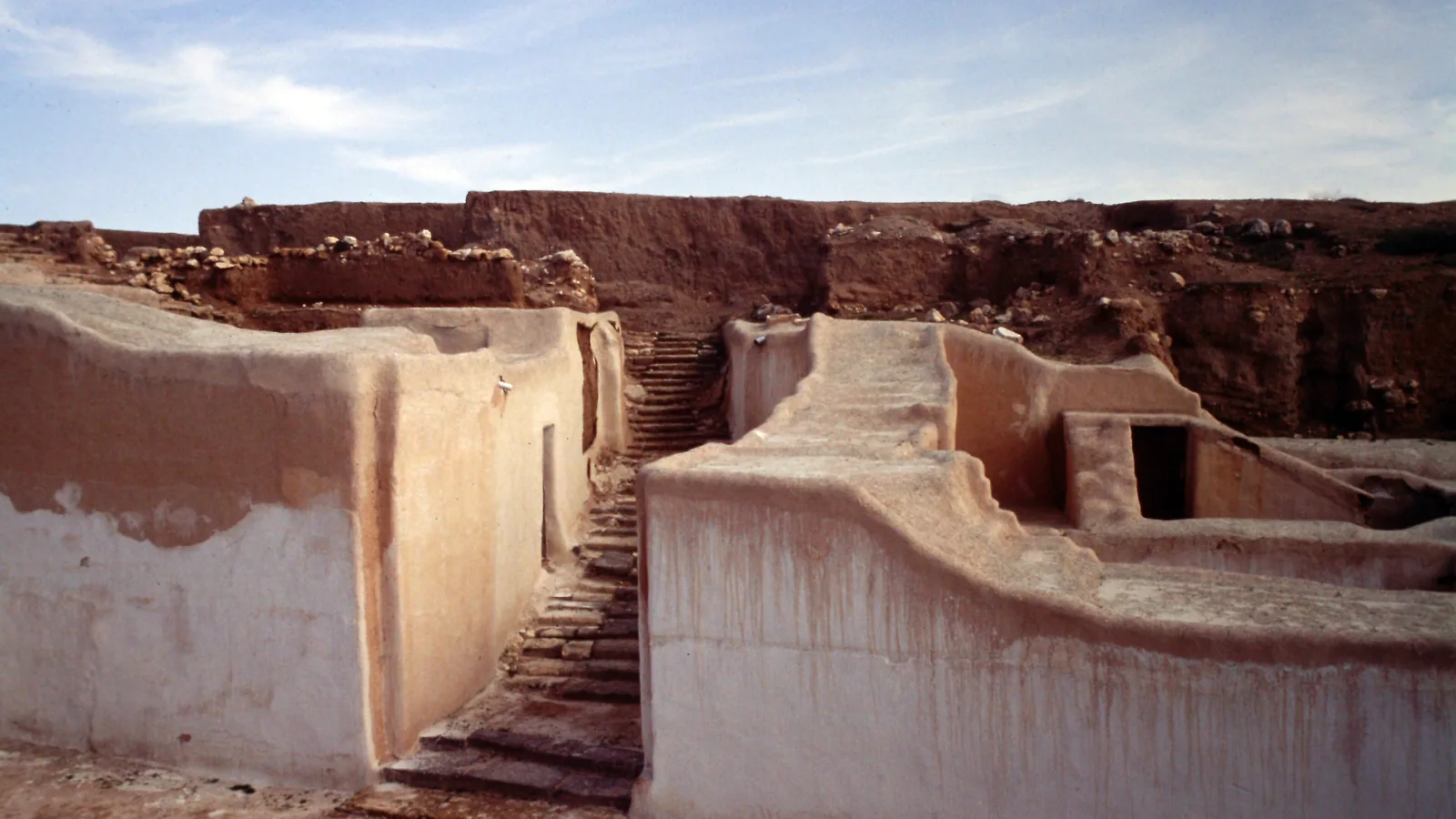

TL;DR — In 1975 Sapienza excavators found Ebla’s palace archive at Tell Mardikh, Syria: thousands of cuneiform tablets buried when the city fell, dated by radiocarbon to 2367–2293 BC.
In August 1975, excavators from Sapienza University of Rome opened Room L.2712 of Palace G at Tell Mardikh, in northern Syria, and found roughly 1,000 numbered tablet pieces. Less than a month later, Room L.2769 of the same palace produced over 15,000 more, from whole tablets to fragments and chips, in the count of Erica Scarpa of Italy’s National Research Council. The expedition’s director, Paolo Matthiae, had been digging the mound since 1964. The tablets were written in cuneiform, in an archaic Semitic language whose scribes leaned on Sumerian word-signs, and they had lain in the burned palace since a destruction that radiocarbon tests place between 2367 and 2293 BC.
Quick facts
- When
- 1964 (excavations begin) · 1968 (inscribed torso identifies the site as Ebla) · 1974 (first 42 tablets) · August 1975 (Small Archive, L.2712) · less than a month later (Great Archive, L.2769) · 1976 (further rooms) · destruction of the city dated by radiocarbon to between 2367 and 2293 BC
- Where
- Palace G on the acropolis of Tell Mardikh, about 55 km southwest of Aleppo, in Idlib Governorate, Syria
- Who
- Paolo Matthiae (director of the Italian Archaeological Expedition to Syria, Sapienza University of Rome); Giovanni Pettinato (first epigrapher); Alfonso Archi (his successor); Maria Giovanna Biga; David Noel Freedman; Jean-Louis Ska
- Outcome
- The palace rooms yielded thousands of cuneiform tablets and fragments of the 24th century BC, most of them administrative records in the Eblaite language and Sumerian word-signs. Who destroyed the palace, Sargon of Akkad, Naram-Sin or Mari, is still disputed
1968, a torso with the name Ebla
Tell Mardikh covers 60 hectares. According to Scarpa, Matthiae’s interest started in the Aleppo Museum, with a stone basin that local farmers had dug out of the mound in the late 1950s. The first campaigns exposed a temple and a royal palace of the third millennium BC, but the Jesuit scholar Jean-Louis Ska, writing in the Nouvelle Revue Théologique in 1978, recorded that the site still could not be identified.
The name came from the torso of a statue with an inscription in Akkadian, the first mention of Ebla at the site. Matthiae and the epigrapher Giovanni Pettinato published it as the torso of Ibbit-Lim, king of Ebla, and Scarpa dates the identification to 1968. Ska wrote that many archaeologists stayed skeptical, since placing Ebla at Tell Mardikh seemed impossible to them.
The first tablets turned up in 1974. Forty-two lens-shaped tablets lay at the bottom of a jar in Room L.2586, north of the monumental stairway of Palace G, most of them listing silver and gold objects. One, catalogued as TM.74.G.120, is a list of Ebla’s rulers.
Paolo Matthiae and the rooms of Palace G
The Small Archive, Room L.2712, held about 1,000 excavation numbers, which Scarpa estimates at 211 complete tablets. They recorded food rations from the last months before Ebla was destroyed. The Great Archive, Room L.2769, opened off the northeast corner of the palace’s Audience Court, and Scarpa cites estimates by Matthiae and by Bonechi that it once held between 4,000 and 5,000 tablets. The American Society of Overseas Research (ASOR) describes the archives as found in place “on collapsed shelves.”
Work went on in 1976. A vestibule beside the Great Archive gave roughly 100 documents reconstructed from 655 fragments, and the Trapezoidal Archive gave about 600 excavation numbers on deliveries of livestock.
The totals depend on what is counted. The expedition gave every find one running number, such as TM.75.G.12345 for Tell Mardikh, 1975, sector G, and Scarpa points out that the number does not say whether the object is a whole tablet or a fragment. ASOR’s 2018 damage report gives “more than 18,000 tablets” for the palace rooms together.
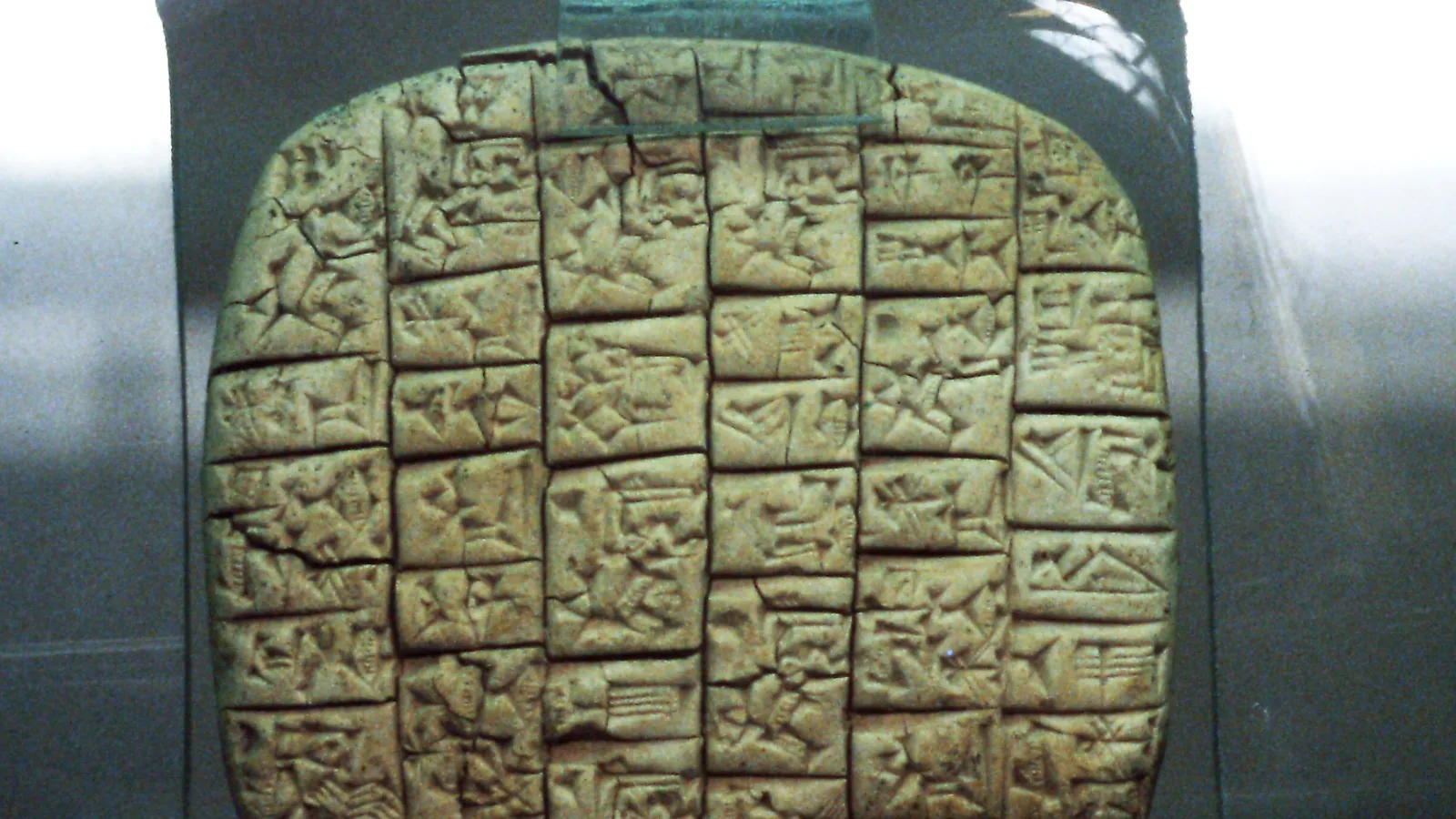

Textile lists, metal accounts and about 60 letters
In Scarpa’s description, the Great Archive held mostly records of monthly textile distributions and annual metal accounts, alongside lexical texts, literary compositions and about 60 diplomatic documents. The monthly textile accounts give only the month, and in 2003 Alfonso Archi and Maria Giovanna Biga built a sequence by matching the annual metal accounts to the terms of the viziers who served the king.
Ska, summarizing Pettinato’s first reports, described word lists of animals, professions and towns, next to court letters and treaties, one of them with the city of Assur. The same reports counted 114 bilingual vocabularies, Sumerian beside Eblaite. Ska added that several clues pointed to scribes who wrote in Sumerian signs and read the words aloud in Eblaite.
The language split its first readers. Christianity Today reported in 1981 that Pettinato classed Eblaite as “Paleo-Canaanite,” close to Ugaritic and Hebrew, while I. Gelb argued that it was an independent Semitic dialect with “many affinities with Akkadian.” Excavator and epigrapher disagreed on the date too: Pettinato preferred 2580–2450 BC on the evidence of script forms, and Matthiae 2400–2250 BC from the archaeology. Scarpa wrote in 2024 that no dictionary of Eblaite was available.
"Sodom and Gomorrah" and the first epigrapher
The claim that reached the wider press came from Pettinato. At a conference in St. Louis in 1976, according to Christianity Today, he announced five names in the texts matching the five cities by the Dead Sea listed in Genesis, with Sodom and Gomorrah among them. David Noel Freedman of the University of Michigan, editor of The Biblical Archeologist, asked him over a meal for the name of a king of one of those cities, and Pettinato wrote down Birsha, king of Gomorrah. The magazine reported that on rechecking “he found no Birsha, king of Gomorrah.”
Syrian authorities, disturbed by press reports of biblical links, put pressure on Pettinato and Matthiae, and in a 1977 letter to a Syrian periodical Pettinato denied any such connection. After a falling-out with Matthiae he resigned and was replaced by Archi. Archi and Matthiae rejected the reading of sa-du-ma as Sodom, and in an English preface written in 1979 Matthiae denied that Ebla held evidence for, among other things, “a mention of the cities of Sodom and Gomorrah and other cities of the plain.”
Destroyed between 2367 and 2293 BC
Scarpa cites radiocarbon dates on 16 short-lived plant samples from Palace G and Building P4, published by Calcagnile, Quarta and D’Elia in 2013. Who destroyed the city has no agreed answer. The case for Sargon of Akkad rests on royal inscriptions in which he names Ebla, though Scarpa notes that the one mentioning Ebla does not necessarily confirm a destruction by him. Matthiae held Sargon responsible, and Archi and Biga offered new evidence for his direct involvement in 2003. The case for his grandson Naram-Sin rests on inscriptions calling him “conqueror of Armānum and Ebla”; Matthiae answered that Naram-Sin defeated only Armanum and named Ebla because the city was already well known. Others point to Mari, and Jean-Marie Durand proposed in 2012 a Mari official with the title šakkanakku acting on Sargon’s orders.
The Sapienza expedition worked at Tell Mardikh for 47 seasons, until 2010. After the Syrian civil war began in 2011, ASOR recorded looting from April 2012, a military outpost built on the site that summer and Russian air strikes reported in October 2015 and February 2016. Between February 21, 2017, and April 13, 2018, according to ASOR’s reading of satellite images, the remains of the Early Bronze Age Royal Palace, Palace G, disappeared.
Key facts
- Sapienza University of Rome excavated Tell Mardikh under Paolo Matthiae from 1964 to 2010, 47 seasons in all (Ricerc@Sapienza).
- An Akkadian inscription on the torso of a statue of Ibbit-Lim, from the campaign of 1967–1968, gave the first mention of Ebla at the site; Scarpa dates the identification to 1968 (Ska 1978; Scarpa 2024).
- The first 42 tablets, found in a jar in Room L.2586 in 1974, include TM.74.G.120, a list of Ebla’s rulers (Scarpa 2024).
- The Small Archive, L.2712, found in August 1975, held about 1,000 excavation numbers, estimated at 211 complete tablets of food rations (Scarpa 2024).
- The Great Archive, L.2769, found less than a month later, held over 15,000 tablets, fragments and chips; Matthiae and Bonechi estimated 4,000 to 5,000 original tablets (Scarpa 2024).
- Scarpa counts over 15,000 numbered pieces in the Great Archive alone; ASOR gives more than 18,000 tablets for the palace rooms.
- Radiocarbon dates on 16 plant samples place Ebla’s destruction between 2367 and 2293 BC; Sargon, Naram-Sin and Mari are all proposed as the destroyer (Scarpa 2024).
- ASOR’s satellite analysis recorded that the remains of Palace G disappeared between February 21, 2017, and April 13, 2018 (ASOR CHI 2018).
FAQ
How many tablets were found at Ebla?
The count depends on the institution and on what is counted. Erica Scarpa counts over 15,000 numbered pieces, from whole tablets to chips, in the Great Archive, and ASOR gives more than 18,000 tablets for all the palace rooms. Matthiae and Bonechi estimated that the Great Archive originally held 4,000 to 5,000 complete tablets.
What language are the Ebla tablets written in?
In Eblaite, which Scarpa describes as an archaic northern Semitic language, written in cuneiform with heavy use of Sumerian word-signs. In the late 1970s Pettinato classed it as "Paleo-Canaanite," and I. Gelb saw it as an independent dialect close to Akkadian.
What happened to the site of Ebla during the Syrian civil war?
ASOR recorded looting from 2012, a military outpost, and Russian air strikes reported in October 2015 and February 2016. In September 2024 Sapienza reported a new campaign, led by Davide Nadali, to restore areas dug and damaged between 2014 and 2019, which also found a headless basalt statue of a seated king from the early second millennium BC.
Sources
- Erica Scarpa (Institute of Heritage Science, CNR-ISPC, Milan), "The Archives of Ebla: A Primer," Mar Shiprim, International Association for Assyriology, June 3, 2024.
- Jean-Louis Ska, S.J., "Les découvertes de Tell Mardikh - Ebla et la Bible," Nouvelle Revue Théologique 100/3 (1978), pp. 389-398.
- Christianity Today, "Unearthing EBLA's Ancient Secrets," May 8, 1981.
- Kyra Kaercher, Susan Penacho, Katherine Burge, Jamie O'Connell and Marina Gabriel, "CHI Update: Ebla, An Evaluation of Damage," American Society of Overseas Research, Cultural Heritage Initiatives, May 2018.
- Sapienza University of Rome, Ricerc@Sapienza, "Ebla Project: From Field Research to the Archives and Back" (project summary, 2021 call, posted 2022).
- Sapienza University of Rome, "Ebla, sixty years later: protection and recovery of the archaeological site," news release, September 18, 2024.
Cite this article
- APA
- Song Letter. (2026, September 29). Room L.2769 at Ebla and the palace archive found in 1975. Our Earth's History. https://ourearthshistory.com/west-asia/ancient/ebla-1975-palace-g-archive-tablets/
- Chicago
- Song Letter. “Room L.2769 at Ebla and the palace archive found in 1975.” Our Earth's History, September 29, 2026. https://ourearthshistory.com/west-asia/ancient/ebla-1975-palace-g-archive-tablets/.
- MLA
- Song Letter. “Room L.2769 at Ebla and the palace archive found in 1975.” Our Earth's History, 29 Sep. 2026, https://ourearthshistory.com/west-asia/ancient/ebla-1975-palace-g-archive-tablets/.
Get the week in history
One email a week: the new articles, and what was happening elsewhere at the same moment. Free, no ads, unsubscribe any time. How we handle your email.
Text licensed CC BY-NC-ND 4.0. Found an error? Tell us.