Millet, wheat and barley in a herders' grave: Begash, 2300 BC
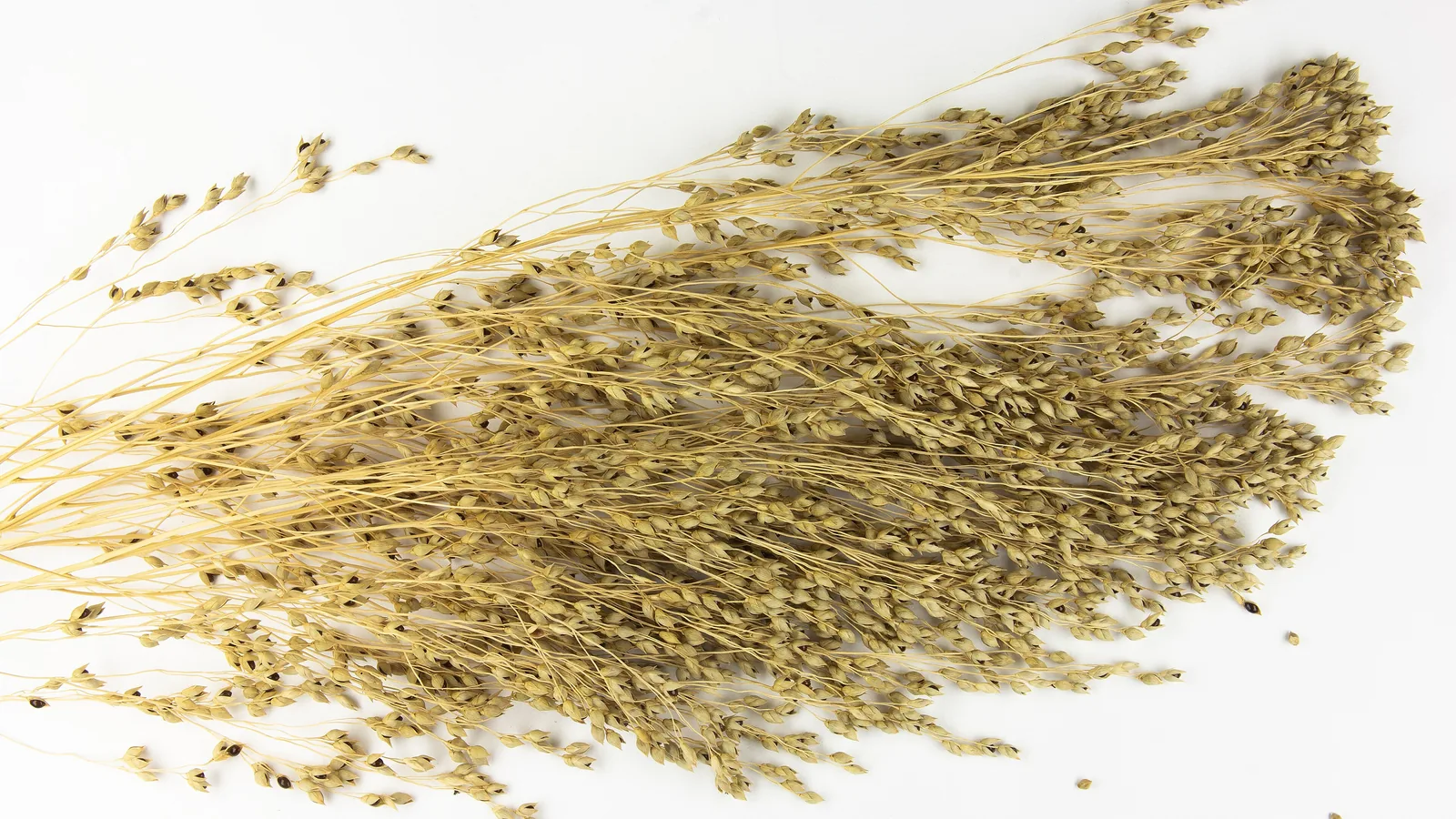

TL;DR — Charred millet, wheat and barley from cremation cists at Begash and Tasbas in Kazakhstan date to about 2300 BC; their excavators later wrote that burial grains cannot show farming.
Grains of broomcorn millet and wheat lay in a human cremation cist at Begash, a herders’ campsite in southeastern Kazakhstan, in a level dated to 2450–2100 BC. Michael Frachetti of Washington University in St. Louis and three colleagues reported them in Antiquity in December 2010, and their abstract stated that the burial context “raises the suggestion that these grains might signal a ritual rather than a subsistence commodity.” In 2014 a larger team including Frachetti argued that mobile herders had carried those crops into the mountains of Inner Asia; in 2019 a third paper, again with Frachetti, stated that grains from burials could not show whether anyone grew them. Nearly every find and date below comes from that one research group.
Quick facts
- When
- Begash Phase 1a, 2450–2100 BC (2014 paper) · Tasbas cremation cist, 2655–2480 BC (2019 paper) · Dali Phase 1, 2705–2545 BC · papers published December 2010, May 22, 2014 and September 4, 2019
- Where
- Begash (950 m) and Tasbas (1500 m) in the Dzhungar Mountains of southeastern Kazakhstan; Dali, about 1 km southwest of Tasbas
- Who
- Michael D. Frachetti, Robert N. Spengler, Gayle J. Fritz, Alexei N. Mar'yashev, Paula N. Doumani Dupuy, Taylor R. Hermes, Cheryl A. Makarewicz and colleagues
- Outcome
- The 2014 paper argued that mobile herders spread wheat and millet across Inner Asia; the 2019 paper stated that grains from burials do not show local cultivation, and found millet used as winter fodder for sheep and goats at Dali about 2700 BC
Begash and Tasbas: two cremation cists in the Dzhungar Mountains
Before 3000 BC, the 2010 abstract stated, western Asia grew wheat and China grew broomcorn millet, and the team was searching the lands between for early cereals. At Begash, it reported, “high precision recovery and dating” had found both crops “in the later third millennium BC.”
The 2014 paper gave the counts. The earliest phase at Begash, 2450–2100 BC, held domestic structures and a cremation cist “nearly identical to the burial documented at Tasbas.” Of 90 liters of soil sampled from the burial, the first 30 yielded 12 carbonized broomcorn millet grains, one wheat grain and four fragments of cereal grain. The other 60 liters yielded 12 more free-threshing wheat grains, 26 cereal grains and one barley grain. An associated fire pit gave 14 millet grains from 11.5 liters of ash. Five household hearths of the third and second millennia BC together produced three millet grains.
Begash lies at 950 meters and was probably an autumn or winter camp, in the 2014 paper’s reading; Tasbas lies at 1500 meters in an arable highland valley and was a spring and summer settlement. The 2019 paper dated the Tasbas cist to 2655–2480 BC and listed its contents as five wheat seeds and three microliths. A grain sample from the earliest Begash level gave a radiocarbon age of 3840 ± 40 years before present, measured on the grain itself.
"The proposed Inner Asian Mountain Corridor"
The 2014 paper, published on May 22 with Robert Spengler as first author, built a route out of these grains. Herders had already moved copper, tin, pottery and bronze metallurgy, it wrote, along “the proposed Inner Asian Mountain Corridor,” an idea it took from earlier work. Its abstract stated that grains from the two sites showed “the first transmission of southwest Asian and East Asian domesticated grains into the mountains of Inner Asia in the early third millennium BC.”
Before it, farming in the steppes and mountains of Central Eurasia was documented only after about 800 BC; the finds, its abstract said, would “push back the chronology for domesticated plant use among Central Eurasian pastoralists by approximately 2000 years.” Its conclusion was broad: “we argue that mobile pastoralists were key agents in the spread of crop repertoires and the transformation of agricultural economies across Asia from the third to the second millennium BC.”
Evidence for farming came from a later level. An oven at Tasbas, dated to about 1500–1200 BC, held 577 grains of naked barley, 53 broomcorn millet grains and 80 peas or pea fragments. The team read 194 barley rachises, stalk segments left by threshing, as a sign that grain was threshed at or near the site. The paper called this the only botanical evidence for local farming among seasonally mobile herders of Central Eurasia in the second millennium BC. A separate paper by Spengler, Frachetti and Doumani on Late Bronze Age agriculture at Tasbas appeared in Quaternary International in October 2014.
In 2013 Giedre Motuzaite-Matuzeviciute and four colleagues directly dated 10 broomcorn millet grains from Europe and found them “significantly younger than the contexts in which they had been found.” That study did not test Begash.
2019: sheep, goats and millet fodder at Dali
On September 4, 2019, Taylor Hermes, Frachetti and four co-authors published a third paper in the same journal. Its abstract named the weakness of the burial finds: “Problematically, the earliest seeds of wheat, barley and millet in Inner Asia were recovered from human mortuary contexts and do not inform on local cultivation or subsistence use.” In the introduction the authors wrote that the early chronology of cereal cultivation on a scale that could feed people in the region “remains hotly debated.”
The team analyzed mitochondrial DNA and stable isotopes in animal bones from Dali, a settlement at 1500 meters about 1 kilometer southwest of Tasbas, excavated in 2011, 2012 and 2014. Sheep and goats of Near Eastern origin at Dali were winter foddered with millet, and in the following centuries millet growing and herding of sheep and goats became more closely tied at Begash. Cattle received little millet fodder at either site for millennia.
The authors concluded that “pastoralist livestock herding was integral for the westward dispersal of millet from farming societies in China.” Their closing section read the burial rites with domesticated plants as marking the value of cultivation for livestock. Phase 1 at Dali, where the millet-fed sheep and goats were kept, dates to 2705–2545 BC.
Key facts
- A cremation cist at Begash, in the earliest phase of the site (2450–2100 BC), held broomcorn millet, wheat and barley; 90 liters of its soil were sampled (Spengler et al., 2014).
- The 2010 Antiquity abstract by Frachetti and colleagues suggested the Begash grains “might signal a ritual rather than a subsistence commodity.”
- The 2014 paper argued that mobile herders spread crops along “the proposed Inner Asian Mountain Corridor” and pushed plant use among Central Eurasian herders back by about 2,000 years.
- An oven at Tasbas dated to about 1500–1200 BC held 577 naked barley grains, 53 millet grains, 80 peas and 194 barley rachises, read as local farming.
- The 2019 paper stated that the earliest seeds, found in burials, “do not inform on local cultivation or subsistence use,” and dated Dali Phase 1, with millet-fed sheep and goats, to 2705–2545 BC.
FAQ
What grains were found at Begash?
Broomcorn millet, free-threshing wheat and barley, plus fragments of other cereal grains. Most came from a human cremation cist of 2450–2100 BC; an associated fire pit held 14 millet grains, and the household hearths together held three.
Who proposed that herders spread crops through the Inner Asian Mountain Corridor?
The 2014 paper by Robert Spengler, Michael Frachetti and five colleagues argued that mobile pastoralists were key agents in spreading crops across Asia, applying the corridor idea from earlier work to grain. Frachetti is an author on the 2010, 2014 and 2019 papers.
Did the herders at Begash farm?
The finders left the question open. The 2019 paper stated that grains from burials do not show local cultivation, and it found millet fed to sheep and goats at nearby Dali about 2700 BC. Direct evidence of threshing in the 2014 paper comes from an oven at Tasbas of about 1500–1200 BC.
Sources
- Michael D. Frachetti, Robert N. Spengler, Gayle J. Fritz and Alexei N. Mar'yashev, "Earliest direct evidence for broomcorn millet and wheat in the central Eurasian steppe region," Antiquity 84, no. 326 (December 2010), pp. 993–1010, abstract on Cambridge Core.
- Robert Spengler, Michael Frachetti, Paula Doumani, Lynne Rouse, Barbara Cerasetti, Elissa Bullion and Alexei Mar'yashev, "Early agriculture and crop transmission among Bronze Age mobile pastoralists of Central Eurasia," Proceedings of the Royal Society B 281, no. 1783 (May 22, 2014), 20133382, full text at PubMed Central.
- Taylor R. Hermes, Michael D. Frachetti, Paula N. Doumani Dupuy, Alexei Mar'yashev, Almut Nebel and Cheryl A. Makarewicz, "Early integration of pastoralism and millet cultivation in Bronze Age Eurasia," Proceedings of the Royal Society B 286, no. 1910 (September 4, 2019), 20191273, full text at PubMed Central.
- Robert N. Spengler III, Michael D. Frachetti and Paula N. Doumani, "Late Bronze Age agriculture at Tasbas in the Dzhungar Mountains of eastern Kazakhstan," Quaternary International 348 (October 2014), pp. 147–157, Crossref record.
- Giedre Motuzaite-Matuzeviciute, Richard A. Staff, Harriet V. Hunt, Xinyi Liu and Martin K. Jones, "The early chronology of broomcorn millet (Panicum miliaceum) in Europe," Antiquity 87, no. 338 (2013), pp. 1073–1085, abstract in the Crossref record.
Cite this article
- APA
- LETTER. (2026, September 28). Millet, wheat and barley in a herders' grave: Begash, 2300 BC. Our Earth's History. https://ourearthshistory.com/central-asia/ancient/begash-tasbas-2300-bc-millet-wheat-barley-herders-graves/
- Chicago
- LETTER. “Millet, wheat and barley in a herders' grave: Begash, 2300 BC.” Our Earth's History, September 28, 2026. https://ourearthshistory.com/central-asia/ancient/begash-tasbas-2300-bc-millet-wheat-barley-herders-graves/.
- MLA
- LETTER. “Millet, wheat and barley in a herders' grave: Begash, 2300 BC.” Our Earth's History, 28 Sep. 2026, https://ourearthshistory.com/central-asia/ancient/begash-tasbas-2300-bc-millet-wheat-barley-herders-graves/.
Text licensed CC BY-NC-ND 4.0. Found an error? Tell us.