Gonur Depe: the Bronze Age city the Karakum desert hid until 1974

TL;DR — A Soviet expedition found the Gonur oasis in Turkmenistan’s Karakum desert in 1974; its Bronze Age city traded with the Indus and Mesopotamia, and its dates are still disputed.
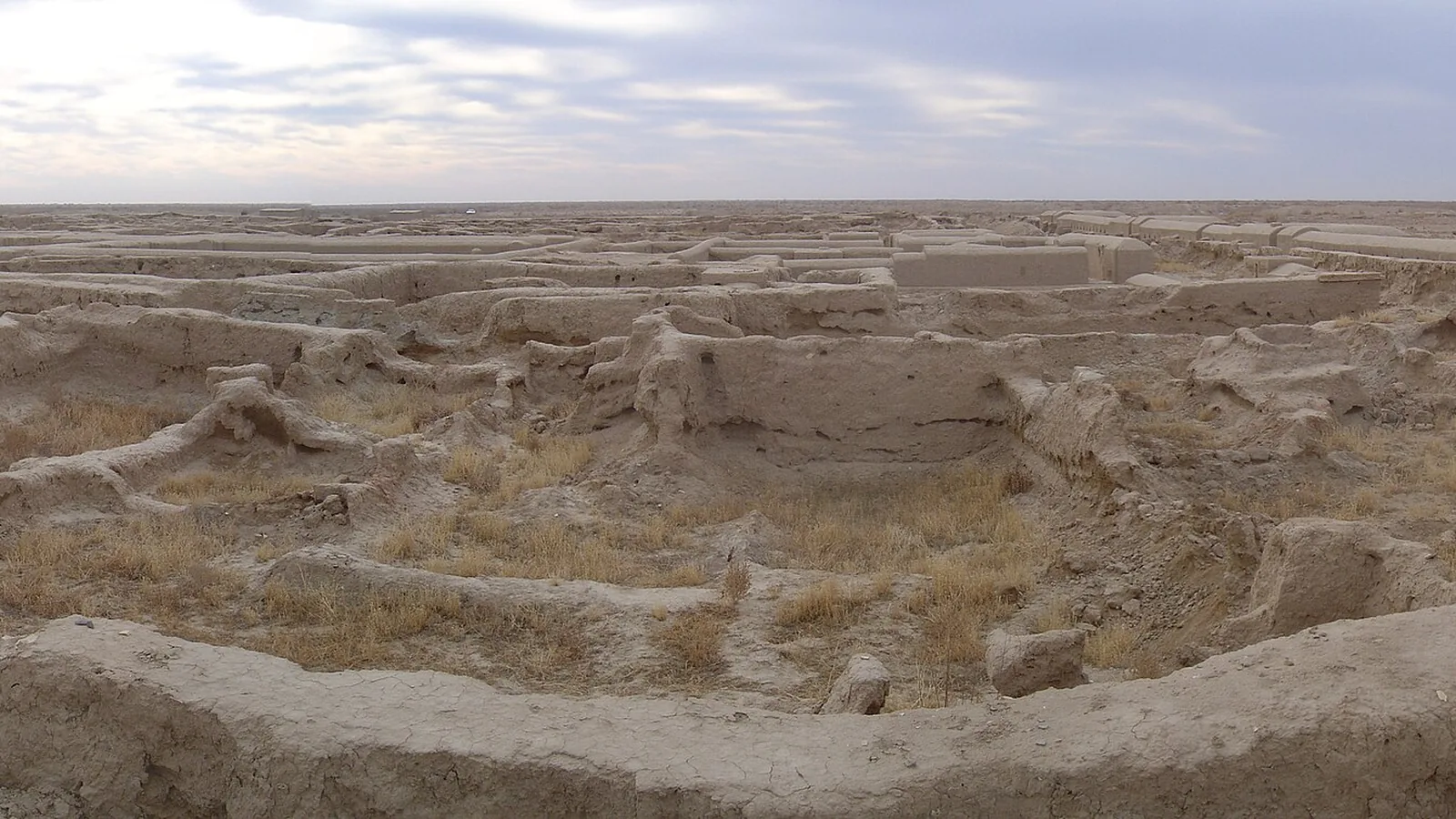
In the Karakum desert of southeastern Turkmenistan, a Soviet expedition found the Gonur oasis in 1974: a Bronze Age settlement in the dry delta of the Murghab river. The archaeologist who led the dig, Victor Sarianidi, called its largest mound, Gonur-I, the capital of an oasis culture that archaeologists group with sites in northern Afghanistan under the name Bactria-Margiana Archaeological Complex, or BMAC. Bactria lay between the Hindu Kush and the Oxus river; Margiana was the Murghab delta. Its people ran irrigation canals and traded bronze and lapis lazuli with India and Mesopotamia. The published dates for the city run from about 2300 BC to about 1700 BC and do not agree. A 2019 study of ancient DNA found that its people descended mostly from farmers related to those of the Iranian plateau, and that steppe ancestry appears in a few burials only from about 2100 BC.
Quick facts
- When
- Gonur oasis found 1974 · large-scale excavation from 1981–83 · occupation dated roughly 2300–1700 BC, with published estimates that disagree
- Where
- Old delta of the Murghab river in the Karakum desert, southeastern Turkmenistan (ancient Margiana); the wider culture also covered Bactria in what is now northern Afghanistan
- Who
- Victor Sarianidi and the Margiana Archaeological Expedition (founded spring 1972); Pierre Leriche (Encyclopaedia Iranica); Vagheesh Narasimhan and co-authors (Science, 2019)
- Outcome
- A walled Bronze Age center with irrigation, potters' quarters, stamp seals found as far as the Indus and Mari, and a population that carried no steppe ancestry until outliers appear about 2100 BC
A dig that stopped in 1959 and started again in 1972
Sarianidi set out the history of the work in his book Margiana and Protozoroastrism, published in Athens in 1998. The Late Bronze Age sites of the Murghab delta were first described in a 1959 monograph by V. Masson, and then the work stopped. Nothing more was done, Sarianidi wrote, until the spring of 1972, when the Institute of Archaeology of the Academy of Sciences of the USSR founded a Margiana Archaeological Expedition for the purpose.
In 1974 the expedition found the Gonur oasis and dug test trenches at the mound it named Gonur-I; the Togolok oasis turned up the same year, and a survey there in 1977 recorded more than 30 farming settlements. Permanent large-scale excavation of the fortress at Gonur-I began only in 1981 to 1983. The southern part of the site, which Sarianidi called the temenos, a sacred precinct, was dug from 1988 to 1994.
What the sources say about the dates
No agreed date exists for Gonur or for the BMAC as a whole. Jona Lendering’s Livius entry on Margiana puts farmers in the delta at about 2200 to 1700 BC. The Metropolitan Museum of Art dates its BMAC objects to the “late 3rd–early 2nd millennium B.C.” Radiocarbon results, Sarianidi wrote, had pushed the Bronze Age of Turkmenistan earlier, so that the preceding Namazga V period now fell within 2300 to 1850 BC and the Namazga VI period of the Margiana cities should begin two or three centuries before the old estimate. He also recorded “another view point” that put the start of Namazga VI at 1400 to 1300 BC. A span of roughly 2300 to 1700 BC covers the first three estimates and nothing more. Even the labels were argued over: Philip Kohl proposed in 1984 to call the mixed upper layers of the older Kopet Dagh sites Namazga VI-A, and Sarianidi preferred to treat them as the south Turkmenistan version of the BMAC.
Canals, kilns and seals that reached the Indus
Pierre Leriche, writing on pre-Islamic Bactria for the Encyclopaedia Iranica, described big oasis communities grouped around a fortress at Dashli in Bactria that, “like those of the oases in Margiana, were already practicing a well-developed system of irrigation and carrying on trade in products such as bronze and lapis lazuli with India and Mesopotamia.”
Sarianidi’s finds fill in the Margiana side. Pottery kilns stood at nearly every settlement, and at Gonur-I they clustered into potters’ quarters, the largest kiln 3 meters long. The most distinctive objects were small stamp seals and amulets of dark gray steatite in what he called the Murgab style. Seals of the same kind had been found in the Indus Valley, published by Joshi and Parpola in 1987, and at Mari in Syria, which he took as proof of export. The Metropolitan Museum’s copper-alloy compartmented stamp seal and shaft-hole ax carry a culture and a date in the museum’s records but no findspot.
The excavator's temples and the seated stone women
Sarianidi read several buildings as temples. Between 1983 and 1994, at Togolok-21, Togolok-1 and the south Gonur temenos, his team excavated what he described as “three temples connected with the cult of hallucinogenic beverages and the fire cult.” In rooms he called “white rooms,” large jars were set into stepped brick platforms and fixed with gypsum; a botanist at Moscow State University, Meyer-Melikyan, identified microscopic remains of ephedra, a plant that contains ephedrine, in residue from the bottom of the jars. Grinding stones and pestles lay on the floors of Togolok-21 in numbers he thought too large for household use, some with poppy pollen on them. He matched this to the drink called haoma in the Avesta and soma in the Rigveda. The temple label and the drink are his interpretation. Lendering’s Livius entry on Bactria records that archaeologists have tried to find traces of an older religion in the BMAC, “but decisive proof is lacking.”
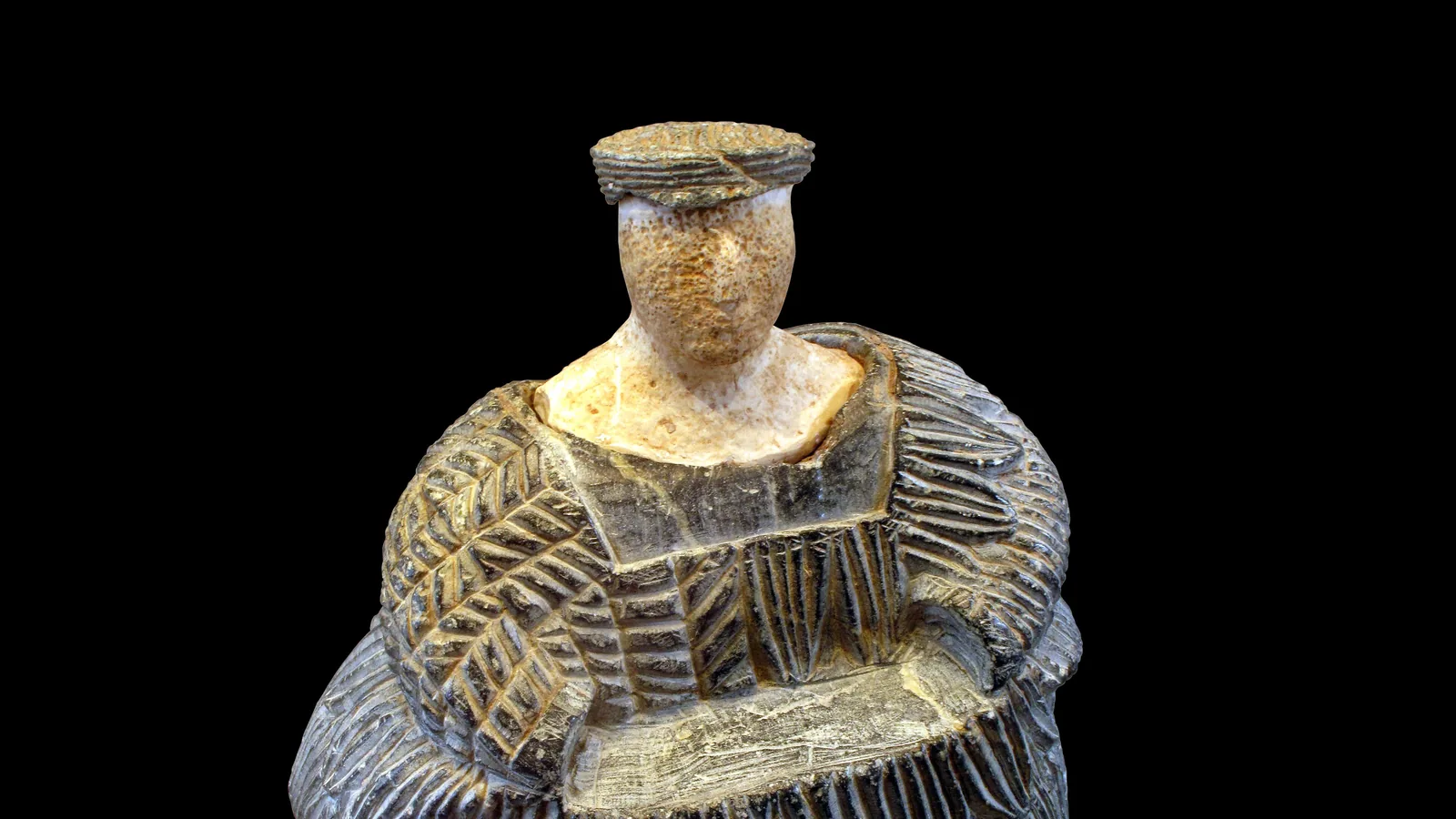
The best-known objects from the culture are small seated women in stone. The Metropolitan Museum’s example, titled “Seated female,” belongs to a group the museum describes as always composite, the body in soft green chlorite or steatite and the head in white stone. Excavated examples come from sites in Margiana, which the museum calls a possible center of their production. This piece did not come from a dig. The museum’s record says it was known on the art market by 1977, went on loan from Norbert Schimmel in 1983 and entered the collection in 1989 as a gift of the Norbert Schimmel Trust.

What the bones said in 2019
In September 2019 Vagheesh Narasimhan and colleagues published in Science genome-wide data from 84 people buried between 3000 and 1400 BC at four urban sites of the BMAC and its immediate successors. The great majority fell in one cluster, close to the people who had lived in the region before the cities, which the authors modeled as about 60 to 65 percent ancestry related to early Iranian farmers, 20 to 25 percent related to Anatolian farmers and about 10 percent related to West Siberian hunter-gatherers, plus 2 to 5 percent related, deeply in time, to Andamanese hunter-gatherers.
The paper found no evidence of steppe-pastoralist ancestry at BMAC sites before 2100 BC; between 2100 and 1700 BC, outliers at three BMAC sites carried ancestry the authors traced to Yamnaya-related pastoralists of the western steppe. At Gonur itself, three individuals radiocarbon dated to 2500 to 2000 BC stood apart with elevated Andamanese-related ancestry; the authors set that beside D. Frenez’s 2018 study of Asian elephant ivory worked at Gonur as evidence of exchange with the Indus. The main BMAC population, the paper concluded, carried no ancestry from steppe pastoralists and did not contribute substantially to later South Asians. The city in the sand kept its own people for most of its life, and the steppe reached its cemeteries around 2100 BC, in a handful of graves.
Key facts
- The Margiana Archaeological Expedition was founded in the spring of 1972; it found the Gonur oasis in 1974 and began permanent large-scale excavation of the Gonur-I fortress in 1981 to 1983 (Sarianidi, 1998).
- Gonur Depe lies in the old delta of the Murghab river, in the Karakum desert of southeastern Turkmenistan, the ancient Margiana.
- Published dates disagree: Livius gives about 2200 to 1700 BC, the Metropolitan Museum “late 3rd–early 2nd millennium B.C.,” and Sarianidi placed Namazga V at 2300 to 1850 BC while recording a rival view that started Namazga VI at 1400 to 1300 BC.
- Oasis communities in Bactria and Margiana ran irrigation systems and traded bronze and lapis lazuli with India and Mesopotamia (Leriche, Encyclopaedia Iranica).
- Murgab-style compartmented seals from the region have been found in the Indus Valley and at Mari in Syria (Sarianidi, citing Joshi and Parpola, 1987).
- Sarianidi described three buildings at Togolok-21, Togolok-1 and south Gonur as temples of a fire cult and a hallucinogenic drink; ephedra remains and poppy pollen were identified in them. Livius records that decisive proof of such a religion is lacking.
- The Metropolitan Museum’s “Seated female” was known on the art market by 1977 and entered the museum in 1989 as a gift; it was not excavated.
- Ancient DNA from 84 BMAC-period people (Narasimhan et al., 2019) shows about 60 to 65 percent Iranian-farmer-related ancestry and no steppe ancestry before 2100 BC; steppe-related outliers appear at three sites between 2100 and 1700 BC.
FAQ
Where is Gonur Depe?
In the old delta of the Murghab river, in the Karakum desert of southeastern Turkmenistan. The river rises in the mountains of Afghanistan, flows north and breaks into branches that vanish in the sand; that delta was the ancient Margiana.
How old is Gonur Depe?
No single agreed date exists. Livius gives about 2200 to 1700 BC for the Bronze Age farmers of the delta, the Metropolitan Museum dates the culture's objects to the late third and early second millennium BC, and Sarianidi placed the preceding Namazga V period at 2300 to 1850 BC. Roughly 2300 to 1700 BC covers those estimates.
Were the people of Gonur from the steppe?
Mostly not. The 2019 Science study found that the main BMAC population carried no steppe-pastoralist ancestry and descended largely from earlier local farmers related to those of the Iranian plateau. Individuals with steppe-related ancestry appear as outliers at BMAC sites only between about 2100 and 1700 BC.
Sources
- Victor Sarianidi, Margiana and Protozoroastrism, translated by Inna Sarianidi (Kapon Editions, Athens, 1998), full text on the Internet Archive.
- Livius.org — Jona Lendering, "Margiana" (created 2011, modified August 13, 2020).
- Livius.org — Jona Lendering, "Bactria."
- Encyclopaedia Iranica — Pierre Leriche, "BACTRIA i. Pre-Islamic Period."
- Vagheesh M. Narasimhan et al., "The Formation of Human Populations in South and Central Asia," Science 365, no. 6457 (September 6, 2019), author manuscript at PubMed Central.
- The Metropolitan Museum of Art — "Seated female," Bactria-Margiana Archaeological Complex, accession 1989.281.41a, b (collection record mirrored on the Internet Archive).
- The Metropolitan Museum of Art — "Compartmented stamp seal," accession 1983.535.117 (record mirrored on the Internet Archive).
- The Metropolitan Museum of Art — "Axe with shaft hole," accession 1983.535.33 (record mirrored on the Internet Archive).
Cite this article
- APA
- Our Earth's History. (2026, September 21). Gonur Depe: the Bronze Age city the Karakum desert hid until 1974. Our Earth's History. https://ourearthshistory.com/central-asia/ancient/gonur-depe-oxus-civilization-bronze-age/
- Chicago
- Our Earth's History. “Gonur Depe: the Bronze Age city the Karakum desert hid until 1974.” Our Earth's History, September 21, 2026. https://ourearthshistory.com/central-asia/ancient/gonur-depe-oxus-civilization-bronze-age/.
- MLA
- “Gonur Depe: the Bronze Age city the Karakum desert hid until 1974.” Our Earth's History, 21 Sep. 2026, https://ourearthshistory.com/central-asia/ancient/gonur-depe-oxus-civilization-bronze-age/.
Text licensed CC BY-NC-ND 4.0. Found an error? Tell us.