A gold necklace, a lead ingot: Sarazm on the Zeravshan, 1976 or 1979
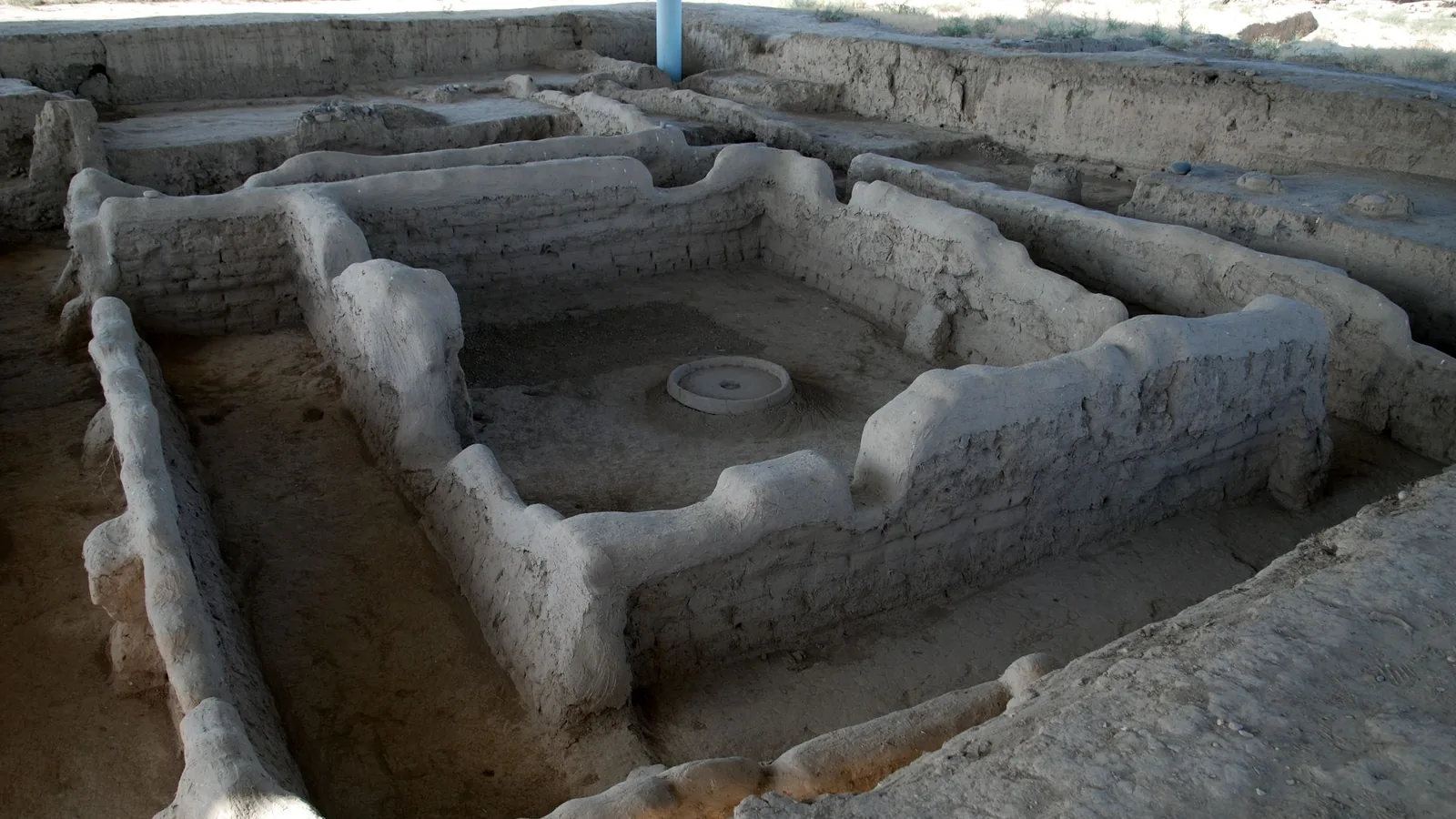

TL;DR — A Tajik institute dates Sarazm’s first dig to 1976, Roland Besenval’s 1987 paper to 1979; its finds include a gold and lapis lazuli necklace and a lead ingot.
Roland Besenval, in a paper delivered to the Académie des Inscriptions et Belles-Lettres in 1987, wrote that Sarazm “est fouillé depuis sa découverte, en 1979, par une mission archéologique de l’Académie des Sciences du Tadjikistan, sous la direction du docteur Abdullah Isakov” (excavated since its discovery, in 1979, by a mission of the Academy of Sciences of Tajikistan, under Dr. Abdullah Isakov). The S.U. Umarov Physical-Technical Institute in Dushanbe gives a different year: the first excavation there “started in 1976 and was conducted by Abdullah Isakov of the Academy of Science of Tajikistan,” with eight soundings and three areas dug. Sarazm sits on the upper Zeravshan River near Panjakent, in what is now Tajikistan, occupied across the fourth and third millennia BC. Its digs have produced a gold and lapis lazuli necklace, imported pottery, and a lead ingot of nearly 10 kilograms.
Quick facts
- When
- 1976 (Physical-Technical Institute's date for the first excavation) · 1979 (Besenval's 1987 paper on Isakov's discovery, and the institute's own date for systematic work) · 1984 (French-Tajik joint mission begins) · 1985 (grave and lead ingot found) · 2011 and 2015 (mission resumes, then merges into MAFAC) · 2021 (Scientific Reports paper)
- Where
- Sarazm, on the upper Zeravshan River near Panjakent, in what is now Tajikistan
- Who
- Abdullah Isakov of the Academy of Sciences of Tajikistan; Roland Besenval of the Académie des Inscriptions et Belles-Lettres; Henri-Paul Francfort; Frédéric Brunet; A. Razzokov
- Outcome
- A settlement of about 100 hectares, occupied across the fourth and third millennia BC, with irrigation agriculture, metalworking, a grave holding a gold and lapis lazuli necklace, imported pottery from Iran and Baluchistan, and a nearly 10-kilogram lead ingot; a 2021 genetics paper cites the site in a long-distance trade network
Isakov's site: one record says 1976, another says 1979
Besenval repeated his date in the same paper, writing that Isakov “présentait les antiquités d’un nouveau site, Sarazm, qu’il avait découvert en 1979” (presented the antiquities of a new site, Sarazm, that he had discovered in 1979) to a 1982 colloquium in Dushanbe. The Physical-Technical Institute’s own page carries a second date beside its 1976 claim, stating that “the site was methodologically excavated since 1979.” The Académie des Inscriptions et Belles-Lettres and the ArScAn laboratory at the University of Paris Nanterre, the two French institutions now tied to the joint mission, each give the year as 1976, writing that the site has been “l’objet de fouilles et d’une collaboration entre le Tadjikistan et la France depuis trente ans” (the subject of Tajik-French collaboration for thirty years) since Isakov’s discovery. That fieldwork began in 1984 under Besenval, stopped during the civil war, and resumed in 2011 under Henri-Paul Francfort and in 2015 under Frédéric Brunet, when the team merged with a mission at Ajakagytma, Uzbekistan, to form the Mission archéologique française en Asie centrale, now led on the Tajik side by A. Razzokov.
A hundred-hectare town on the Zeravshan River
Encyclopaedia Iranica’s entry on Sogdiana states that the earliest town-level settlement in the region was “Sarazm (4th-3rd m. BCE), a town of some 100 hectares… where both irrigation agriculture and metallurgy were practiced,” citing Isakov’s 1996 paper in the Bulletin of the Asia Institute. The same entry adds that work at the site has made it “possible to demonstrate the magnitude of links with the civilization of the Oxus as well as with more distant regions, such as Baluchistan.” A second Iranica article places Sarazm among “centers of ancient-agrarian culture” in the eastern Zeravshan valley, alongside Zaman Baba. A third traces a link further west: Geoksyur-complex settlements of southern Turkmenistan turn up in the Murghab delta and upstream on the Zeravshan, at Sarazm, as the region moved toward the Namazga IV period, roughly 2900 to 2300 BC.
Its oldest level held a grave with gold and lapis lazuli
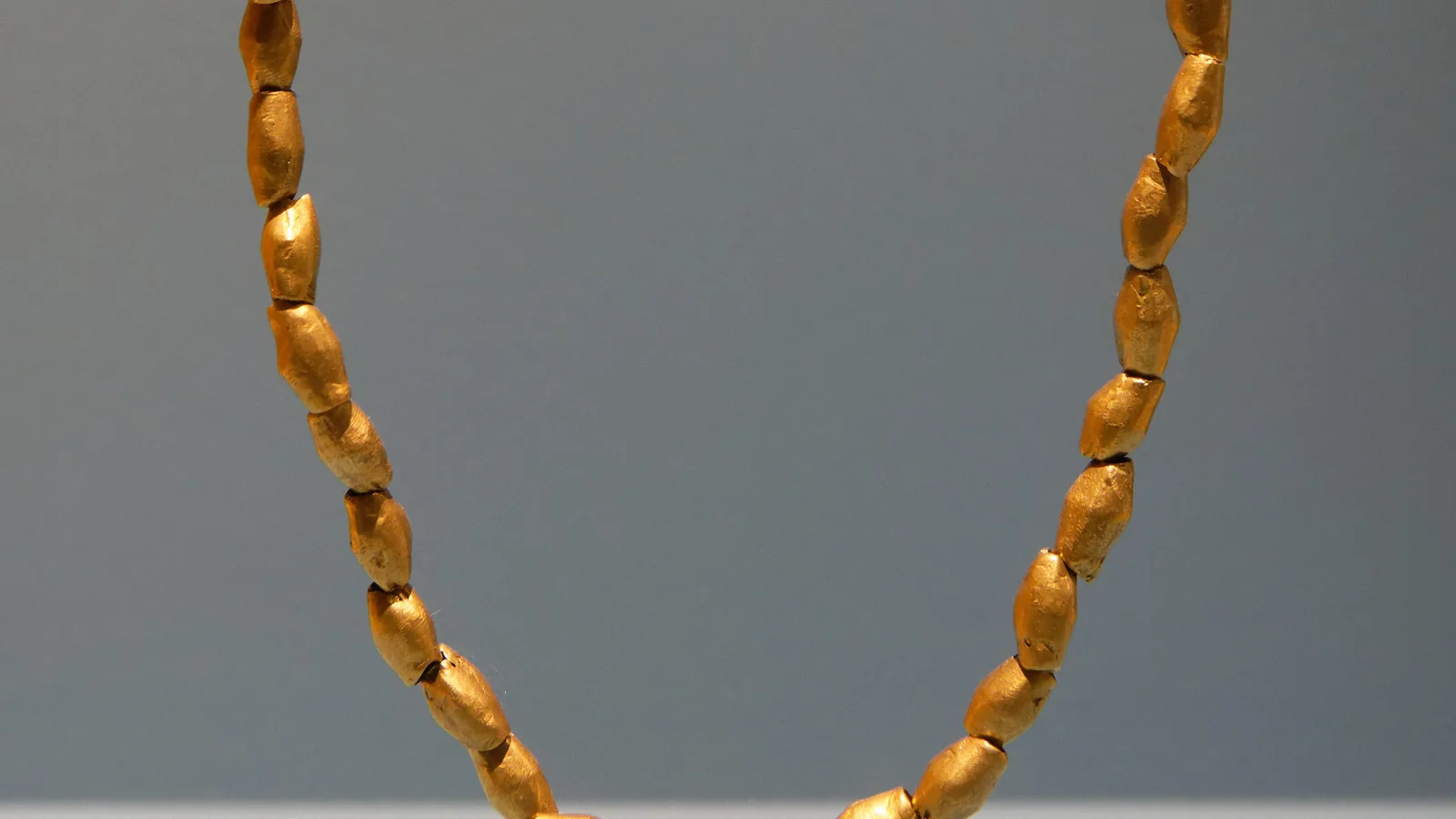
Besenval’s 1987 report divides the occupation in Area VII into five periods. Its oldest level held what Besenval called a “cercle funéraire,” a burial circle; one burial there, he wrote, “était dotée d’un mobilier funéraire particulièrement riche qui permet de la dater du milieu du IVe millénaire av. J.-C.” (was furnished with grave goods rich enough to date it to the middle of the fourth millennium BC). Isakov found those goods in 1985: a necklace of biconical beads in solid gold, which Besenval called unique for the period “par la quantité de métal précieux” (for the quantity of precious metal), since most gold ornaments of the time were rolled sheet rather than cast beads. The grave also held lapis lazuli beads, and raw fragments of the stone turned up elsewhere in the excavations, evidence Besenval read as a Bactrian stage in the mineral’s movement. At the far end of Area VII’s sequence, the top level, Level IV, had been “considérablement mutilé par le labourage,” badly damaged by plowing, but still yielded eight intact pots on the floor of a building destroyed by fire. Two radiocarbon dates from that burned level, run at Gif-sur-Yvette, gave calibrated ranges of 2620 to 2165 BC and 2525 to 2105 BC.
.jpg)
Gorgan ware and Baluchistan pottery reached the same burned floor
Among the pottery from that top level, one gray jar belonged, Besenval wrote, to “la culture de l’âge du Bronze du Nord-Est iranien centrée sur la plaine du Gorgan” (the Bronze Age culture of northeastern Iran centered on the Gorgan plain), some 1,200 kilometers away, identified against material from Erich Schmidt’s dig at Tepe Hissar and Jean Deshayes’s at Tureng Tepe. The same layer held painted pottery from Baluchistan, a combination Besenval called unexpected, since most of one household’s vessels turned out to be foreign. Sieving in Level III had already turned up galena and litharge, evidence of lead collection and working, possibly argentiferous, plus copper ore; a chance find on the site in 1985 added a lead ingot of close to 10 kilograms. Besenval pointed to the mountains around Sarazm as the source, writing that “les matières premières minérales sont particulièrement abondantes dans l’environnement montagneux de Sarazm: or (alluvionnaire et filonien), argent, plomb argentifère, mercure, cuivre, étain” (mineral raw materials are especially abundant in Sarazm’s mountainous surroundings: gold, both alluvial and vein, silver, argentiferous lead, mercury, copper and tin), the basis, in his reading, for a relay point in long-distance trade. On how long that trade lasted, Besenval broke with the Soviet team: “malgré l’opinion de nos collègues soviétiques, partisans d’une datation très basse, l’observation de l’ensemble du matériel sorti à Sarazm… ne nous permet pas, pour l’instant, de supposer l’existence d’un niveau plus récent” (despite the opinion of our Soviet colleagues, who favor a much later date, the material recovered at Sarazm does not allow us, for now, to suppose a more recent level exists).
In 2021, a genetics paper cited Sarazm's long-distance trade
A 2021 paper in Scientific Reports on the genetic history of Indo-Iranian speakers in southern Central Asia cited the site as an example of exchange reaching the Arabian Sea. Its authors wrote that “material from Balochistan and shells used in necklaces and bracelets from the Arabian Sea are found at the Sarazm site in Tajikistan, showing a long-distance commercial exchange.”
Key facts
- The S.U. Umarov Physical-Technical Institute records Sarazm’s first excavation as 1976, under Abdullah Isakov of the Academy of Sciences of Tajikistan.
- Roland Besenval’s 1987 paper for the Académie des Inscriptions et Belles-Lettres states, twice, that Isakov discovered Sarazm in 1979.
- Encyclopaedia Iranica gives Sarazm as a 100-hectare town of the fourth to third millennium BC, with irrigation agriculture and metallurgy practiced together.
- Iranica’s article on Central Asian excavations groups Sarazm with Zaman Baba as an ancient-agrarian center of the eastern Zeravshan valley.
- Isakov found a grave in Sarazm’s oldest level in 1985, holding a solid gold bead necklace and lapis lazuli beads, dated by Besenval to the middle of the fourth millennium BC.
- Two radiocarbon dates from Area VII’s burned top level, GIF-7397 and GIF-7398, calibrate to 2620-2165 BC and 2525-2105 BC.
- That same top level held gray pottery from Iran’s Gorgan plain and painted pottery from Baluchistan, plus lead-working debris and a nearly 10-kilogram lead ingot found in 1985.
- The French-Tajik joint mission began in 1984 under Besenval, resumed in 2011 and 2015, and merged in 2015 into the Mission archéologique française en Asie centrale.
FAQ
When was Sarazm discovered?
Sources disagree. The S.U. Umarov Physical-Technical Institute dates the first excavation to 1976. Roland Besenval's 1987 paper states twice that Isakov discovered the site in 1979.
What was found in Sarazm's oldest grave?
Isakov's 1985 excavation of a burial circle in Area VII's oldest level uncovered a necklace of solid gold biconical beads and beads of lapis lazuli, which Besenval dated to the middle of the fourth millennium BC.
How large was the settlement at Sarazm?
Encyclopaedia Iranica describes a town of some 100 hectares, occupied across the fourth and third millennia BC, with irrigation agriculture and metalworking.
Sources
- S.U. Umarov Physical-Technical Institute, Academy of Sciences of the Republic of Tajikistan, "Sarazm"
- Roland Besenval, "Découvertes récentes à Sarazm (R.S.S. du Tadjikistan): attestation des relations au IIIe millénaire entre l'Asie centrale, l'Iran du Nord-Est et le Baluchistan," Comptes rendus des séances de l'Académie des Inscriptions et Belles-Lettres 131, no. 2 (1987)
- Encyclopaedia Iranica, "Sogdiana iii. History and Archaeology"
- Encyclopaedia Iranica, "Excavations iii. In Central Asia"
- Encyclopaedia Iranica, "Archaeology v. Pre-Islamic Central Asia"
- Académie des Inscriptions et Belles-Lettres, "Mission archéologique française en Asie centrale (MAFAC) (Ouzbékistan-Tadjikistan)"
- Laboratoire ArScAn (UMR 7041, CNRS/Université Paris Nanterre), "Sarazm (Tadjikistan)"
- Fan Zhang et al. cited work aside, Scientific Reports 11 (2021), article s41598-021-04144-4, "Genetic continuity of Indo-Iranian speakers since the Iron Age in southern Central Asia"
Cite this article
- APA
- Our Earth's History. (2026, September 27). A gold necklace, a lead ingot: Sarazm on the Zeravshan, 1976 or 1979. Our Earth's History. https://ourearthshistory.com/central-asia/ancient/sarazm-zeravshan-1976-1979-isakov-besenval-lapis-necklace-lead-ingot/
- Chicago
- Our Earth's History. “A gold necklace, a lead ingot: Sarazm on the Zeravshan, 1976 or 1979.” Our Earth's History, September 27, 2026. https://ourearthshistory.com/central-asia/ancient/sarazm-zeravshan-1976-1979-isakov-besenval-lapis-necklace-lead-ingot/.
- MLA
- “A gold necklace, a lead ingot: Sarazm on the Zeravshan, 1976 or 1979.” Our Earth's History, 27 Sep. 2026, https://ourearthshistory.com/central-asia/ancient/sarazm-zeravshan-1976-1979-isakov-besenval-lapis-necklace-lead-ingot/.
Text licensed CC BY-NC-ND 4.0. Found an error? Tell us.