Ten dams and a levee before the walls: Liangzhu, 5,100 years ago

TL;DR — Ten dams and the Tangshan Levee at Liangzhu predate most of its 300 ha walled city; a wet spell about 4,300 years ago ended the culture.
Ten dams and a levee at Liangzhu predate most of the walled city they protected, the Proceedings of the National Academy of Sciences reported on December 4, 2017. The paper’s authors, Bin Liu of the Zhejiang Provincial Institute of Cultural Relics and Archaeology and seven colleagues, wrote of “the Liangzhu culture of the Yangtze Delta, dated at 5,300–4,300 years cal B.P.,” that is, calibrated radiocarbon years before present, roughly 3300 to 2300 BC. They dated the earthworks, at the foot of Tianmu Mountain in what is now Zhejiang province, to 5,200–4,800 years ago. South and southeast of them, “earthen walls enclosed the city of Liangzhu in an area of about 300 ha (approximately 1.9 × 1.7 km),” and most of that city came later, at 4,900–4,600 cal B.P. A 2021 stalagmite study put the culture’s end in a wet period about 4,300 years ago. The site joined the World Heritage List on July 6, 2019.
Quick facts
- When
- 5,300–4,300 years cal B.P. (the Liangzhu culture) · 5,200–4,800 cal B.P. (high dams) · 5,000–4,800 cal B.P. (low dams and levee) · 4,900–4,600 cal B.P. (most of the city) · 4345 ± 32 to 4324 ± 30 years ago (collapse in a wet period) · 1936 (first Neolithic finds) · 1986–1987 (Fanshan and Yaoshan tombs) · July 6, 2019 (World Heritage inscription)
- Where
- Liangzhu, near Hangzhou, at the foot of Tianmu Mountain in the Yangtze Delta, in what is now Zhejiang province, China
- Who
- Bin Liu and the Zhejiang Provincial Institute of Cultural Relics and Archaeology (2017 paper); Haiwei Zhang and co-authors (2021 paper); Sun Zhixin (1993 article); Shi Xingeng (author of the early report Liangzhu)
- Outcome
- Ten dams and a levee, built before most of the walled city, held reservoirs north and northwest of a 300 ha city with a 30 ha palace mound. Speleothem records place the culture's collapse in a short, anomalously wet period about 4,300 years ago. The site was inscribed on the World Heritage List on July 6, 2019
Tangshan Levee and ten dams at the foot of Tianmu Mountain
The paper’s map legend numbers the hydraulic works: “1, Tangshan Levee; 2, Shizishan dam; 3, Liyushan dam; 4, Guanshan dam; 5, Wutongnong dam; 6, Ganggongling dam; 7, Laohuling dam; 8, Zhoujiafan dam; 9, Qiuwu dam; 10, Shiwu dam; 11, Mifengnong dam.” The authors sorted the dams into high dams between the hills and low dams on the swampy ground below. The Tangshan levees “extend for at least 5 km, and they are 20–50 m in width and 2–7 m in height.”
Radiocarbon dates came from grass and charcoal inside 10 dams and one levee. “Most of the dating results from the high dams cluster at 5,200–4,800 cal B.P., whereas most of the dates from the low dams and the levees cluster at 5,000–4,800 cal B.P.” The works therefore “most likely existed before the construction of most of Liangzhu city dated at 4,900–4,600 cal B.P.” The system formed what the paper calls “a 1,300-ha protective screen to the north and northwest of the city,” and the high and low reservoirs held “about 1,498 and 5,072.4 million cubic meters, respectively.”
Earthen walls on 40 to 60 m of rock
Inside the screen stood the city. Its wall sat on a bed of rock 40 to 60 m across, covered with yellow clay; the best-preserved sections stood “about 4 m in height and 20–150 m in width” in 2017. The stones “were quarried from the nearby mountains in the north and transported downstream into the city through the water system.” The Mojiaoshan palatial compound rose on an artificial mound of about 30 ha, with three palace foundations on top, among them Damojiaoshan, “with parts up to 15-m high,” and a plaza of 7 ha between them. Moats, ditches and canals about 30 km long threaded the city through eight water gates, with 51 old channels and ditches documented by 2017. Outside the walls stood a timber pier at Bianjiashan and a timber bank at Meirendi.
"Sand bags" of clay and 2.88 million cubic meters
Excavations at three dams found a bottom layer of whitish clay leached by long inundation. On it, the paper reads, “people had posed bundles of grayish clay wrapped by grass leaves resembling ‘sand bags’,” the grass being Miscanthus lutarioriparius, and the dam body went up in piles of yellow clay, some also wrapped. The Liangzhu Site Administrative Committee describes the Laohuling dam as about 135 m long, its water-facing side built of grass-wrapped mud.
Liu and his co-authors estimated the labor: “3,000 people worked for nearly 8 y to move ∼2.88 million cubic meters of earth.” The workers came from a population that “reached 22,900–34,350 at its peak, according to the density of archaeological features.” Rice fed them. A storage pit at eastern Mojiaoshan “contained 10,000–15,000 kg of preserved rice,” and paddy fields at Maoshan grew from less than 30–40 square meters to as much as 0.2 ha.
What such labor meant for power the authors left open. Karl Wittfogel’s 1957 model of “Oriental Despotism” had Asian elites forcing their populations into labor through water control; the paper answers that “a narrow interpretation of Wittfogel’s hydraulic hypothesis . . . as a technological phenomenon would disregard the potentially diverse pathways to power through ritual performance and religious ceremony,” citing Stephen Lansing’s 2009 study of Bali.
1986 and 1987: jades from Fanshan and Yaoshan
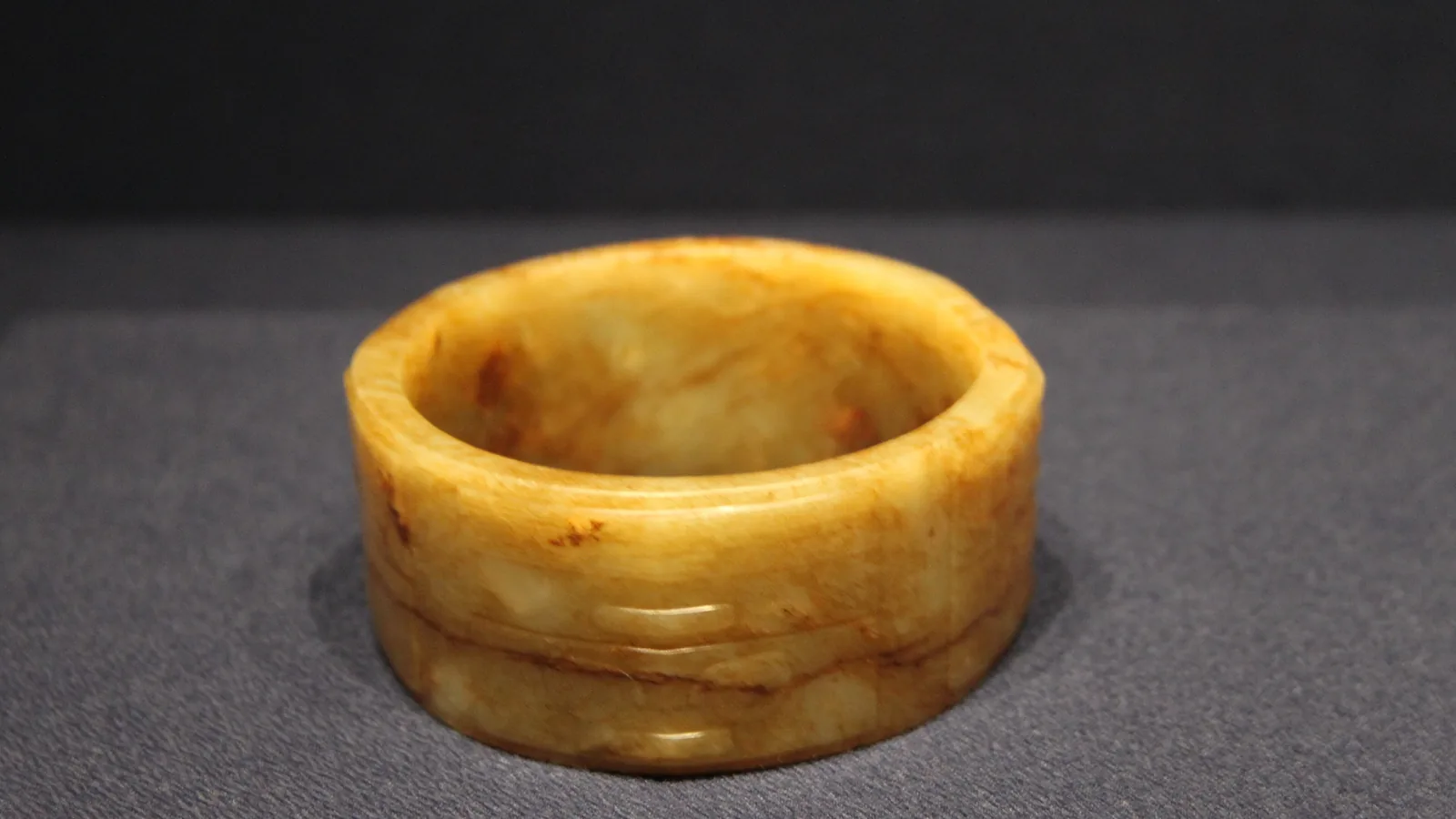
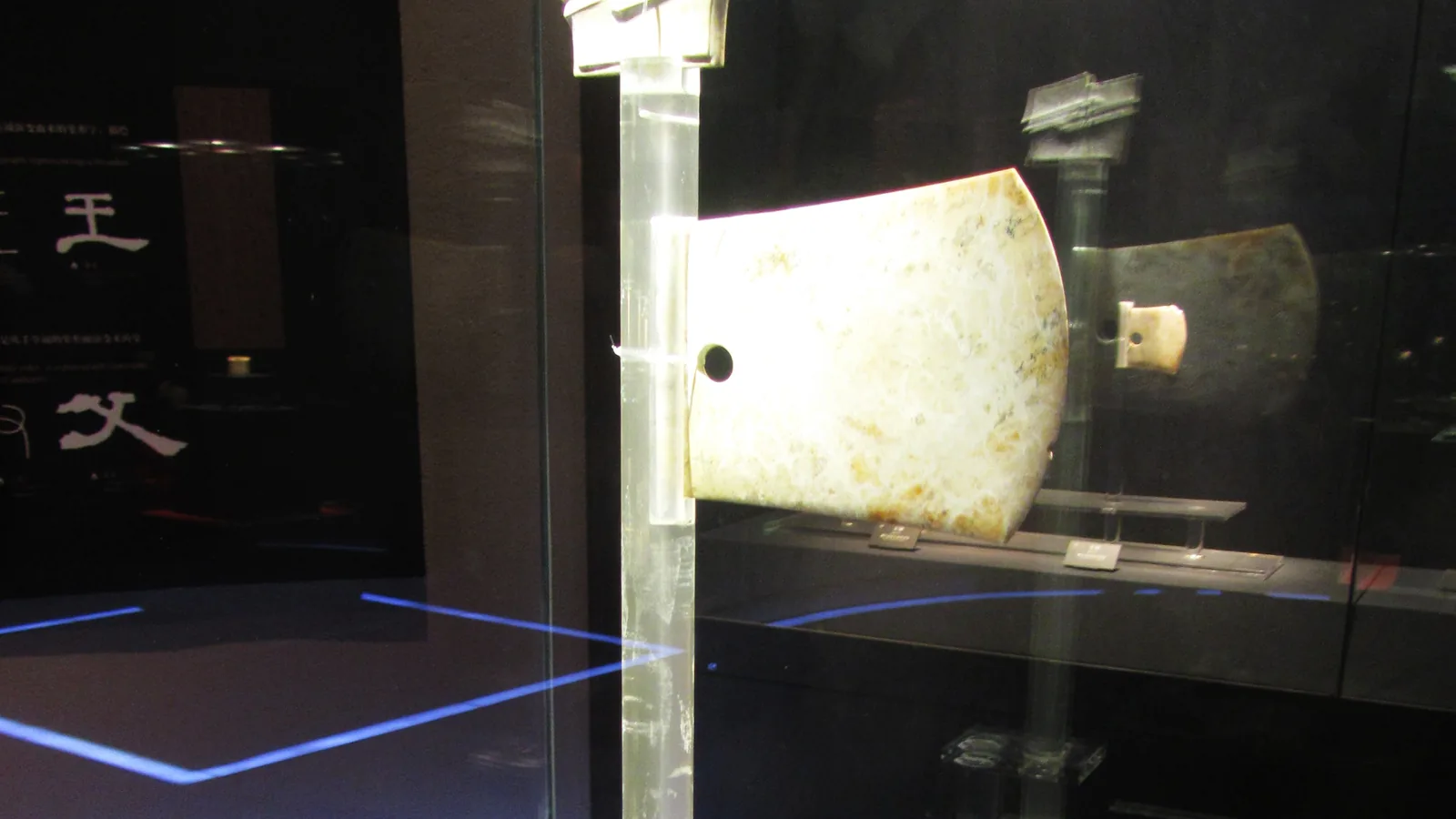
Sun Zhixin opened a 1993 article in Early China with the site’s beginning: “The discovery of neolithic remains in 1936 at a place called Liangzhu near Hangzhou was the first evidence of a culture which in recent decades has revolutionized the prehistory of the lower Yangzi region.” His footnotes cite Shi Xingeng’s book Liangzhu as the early report. The administrative committee’s collection lists a half-disc huang from Fanshan tomb M23, item M23:67, excavated in 1986, 5.75 cm high, 13.88 cm wide and 0.8 cm thick, with the sacred human-and-animal motif in low relief. From Fanshan M14, also 1986, came a yue ax set, the blade 14.1 cm long. At Yaoshan, 12 tombs were excavated in 1987; two small cong from tomb M7 stand 4.2 cm and 4.4 cm high.

Between 4345 ± 32 and 4324 ± 30 years ago
Haiwei Zhang of Xi’an Jiaotong University and 20 co-authors published stalagmite records from two caves in Science Advances in 2021. The culture’s end, they wrote, “has been attributed to catastrophic climate and/or environmental events such as fluvial floods . . . , marine inundation caused by super typhoon events . . . or marine transgression . . . accompanying accelerated sea level rise, frequent cycles of droughts and floods . . . , extremely cold temperatures or cold-wet climate . . . , military conflicts, and changes in the social structure.” Most archeological studies, they added, “support the flood hypothesis,” citing a silt layer over the late Liangzhu deposits.
Their own data gave a sequence. “The dam construction terminated around 4.4 ka B.P.,” that is, 4,400 years before present, possibly in relation to “a megadrought at 4423 ± 42 yr B.P.” Then the rain came. “The Liangzhu culture collapsed within a short and anomalously wet period between 4345 ± 32 and 4324 ± 30 years ago,” the paper states, matching a second flood layer at the Yushan site dated 4365 ± 80 years ago. After the Qianshanyang-Guangfulin cultures of 4,300 to 4,000 years ago, only a few Neolithic sites are known in the delta until about 3,000 years ago.
The State Council listed the city as a national key protected site in 1996; the Liangzhu Museum, designed by David Chipperfield, shows the finds in more than 4,000 square meters of galleries. On July 6, 2019, the site was inscribed on the World Heritage List, and on June 15, 2023, the flame for the Hangzhou Asian Games was collected at Damojiaoshan, on the mound where the palaces had stood.
Key facts
- The 2017 PNAS paper by Bin Liu and co-authors dated the Liangzhu culture of the Yangtze Delta to 5,300–4,300 years cal B.P.
- Its map numbered the Tangshan Levee and ten dams: Shizishan, Liyushan, Guanshan, Wutongnong, Ganggongling, Laohuling, Zhoujiafan, Qiuwu, Shiwu and Mifengnong.
- High dam dates cluster at 5,200–4,800 cal B.P., low dams and levees at 5,000–4,800 cal B.P.; most of the city dates to 4,900–4,600 cal B.P.
- The Tangshan levees run at least 5 km, 20–50 m wide and 2–7 m high; the dams were built of clay bundles wrapped in Miscanthus leaves.
- The city walls cover about 300 ha (1.9 × 1.7 km) on a rock base 40 to 60 m across; Mojiaoshan is a 30 ha mound with three palace foundations and a 7 ha plaza.
- The authors estimated 3,000 people working nearly eight years to move about 2.88 million cubic meters of earth, from a peak population of 22,900–34,350.
- The Fanshan M23:67 huang (5.75 × 13.88 × 0.8 cm) and M14 yue ax set (blade 14.1 cm) were excavated in 1986; 12 tombs at Yaoshan were excavated in 1987.
- Zhang and co-authors (Science Advances, 2021) placed the collapse in a wet period between 4345 ± 32 and 4324 ± 30 years ago; the site joined the World Heritage List on July 6, 2019.
FAQ
How old are the dams at Liangzhu?
Radiocarbon dates published in 2017 cluster at 5,200–4,800 calibrated years before present for the high dams and 5,000–4,800 for the low dams and the Tangshan Levee. The paper's title gives the round figure of 5,100 years.
Were the dams built before or after the city walls?
Before. Liu and his co-authors wrote that the dams and levees, dated before 4,800 years ago, "most likely existed before the construction of most of Liangzhu city dated at 4,900–4,600 cal B.P."
Why did the Liangzhu culture end?
The 2021 Science Advances paper by Haiwei Zhang and co-authors, using stalagmite records, found that the culture "collapsed within a short and anomalously wet period between 4345 ± 32 and 4324 ± 30 years ago," which supports the flood hypothesis that most archaeological studies favor. The paper also lists super typhoons, marine transgression, cold climate, conflict and social change as explanations other authors have offered.
Sources
- Bin Liu, Ningyuan Wang, Minghui Chen, Xiaohong Wu, Duowen Mo, Jianguo Liu, Shijin Xu and Yijie Zhuang, "Earliest hydraulic enterprise in China, 5,100 years ago," Proceedings of the National Academy of Sciences 114(52), December 4, 2017, pp. 13637–13642, open text at PubMed Central (PMC5748178).
- Haiwei Zhang, Hai Cheng, Ashish Sinha, Christoph Spötl, Yanjun Cai, Bin Liu and others, "Collapse of the Liangzhu and other Neolithic cultures in the lower Yangtze region in response to climate change," Science Advances 7(48), eabi9275, 2021, open text at PubMed Central (PMC8626068).
- Sun Zhixin, "The Liangzhu Culture: Its Discovery and its Jades," Early China, vol. 18 (1993), pp. 1–40, Cambridge University Press, extract and reference list on Cambridge Core.
- Liangzhu Site Administrative Committee of Yuhang District, Hangzhou (lzsite.cn), "Liangzhu Ancient City" page: 1996 national key protected site, World Heritage inscription of July 6, 2019, Asian Games flame of June 15, 2023 (in Chinese).
- Liangzhu Site Administrative Committee (lzsite.cn), "Laohuling Site" page: dam about 135 m long, grass-wrapped mud construction (in Chinese).
- Liangzhu Site Administrative Committee (lzsite.cn), "Yaoshan Site" page: 12 tombs excavated in 1987 (in Chinese).
- Liangzhu Site Administrative Committee (lzsite.cn), home page, collection entries for the Fanshan M23:67 huang, the Fanshan M14 yue set and the Yaoshan M7 cong, with findspot, year and dimensions (in Chinese).
- Liangzhu Site Administrative Committee (lzsite.cn), "Liangzhu Museum" page: David Chipperfield design, three permanent galleries, exhibition area (in Chinese).
- Liangzhu Museum (lzmuseum.cn), home page, institutional site with news of the 2026 ninetieth-anniversary exhibition (in Chinese).
Cite this article
- APA
- Our Earth's History. (2026, September 22). Ten dams and a levee before the walls: Liangzhu, 5,100 years ago. Our Earth's History. https://ourearthshistory.com/east-asia/ancient/liangzhu-dams-5100-years-pnas-2017-city-walls-jade-collapse-flood/
- Chicago
- Our Earth's History. “Ten dams and a levee before the walls: Liangzhu, 5,100 years ago.” Our Earth's History, September 22, 2026. https://ourearthshistory.com/east-asia/ancient/liangzhu-dams-5100-years-pnas-2017-city-walls-jade-collapse-flood/.
- MLA
- “Ten dams and a levee before the walls: Liangzhu, 5,100 years ago.” Our Earth's History, 22 Sep. 2026, https://ourearthshistory.com/east-asia/ancient/liangzhu-dams-5100-years-pnas-2017-city-walls-jade-collapse-flood/.
Text licensed CC BY-NC-ND 4.0. Found an error? Tell us.