Who made the bronze giants of Sanxingdui, and why bury them?
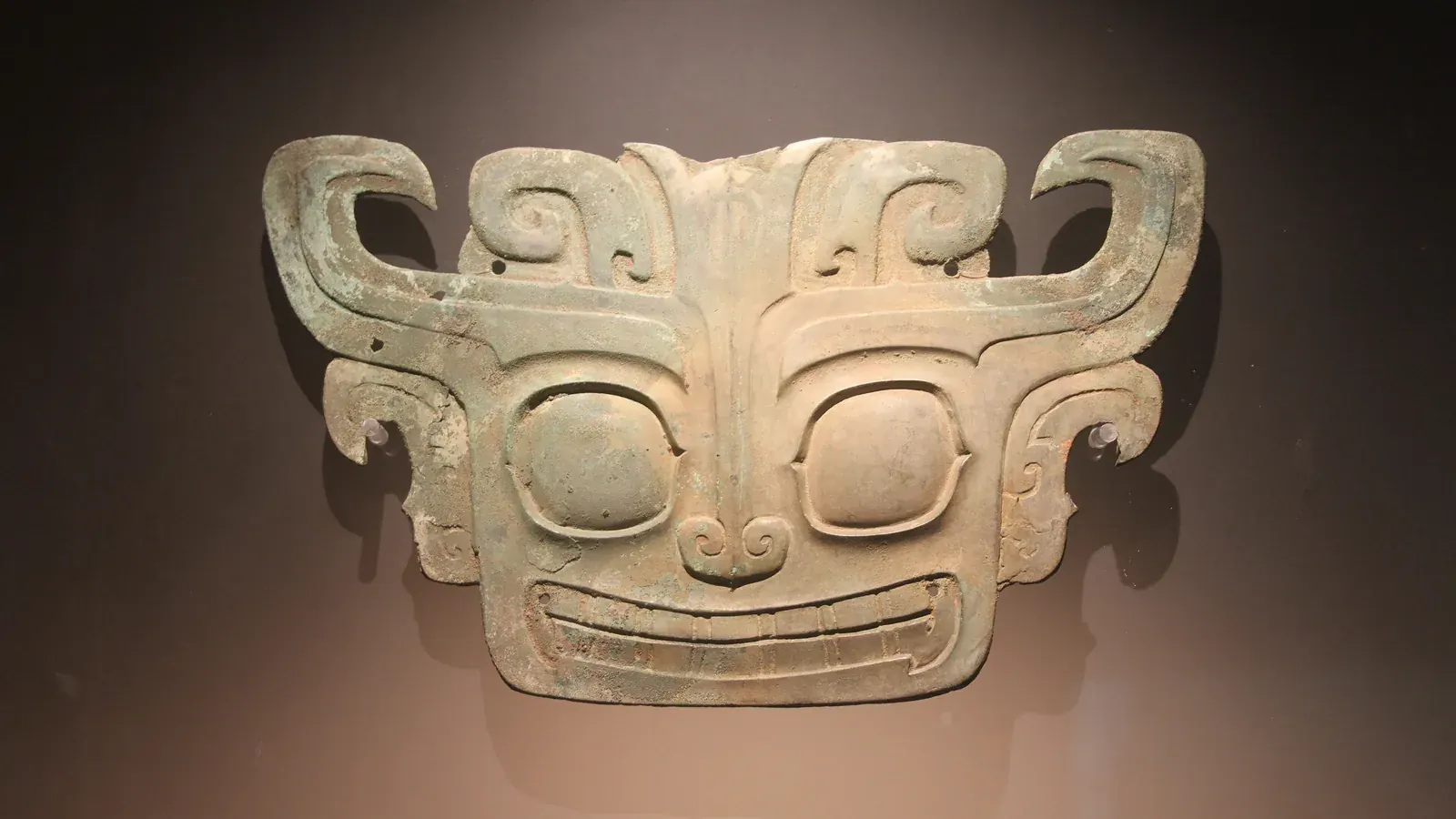

TL;DR — A walled city in Sichuan cast the bronzes, then broke, burned and buried them in eight pits around 1200 BC. No bones, no writing, and the reason is still argued.
The bronze giants of Sanxingdui were made by the people of a walled city on the Chengdu Plain, and no text from that city says why they buried them. The site lies west of Guanghan, about 40 kilometers northeast of Chengdu in Sichuan province, in what is now southwest China. Its eight pits, dated to about 1200 to 1000 BC, held a bronze figure 2.6 meters tall, masks more than a meter wide, bronze trees, gold masks, elephant tusks and cowrie shells, nearly all broken or burned before burial. Whether the burial closed a ritual, cleared a wrecked temple or answered a disaster is still argued.
Quick facts
- When
- City from about 1800 BC · jades found in the late 1920s · pits 1 and 2 found in summer 1986 · pits 3–8 dug 2020–2022 · pits dated about 1200–1000 BC (Antiquity, 2023) · UNESCO tentative list January 29, 2013
- Where
- Sanxingdui, west of Guanghan, about 40 kilometers northeast of Chengdu in Sichuan province, in what is now southwest China
- Who
- Farmer Yan Daocheng (jades); David C. Graham (1934 dig); Feng Hanji (1963, Shu proposal); Sichuan Provincial Institute of Cultural Relics and Archaeology (1986 and 2020–2022); Tianlong Jiao and Shengyu Wang (Hong Kong Palace Museum); Jianjun Mei (Cambridge)
- Outcome
- Eight pits holding a 2.6-meter bronze figure, masks up to 131 centimeters wide, bronze trees, gold masks, ivory and cowries, all broken or burned before burial; no bones, no writing, and no agreed reason for the burial
How the site was found, 1920s to 1986
The first finds were jades. A farmer named Yan Daocheng, digging a cistern near his home at Yueliangwan on the north of the site, uncovered more than 400 jade and stone objects, according to the Hong Kong Palace Museum curators Tianlong Jiao and Shengyu Wang. Sources give the year as 1927, 1928 or 1929. In 1934 David C. Graham, who ran the museum of West China Union University, led the first excavation and named what he found the “Guanghan culture.”
In the summer of 1986, workmen digging clay for bricks cut into two rectangular pits, as the Metropolitan Museum of Art recorded when it showed the finds in 2002. Yingfu Li and colleagues at Sichuan University put the yield of pits 1 and 2 at more than 900 objects of bronze, gold, jade and ivory.
What was in pits 1 and 2
The largest object was a bronze man on a pedestal, the only large human figure in either pit. The Met described it as life-size on a base that raised it to more than eight feet, with massive eyebrows, bulging eyes and hands far too big for the body; Chinese researchers give the total height as 2.62 meters.
Around it lay bronze heads, some faced with gold foil, and masks with knife-shaped brows and pupils on stalks; the Met put one, the Mask with Protruding Pupils, at more than four feet across. There was a bronze tree 13 feet tall hung with birds, and gold foil once wrapped around a wooden stick, which Wang described to Current World Archaeology in 2023 as a scepter. Elephant tusks and cowrie shells filled the layers between.
What pits 3 to 8 added, 2019 to 2022
Six more pits turned up beside the first two in 2019, and in March 2020 the Sichuan Provincial Institute of Cultural Relics and Archaeology reopened the area. Li and colleagues recorded ivory on top and bronze below in pits 3, 4, 7 and 8, small gold objects in pit 5, and a wooden chest painted with cinnabar in pit 6.
The institute announced 1,771 objects from pits 3 and 4 on September 9, 2021, among them 314 intact bronzes and 147 tusks. A gold mask from pit 3, found that June, measured 37.2 by 16.5 centimeters and weighed about 100 grams, according to Xu Feihong of Shanghai University, who led that pit; a second, from pit 5, weighed about 280 grams. By June 2022 Smithsonian Magazine, citing China Daily, counted about 13,000 objects from the six pits, including 1,238 bronzes, 543 gold pieces and 565 jades. Fragments from pit 2, dug in 1986, joined fragments from the new pits, which Wang took to mean that all the pits were filled at about the same time.
How the bronzes were cast and what ties them to the Shang
The metal came out of a Shang-era network. Jianjun Mei, director of the Needham Research Institute in Cambridge, said in a 2023 seminar that most Sanxingdui bronzes were copper-tin-lead alloys cast in piece molds, a method the Central Plains had developed earlier, and soldered together. In his account Sanxingdui was one node in a Shang-era market of ore, craftsmen and finished goods. Sun Weidong and colleagues wrote in Scientific Reports in 2016 that the Sanxingdui bronzes carry the same highly radiogenic lead as the early bronzes of Yinxu, the last Shang capital, and no known deposit in southwest China fits. Jiao and Wang wrote that the Sanxingdui casters cared about shape and size over fine detail, and that none of the bronzes has been found in a grave.
Why the pits were dug: three readings
The pits were orderly. Jiao described the sequence: bronzes, jade, gold and tusks first, then a thick layer of ash, then clay, sometimes pounded down. “The pits were not being filled in a hurry,” he said, and added: “whether it was a closing part of the ritual, or a response to some kind of emergency event, is not something that we can say conclusively.”
Three readings sit on that evidence. The Met’s 2002 text took the two pits as two ritual performances in which offerings were broken or burned and then buried. A second reading, which Guo Yuming, Ran Honglin and colleagues summarized in npj Heritage Science in 2023, holds that the pits were dumps for objects damaged in war or some other event; their soil tests led them to reject it. The third is the emergency Jiao left open, which the UNESCO tentative-list entry phrases as temples buried and their vessels damaged in “great changes” around 1200 BC. Two absences shape all three: no human bones were found in the pits, and no writing has come from anywhere at Sanxingdui.
Who they were and where they went
The name attached to the makers rests on late texts. After digging at Yueliangwan in 1963, the historian Feng Hanji proposed that the site was the capital of the ancient state of Shu, as recorded in Chang Qu’s Huayang guozhi, a work of the fourth century AD written more than a thousand years after the pits were filled. China’s submission to the UNESCO tentative list on January 29, 2013, follows that identification and dates the city’s rise as a bronze center to about 1800 BC. Li and colleagues placed pits 1 to 4, 7 and 8 at about 1200 to 1000 BC and pits 5 and 6 at about 1046 to 950 BC.
The city was abandoned around 1000 BC. About 50 kilometers away at Jinsha, in the west of Chengdu, a second center produced elephant tusks, gold masks and a small bronze figure with the same grasping hands, and Wang said most archaeologists see it as the successor settlement. The giants were cast by a city that traded metal with the Shang world, buried by that city in a planned sequence, and left without a word from the people who did it.
Key facts
- Sanxingdui lies west of Guanghan, about 40 kilometers northeast of Chengdu; its walls enclosed 3.6 square kilometers (Jiao and Wang, 2023).
- Jades were found by the farmer Yan Daocheng in the late 1920s (1927, 1928 or 1929 by source); David C. Graham dug first in 1934.
- Pits 1 and 2 were found by brick-clay workers in summer 1986 and held more than 900 objects (Li et al., Antiquity, 2023).
- The standing figure is 2.62 meters tall with its pedestal; the Mask with Protruding Pupils from 1986 is more than four feet wide (Met); the largest mask from pit 3 is 131 centimeters wide (CWA, 2023).
- Pits 3 to 8 were dug from 2020 to 2022 and yielded about 13,000 objects, including 1,238 bronzes, 543 gold pieces and 565 jades (Smithsonian, citing China Daily, 2022).
- The gold mask from pit 3 measures 37.2 by 16.5 centimeters and weighs about 100 grams (China Daily, 2021); the pit 5 mask weighs about 280 grams (Antiquity, 2023).
- No human bones and no writing have been found in the pits; the pits are dated about 1200 to 1000 BC, with pits 5 and 6 at about 1046 to 950 BC.
FAQ
Who made the Sanxingdui bronzes?
The people of the walled city at Sanxingdui, using copper-tin-lead alloys and piece-mold casting that came from the Central Plains. They are usually called the ancient Shu, a name taken from Chang Qu's fourth-century AD Huayang guozhi rather than from anything found at the site.
Why were the Sanxingdui bronzes broken and buried?
No source from the site says. The objects were smashed or burned, then laid in layers under ash and clay. Readings include a closing ritual, disposal of damaged goods, and a response to some emergency; Guo Yuming and colleagues argued in 2023 against the disposal reading, and Tianlong Jiao said the choice between ritual and emergency could not be made conclusively.
Were human remains found at Sanxingdui?
No human bones were found in the eight pits, and no writing has been found anywhere at the site. Seven of the eight pits held a layer of burnt elephant tusks.
Sources
- Antiquity — Yingfu Li, Tian Qiu, Jianbo Guo and Yuniu Li, "New discoveries at the Sanxingdui Bronze Age site in south-west China," Antiquity 97(391) (February 2023), Project Gallery.
- The Metropolitan Museum of Art — "Treasures from a Lost Civilization: Ancient Chinese Art from Sichuan," exhibition listing (March 6–June 16, 2002).
- Asian Art Museum, San Francisco — "Virtual Director's Showcase: A Lost Civilization, a Landmark Exhibition, and New Wonders," event page (June 16, 2021).
- Orientations — Tianlong Jiao and Shengyu Wang, "Gazing at Sanxingdui: Interactions and Ritual Arts," 54(5) (September/October 2023).
- Current World Archaeology / The Past — Matthew Symonds, "The lost world of Sanxingdui: Fabulous finds from a forgotten civilisation," CWA 122 (November 23, 2023), interview with Tianlong Jiao and Shengyu Wang.
- Jesus College, University of Cambridge — "Sanxingdui bronzes and metallurgical network in the Shang dynasty," report of Jianjun Mei's China Forum seminar of October 17, 2023 (November 10, 2023).
- Scientific Reports — Wei-dong Sun et al., "Origin of the mysterious Yin-Shang bronzes in China indicated by lead isotopes," 6, 23304 (March 18, 2016).
- npj Heritage Science — Yuming Guo, Fang Xiang, Honglin Ran et al., "The sacrificial record in burial pits of the late Shang Dynasty: evidences from the chroma and magnetic properties of the Sanxingdui site, Sichuan, China" (December 6, 2023).
- UNESCO World Heritage Centre, Tentative Lists — "Archaeological Sites of the Ancient Shu State: Site at Jinsha and Joint Tombs of Boat-shaped Coffins in Chengdu City, Sichuan Province; Site of Sanxingdui in Guanghan City, Sichuan Province," ref. 5816 (submitted January 29, 2013).
- Smithsonian Magazine — Meilan Solly, "Trove of 13,000 Artifacts Sheds Light on Enigmatic Chinese Civilization" (June 14, 2022).
- China Daily — Huang Zhiling and Chen Meiling, "New finds at Sanxingdui Ruins site shed more light on ancient kingdom's culture" (September 10, 2021).
Cite this article
- APA
- Our Earth's History. (2026, September 20). Who made the bronze giants of Sanxingdui, and why bury them? Our Earth's History. https://ourearthshistory.com/east-asia/ancient/sanxingdui-bronze-giants-buried/
- Chicago
- Our Earth's History. “Who made the bronze giants of Sanxingdui, and why bury them?” Our Earth's History, September 20, 2026. https://ourearthshistory.com/east-asia/ancient/sanxingdui-bronze-giants-buried/.
- MLA
- “Who made the bronze giants of Sanxingdui, and why bury them?” Our Earth's History, 20 Sep. 2026, https://ourearthshistory.com/east-asia/ancient/sanxingdui-bronze-giants-buried/.
Text licensed CC BY-NC-ND 4.0. Found an error? Tell us.