Why were China's oldest records sold as medicine in 1899?
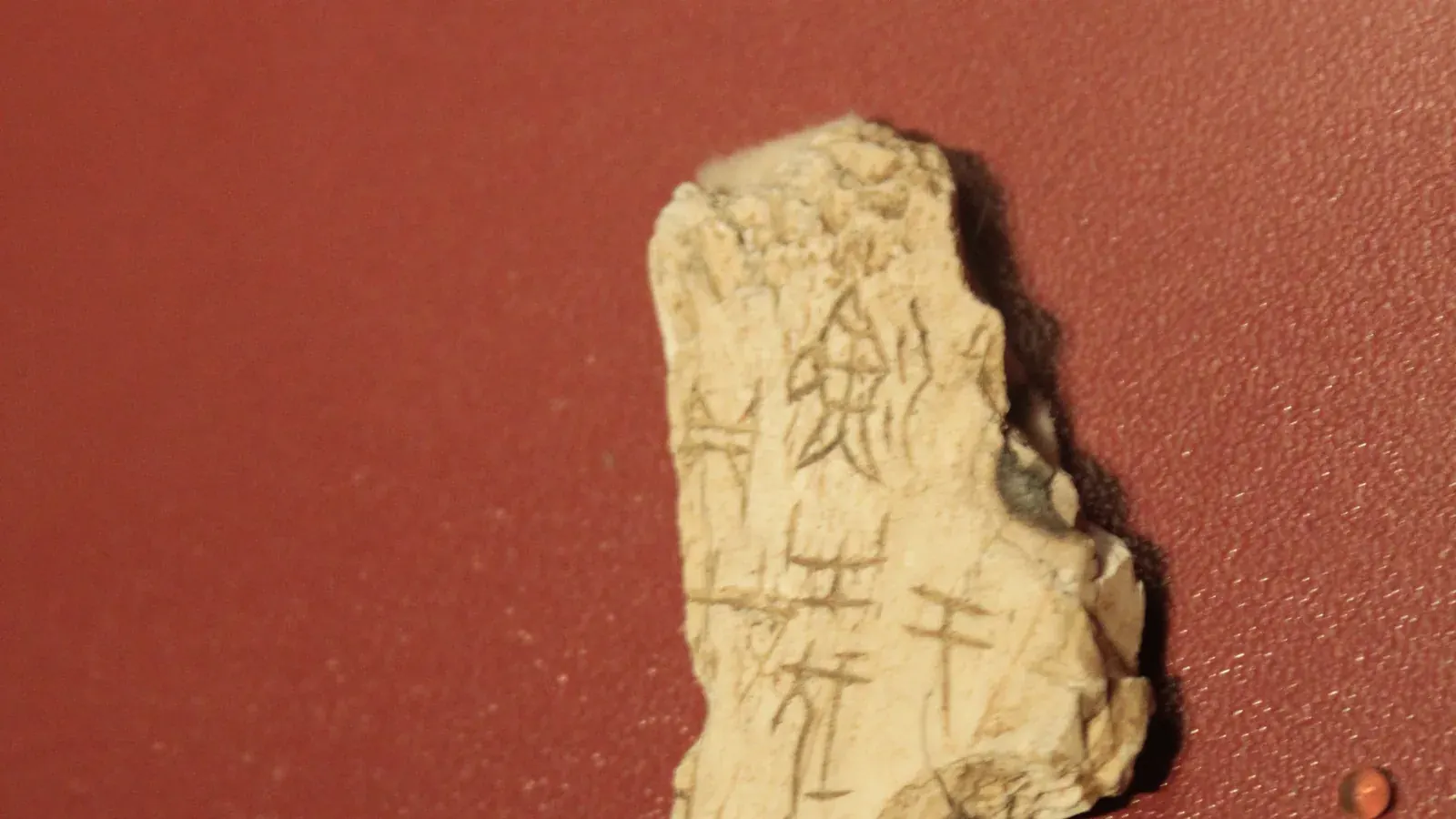

TL;DR — Anyang farmers dug up inscribed Shang divination bones and sold them to pharmacies as “dragon bones.” Scholars read the marks as writing in 1899.
Chinese pharmacies sold Shang divination bones as a drug called dragon bones because no one yet knew that the marks on them were the oldest Chinese writing. The bones came out of fields near Xiaotun village, outside Anyang in Henan province, where the last Shang kings had held court between about 1250 and 1050 BC. Farmers scraped the inscriptions off so the pieces would pass for the fossil bone the medicine trade wanted, then sold them to dealers who ground them into powder. In 1899 the chancellor of the Imperial Academy in Beijing, Wang Yirong, received a batch that had not been ground, and the marks on it resembled the writing he knew from ancient bronzes. Within 30 years the same site yielded royal tombs, palace foundations and tens of thousands of inscribed bones.
Quick facts
- When
- Inscriptions about 1250–1050 BC · noticed in 1899 · Liu E's catalogue 1903 · Wang Guowei's king list 1917 · Academia Sinica digs 1928–37 · UNESCO register December 26, 2017
- Where
- Xiaotun village and the Yinxu site at Anyang, Henan province, in what is now north central China
- Who
- Wang Yirong and Liu E (1899 and 1903); Li Chi and Dong Zuobin (Academia Sinica excavations); Wang Guowei (1917 king list); Wu Ding and Lady Hao (Fu Hao) in the inscriptions
- Outcome
- About 160,000 pieces found by one count; of about 4,300 to 4,500 characters, roughly 1,600 read; the Shang dynasty confirmed as documented history
What happened in 1899, and what is actually on record
The details of that first recognition are a story told since, not a documented scene. Andrea Bachner, writing for China Heritage in 2018, introduced it with the phrase “or so the legend goes”: in the summer of 1899 Wang Yirong, ill with malaria, bought a preparation of dragon bones and inspected the ingredient before it was ground. World History Encyclopedia gives a second version, in which Wang’s friend Liu E, a novelist and collector, was visiting that night and examined the bones with him. The Linda Hall Library’s account says only that Wang bought unground bones from a pharmacist who refused to name his source.
What the sources agree on is what followed. Wang died in 1900 during the Boxer Rebellion without learning where the bones were dug. Liu E gathered about 5,000 pieces, many of them Wang’s, and published rubbings of them in 1903 as Tieyun canggui, the first catalogue of oracle bone inscriptions.
How a Shang diviner worked
Cattle scapulae and tortoise plastrons, the flat underside of the shell, were scraped clean and polished, according to the Smithsonian National Museum of Asian Art’s teaching text on its own inscribed plastron, then chiseled on the back with rows of hollows and grooves. A diviner then applied a heated bronze rod to the hollow, and the heat split the front surface into hairline cracks. The shape and direction of the cracks carried the answer.
A scribe cut the record beside the cracks, usually in four parts: the date and the diviner’s name, the topic put to the spirits, the king’s reading of the cracks, and, at times, what actually happened.
What the kings asked
The charges were practical. One inscription in that teaching text runs: “We will hunt at Wu; going and coming back there will be no disasters.” The verification reads: “[We] caught one wild buffalo, one tiger, seven foxes.”
Questions often came in pairs, one positive and one negative, as in the texts collected in Sources of Chinese Tradition: “It is Di who is harming our harvest” set against “It is not Di who is harming our harvest.” Di was the highest Shang deity. Dead kings were also suspects, and one charge names the twentieth king, Xiao Yi, as the cause of his son’s toothache.
Most surviving records date from the reign of Wu Ding and his successors, which is why Columbia University’s Asia for Educators places the start of China’s written history around 1200 BC. One set concerns Wu Ding’s consort Lady Hao, known as Fu Hao. The diviner Que put the charge that “Lady Hao’s childbearing will be good.” The king read the cracks and predicted prolonged luck if she gave birth on a ding day. The verification, cut later: “(After) thirty-one days, on jiayin (day 51), she gave birth; it was not good; it was a girl.”
The excavations at Anyang, 1928 to 1937
The source of the bones was traced to Xiaotun in 1928. That year the Institute of History and Philology at Academia Sinica sent an archaeological team to the Yinxu site under Li Chi, and it carried out 15 excavations there before the war with Japan stopped the work in 1937. Liu Yiman put the yield at more than 24,900 inscribed pieces. Dong Zuobin, who worked on the team, sorted the inscriptions into five periods by 10 criteria, which gave the corpus a chronology.
Totals for the whole find depend on who is counting. Chinese state media, reporting the 2017 UNESCO listing, gave about 160,000 pieces in all, and the Academia Sinica digs account for about 24,900 of those. Bones also left China early: Cambridge University Library holds 614, dated in its records to 1339 to 1112 BC, among them a report of a lunar eclipse in 1192 BC.
The 1917 comparison that made the Shang historical
Before the digs, the Shang were known mainly from the “Annals of Yin” chapter of Sima Qian’s Records of the Grand Historian, written around 1,000 years after the dynasty fell. In 1917 the historian Wang Guowei compiled the royal ancestors named in the inscriptions and set their names, titles and order against Sima Qian’s list. According to Liu Yiman, the comparison showed that the Records was correct in the main, with a few minor discrepancies that Wang marked. Wang argued from this for a method of double proof, in which transmitted texts and excavated material have to support each other.
How much of the script can be read
The signs were the ancestors of modern Chinese characters, and UNESCO’s Memory of the World Register took in the corpus in 2017, announced at the Palace Museum in Beijing on December 26 that year. Counts of characters and of readings differ by source. Xinhua reported 4,300 characters with 1,600 decoded. China Daily put the total above 4,500 with more than 3,000 still unread, and the government of Henan province wrote that about one-third of roughly 4,500 had been interpreted by consensus.
Progress is slow enough to be priced. In 2016 the National Museum of Chinese Writing in Anyang offered 100,000 yuan for a single new reading; by the China Daily report of May 23, 2025, three scholars had received it. Zhou Zhongbing of Jilin University, who won a first prize in that program, spent two years on one character. In April 2025 the Henan cultural heritage administration, the Anyang government, Anyang Normal University and Tencent opened a competition for artificial intelligence work on the script, with entries due by September 20.
Key facts
- The inscriptions were cut at Yinxu, near Anyang in Henan province, and date from about 1250 to 1050 BC.
- Wang Yirong, chancellor of the Imperial Academy, recognized the marks as ancient writing in 1899; the circumstances are known from later retellings, which differ on whether Liu E was present.
- Liu E published the first catalogue of rubbings, Tieyun canggui, in 1903.
- Academia Sinica ran 15 excavations at Yinxu from 1928 to 1937 and recovered more than 24,900 inscribed pieces (Liu Yiman, Chinese Academy of Social Sciences).
- Totals for all finds are given as about 160,000 pieces by Chinese state media at the 2017 UNESCO listing; counts vary with the counting body.
- In 1917 Wang Guowei matched the king list in the inscriptions against Sima Qian’s “Annals of Yin” and found it correct in the main.
- Of about 4,300 to 4,500 distinct characters, roughly 1,600, or about one-third, have agreed readings (Xinhua, 2017; Henan provincial government, 2024).
FAQ
What were dragon bones?
Fossil and old bone sold by Chinese pharmacies as a ground remedy. Farmers near Anyang dug up inscribed Shang bones, scraped off the writing so the pieces would pass as the medicine, and sold them to dealers.
How did oracle bone divination work?
A diviner bored hollows into the back of an ox shoulder blade or a tortoise plastron, applied a heated rod, and read the cracks that opened on the front. A scribe then cut the date, the question, the king's reading and sometimes the outcome beside them.
How many oracle bone characters have been deciphered?
Xinhua reported 1,600 of 4,300 read at the time of the 2017 UNESCO listing; the Henan provincial government wrote in 2024 that about one-third of roughly 4,500 had agreed readings. China Daily reported in 2025 that more than 3,000 remain unread.
Sources
- World History Encyclopedia — Emily Mark, "Oracle Bones" (February 26, 2016).
- Linda Hall Library — William B. Ashworth, Jr., "Wang Yirong," Scientist of the Day (August 14, 2023).
- China Heritage — Andrea Bachner, "1899: Oracle Bones, That Dangerous Supplement…" (July 24, 2018).
- Chinese Social Sciences Today — Gan Yifan, interview with Liu Yiman, "China's 122-year study of oracle bone scripts" (May 27, 2021).
- Columbia University Asia for Educators — "Oracle-Bone Inscriptions of the Late Shang Dynasty," from Sources of Chinese Tradition, 2nd ed. (1999), PDF.
- Columbia University Asia for Educators — "Oracle-Bone Inscriptions of the Late Shang Dynasty: On Childbearing."
- Smithsonian National Museum of Asian Art — Kevin Hsieh and Alan Merlo, "Making Sense of the Future: The Oracle Bone and Shang Dynasty Divination" (lesson plan).
- University of Cambridge — "World first as 3,000-year-old Chinese oracle bones go 3D" (March 21, 2016).
- UNESCO Memory of the World — "Chinese Oracle-Bone Inscriptions" (registered 2017).
- Xinhua — "Chinese oracle bone inscriptions added to UNESCO world memory register" (December 26, 2017).
- China Daily — Fang Aiqing, "Race on to decipher oracle bone characters with AI" (May 23, 2025).
- The People's Government of Henan Province — "Amazing Oracle Bone Scripts ①: How hard is deciphering oracle bone inscriptions?" (January 26, 2024).
Cite this article
- APA
- Our Earth's History. (2026, September 19). Why were China's oldest records sold as medicine in 1899? Our Earth's History. https://ourearthshistory.com/east-asia/ancient/shang-oracle-bones-dragon-bones-1899/
- Chicago
- Our Earth's History. “Why were China's oldest records sold as medicine in 1899?” Our Earth's History, September 19, 2026. https://ourearthshistory.com/east-asia/ancient/shang-oracle-bones-dragon-bones-1899/.
- MLA
- “Why were China's oldest records sold as medicine in 1899?” Our Earth's History, 19 Sep. 2026, https://ourearthshistory.com/east-asia/ancient/shang-oracle-bones-dragon-bones-1899/.
Text licensed CC BY-NC-ND 4.0. Found an error? Tell us.