How did the Americas' oldest city rise on cotton, fish and no pottery?
.jpg)
TL;DR — Caral’s farmers grew cotton in the irrigated Supe valley, traded it to coastal fishers for dried fish, and raised pyramids on that surplus by 2627 BC — without one pot.
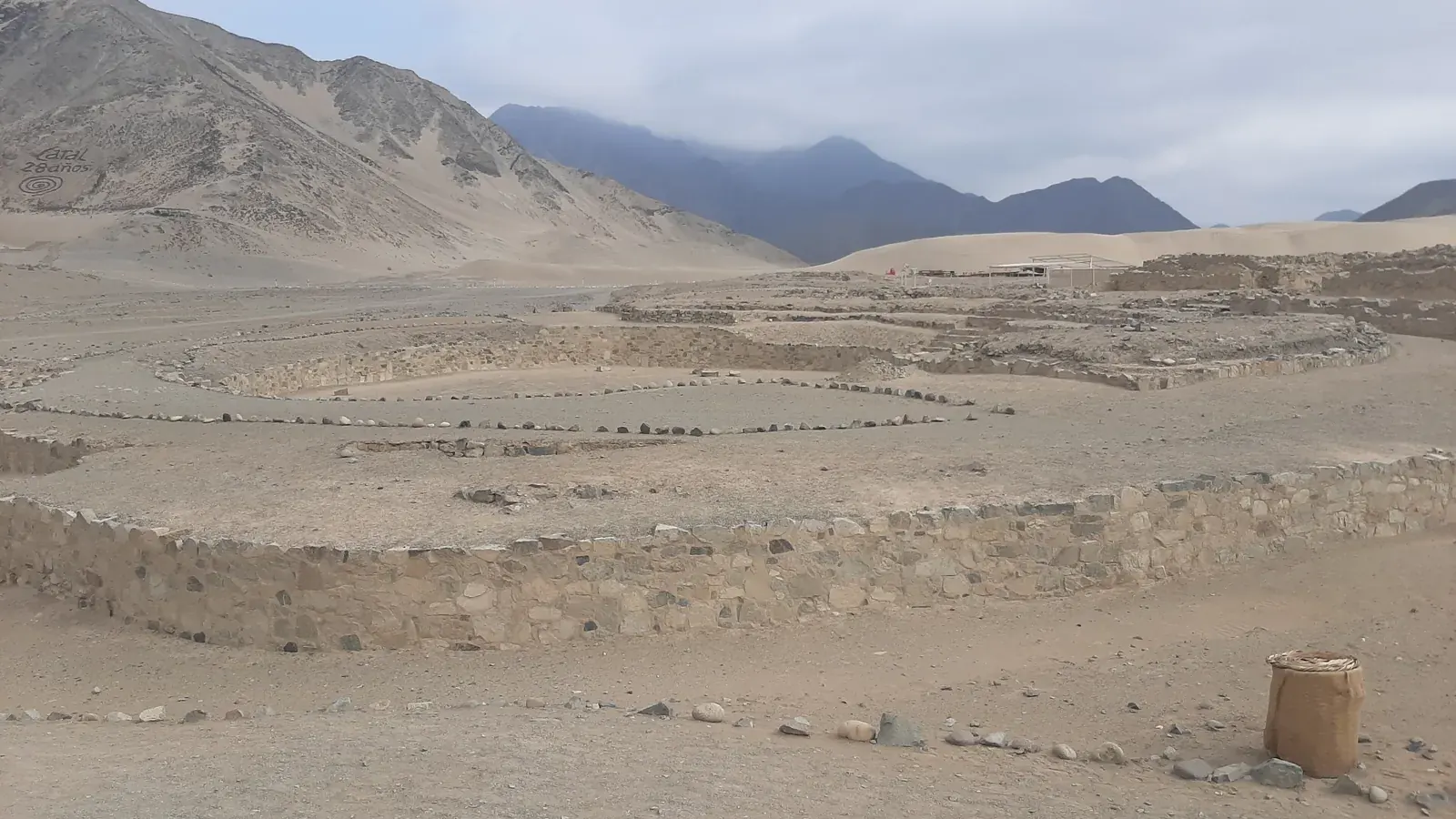
Caral grew because its farmers grew cotton for fishing nets and exchanged it for dried fish from the coast, a trade that fed a city without grain or pottery. The site sits on a desert terrace above the Supe river in Peru, 120 miles north of Lima and 14 miles inland from the Pacific. Radiocarbon dates on reed bags from its largest pyramid, published in Science on April 27, 2001, put construction under way by 2627 BC. Six platform mounds, sunken circular plazas and rows of houses covered about 68 hectares. The builders fired no clay, and the excavators found no maize.
Quick facts
- When
- About 3000–1800 BC · pyramids under way by 2627 BC (radiocarbon, published April 27, 2001) · World Heritage listing June 2009
- Where
- Supe valley on the central coast of Peru, 120 miles north of Lima and 14 miles inland from the Pacific
- Who
- Ruth Shady Solís (San Marcos University) excavating from 1996; Jonathan Haas and Winifred Creamer (radiocarbon dates, 2001); Michael Moseley and Daniel Sandweiss (decline hypothesis, 2009)
- Outcome
- Six platform mounds and sunken circular plazas built by a society with no pottery; cotton grown for nets and traded for fish; abandoned about 1800 BC, or 1600 BC by some accounts
Where Caral is and how its date was fixed
The Supe valley holds 18 large sites of the same period. Paul Kosok, an American historian, visited the mounds in 1948 and called them Chupa Cigarro Grande after a nearby hacienda, according to Ratha Tep’s 2021 account for History.com.
Ruth Shady Solís of San Marcos University in Lima reached the valley in 1994 and began digging at Caral in 1996. She found no potsherds, which meant the city could predate pottery in Peru. In the foundations of the largest mound her team found shicras, bags woven from reeds and filled with quarried stone. In 1999 she sent reed samples to Jonathan Haas of the Field Museum in Chicago and Winifred Creamer of Northern Illinois University; the answer came in December 2000, and the three published the dates in Science with 2627 BC the earliest.
What the city looked like
Six large platform mounds stood around a central plaza. The biggest, Pirámide Mayor, measured about 450 by 500 feet at the base according to the Field Museum’s 2001 release; its height is given as 60 feet by the Field Museum and Smithsonian magazine, 92 feet by Discover in 2005 and nearly 100 feet by a University of Florida release in 2009. Three sunken circular plazas lay among the mounds, the largest 150 feet across.
The size of the city depends on who measured what. The Zona Arqueológica Caral, the state body that runs the site, gives 68 hectares and 32 public buildings; the Field Museum said 200 acres and Smithsonian magazine 150. UNESCO’s World Heritage property, inscribed in June 2009, covers 626 hectares, far more than the built core.
Cotton, nets and fish, but no pots and no maize
Rain barely falls on this coast, so the fields drank from the Supe river through canals. The crops recovered were squash, beans, sweet potatoes and cotton. No maize turned up, and the Field Museum concluded that a starchy staple was not needed for a complex society to arise in South America. Shady’s team found the remains of sardines and anchovies 14 miles from the shore.
Cotton was the crop found everywhere, as seeds, fiber and cloth in nearly every excavated building. When a fishing net from an unrelated dig on the coast proved as old as Caral, Shady put the pieces together. The farmers grew the cotton, she said, and the fishermen who needed it for nets paid in shellfish and dried fish; dried gourds served as floats and containers, which is how a city managed without ceramics. The fishing partner is usually named as Áspero, a settlement at the river mouth that the Zona Arqueológica Caral dates to 3000 to 1800 BC. The exchange model is Shady’s interpretation; Haas and Creamer also wrote that coastal trade helped feed the inland cities.
Flutes, cornets and a knotted cord
Between the mounds lay a sunken amphitheater that could seat several hundred people. In it Shady’s team found 32 flutes made from pelican and condor bones, and in April 2002 they added 37 cornets of deer and llama bone. In July 2005 Reuters reported that her team had found a quipu, a record of knotted cotton strings, left as an offering on a stairway; until then the oldest known quipus dated from about AD 650.
The Zona Arqueológica Caral describes Caral as a culture that flourished without walls or weapons and reads that absence as a sign that trade and religion, not war, held the valley together. This is the project’s account of what it has not found, and absence in one city is not the same as peace across the region.
Who gets to name it
In December 2004 Haas, Creamer and Alvaro Ruiz published 95 radiocarbon dates from 13 sites in the neighboring Pativilca and Fortaleza valleys in Nature, some as early as 3200 BC, named the whole area the Norte Chico and cited Shady in the footnotes. Shady accused the couple of plagiarism and complained to the Society for American Archaeology and to their employers; the society declined to rule, both institutions cleared Haas and Creamer, and the Field Museum’s science advisory council rebuked Haas for press material that gave Shady too little credit, according to Discover in 2005. Shady calls the civilization Caral-Supe, the name UNESCO adopted.
Behind the names lies an older dispute about origins. Michael Moseley of the University of Florida argued from the 1970s that Peruvian civilization began with fishers on the coast, a maritime hypothesis Shady kept with amendments; Haas and Creamer wrote in Nature that the coast could not have preceded the inland cities.
Why the city emptied
UNESCO and the Zona Arqueológica Caral date the site’s life to 3000 to 1800 BC, while Smithsonian magazine put the collapse around 1600 BC, so the end came around 1800 BC, or as late as 1600 BC by some accounts. In January 2009 Daniel Sandweiss of the University of Maine, Moseley, Shady and two co-authors proposed a cause in the Proceedings of the National Academy of Sciences. An earthquake about 3,600 years ago, which Moseley estimated at magnitude 8 or more, brought down walls and floors on top of Pirámide Mayor and damaged temples at Áspero; El Niño rains then washed debris to the sea, where a current built the sand ridge called Medio Mundo, sealing the bays, and wind drove sand over canals and fields.
Thomas Pozorski did not accept it. There was no concrete evidence, he told History.com, that a single event ended the occupation; several factors, including internal strife, were more likely. In July 2025 Peru’s Ministry of Culture opened Peñico, a site in Barranca province founded between 1800 and 1500 BC, which Shady’s team reads as a successor built after the Caral centers were given up.
What remains at Caral is a city of cotton and fish bones under six mounds of reed-bagged stone. Its builders never fired a pot, and no grain has been found in their kitchens, yet they raised the earliest large architecture yet dated in the Americas.
Key facts
- Caral lies in the Supe valley of Peru, 120 miles north of Lima and 14 miles from the Pacific, one of 18 sites of the same period in the valley (Field Museum, 2001).
- Radiocarbon dates on reed shicra bags from Pirámide Mayor gave 2627 BC as the earliest date; Shady, Haas and Creamer published them in Science on April 27, 2001.
- Six platform mounds and three sunken circular plazas form the core; Pirámide Mayor’s height is given as 60 to 100 feet depending on the source.
- The built city covers 68 hectares according to the site authority; UNESCO’s World Heritage property of 2009 covers 626 hectares.
- No pottery and no maize were found; crops were squash, beans, sweet potatoes and cotton, and the fish remains were sardines and anchovies.
- Excavators found 32 bone flutes and, in April 2002, 37 bone cornets in the sunken amphitheater.
- The site was abandoned about 1800 BC (UNESCO), or about 1600 BC (Smithsonian, 2002); a 2009 PNAS paper blamed an earthquake and El Niño floods, a reading Thomas Pozorski rejected.
FAQ
Is Caral the oldest city in the Americas?
UNESCO calls it the oldest center of civilization in the Americas, and the 2001 Science paper reported 2627 BC as its earliest date for monumental building. Haas and Creamer later published dates as early as 3200 BC from sites in nearby valleys, so Caral is the oldest large city dated so far rather than the oldest settlement.
Why did Caral have no pottery?
Pottery had not yet reached Peru when Caral was built. Shady suggested that dried gourds served as containers and net floats, and the Field Museum described the site as preceramic, from before pot-firing technology arrived in the region.
Why was Caral abandoned?
No one knows for certain. A 2009 paper by Sandweiss, Moseley and colleagues argued that an earthquake followed by El Niño floods buried the bays and fields in sand about 3,600 years ago. Thomas Pozorski answered that no evidence ties the end to a single event and that internal strife may have played a part.
Sources
- UNESCO World Heritage Centre — "Sacred City of Caral-Supe" (inscribed 2009).
- ScienceDaily — Field Museum release, "Field Museum Anthropologists Establish Date And Importance Of The Americas' Oldest City" (May 1, 2001).
- Smithsonian Magazine — "First City in the New World?" (July 31, 2002).
- Discover — Kenneth Miller, "Showdown at the O.K. Caral" (September 9, 2005).
- EurekAlert — University of Florida release, "Scientists: Earthquakes, El Ninos fatal to earliest civilization in Americas," on Sandweiss et al., PNAS (January 19, 2009).
- Zona Arqueológica Caral (Peru Ministry of Culture) — "Sacred city of Caral" (site page, English).
- Zona Arqueológica Caral (Peru Ministry of Culture) — "Zona Arqueológica Áspero" (site page, in Spanish).
- Plataforma del Estado Peruano — Ministerio de Cultura, "Conmemoran 30 aniversario de la civilización Caral" (October 17, 2024, in Spanish).
- ABC Science (Reuters, Jude Webber) — "Pre-Incas kept detailed records too" (July 20, 2005).
- HISTORY — Ratha Tep, "This Little-Known Peruvian Civilization Built Pyramids as Old as Ancient Egypt's" (August 6, 2021, updated August 27, 2025).
- Smithsonian Magazine — Asia London Palomba, "Archaeologists Unveil a 3,500-Year-Old City in Peru That Sheds Light on the Caral Culture" (July 10, 2025).
Cite this article
- APA
- Our Earth's History. (2026, September 20). How did the Americas' oldest city rise on cotton, fish and no pottery? Our Earth's History. https://ourearthshistory.com/americas/ancient/caral-oldest-city-americas-cotton-fish/
- Chicago
- Our Earth's History. “How did the Americas' oldest city rise on cotton, fish and no pottery?” Our Earth's History, September 20, 2026. https://ourearthshistory.com/americas/ancient/caral-oldest-city-americas-cotton-fish/.
- MLA
- “How did the Americas' oldest city rise on cotton, fish and no pottery?” Our Earth's History, 20 Sep. 2026, https://ourearthshistory.com/americas/ancient/caral-oldest-city-americas-cotton-fish/.
Text licensed CC BY-NC-ND 4.0. Found an error? Tell us.