Twenty shell trumpets in a gallery: Chavín de Huántar, 2001 to 2025

TL;DR — Twenty shell trumpets came out of Chavín’s Caracolas Gallery in 2001; in 2025 a PNAS paper reported vilca and tobacco alkaloids on six artifacts from sealed Gallery 3.
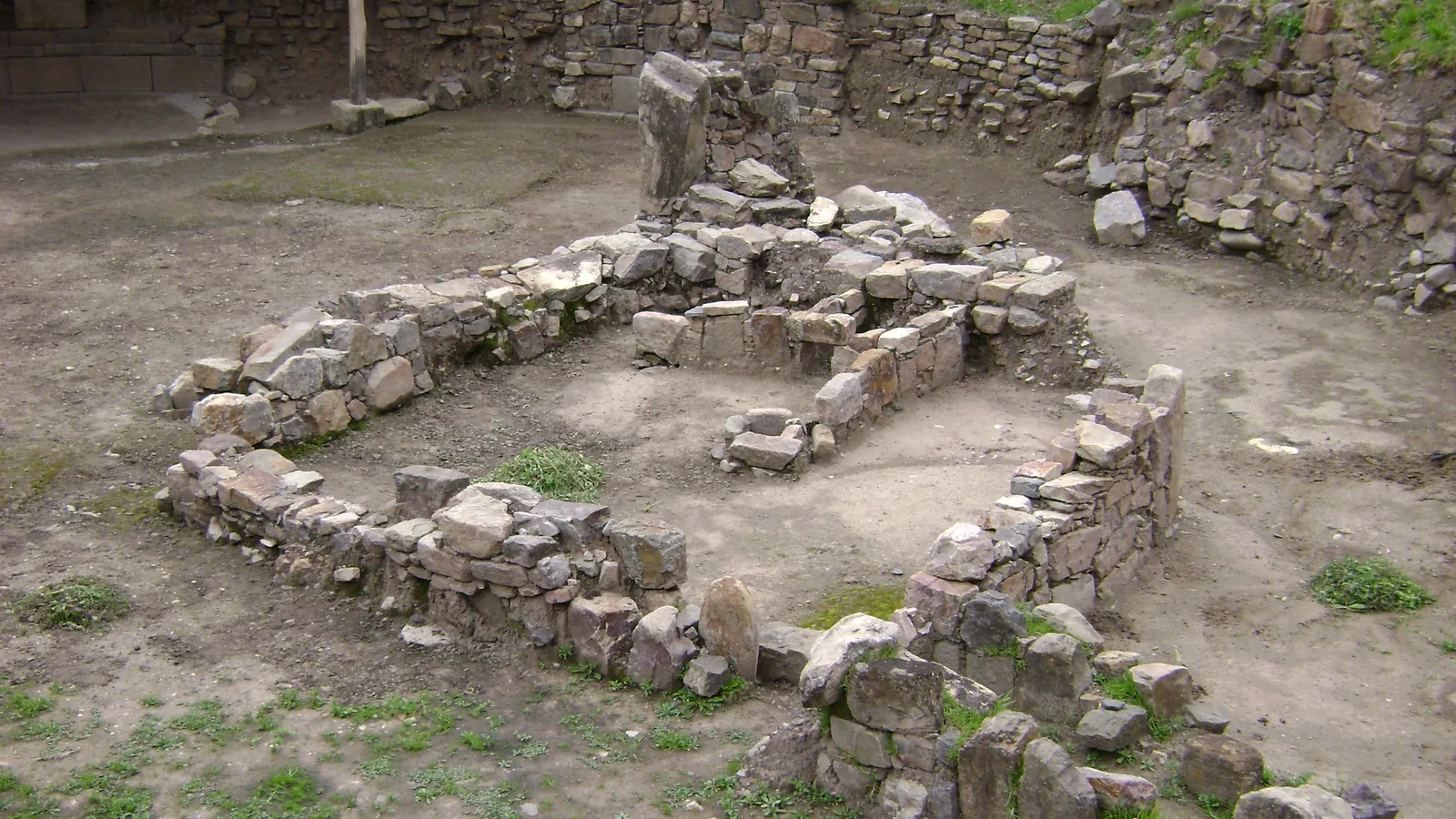
Between approximately 1000 and 500 BC, in the words of Jason Nesbitt of Tulane University, writing in the Proceedings of the National Academy of Sciences (PNAS) in 2025, Chavín de Huántar was “a major ceremonial and population center located in the north-central highlands of Peru at an altitude of 3,150 m asl.” The temple’s underground galleries have produced two finds a generation apart. Stanford University’s Center for Computer Research in Music and Acoustics (CCRMA) records the first: “In 2001, twenty Strombus galeatus marine shell trumpets were excavated at the 3,000 year-old ceremonial center at Chavín de Huántar, Perú,” from the Caracolas Gallery, by John Rick and his team. The second came from Gallery 3, a chamber under the South Atrium of the Circular Plaza that was opened in 2017 and 2018. A PNAS paper by Rick and seven co-authors, published on May 5, 2025, reported the alkaloids of vilca and tobacco on six of the 23 artifacts tested.
Quick facts
- When
- Temple in use about 1200 to 400 BC (Rick et al. 2025) · 2001 (20 shell trumpets excavated from the Caracolas Gallery) · 2007 (Stanford CCRMA acoustics project begins) · July 2008 (first measurements presented at Acoustics '08, Paris) · 2017–2018 (Gallery 3 excavated) · May 5, 2025 (PNAS paper on vilca and tobacco residues)
- Where
- Chavín de Huántar, north-central highlands of Peru, at 3,150 m above sea level; the Caracolas, Ofrendas and Lanzón galleries; Gallery 3 under the South Atrium of the Circular Plaza
- Who
- John W. Rick (Stanford, director of the Programa de Investigación Arqueológica y Conservación Chavín de Huántar); Miriam A. Kolar and the CCRMA acoustics team; Verónica S. Lema, Javier Echeverría and five other co-authors; Jason Nesbitt (commentary); Peter Whitridge (letter)
- Outcome
- Twenty, later 21, Titanostrombus galeatus trumpets were tied by acoustic measurement to the Lanzón Gallery and Circular Plaza; six of 23 artifacts from Gallery 3 carried DMT, bufotenine and nicotine, which the 2025 paper calls the oldest evidence for inhalation of mixed vilca and Nicotiana in the Americas
Three galleries under the temple
Rick’s 2025 paper puts the temple’s ritual activity in the Middle-Late Formative Period, about 1200 to 400 BC. Beneath its platforms runs what a 2008 abstract by Abel, Rick, Huang, Kolar, Smith and Chowning called “an extensive network of underground galleries used in part for ritual purposes. The labyrinthine galleries are stone-walled and arranged in a series of small rectangular alcoves off narrow corridors.”
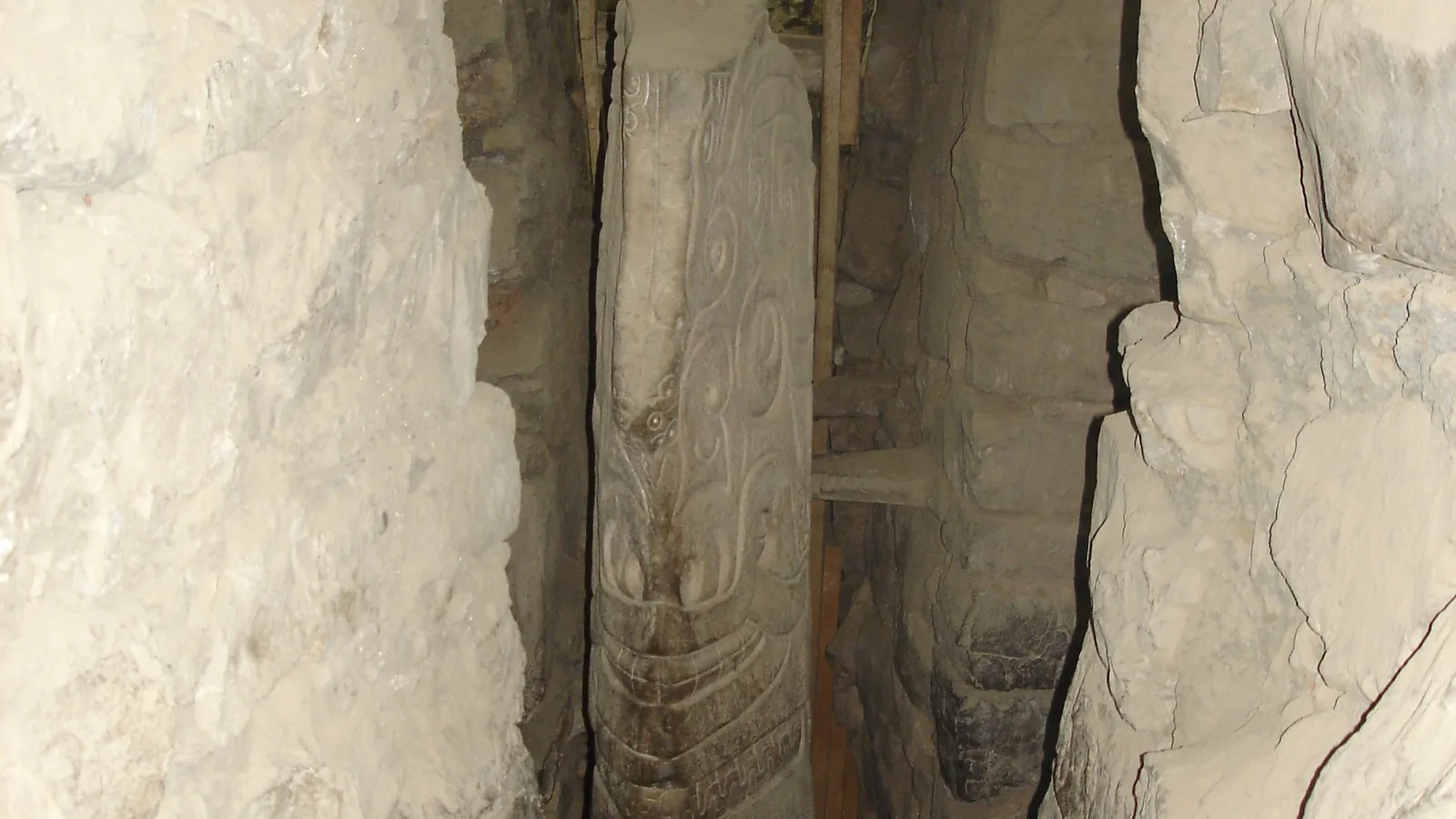
Rick and his co-authors list “the Gallery of the Lanzón, which houses a >4 m high carved granite monolith”; Nesbitt calls the figure “a monstrous deity.” They list “the Ofrendas Gallery, from which nearly 700 ceramic vessels were excavated,” citing a 1993 report by Lumbreras, and “the Caracolas Gallery, from which 20 complete Strombus shell trumpets were excavated.” Rick directs the Programa de Investigación Arqueológica y Conservación Chavín de Huántar with the permission of Peru’s Ministerio de Cultura; Stanford’s Department of Anthropology describes it as “aimed at exploring the foundations of authority in the central Andes.”
July 2008, Paris: a short reverberation time
The trumpets are called pututus. The CCRMA project page reads: “Initiated in 2007 as an archaeoacoustical collaboration between Stanford University’s Center for Computer Research in Music and Acoustics (CCRMA) and Archaeology/Anthropology,” with fieldwork under Rick’s program. CCRMA’s pututus page states that the instruments were “excavated from the ceremonial center at Chavín by Dr. John Rick and teams in 2001 and 2018,” and a 2019 conference abstract counts “21 Titanostrombus galeatus pututus.” The same page gives the species as “Titanostrombus galeatus (formerly classified as Strombus Lobatus galeatus and Strombus galeatus).”
In July 2008 the team presented its first measurements at the Acoustics ‘08 meeting in Paris. The abstract reads: “Preliminary measurements at Chavín show a short reverberation time, dense and energetic early reflections, and low inter-aural cross correlation. The short reverberation time would enable rhythmically articulated playing of Strombus shell trumpets found on site.” A short reverberation time means a note dies soon after the player stops; dense early reflections mean the stone walls return the sound fast and from many directions.
Kolar's sounding oracle
Miriam A. Kolar, who published her dissertation “Archaeological Psychoacoustics at Chavín de Huántar, Perú” in 2013 and directs the CCRMA project, took the measurements further. In a 2012 chapter, “Ancient Pututus Contextualized,” Kolar, Rick, Cook and Abel wrote: “We present findings that demonstrate an architectural acoustic mechanism specifically linking the Chavín pututus to the area of the Lanzón Gallery and Circular Plaza, focal in this reputed oracle center. We propose a sounding oracle, and how it could be given voice.”
The abstract of Kolar’s 2017 paper in Time and Mind proposes “the plausible evocation of a roaring cayman through hydraulic-sonic enactment of Chavín’s so-called ‘acoustic canal,’” and a 2020 conference abstract names the channel as the Rocas Canal, which passes under the Circular Plaza and connects to the Lanzón Gallery. Both are Kolar’s interpretations, published as abstracts. Jose Valenzuela, Margarita Díaz-Andreu and Carles Escera, writing in Frontiers in Psychology in 2020, summarized Kolar’s field test in which “45 volunteer participants were asked to locate sound sources within the Chavín interior galleries,” and reported “broad consensus regarding the perceptual effects of gallery acoustics on sound transmission.”

"Sealed from shortly after the Chavín period": Gallery 3
Gallery 3 was a different kind of find. Rick and his co-authors describe it as an “~7 m long × 1.2 m wide × 1.9 m high rectangular subterranean structure that was built into the South Atrium of Chavín’s Circular Plaza” in the early first millennium BC. It stayed “sealed from shortly after the Chavín period,” about 500 BC, until the program excavated it in 2017 and 2018. Radiocarbon dates on the layers tied to its use fall between approximately 800 and 350 BC.
Twenty-three artifacts from the gallery went through organic residue analysis. Six carried N,N-dimethyltryptamine (DMT), bufotenine and nicotine, the paper’s diagnostic markers for the plant genera Anadenanthera and Nicotiana. Microbotanical analysis of 11 artifacts found, on four of the chemically positive ones, root starch of “wild Nicotiana species” and seed and leaf starch of “vilca (A. colubrina var cebil).” The paper’s acknowledgments record the permission of the Ministerio de Cultura del Perú and the “financial support of the Compañía Minera Antamina and Archaeology in Action.”
Vilca, tobacco and a letter to PNAS
The paper’s conclusion is exact in its wording: the Gallery 3 results “provide the oldest evidence for inhalation of a mixed consumption of vilca and Nicotiana in the Americas” and are “the northernmost direct evidence of vilca and Nicotiana use in the pre-Hispanic Andes.” Rick and his co-authors also write that “the only psychoactive plant unequivocally depicted in the iconography is the San Pedro cactus, which appears on a granite plaque found in situ in the Circular Plaza.” The Tello Obelisk and the tenon heads on the temple’s exterior “may depict psychoactive plants or their effects” and “have been argued” to show a sequence of shamanic transformation. Nesbitt’s commentary calls the residues “the first direct identification of entheogens” at the site. He describes vilca’s effect as “potent, but short-lived (~20 min)” and infers “multiple doses over the course of a single ceremony.”
A letter to PNAS from Peter Whitridge of Memorial University of Newfoundland, printed in volume 122, number 38, proposed that the monoamine oxidase inhibitors in tobacco “pharmacologically enhanced and prolonged their effects,” an “ayahuasca effect.” Whitridge quoted the paper’s own caution, that “it cannot be unequivocally demonstrated that vilca and tobacco were consumed in the same episodes,” and wrote that his idea “further problematizes reports of prehistoric ayahuasca (sensu stricto) based solely on detection of harmine or harmaline.” The eight authors submitted the manuscript on December 1, 2024. PNAS accepted it on March 25, 2025, and published it in volume 122, number 19, on May 5, 2025.
Key facts
- Jason Nesbitt (PNAS, 2025) places Chavín de Huántar between approximately 1000 and 500 BC in the north-central highlands of Peru at 3,150 m above sea level; Rick et al. (2025) put ritual activity in the Middle-Late Formative Period, about 1200 to 400 BC.
- In 2001 John Rick’s team excavated 20 Strombus galeatus shell trumpets from the Caracolas Gallery; a further excavation in 2018 brought the count to 21 (CCRMA pututus page; 2019 abstract).
- The species has been reclassified as Titanostrombus galeatus, formerly Strombus galeatus (CCRMA).
- The Gallery of the Lanzón holds a carved granite monolith more than 4 m high; nearly 700 ceramic vessels came from the Ofrendas Gallery (Rick et al. 2025, citing Lumbreras 1993).
- The Stanford CCRMA acoustics project began in 2007; its first measurements, presented at Acoustics ‘08 in Paris in July 2008, found “a short reverberation time, dense and energetic early reflections, and low inter-aural cross correlation.”
- Kolar, Rick, Cook and Abel (2012) proposed “a sounding oracle” linking the pututus to the Lanzón Gallery and Circular Plaza; Kolar published her dissertation in 2013.
- Gallery 3, about 7 m by 1.2 m by 1.9 m under the South Atrium of the Circular Plaza, stayed sealed from about 500 BC until excavation in 2017–2018; radiocarbon dates on its use fall between approximately 800 and 350 BC (Rick et al. 2025).
- Of 23 artifacts analyzed, six carried DMT, bufotenine and nicotine; the paper (PNAS 122(19), May 5, 2025) calls this “the oldest evidence for inhalation of a mixed consumption of vilca and Nicotiana in the Americas.”
FAQ
What are the Chavín pututus?
Shell trumpets made from the marine gastropod Titanostrombus galeatus (formerly Strombus galeatus). Twenty complete instruments were excavated from the Caracolas Gallery at Chavín de Huántar in 2001 by John Rick's team, and a 2018 excavation raised the count to 21.
What did the Stanford acoustics project find in the galleries?
Measurements presented in July 2008 showed a short reverberation time, dense early reflections and low inter-aural cross correlation, conditions that the team said would allow rhythmic playing of the shell trumpets. Later work by Miriam A. Kolar proposed an acoustic link between the pututus, the Lanzón Gallery and the Circular Plaza.
What was found in Gallery 3 at Chavín de Huántar?
A sealed chamber excavated in 2017 and 2018 yielded 23 artifacts that were tested for organic residues. Six carried DMT, bufotenine and nicotine, markers of vilca (Anadenanthera colubrina) and tobacco (Nicotiana), according to the PNAS paper of May 5, 2025.
Sources
- John W. Rick, Verónica S. Lema, Javier Echeverría, Giuseppe Alva Valverde, Daniel A. Contreras, Oscar Arias Espinoza, Silvana A. Rosenfeld and Matthew P. Sayre, "Pre-Hispanic ritual use of psychoactive plants at Chavín de Huántar, Peru," Proceedings of the National Academy of Sciences 122(19), e2425125122, published May 5, 2025 (open access via PubMed Central).
- Jason Nesbitt, "Psychoactive plants and secret rituals in ancient Peru," commentary, Proceedings of the National Academy of Sciences 122(24), e2509867122, 2025 (PubMed Central).
- Peter Whitridge, "Did the vilca/tobacco snuff combination at Chavín aim for an 'ayahuasca effect'?," letter, Proceedings of the National Academy of Sciences 122(38), e2521671122, 2025 (PubMed Central).
- Jose Valenzuela, Margarita Díaz-Andreu and Carles Escera, "Psychology Meets Archaeology: Psychoarchaeoacoustics for Understanding Ancient Minds and Their Relationship to the Sacred," Frontiers in Psychology 11, 550794, 2020 (PubMed Central).
- Stanford University, Center for Computer Research in Music and Acoustics (CCRMA), "Chavín de Huántar Archaeological Acoustics Project," project home page.
- Stanford CCRMA, Chavín de Huántar Archaeological Acoustics Project, "Publications" page (abstracts of Abel, Rick, Huang, Kolar, Smith and Chowning, Acoustics '08, 2008; Kolar, Rick, Cook and Abel, "Ancient Pututus Contextualized," 2012; Kolar, Time and Mind, 2017; conference abstracts of 2019 and 2020).
- Stanford CCRMA, Chavín de Huántar Archaeological Acoustics Project, "Pututus" page (the 2001 and 2018 excavations, the count of 21 instruments and the species name Titanostrombus galeatus).
- Stanford CCRMA, Chavín de Huántar Archaeological Acoustics Project, "Current Work" page (Miriam A. Kolar's 2013 dissertation).
- Stanford University, Department of Anthropology, faculty page for John W. Rick.
- Ministerio de Cultura del Perú, institutional home page on gob.pe (the ministry named in the excavation permits).
Cite this article
- APA
- Our Earth's History. (2026, September 22). Twenty shell trumpets in a gallery: Chavín de Huántar, 2001 to 2025. Our Earth's History. https://ourearthshistory.com/americas/ancient/chavin-de-huantar-twenty-pututus-2001-gallery-3-vilca-pnas-2025/
- Chicago
- Our Earth's History. “Twenty shell trumpets in a gallery: Chavín de Huántar, 2001 to 2025.” Our Earth's History, September 22, 2026. https://ourearthshistory.com/americas/ancient/chavin-de-huantar-twenty-pututus-2001-gallery-3-vilca-pnas-2025/.
- MLA
- “Twenty shell trumpets in a gallery: Chavín de Huántar, 2001 to 2025.” Our Earth's History, 22 Sep. 2026, https://ourearthshistory.com/americas/ancient/chavin-de-huantar-twenty-pututus-2001-gallery-3-vilca-pnas-2025/.
Text licensed CC BY-NC-ND 4.0. Found an error? Tell us.