The Ferry Berth site: Samoa's one Lapita deposit, under a lagoon floor
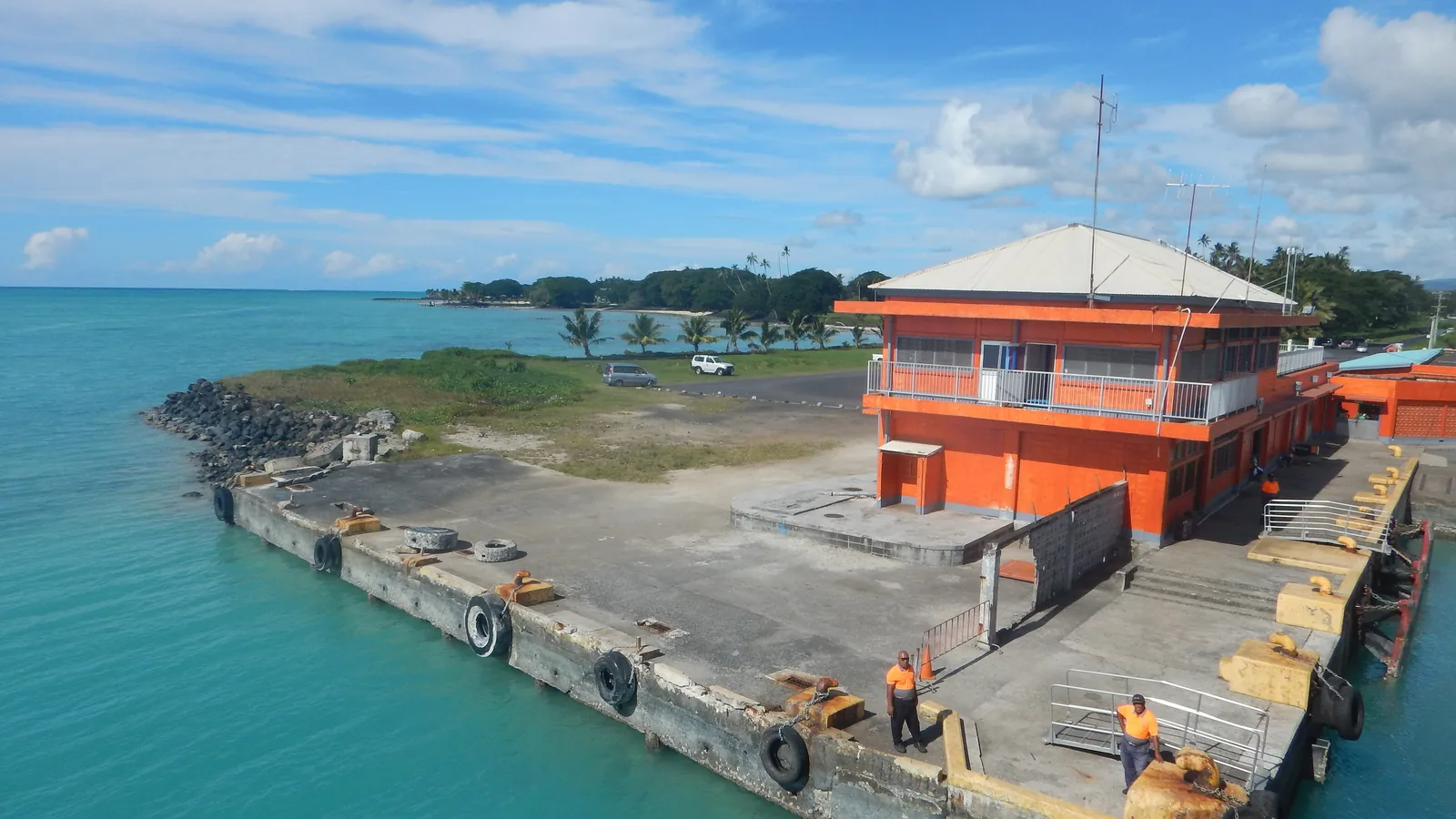

TL;DR — The Ferry Berth site at Mulifanua, on ‘Upolu, holds Samoa’s only known Lapita pottery, dated by Fiona Petchey to 930–800 BC and now under a lagoon floor.
In 2001 Fiona Petchey put the occupation of the Mulifanua ferry berth site, on the western coast of ‘Upolu in Samoa, at about 930 to 800 BC. Her paper in the journal Radiocarbon described it as “the only site in Samoa with dentate-stamped Lapita wares” and “the most easterly Lapita site in the Pacific.” The pottery came up while a basin was dredged for the car ferry to Savai’i, and the deposit still lies under water. William R. Dickinson explained the drowning by the sinking of ‘Upolu under the weight of Savai’i, and a University of Auckland team led by Ethan E. Cochrane has since tested other reasons for Samoa’s lack of early sites.
Quick facts
- When
- About 930 to 800 BC (Petchey 2001; a 2019 recalculation gives 3020 to 2760 cal BP) · 1974 (first reports printed) · 1994 (bone date processed) · 2001 (radiocarbon paper) · 2016 and 2019 (Auckland coring studies)
- Where
- The lagoon off Mulifanua, on the western coast of 'Upolu, Samoa, at the berth of the car ferry to Savai'i; the deposit lies about 115 meters offshore under beachrock
- Who
- J. D. Jennings and Roger C. Green (1974 reports); Helen M. Leach and Roger C. Green (1989); Fiona Petchey; William R. Dickinson; Ethan E. Cochrane and colleagues; Patrick V. Kirch
- Outcome
- Still the only site in Samoa with dentate-stamped Lapita pottery. Its sunken position is explained by the subsidence of 'Upolu under the load of Savai'i; whether that subsidence also hid other sites, or whether few existed, remains argued
Dentate-stamped sherds from a ferry turning basin
Mulifanua is about 20 kilometers from Savai’i. Cochrane and seven co-authors wrote in The Holocene in 2016 that “The Lapita deposit was found while dredging a turning basin for the car-ferry that sails between ‘Upolu and Savai’i.” Their 2019 paper placed the find about 115 meters offshore, beneath a layer of beachrock, uncovered “during mechanical excavation for a car-ferry berth.”
The 2016 paper lists Lapita pottery, turtle bone and a possible basalt artifact in a humus-rich soil; the 2019 paper speaks of pottery, stone artifacts and animal remains. The sherds carry dentate stamping, decoration pressed into wet clay with a toothed tool.
No year for the dredging appears in the papers cited below. The first reports were printed in 1974, in the second volume of Archaeology in Western Samoa, published by the Auckland Institute and Museum: J. D. Jennings wrote “The Ferry Berth site, Mulifanua District, Upolu,” and Roger C. Green wrote “Pottery from the lagoon at Mulifanua, Upolu.” Helen M. Leach and Green followed with “New Information for the Ferry Berth Site, Mulifanua, Western Sāmoa” in the Journal of the Polynesian Society in 1989. In 1995 Petchey analyzed the pottery for a master’s thesis at the University of Auckland, alongside sherds from Sigatoka in Fiji.
Petchey's dates, 2001 and 2019
A bone sample coded NZA-4780, processed in 1994 at the Rafter Radiocarbon Laboratory in New Zealand, gave 3062 ± 66 radiocarbon years before present. Petchey’s 2001 paper added two new determinations on material found with the pottery and pooled the results into a calibrated range of 2880 to 2750 years before 1950, or 930 to 800 BC. She wrote that the range agreed with the pottery chronology.
On September 5, 2019, Petchey and Patrick V. Kirch revised the regional chronology in PLoS ONE. For Mulifanua they set aside the pooled result and used NZA-4780 alone, with a different marine correction value, and the range moved slightly older, to 3020 to 2760 calibrated years before present. They warned that the date was more than 20 years old and “would not pass bone assessment protocols now considered essential for an accurate 14C result.”
The other early sites in Samoa are younger. Petchey and Kirch cited a 2008 analysis by Timothy Rieth and T. L. Hunt that left about 300 years between Mulifanua and the next occupations, at To’aga on Ofu, Utumea on Tutuila and Jane’s Camp on ‘Upolu.
A lagoon floor 1.5 meters down
As summarized by Cochrane’s team in 2016 from Dickinson and Green’s 1998 study in Geoarchaeology, the deposit lay under about 0.75 meters of cemented beach rock that forms the lagoon floor, itself about 1.5 meters below modern sea level. Dickinson and Green, the 2019 paper reports, read it as a midden on dry land that sank into the tidal zone. Dickinson argued in 2007 that the volcanic mass of Savai’i was pressing down the crust beneath ‘Upolu.
The 2016 paper set out his numbers. Beachrock at Mulifanua lay 2.25 meters below mean sea level and dated to 2,750 years ago, when sea level was modeled at 1.2 meters above the present. That gave Mulifanua a modeled subsidence rate of 1.25 ± 0.15 millimeters a year, against 0.52 ± 0.12 at Maninoa, 30 kilometers farther from Savai’i. Green in 2002 used a general rate of 1.4 millimeters a year to predict the locations of 13 Lapita sites around ‘Upolu.
Rieth and colleagues argued in 2008 for a real absence instead: “sandy coastal flats had not formed in many areas prior to ∼2500 cal BP,” they wrote, limiting the land fit for settlement. Cochrane’s 2019 paper called the missing record “a puzzle that has preoccupied archaeologists for almost 50 years” and listed a third explanation, that the colonists were few and isolated. A 2020 genetic study led by Daniel N. Harris estimated Samoa’s effective population, a measure of breeding numbers, at 700 to 3,440 between about 3,000 and 1,000 years ago.
No land excavation had ever been made at Mulifanua when Cochrane, Aumua Ausilafai Matiu Matavai Tautunu and Robert J. DiNapoli drilled 21 auger cores in the village. Below the surface layer the cores showed no clear sign of people, and the one core that neared the depth of the offshore deposit met neither beachrock nor artifacts. Weighing a shortage of coastal flats against the destruction of sites on land, the team concluded that “both hypotheses may be valid explanations in different coastal settings.” Their core logs, including a file named “Mulifanua Core Descriptions 2017,” went into the University of Auckland’s data repository in February 2019.
Key facts
- The Mulifanua ferry berth site on ‘Upolu is the only site in Samoa with dentate-stamped Lapita pottery (Petchey, Radiocarbon, 2001).
- It was found while dredging a turning basin for the ‘Upolu–Savai’i car ferry, about 115 meters offshore, under beachrock that forms the lagoon floor about 1.5 meters below sea level (Cochrane et al. 2016, 2019).
- Petchey’s pooled dates give 2880 to 2750 years before 1950, or 930 to 800 BC; Petchey and Kirch in 2019 recalculated the single bone date NZA-4780, processed in 1994, to 3020 to 2760 cal BP and warned it would fail current bone protocols.
- Dickinson attributed the drowning to subsidence of ‘Upolu under the load of Savai’i, modeled at 1.25 ± 0.15 millimeters a year at Mulifanua (as summarized by Cochrane et al. 2016).
- In 2019, 21 auger cores in Mulifanua village found no clear evidence of people below the surface layer; the team judged that a lack of coastal flats and the destruction of sites on land may each explain the scarcity of early sites in different places.
FAQ
How many Lapita sites are there in Samoa?
One. Mulifanua on 'Upolu is the only site in Samoa with dentate-stamped Lapita pottery, according to Petchey (2001) and Cochrane and colleagues (2016, 2019). In Rieth and Hunt's 2008 analysis, the next-oldest Samoan sites were about 300 years younger.
How old is the Mulifanua Lapita site?
Petchey's 2001 paper gives about 930 to 800 BC from pooled radiocarbon dates. A 2019 recalculation by Petchey and Kirch, based on one bone sample, gives 3020 to 2760 years before present, though the authors doubted that sample's reliability.
Why is the Mulifanua site under water?
Dickinson and Green (1998) read the deposit as a midden on dry land that subsided into the tidal zone. Dickinson (2007) attributed the subsidence to the weight of the volcanic island of Savai'i, modeled at about 1.25 millimeters a year at Mulifanua.
Sources
- Fiona J. Petchey, "Radiocarbon Determinations from the Mulifanua Lapita Site, Upolu, Western Samoa," Radiocarbon 43(1): 63–68 (2001), Cambridge University Press (abstract).
- Ethan E. Cochrane, Haunani Kane, Charles Fletcher III, Mark Horrocks, Joseph Mills, Matthew Barbee, Alex E. Morrison and Matiu Matavai Tautunu, "Lack of suitable coastal plains likely influenced Lapita (~2800 cal BP) settlement of Sāmoa: Evidence from south-eastern 'Upolu," The Holocene 26(1): 126–135 (2016), accepted manuscript, University of Auckland ResearchSpace.
- Ethan E. Cochrane, Aumua Ausilafai Matiu Matavai Tautunu and Robert J. DiNapoli, "Hypotheses to explain the few early coastal archaeological deposits in Sāmoa: Preliminary evaluations," Journal of Archaeological Science: Reports 26, article 101931 (2019), accepted manuscript, University of Auckland ResearchSpace.
- Fiona Petchey and Patrick V. Kirch, "The importance of shell: Redating of the To'aga site (Ofu Island, Manu'a) and a revised chronology for the Lapita to Polynesian Plainware transition in Tonga and Sāmoa," PLoS ONE 14(9): e0211990, September 5, 2019 (PubMed Central).
- Daniel N. Harris and colleagues, "Evolutionary history of modern Samoans," Proceedings of the National Academy of Sciences (2020) (PubMed Central).
- Ethan Cochrane, Robert J. DiNapoli and Matavai Tautunu, "Samoa Archaeological Core Data & Analyses," data set, University of Auckland figshare, version 4 (2019).
Cite this article
- APA
- LETTER. (2026, September 28). The Ferry Berth site: Samoa's one Lapita deposit, under a lagoon floor. Our Earth's History. https://ourearthshistory.com/oceania/ancient/mulifanua-ferry-berth-lapita-site-samoa/
- Chicago
- LETTER. “The Ferry Berth site: Samoa's one Lapita deposit, under a lagoon floor.” Our Earth's History, September 28, 2026. https://ourearthshistory.com/oceania/ancient/mulifanua-ferry-berth-lapita-site-samoa/.
- MLA
- LETTER. “The Ferry Berth site: Samoa's one Lapita deposit, under a lagoon floor.” Our Earth's History, 28 Sep. 2026, https://ourearthshistory.com/oceania/ancient/mulifanua-ferry-berth-lapita-site-samoa/.
Text licensed CC BY-NC-ND 4.0. Found an error? Tell us.