How do we know Stonehenge's Altar Stone came from Scotland?
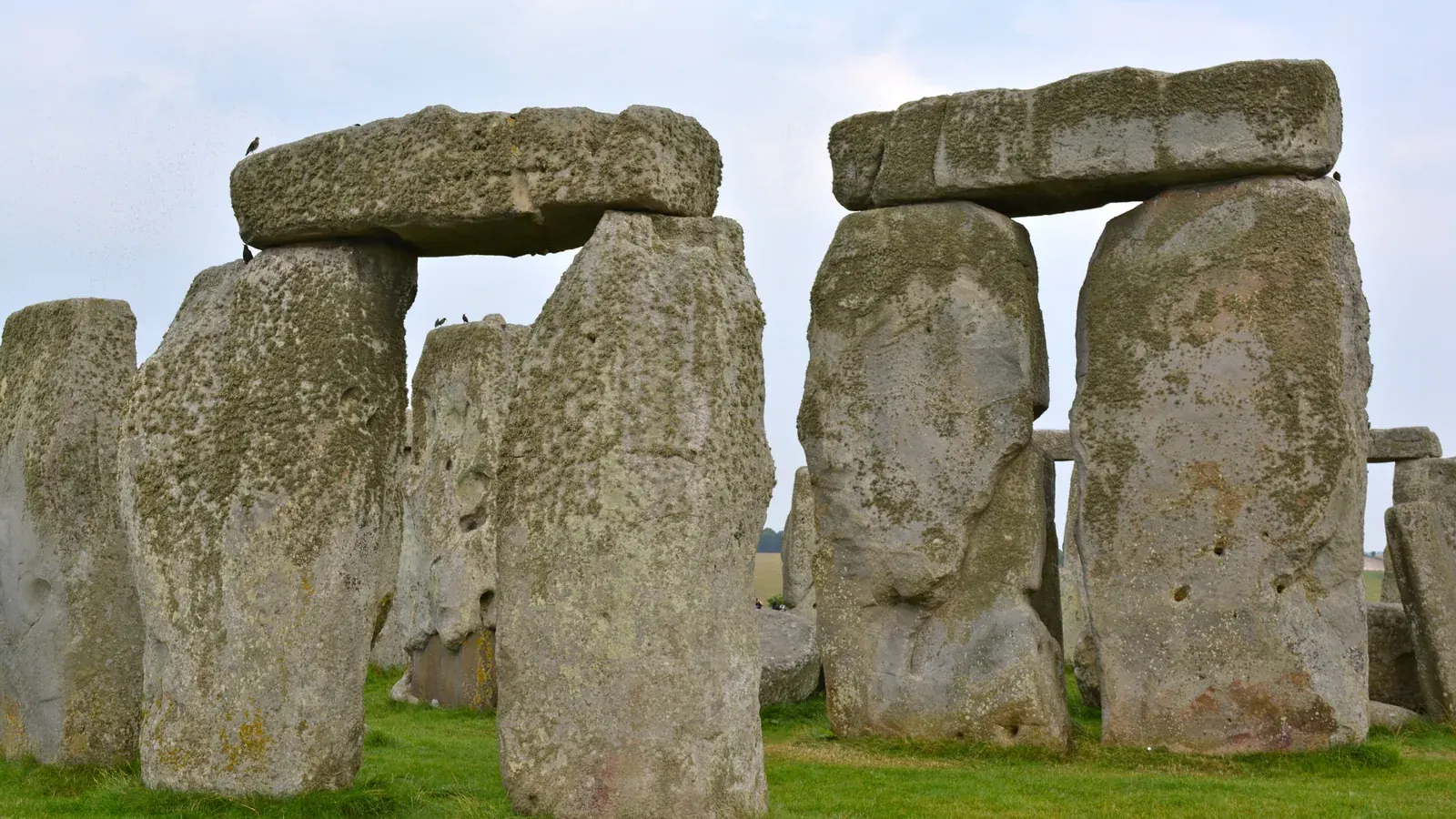

TL;DR — Mineral grains in the Altar Stone match rock in northeast Scotland, at least 750 km away; the big sarsens came from 25 km north, the bluestones from west Wales.
Stonehenge’s Altar Stone came from the Orcadian Basin of northeast Scotland, at least 750 km away, according to a 2024 study led by Curtin University in Australia. The team dated mineral grains in two fragments of the slab, and their ages and chemistry matched Scottish sandstone, not the Welsh rock long believed to be its source. It was the last of the monument’s three stone types to be traced: a 2020 study tied the large sarsens to West Woods, 25 km north, and the bluestones come from the Preseli Hills of west Wales, about 225 km away. How any of them traveled remains in dispute.
Quick facts
- When
- About 3000 BC ditch and Aubrey Holes · about 2500 BC sarsens raised · 2018 drill core returned · 2020 sarsen study · August 14, 2024 Altar Stone study
- Where
- Salisbury Plain, Wiltshire, England; sources at West Woods (25 km), the Preseli Hills of west Wales (about 225 km) and the Orcadian Basin of northeast Scotland (at least 750 km)
- Who
- Anthony Clarke and Chris Kirkland (Curtin University); David Nash (University of Brighton); Mike Parker Pearson (UCL); Timothy Darvill (Bournemouth); Richard Bevins (Aberystwyth)
- Outcome
- All three stone types traced by geochemistry; the Altar Stone's Scottish source published in Nature in 2024; transport method and the Waun Mawn circle still disputed
What stands on Salisbury Plain, and when it was built
Stonehenge stands on the chalk of Salisbury Plain in Wiltshire, England. English Heritage, the charity that manages the site, dates the first monument to about 3000 BC: a circular ditch and bank about 100 meters across, with a ring of 56 pits inside, the Aubrey Holes, named for the antiquary John Aubrey who recorded them in the 17th century. People buried cremations in and around the holes for several hundred years.
In about 2500 BC the builders raised the central stones: an outer circle of sarsen uprights capped by lintels, an inner horseshoe of sarsen trilithons, and the bluestones between them in a double arc. English Heritage gives the average sarsen weight as 25 tons. Some 200 or 300 years later the bluestones were rearranged into a circle and inner oval. UNESCO inscribed Stonehenge and Avebury on the World Heritage list in 1986.
The sarsens: a drill core comes home
The sarsens are silcrete, a sandstone bound with silica, and antiquaries since the 16th century had assumed they came from the Marlborough Downs. Proving it needed unweathered rock from inside a stone. During restoration work in 1958, the firm Van Moppes drilled three holes through the cracked upright Stone 58 to insert metal rods, and an employee named Robert Phillips kept one core, 108 centimeters long, through a career and a move to the United States. In 2018, at his request, his sons handed it back to English Heritage.
David Nash of the University of Brighton and his co-authors published the analysis in Science Advances in July 2020. Readings of all 52 surviving sarsens showed that 50 shared one chemistry. The team then measured 21 trace elements in the Phillips core against sarsen from 20 areas of southern Britain. Only West Woods, 25 km north of Stonehenge, matched on every ratio.
The bluestones: Wales, and a disputed circle
The bluestones are a mixed lot of dolerites, rhyolites, tuffs and sandstones, each weighing 2 to 5 tons, and all of them, English Heritage writes, came from the Preseli Hills in Pembrokeshire, west Wales. Two outcrops there, Craig Rhos-y-felin and Carn Goedog, have been identified as quarries for particular stones.
Mike Parker Pearson of University College London went further in February 2021, reporting in Antiquity that empty stoneholes at Waun Mawn, near the quarries, were the remains of a circle 110 meters across, the diameter of the Stonehenge ditch, dismantled and carried to Salisbury Plain to stand in the Aubrey Holes. Timothy Darvill of Bournemouth University answered in the same journal in 2022 that the features read as a three-stone row and small settings typical of southwest Wales, that only three radiocarbon dates fell in the right centuries, and that no bluestone at Stonehenge dates before the stage 2 works. A Welsh source circle, he wrote, “cannot be excluded” but “is unsupported by the current evidence.” Parker Pearson’s group replied that a hearth found in 2021 at the exact center of the ring supported an unfinished circle. English Heritage says only that at least six pillars were removed from Waun Mawn in prehistory.
People moved too. Christophe Snoeck’s team reported in Scientific Reports in 2018 that strontium isotopes in cremated bone from 25 people buried at Stonehenge showed at least 10 had not eaten food grown on the Wessex chalk in their last decade; west Wales was “the most likely origin” of some of them.
The Altar Stone: Scotland, 2024
The Altar Stone is the odd one out: a slab of grey-green sandstone 5 meters long, 1 meter wide and half a meter thick, weighing about 6 tons, lying flat near the center of the monument under two fallen sarsens. It had long been classed with the bluestones and sourced to the Brecon Beacons in southeast Wales.
Anthony Clarke, a doctoral student at Curtin University in Perth, led the study published in Nature on August 14, 2024. Sandstone is made of grains eroded from older rock, and each grain carries its own age. Using uranium-lead dating, the team measured when zircon, apatite and rutile grains in two fragments had formed. Most were between 1 and 2 billion years old and a second group about 450 million years old, a pattern the Curtin release described as a fingerprint of the Orcadian Basin, the Old Red Sandstone belt running from the northeast Scottish mainland to Orkney, and one that ruled out Welsh bedrock. A follow-up led by Richard Bevins of Aberystwyth University on September 5, 2024, ruled out mainland Orkney; the exact outcrop is still being sought.
How the stones might have traveled
No source records how any stone reached Salisbury Plain. Chris Kirkland of Curtin said that hauling a 6-ton slab overland from Scotland “would have been extremely challenging,” which to him indicated a sea route along the coast. Nick Pearce of Aberystwyth said that the answer depended on the still unknown quarry: from an island, a ship down the east coast and a 160 km overland leg made more sense. For the sarsens, English Heritage describes raising each stone with ropes and probably a wooden A-frame, but gives no method for the haul from West Woods.
What Stonehenge was for, as far as anyone knows
English Heritage’s summary of current opinion is that Stonehenge was a temple aligned on the sun, with midsummer sunrise and midwinter sunset built into its axis, and that its earliest stage was one of the largest cremation cemeteries in Neolithic Britain. The Druid theory began with Aubrey, who reasoned that the Druids were the only prehistoric British priests named in classical texts; English Heritage presents it as an antiquarian idea, not a finding.
What the provenance studies add is a map of connections. Alasdair Whittle of Cardiff University told Science News that a Scottish Altar Stone fits shared pottery styles and house plans across Late Neolithic Britain, and Susan Greaney of the University of Exeter told Eos that it gives the first direct link between Stonehenge and northeast Scotland. Three stone types, three sources, the farthest found last.
Key facts
- The first monument at Stonehenge, a ditch, bank and 56 Aubrey Holes, was built about 3000 BC; the sarsen circle and trilithons were raised about 2500 BC (English Heritage).
- Nash et al., Science Advances 2020: 50 of 52 surviving sarsens share one chemistry, and the core from Stone 58 matched West Woods, 25 km north of the monument, on all 21 trace element ratios.
- The core was drilled in 1958 by Van Moppes, kept by employee Robert Phillips, and returned to English Heritage in 2018.
- The bluestones, weighing 2 to 5 tons each, came from the Preseli Hills of west Wales, about 225 km away; quarries have been identified at Craig Rhos-y-felin and Carn Goedog.
- Clarke et al., Nature, August 14, 2024: zircon, apatite and rutile grains in the 6-ton Altar Stone match the Orcadian Basin of northeast Scotland, at least 750 km away.
- Bevins et al., September 2024: mainland Orkney ruled out as the source; the exact outcrop is still unknown.
- Snoeck et al., 2018: at least 10 of 25 cremated individuals at Stonehenge had lived off the Wessex chalk; west Wales was the most likely origin of some of them.
FAQ
Where did the Stonehenge Altar Stone come from?
From the Orcadian Basin of northeast Scotland, at least 750 km from Stonehenge, according to a Curtin University-led study in Nature in August 2024. A September 2024 follow-up by Richard Bevins excluded mainland Orkney, so the exact outcrop is still being sought.
Where did the big sarsen stones come from?
From West Woods on the Marlborough Downs, 25 km north of Stonehenge. David Nash's team matched a drill core from Stone 58, returned in 2018, to sarsen samples from 20 areas of southern Britain and published the result in Science Advances in 2020.
Was Stonehenge first built in Wales and moved?
That is a hypothesis, not a finding. Mike Parker Pearson's team proposed in 2021 that a dismantled circle at Waun Mawn in the Preseli Hills supplied bluestones for the Aubrey Holes; Timothy Darvill answered in 2022 that the evidence supports smaller stone settings and no circle. The debate is unresolved.
Sources
- Curtin University — media release, "Great Scott! Stonehenge's Altar Stone origins reveal advanced ancient Britain" (August 2024).
- Science News — Bruce Bower, "Stonehenge's mysterious Altar Stone had roots in Scotland" (August 14, 2024).
- Eos — Rebecca Owen, "From Sandstone Basin to Stonehenge Altar" (September 16, 2024).
- Aberystwyth University — "Stonehenge origins search heats up as Orkney ruled out" (September 5, 2024).
- David J. Nash et al. — "Origins of the sarsen megaliths at Stonehenge," Science Advances 6(31) (2020), via PubMed Central.
- English Heritage — "Missing Piece of Stonehenge Returned" (May 8, 2019).
- English Heritage — "A timeline of Stonehenge."
- English Heritage — "Building Stonehenge."
- English Heritage — "The Stones of Stonehenge."
- English Heritage — Susan Greaney, "History of Stonehenge."
- English Heritage — "Research on Stonehenge."
- English Heritage — "Significance of Stonehenge."
- Current Archaeology — "Stonehenge: a recycled Welsh monument?" (February 28, 2021).
- Timothy Darvill — "Mythical rings? Waun Mawn and Stonehenge Stage 1," Antiquity 96(390) (2022).
- Mike Parker Pearson et al. — "How Waun Mawn stone circle was designed and built, and when the Bluestones arrived at Stonehenge," Antiquity (2022), accepted manuscript PDF, UCL Discovery.
- Christophe Snoeck et al. — "Strontium isotope analysis on cremated human remains from Stonehenge support links with west Wales," Scientific Reports 8 (2018), via PubMed Central.
- UNESCO World Heritage Centre — "Stonehenge, Avebury and Associated Sites."
Cite this article
- APA
- Our Earth's History. (2026, September 20). How do we know Stonehenge's Altar Stone came from Scotland? Our Earth's History. https://ourearthshistory.com/europe/ancient/stonehenge-where-the-stones-came-from/
- Chicago
- Our Earth's History. “How do we know Stonehenge's Altar Stone came from Scotland?” Our Earth's History, September 20, 2026. https://ourearthshistory.com/europe/ancient/stonehenge-where-the-stones-came-from/.
- MLA
- “How do we know Stonehenge's Altar Stone came from Scotland?” Our Earth's History, 20 Sep. 2026, https://ourearthshistory.com/europe/ancient/stonehenge-where-the-stones-came-from/.
Text licensed CC BY-NC-ND 4.0. Found an error? Tell us.