A telegram to King George: Schliemann's gold at Mycenae, 1876
.jpg)
TL;DR — Schliemann began digging at Mycenae on August 7, 1876, and telegraphed the king about Agamemnon’s tombs; the “face of Agamemnon” line does not appear in his 1878 book.
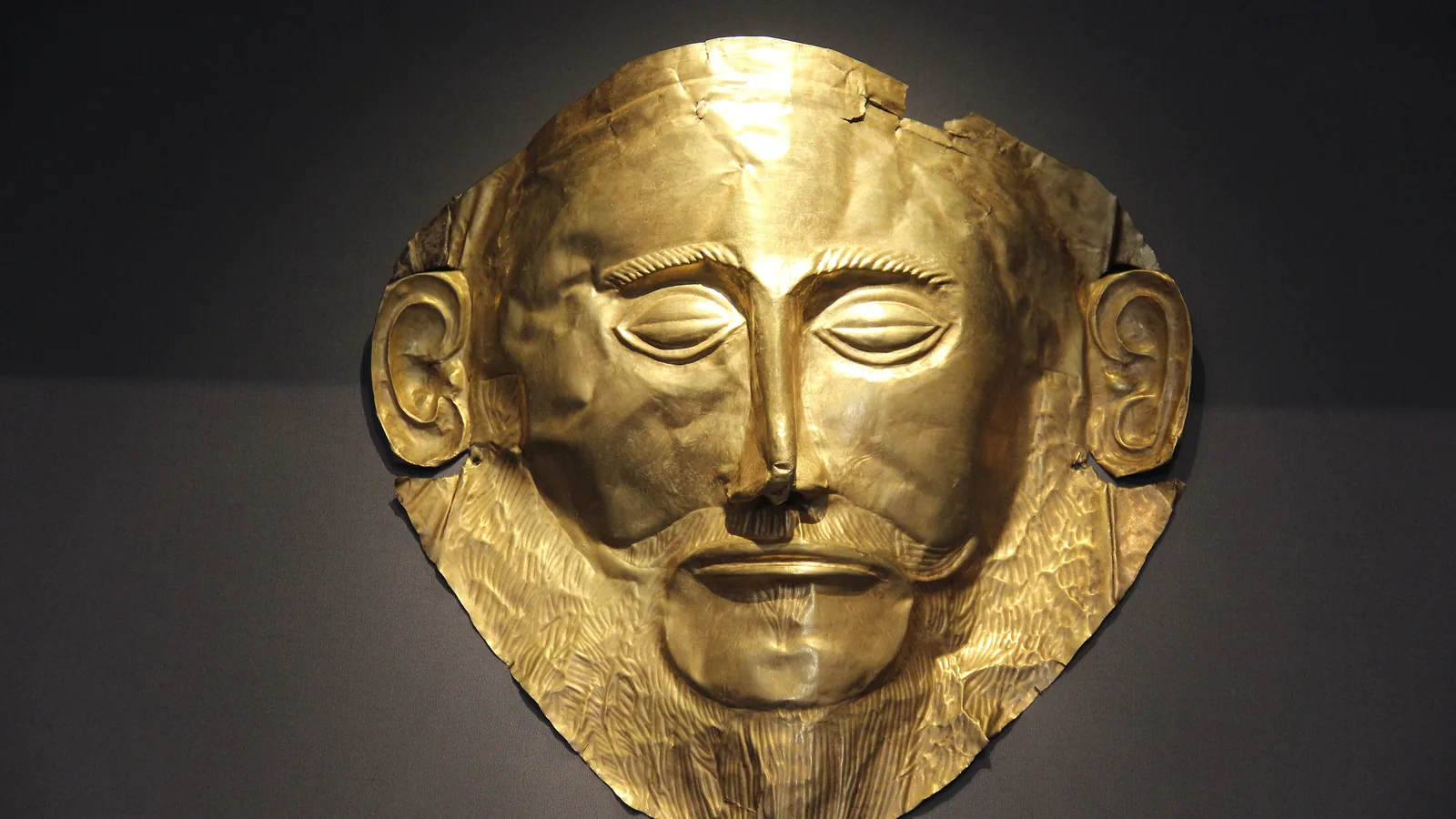
“Excavations begun, August 7, 1876,” reads a line in the table of contents of Heinrich Schliemann’s Mycenae, his 1878 account of a season at the Bronze Age citadel in the Peloponnese. By late November he had cleared the shaft graves now called Grave Circle A and telegraphed King George of Greece that he had found the tombs tradition gave to Agamemnon. The National Archaeological Museum in Athens, which holds the gold, dates the graves to the 16th century BC. The sentence most often quoted from that season, “I have gazed on the face of Agamemnon,” does not appear in his 1878 book. The authenticity of the best-known gold mask was argued in print in 1999.
Quick facts
- When
- August 7, 1876 (excavations begun, by Schliemann's table of contents) · November 16 (28), 1876 (telegram to King George) · November 30, 1876 (the bearded mask found, by Calder's and Lapatin's dates) · October 1877 (first exhibition in Athens) · 1999 (authenticity debate in Archaeology magazine) · 2005 (Dickinson in Hesperia)
- Where
- Grave Circle A, just inside the Lions' Gate of the citadel of Mycenae, in the Peloponnese; the finds are in the National Archaeological Museum, Athens
- Who
- Heinrich Schliemann; Panagiotis Stamatakis, the supervising Greek archaeologist; King George of Greece; William M. Calder III; David A. Traill; Katie Demakopoulou; Kenneth D. S. Lapatin; Oliver Dickinson
- Outcome
- Schliemann telegraphed that he had found the tombs tradition assigned to Agamemnon and gave the gold to Greece. The National Archaeological Museum dates the graves to the 16th century BC; Archaeology magazine counts five graves, the museum six. The authenticity of the bearded mask was argued in 1999; a request to test it was refused in 1983.
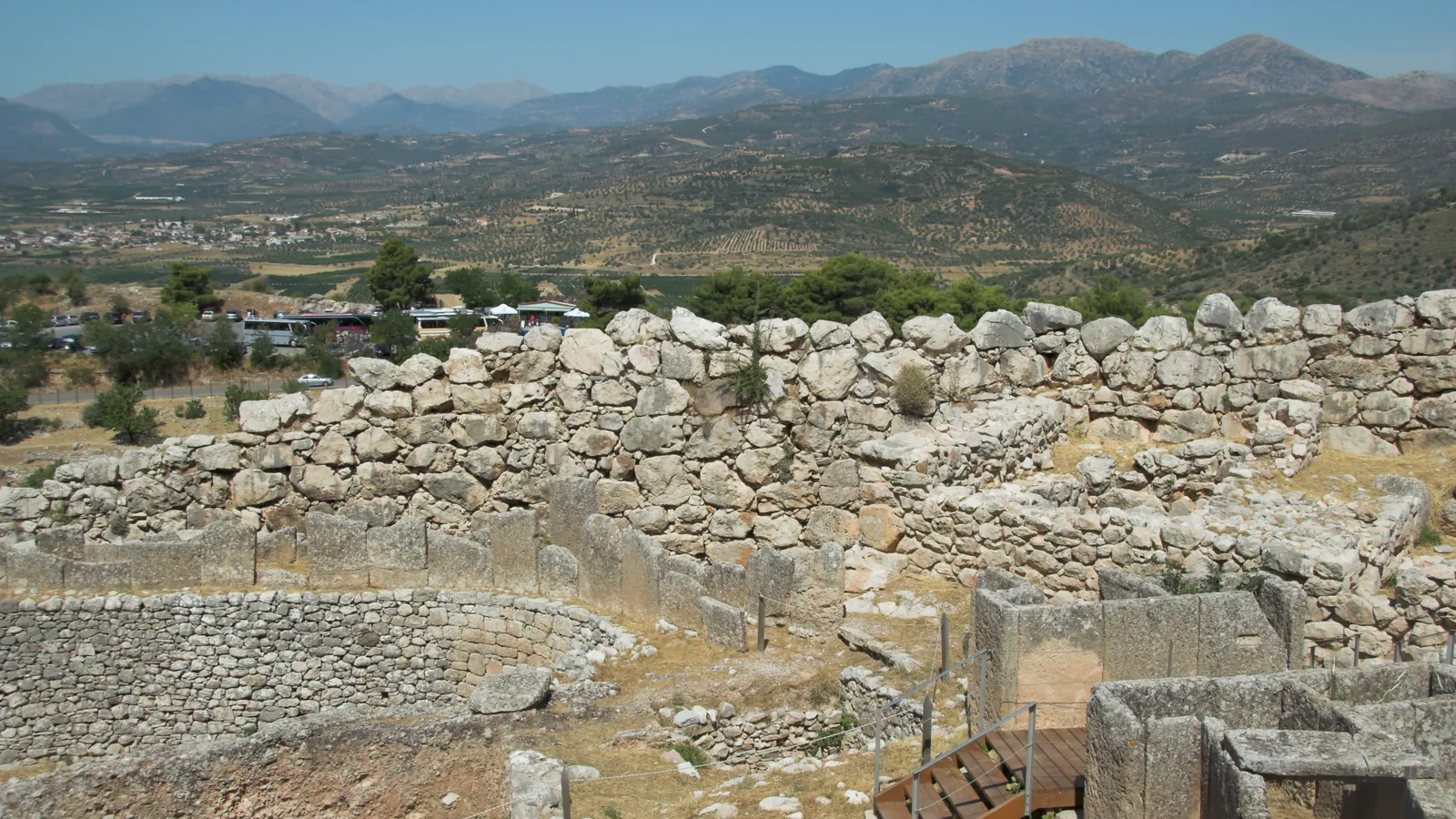
Mycenae, August 7, 1876: a ring of slabs by the Lions' Gate
Archaeology, the magazine of the Archaeological Institute of America, wrote in 1999 that Schliemann dug between August and December “on behalf of the Greek Archaeological Society, which held the excavation permit,” watched by Panagiotis Stamatakis, a Greek archaeologist who “often accused Schliemann of destroying classical antiquities in his quest for Homeric remains.” He had come for a passage in Pausanias, the ancient geographer who placed the grave of Agamemnon at Mycenae, and read it as putting the graves inside the walls.
Under the heading “Mycenæ, Sept. 9, 1876,” he wrote: “Since the 19th of August I have continued the excavations with an average number of 125 workmen and 4 horse-carts.” A laborer earned 2½ drachmas a day. Just inside the Lions’ Gate, the magazine reported, the workmen exposed stelae marking a grave circle 90 feet across. Schliemann dated the carved slabs himself, in a chapter summary: “Their probable age about 1500 B.C.”
November 28, 1876: a telegram in French
The book prints the telegram in French: “Avec une extrême joie j’annonce à Votre Majesté que j’ai découvert les tombeaux que la tradition, dont Pausanias se fait l’écho, désignait comme les sépulcres d’Agamemnon, de Cassandra, d’Eurymédon et de leurs camarades.” Archaeology’s translation has the tombs that “the tradition proclaimed by Pausanias indicates to be the graves of Agamemnon, Cassandra, Eurymedon and their companions.” He reported “des trésors immenses” in pure gold and gave them away: “je n’ai naturellement aucune prétention à ces trésors, que je donne, avec un vif enthousiasme, intacts à la Grèce.”
The telegram is dated “16 (28) Novembre 1876,” the Greek calendar’s day with the Western one in parentheses. The king’s secretary, A. Calinskis, thanked him for his “zèle et amour pour la science.” By the date William M. Calder III and Kenneth D. S. Lapatin both gave in 1999, the bearded mask later called Agamemnon’s came out of the ground on November 30, two days after the Western date on the telegram.
"I have gazed on the face of Agamemnon": a sentence missing from the book
Spencer P. M. Harrington, introducing the 1999 debate in Archaeology, wrote that Schliemann “is said to have telegrammed a Greek newspaper” with those words on first seeing the mask, and “In fact, he himself never identified it as belonging to Agamemnon.” The line does not appear in his 1878 book, which prints the royal telegram and praises the mask at the south end of the tomb, “Its features are altogether Hellenic,” without it. Lapatin, an art historian at Boston University, wrote that the name Mask of Agamemnon was “a designation which, as Oliver T.P.K. Dickinson has noted, Schliemann seems never to have used.”
Dickinson set out his case in 2005 in Hesperia, the journal of the American School of Classical Studies at Athens. Shaft grave V held two gold masks: NM 624, from the southern burial, the one almost universally taken for Schliemann’s Agamemnon, and NM 623, from the northern burial. Citing a telegram “to the Minister” printed in Emil Ludwig’s 1931 biography, he argued that Schliemann’s Agamemnon was NM 623, and that Schliemann “would have had little motive to forge” NM 624.
Five graves or six, 300 years or four centuries
Harrington described “the first of five late Bronze Age shaft graves,” found by the end of August, “its five tombs indicated with Roman numerals.” The National Archaeological Museum’s page on Stamatakis’s diary, written by Eleni Konstantinidi-Syvridi in November 2020, states that he “recorded the six tombs of Circle A (I-VI).”
The gap to Troy differs too. Harrington wrote that the graves “were later shown to be at least 300 years earlier than the conjectured date of the Trojan War.” The museum places the dead of Circle A among “the first generations of Mycenaean rulers” of the 16th century BC, “at least four centuries before the great war that is archaeologically identified with the Trojan War.”
Tomb V held three burials, two with gold masks and breastplates, the museum states. From it came a bronze dagger, inventory P 765, 16 centimeters long, inlaid in silver and gold with wild cats attacking ducks among papyrus, found “in the same burial assemblage as the famous ‘Agamemnon mask’.” The Circle A finds were first shown at the Polytechnic in Athens in October 1877, arranged by Stamatakis.

Calder, Traill and Demakopoulou: the mask argued in 1999
In the July/August 1999 issue, Calder, a professor of classics at the University of Illinois at Urbana-Champaign, set out “nine reasons to believe it may be” a hoax. He cited the mask’s beard and mustache, unlike the other masks, Schliemann’s record of invented stories, and the timing: digging from August 7 to December 3, the mask found on November 30, the site shut on November 26 and 27 while Schliemann was away. “My evidence is circumstantial,” he wrote. David A. Traill, author of Schliemann of Troy: Treasure and Deceit, supported the questions, Dickinson recorded.
Katie Demakopoulou, then director of the Prehistoric Collection at the museum, answered that the two scholars’ accusations “have not been generally accepted by the academic community.” She cited Ellen N. Davis, who found the beard of the mask and the mane of the gold lion-head rhyton from shaft grave IV “almost identical,” and pointed to Stamatakis’s close supervision. Lapatin found in Calder’s case “no smoking gun,” listed the rain that stopped digging on November 14 and 22, and left open a third possibility: a pastiche, ancient work reworked in modern times.
Calder closed by asking for “a public test by an independent expert” from outside the National Museum. Traill had asked before him. Demakopoulou wrote that the request for a scientific examination was rejected by the Central Archaeological Council in 1983, after the National Archaeological Museum gave a negative opinion.
Key facts
- Schliemann’s table of contents records “Excavations begun, August 7, 1876” at Mycenae; the Greek Archaeological Society held the permit and Panagiotis Stamatakis supervised (Harrington, Archaeology, 1999).
- On September 9, 1876, Schliemann wrote that since August 19 he had worked with an average of 125 workmen and 4 horse-carts.
- The grave circle inside the Lions’ Gate measured 90 feet across (Harrington); Schliemann dated its carved stelae “about 1500 B.C.”
- His telegram to King George, dated “16 (28) Novembre 1876,” announced the tombs tradition assigned to Agamemnon, Cassandra and Eurymedon and gave the gold to Greece.
- “I have gazed on the face of Agamemnon” does not appear in his 1878 book; Harrington wrote that Schliemann “is said to have” sent it to a Greek newspaper.
- Archaeology magazine counts five shaft graves in Grave Circle A; the National Archaeological Museum, from Stamatakis’s diary, counts six (I-VI).
- The museum dates the graves to the 16th century BC, “at least four centuries” before the Trojan War; Harrington wrote “at least 300 years.”
- Calder and Traill questioned the bearded mask’s authenticity in 1999; Demakopoulou and Lapatin answered; a request to test it was rejected in 1983, Demakopoulou wrote.
FAQ
Did Schliemann say "I have gazed on the face of Agamemnon"?
The sentence does not appear in his 1878 book Mycenae. Spencer Harrington wrote in Archaeology in 1999 that Schliemann "is said to have" telegraphed it to a Greek newspaper, and that Schliemann never identified the mask as Agamemnon's.
How old are the shaft graves of Grave Circle A?
The National Archaeological Museum in Athens dates them to the 16th century BC and places them at least four centuries before the Trojan War. Archaeology magazine wrote in 1999 that they are at least 300 years earlier than the conjectured date of that war.
Is the Mask of Agamemnon a fake?
William M. Calder III argued in 1999 that it might be, on evidence he called circumstantial. Katie Demakopoulou of the National Archaeological Museum and Kenneth Lapatin disputed it, and Oliver Dickinson argued in 2005 that Schliemann had little motive to forge it. Demakopoulou wrote that a request to test the mask was rejected in 1983.
Sources
- Heinrich Schliemann, Mycenae: A Narrative of Researches and Discoveries at Mycenae and Tiryns (London and New York, 1878), Project Gutenberg ebook 56940.
- National Archaeological Museum, Athens, Eleni Konstantinidi-Syvridi, "Pages from the Mycenae excavation diary of Panayotis Stamatakis" (Exhibit of the Month, November 2020).
- National Archaeological Museum, Athens, "Collection of Mycenaean Antiquities."
- National Archaeological Museum, Athens, "Once upon a time in the Aegean.." (Exhibit of the Month, January 2024), bronze dagger P 765 from Grave Circle A, Tomb V.
- Spencer P. M. Harrington, "Behind the Mask of Agamemnon," Archaeology (Archaeological Institute of America) 52, no. 4, July/August 1999.
- William M. Calder III, "Is the Mask a Hoax?," Archaeology 52, no. 4, July/August 1999.
- Katie Demakopoulou, "The Case for Authenticity," Archaeology 52, no. 4, July/August 1999.
- Kenneth D. S. Lapatin, "Not A Forgery. How about a Pastiche?," Archaeology 52, no. 4, July/August 1999.
- Oliver Dickinson, "The 'Face of Agamemnon'," Hesperia 74 (2005), pp. 299–308, American School of Classical Studies at Athens.
Cite this article
- APA
- Song Letter. (2026, September 29). A telegram to King George: Schliemann's gold at Mycenae, 1876. Our Earth's History. https://ourearthshistory.com/europe/ancient/mycenae-1876-schliemann-grave-circle-a-mask/
- Chicago
- Song Letter. “A telegram to King George: Schliemann's gold at Mycenae, 1876.” Our Earth's History, September 29, 2026. https://ourearthshistory.com/europe/ancient/mycenae-1876-schliemann-grave-circle-a-mask/.
- MLA
- Song Letter. “A telegram to King George: Schliemann's gold at Mycenae, 1876.” Our Earth's History, 29 Sep. 2026, https://ourearthshistory.com/europe/ancient/mycenae-1876-schliemann-grave-circle-a-mask/.
Get the week in history
One email a week: the new articles, and what was happening elsewhere at the same moment. Free, no ads, unsubscribe any time. How we handle your email.
Text licensed CC BY-NC-ND 4.0. Found an error? Tell us.