A copper ax and 61 tattoos: what Ötzi carried, September 19, 1991

TL;DR — On September 19, 1991, Erika and Helmut Simon found a body in the ice at 3,210 meters on the Tisenjoch, 92.56 meters inside Italy by the survey that followed.
On September 19, 1991, Erika and Helmut Simon, hikers from Germany, found a human body at 3,210 meters near the Tisenjoch, a pass above the Schnalstal in South Tyrol. Only the upper body stood out of the ice. The landlord of the Similaun refuge called both the Austrian police and the Italian carabinieri, because the pass sat on the border; everyone assumed a climbing accident. A survey on October 2, 1991, placed the find 92.56 meters from the border, on the Italian side. The man had died there more than 5,300 years ago, in the museum’s phrase; a 2013 study title cited on its milestones page gives about 3300 BC. He carried a copper ax and 61 tattoos, and an arrow in his left shoulder that no one saw until 2001.
Quick facts
- When
- Found September 19, 1991; recovered September 23; border survey October 2, 1991; site excavated July and August 1992; on display in Bolzano since 1998; arrowhead found 2001; genomes published 2012 and 2023
- Where
- Tisenjoch (Giogo di Tisa), 3,210 meters above sea level, Schnalstal (Val Senales), South Tyrol, in what is now Italy, 92.56 meters from the Austrian border
- Who
- Erika and Helmut Simon (finders); Markus Pirpamer, Reinhold Messner and Hans Kammerlander (at the site, September 21); Konrad Spindler (Innsbruck); Paul Gostner (radiologist); Andreas Keller, Ke Wang and Frank Maixner (papers)
- Outcome
- A man of 45 or 46, killed by an arrow to the left shoulder more than 5,300 years ago, kept with his clothing and tools in a cold cell at the South Tyrol Museum of Archaeology; his genome, first read in 2012, was revised in 2023
Four days on the ice
The first attempt to free the body, on September 20, failed in bad weather; the rescuers took only the ax down to the valley. On September 21, with no helicopter available, Markus Pirpamer, the landlord, covered the body with a plastic sheet, and the mountaineers Reinhold Messner and Hans Kammerlander arrived the same day. Pirpamer showed them a sketch of the ax, and Messner was the first to say the body was very old.
The body came out on September 23, freed with ice picks. No archaeologist was present; a forensic scientist from Innsbruck oversaw the transport. A dagger lay beside the body, and a long stick nearby was later identified as a bow. A helicopter flew the dead man to Vent in the Ötztal, and a hearse took him on to the Institute of Forensic Medicine in Innsbruck. Konrad Spindler of Innsbruck University saw him on September 24 and put his age at “at least 4000 years old.” The gully was not searched properly until July and August 1992, when archaeologists cleared it with steam blowers and found the bearskin cap.
What he carried
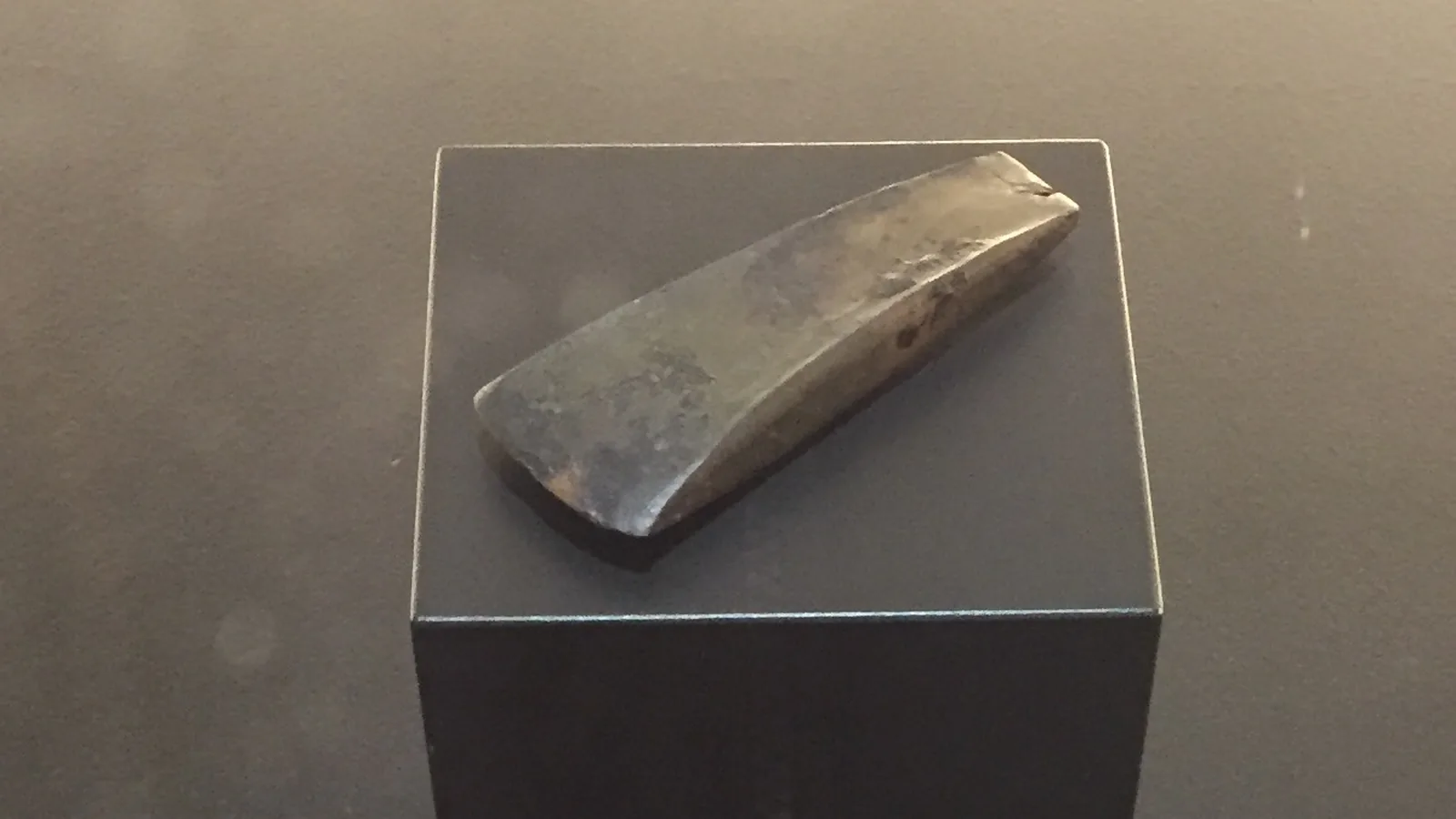
The ax is the only complete one of its kind. Its blade is 99.7 percent copper, trapezoidal, set in the forked end of a yew haft about 60 centimeters long with birch tar and leather straps. A 2017 paper by G. Artioli and colleagues in PLOS One, cited on the museum’s milestones page, traced the ore to southern Tuscany, not the Alps.
The bow was a 1.82-meter stave of yew, not yet finished; the museum’s page says Ötzi was still shaping it with his ax. His deer-hide quiver held 12 arrow shafts, two finished arrows tipped with flint, four deer antler tips and a 2-meter bowstring of animal sinew. The dagger, 13 centimeters long with a flint blade and an ash handle, is the only fully preserved dagger from the Copper Age. Two birch-bark containers lay near the body, one blackened inside and holding fresh Norway maple leaves and charcoal, read as a way of carrying embers.
His clothes were leather, hide and braided grass, with no wool or woven cloth: a knee-length coat of goat and sheep hide, fur outward; goat-hide leggings; a sheep-hide loincloth; a calfskin belt with a pouch for flint and tinder; shoes with a bast mesh inner and a deerskin upper; and the bearskin cap with a chin strap. A mat of alpine swamp grass was first read as a grass cape; the museum now calls that doubtful and suggests a rain mat or part of a backpack.
The arrowhead in the left shoulder
In 2001 the radiologist Paul Gostner found a flint arrowhead in the left shoulder on an X-ray, and a 2-centimeter entry wound was then found in the back. The arrow cut the subclavian artery, and the museum’s page says he bled to death in minutes. He also had a head injury and a deep, unhealed cut on his right hand, reported in The Lancet in 2003, which the museum reads as fighting a few days before he died. Someone pulled the shaft out, and the head broke off inside. “There can be no doubt that Ötzi was murdered,” the museum writes. Pollen and the maple leaves put the death in early summer.
He was about 1.60 meters tall and weighed about 50 kilograms in life, 45 or 46 by the museum’s own pages. The 61 tattoos, counted under light of different wavelengths in 2015, are all lines or crosses, cut into the skin and rubbed with charcoal, on the lower back, wrist, knee, calves and ankles.
Stomach contents: a bacterium and a last meal
In 2016 Frank Maixner of the Institute for Mummy Studies at Eurac Research in Bolzano, with colleagues, published in Science the genome of a Helicobacter pylori strain from the stomach, “a nearly-pure representative” of the Asian-origin population that lived in Europe before it mixed with an African one. In 2018 the same group reported in Current Biology what he ate last: fat and meat of ibex and red deer, and einkorn wheat, with bracken fern that the authors thought came from wrapping leaves.
From one genome to the next, and a cold cell in Bolzano
The first whole genome, published by Andreas Keller and colleagues in Nature Communications on February 28, 2012, said Ötzi probably had brown eyes, belonged to blood group O and was lactose intolerant, placed his father’s line in Y-chromosome haplogroup G2a, now rare in Central Europe, and found his nearest present-day relatives in Sardinia and Corsica. DNA of Borrelia burgdorferi made him, the authors wrote, the earliest known human case of Lyme borreliosis.
In 2023 Ke Wang and colleagues sequenced him again at higher coverage and reported in Cell Genomics that, “contrary to previous studies,” he had no detectable Steppe ancestry. With Anatolian early farmers as the reference, 90 percent of his ancestry, give or take 2.5, came from that population, the highest share among the Europeans of his time. He “likely had darker skin than present-day Europeans,” the paper says. The museum’s page on the body now follows the 2023 result: dark hair, dark eyes and medium to dark brown skin.
Since 1998 the mummy has lain in the South Tyrol Museum of Archaeology in Bolzano, in a cold cell at minus 6 degrees Celsius and 99 percent humidity, visible through a small window. The ax, the bow and the bearskin cap are in the same building, 92.56 meters of survey line away from having been Austrian.
Key facts
- Erika and Helmut Simon found the body on September 19, 1991, at 3,210 meters near the Tisenjoch, Schnalstal, South Tyrol; only the upper body showed above the ice.
- The body was freed with ice picks on September 23, 1991, flown to Vent and driven to Innsbruck; Konrad Spindler estimated it “at least 4000 years old” on September 24.
- A survey on October 2, 1991, placed the site 92.56 meters inside Italy; the museum says the 1922 border had been drawn in deep snow.
- The ax blade is 99.7 percent copper on a yew haft about 60 centimeters long; the ore came from southern Tuscany (Artioli et al., PLOS One, 2017).
- He also carried an unfinished 1.82-meter yew bow, a quiver with 12 shafts and two finished arrows, a 13-centimeter flint dagger, and two birch-bark containers.
- An X-ray in 2001 found a flint arrowhead in the left shoulder; the arrow cut the subclavian artery. The museum’s pages give his age as 45 or 46.
- Keller et al. (2012): brown eyes, blood group O, lactose intolerance, haplogroup G2a, Borrelia DNA. Wang et al. (2023): no Steppe ancestry, 90 percent Anatolian farmer ancestry, darker skin than present-day Europeans.
- The mummy has been in the South Tyrol Museum of Archaeology in Bolzano since 1998, in a cold cell at minus 6 degrees Celsius and 99 percent humidity.
FAQ
How did Ötzi die?
An arrow entered his back and lodged its flint head in his left shoulder, cutting the subclavian artery; the museum's page says he bled to death in minutes. The arrowhead was found on an X-ray in 2001. He also had a head injury and a cut on his right hand from a few days before.
Was Ötzi found in Italy or Austria?
In Italy. The site lay near the border, and both Austrian police and Italian carabinieri were called, but a survey on October 2, 1991, placed the find 92.56 meters on the South Tyrol side. He was studied in Innsbruck until 1998, when he moved to Bolzano.
What did Ötzi look like?
The museum, following the 2023 genome, describes dark hair, dark eyes and medium to dark brown skin, a height of about 1.60 meters and a weight of about 50 kilograms. The 2012 genome gave brown eyes and blood group O; the 2023 paper added that he likely had darker skin than present-day Europeans.
Sources
- South Tyrol Museum of Archaeology (iceman.it) — "The discovery" and "The body."
- South Tyrol Museum of Archaeology (iceman.it) — "Ötzi's clothing," "The Iceman's equipment" and "Who was Ötzi."
- South Tyrol Museum of Archaeology (iceman.it) — "Ötzi the Iceman" and "Milestones in Ötzi research."
- Andreas Keller et al. — "New insights into the Tyrolean Iceman's origin and phenotype as inferred by whole-genome sequencing," Nature Communications 3, 698 (February 28, 2012).
- Ke Wang et al. — "High-coverage genome of the Tyrolean Iceman reveals unusually high Anatolian farmer ancestry," Cell Genomics 3 (August 16, 2023), via PubMed Central.
- Frank Maixner et al. — "The 5300-year-old Helicobacter pylori genome of the Iceman," Science 351 (January 8, 2016), via PubMed Central.
- Frank Maixner et al. — "The Iceman's Last Meal Consisted of Fat, Wild Meat, and Cereals," Current Biology 28 (July 23, 2018), via PubMed Central.
- Eurac Research — Institute for Mummy Studies, Bolzano.
Cite this article
- APA
- Our Earth's History. (2026, September 22). A copper ax and 61 tattoos: what Ötzi carried, September 19, 1991. Our Earth's History. https://ourearthshistory.com/europe/prehistory/otzi-iceman-1991-tisenjoch-copper-axe/
- Chicago
- Our Earth's History. “A copper ax and 61 tattoos: what Ötzi carried, September 19, 1991.” Our Earth's History, September 22, 2026. https://ourearthshistory.com/europe/prehistory/otzi-iceman-1991-tisenjoch-copper-axe/.
- MLA
- “A copper ax and 61 tattoos: what Ötzi carried, September 19, 1991.” Our Earth's History, 22 Sep. 2026, https://ourearthshistory.com/europe/prehistory/otzi-iceman-1991-tisenjoch-copper-axe/.
Text licensed CC BY-NC-ND 4.0. Found an error? Tell us.