Star Carr by the count: 227 barbed points, 33 antler frontlets

TL;DR — Star Carr, dug by Grahame Clark in 1949–51 and again in 2004–15, yielded 227 barbed points, 33 antler frontlets and postholes dated 9300–9200 cal BC.
“It took only a glance to see that here was a clue to something I had been seeking for many years,” Grahame Clark wrote of the parcel of flints that John Moore sent him from the Vale of Pickering in North Yorkshire. Moore, an amateur archaeologist, had found a flint blade early in the summer of 1947 in the side of a drainage ditch, and by late 1948 he had eight more sites around a peat-filled basin he named Lake Flixton. His site 4 was Star Carr. Clark dug it for three weeks each summer from 1949 to 1951 and counted 191 barbed antler points and 21 red deer antler frontlets. Excavations from 2004 to 2015, published in two open-access volumes in 2018, raised the counts to 227 and 33, dated the first arrival to 9385–9260 cal BC, recorded the earliest built structures known in Britain, and reported that the peat that kept all of this was drying out past recovery.
Quick facts
- When
- Early summer 1947 (John Moore finds a flint blade) · 1949 to 1951 (Clark's excavations, three weeks each summer) · 1954 (Clark's report) · 1985 (Vale of Pickering Research Trust, trench VP85A) · 2008 (first structure recorded in trench SC23) · November 2011 (Scheduled Monument) · 2013 to 2015 (trench SC34) · 2018 (two open-access volumes)
- Where
- Star Carr, on the former shore of Lake Flixton in the Vale of Pickering, North Yorkshire, in what is now England
- Who
- John Moore; Grahame Clark; Nicky Milner, Chantal Conneller and Barry Taylor; Ben Elliott, Becky Knight and Aimée Little; the Vale of Pickering Research Trust; Historic England
- Outcome
- The 2018 volumes count 227 uniserial barbed points (92% of those from England) and 21 plus 12 red deer antler frontlets, date the first arrival to 9385–9260 cal BC and the central structure to 9300–9200 cal BC, and record a 2012 conclusion that the decay of the peat was irreversible
Three weeks each summer, 1949 to 1951
Clark, at Cambridge, had spent more than a decade looking for a British site of the Mesolithic, the period after the last ice age, where bone and antler survived in waterlogged ground. His first question to Moore, he wrote, “was whether he had found antler or bone on any of his sites. On hearing that he had, I lost no time in meeting him.” Moore dug eight square yards along the ditch at site 4. The excavation ran under the Prehistoric Society and the Department of Archaeology and Anthropology at Cambridge, three weeks in each of the summers of 1949, 1950 and 1951. Out of the trenches came 191 barbed antler projectile points, 21 red deer antler frontlets and a layer of unworked wood that Clark read as an occupation platform. He published Excavations at Star Carr in 1954.
His reading of the season of occupation did not hold. Seamus Caulfield and Roger Jacobi argued in 1978 that the antler was raw material and could not count animals killed, Tony Legge and Peter Rowley-Conwy read tooth eruption in 1988 as summer killing, Richard Carter’s radiographs of 1997 and 1998 put one juvenile red deer death in winter, and the 2018 volume states that “reinterpretations revealed little consensus as to the time the site was occupied.”
Barbed points and frontlets, counted again
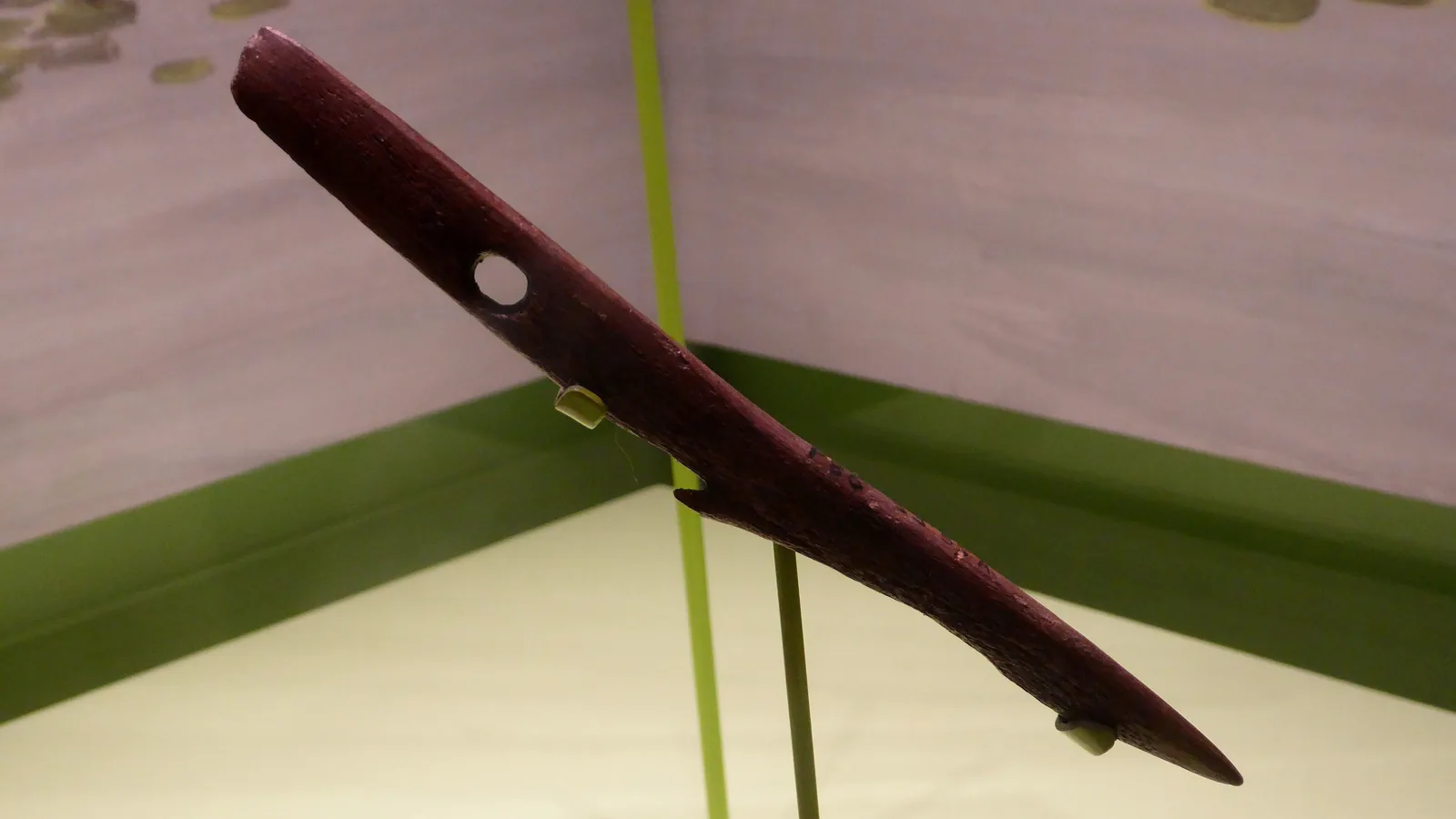
Nicky Milner, Chantal Conneller and Barry Taylor returned to the site in 2004, and their 2018 volumes recounted the finds. To Clark’s 191 uniserial barbed points Ben Elliott and Aimée Little added in chapter 25 one point that Tot Lord took from a section in 1950, one intact point from the 1980s and 34 from 2004 to 2015: 227 in all. The chapter’s conclusion gives Star Carr “227 of the 244 uniserial barbed points recovered from England to date,” or 92% of the national record.
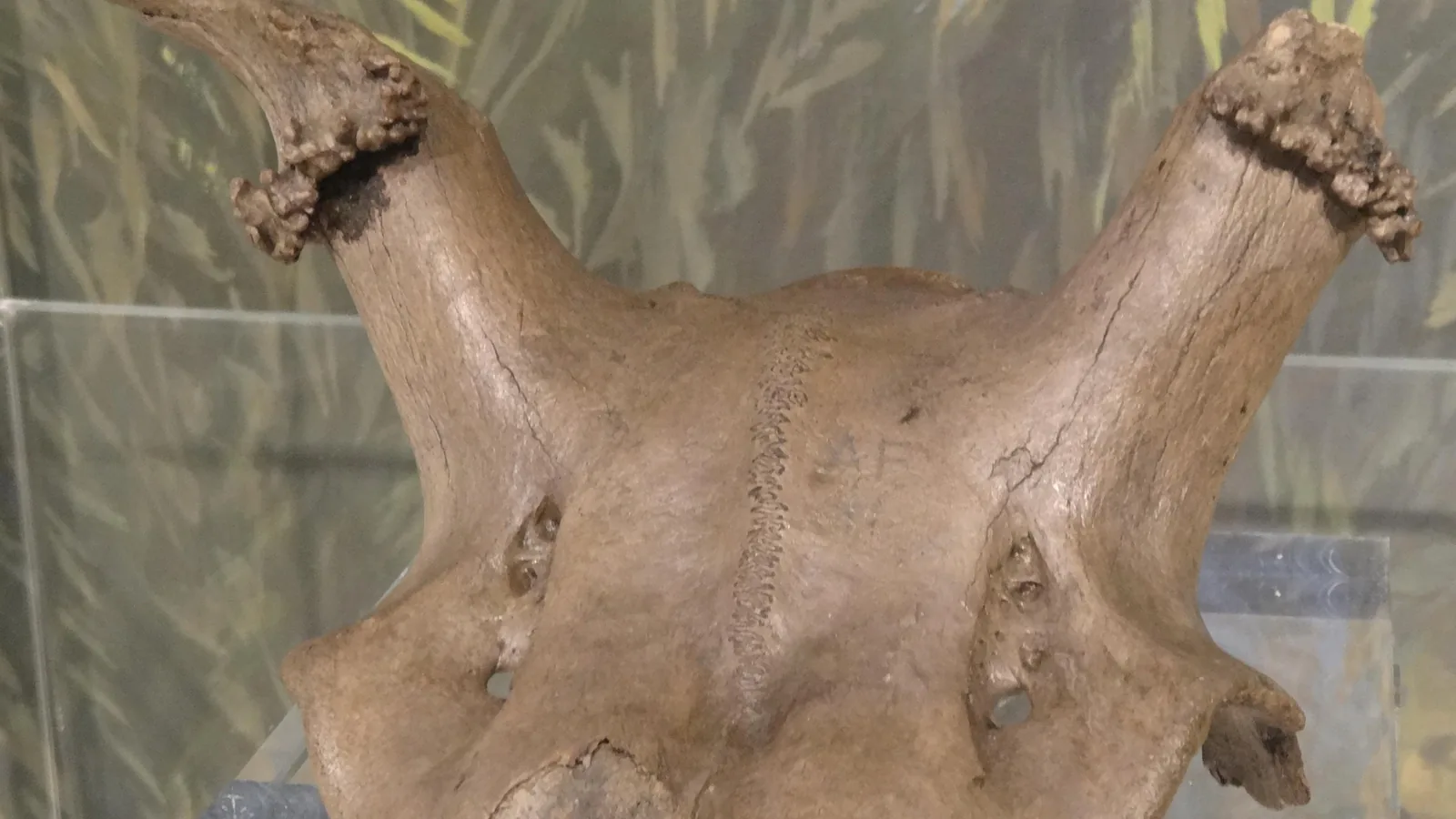
Chapter 26, by Elliott, Becky Knight and Little, restated Clark’s 21 “stag frontlets having still in place portions of antler worked in a special manner” and reported 12 more humanly modified red deer frontlets from 2004 to 2015: 33. A 2016 paper in PLOS ONE by Little, Elliott and others had put the total at 24 headdresses, about 90% of those known from early prehistoric Europe, and the project’s website at starcarr.com still gave 21 headdresses and 193 barbed points.

"A bed of embers for four hours"
Clark offered two uses for the frontlets: a hunting disguise for drawing deer close, or “a ritualised costume for shamanic ceremonies.” He did not choose. In 2016 Little, Elliott, Conneller and colleagues published a study of the most complete frontlet from the 2013 season, find number 103625, the frontal and parietal bones of a male red deer. They also made one. The underside of a skull was packed in clay and, in the paper’s words, “The entire head, complete with skin, was then placed into a bed of embers for four hours”; the authors called the process expedient. The title, “Technological Analysis of the World’s Earliest Shamanic Costume,” gave the paper’s framing; its text added that in comparable ethnographic groups hunting and ritual were not kept apart.
1985, and a trench 20 meters west of Clark's cuttings
The Vale of Pickering Research Trust was set up in 1985 and that year cut an 18 meter trench, VP85A, through the lake edge deposits about 20 meters west of Clark’s area, and found what looked like a wooden platform. Re-analysis showed “a deliberate anthropogenic structure made from deliberately split timbers, which had been laid down parallel to each other on the surface of the peat,” and the 2018 volume calls the split and hewn timbers “the earliest evidence of carpentry in Britain.” Its radiocarbon model puts the western of three platforms in the middle of the 88th century cal BC.
“The first structure was recorded in 2008, during the excavation of trench SC23, and consisted of a small hollow surrounded by postholes,” the volume records, adding that the news media reported it as “Britain’s oldest house.” Two more clusters of postholes followed in trench SC34, the western and central structures, and the volume calls the three “the earliest evidence for built structures in Britain.” A 2024 paper in PLOS ONE by J. Bates with Milner, Conneller and Little has the central structure in use between 9300 and 9200 cal BC, a hollow 3.32 meters north to south, about 2.65 meters wide and 18 centimeters deep, ringed by at least six postholes; the western structure was built in 8945–8760 cal BC at 95% probability. The volume’s model has people first arriving in 9385–9260 cal BC, “within a generation of 9300 BC,” and using the site for around 800 years.
Nicky Milner's management strategy, 2012
Small trenches in the wetland in the 2000s showed that the local water table had fallen below the main artifact horizons and that bone and antler “was now very poorly preserved.” Historic England, then English Heritage, held seminars on the loss at York in November 2008 and at Cambridge in May 2010. A management strategy written by Milner in 2012 “concluded that the deterioration was irreversible and full excavation was therefore necessary.” A 2016 paper in PNAS by K. High, Milner and three colleagues described “the inexorable and rapid loss of valuable archaeological and paleoenvironmental information.”
In November 2011 the Department for Culture, Media and Sport had made Star Carr a Scheduled Monument, “Nationally Important” under the 1979 Ancient Monuments and Archaeological Areas Act. A European Research Council grant, number 283938, project POSTGLACIAL, went to Milner in 2012, and one trench, SC34, was dug in three eight-week seasons from 2013 to 2015. The two volumes edited by Milner, Conneller and Taylor came out from White Rose University Press in 2018, and their first chapter carried the 2012 finding unchanged: “the deterioration was irreversible.”
Key facts
- John Moore found a flint blade early in the summer of 1947 in the side of a drainage ditch; by late 1948 he had found eight more sites around the basin he named Lake Flixton (Volume 1, chapter 2).
- Clark excavated Star Carr for three weeks in each summer of 1949 to 1951 under the Prehistoric Society and Cambridge, and published Excavations at Star Carr in 1954 (Volume 1, chapter 2).
- Clark’s finds included 191 barbed antler projectile points and 21 red deer antler frontlets (Volume 1, chapter 2).
- With one point from Tot Lord in 1950, one from the 1980s and 34 from 2004 to 2015, Star Carr accounts for “227 of the 244 uniserial barbed points recovered from England to date,” or 92% (Volume 2, chapter 25).
- The 2004 to 2015 excavations added 12 humanly modified red deer frontlets to Clark’s 21; the 2016 PLOS ONE paper had counted 24 headdresses at that date (Volume 2, chapter 26; Little et al. 2016).
- The split timbers found in trench VP85A in 1985 are “the earliest evidence of carpentry in Britain”; the western platform dates to the middle of the 88th century cal BC (Volume 1).
- The first structure was recorded in 2008 in trench SC23; the central structure was in use 9300–9200 cal BC, its hollow 3.32 meters by about 2.65 meters and 18 centimeters deep, with at least six postholes (Bates et al. 2024).
- People first arrived in 9385–9260 cal BC (95% probability) and used the site for around 800 years; Star Carr became a Scheduled Monument in November 2011, and the 2012 management strategy concluded that the deterioration was irreversible (Volume 1).
FAQ
How many antler frontlets have been found at Star Carr?
Clark's excavations of 1949 to 1951 produced 21. The 2004 to 2015 excavations added 12 humanly modified red deer frontlets, according to chapter 26 of the 2018 volumes, for 33 in all. A 2016 paper in PLOS ONE gave 24 at the time it was written, and the project website still lists Clark's 21.
Is the Star Carr structure really the oldest house in Britain?
The 2018 volumes call the postholes recorded from 2008 "the earliest evidence for built structures in Britain" and record that the news media reported the first one as "Britain's oldest house." The 2024 PLOS ONE paper dates the central structure to 9300–9200 cal BC.
Why was Star Carr fully excavated between 2013 and 2015?
Because the peat was drying. The water table had fallen below the artifact layers, bone and antler were poorly preserved, and a 2012 management strategy concluded that the deterioration was irreversible. An ERC grant awarded in 2012 funded three eight-week seasons in trench SC34.
Sources
- Milner, N., Conneller, C. and Taylor, B. (eds.), Star Carr Volume 1: A Persistent Place in a Changing World (York: White Rose University Press, 2018), DOI 10.22599/book1, CC BY-NC 4.0; chapters 1, 2, 5, 6 and 17; text read from the OAPEN open-access copy mirrored on the Internet Archive.
- Milner, N., Conneller, C. and Taylor, B. (eds.), Star Carr Volume 2: Studies in Technology, Subsistence and Environment (York: White Rose University Press, 2018), DOI 10.22599/book2, CC BY-NC 4.0; chapter 25, Barbed Points (Elliott and Little) and chapter 26, Antler Frontlets (Elliott, Knight and Little); text read from the OAPEN copy mirrored on the Internet Archive.
- Little, A., Elliott, B., Conneller, C. et al., "Technological Analysis of the World's Earliest Shamanic Costume: A Multi-Scalar, Experimental Study of a Red Deer Headdress from the Early Holocene Site of Star Carr, North Yorkshire, UK," PLoS ONE 11(4), 2016, e0152136, DOI 10.1371/journal.pone.0152136; full text via Europe PMC (PMC4830440).
- Bates, J., Milner, N., Conneller, C. and Little, A., "Spatial organisation within the earliest evidence of post-built structures in Britain," PLOS ONE 19(7), 2024, e0306908, DOI 10.1371/journal.pone.0306908; full text via Europe PMC (PMC11249238).
- High, K., Milner, N., Panter, I., Demarchi, B. and Penkman, K. E. H., "Lessons from Star Carr on the vulnerability of organic archaeological remains to environmental change," PNAS 113(45), 2016, 12957–12962, DOI 10.1073/pnas.1609222113; abstract via Europe PMC (PMC5135359).
- University of York, Star Carr Project website, "History of the site" (John Moore, Clark's excavations of 1949 to 1951, the 1954 report, and the site's own counts of headdresses and barbed points).
- University of York, Star Carr Project website, "Headdresses" (21 headdresses from the 1949 to 1951 excavations, further examples since).
Cite this article
- APA
- Our Earth's History. (2026, September 22). Star Carr by the count: 227 barbed points, 33 antler frontlets. Our Earth's History. https://ourearthshistory.com/europe/prehistory/star-carr-9300-bc-antler-frontlets-oldest-house-britain/
- Chicago
- Our Earth's History. “Star Carr by the count: 227 barbed points, 33 antler frontlets.” Our Earth's History, September 22, 2026. https://ourearthshistory.com/europe/prehistory/star-carr-9300-bc-antler-frontlets-oldest-house-britain/.
- MLA
- “Star Carr by the count: 227 barbed points, 33 antler frontlets.” Our Earth's History, 22 Sep. 2026, https://ourearthshistory.com/europe/prehistory/star-carr-9300-bc-antler-frontlets-oldest-house-britain/.
Text licensed CC BY-NC-ND 4.0. Found an error? Tell us.