Who built Göbekli Tepe, and why does it upset the farming-first story?
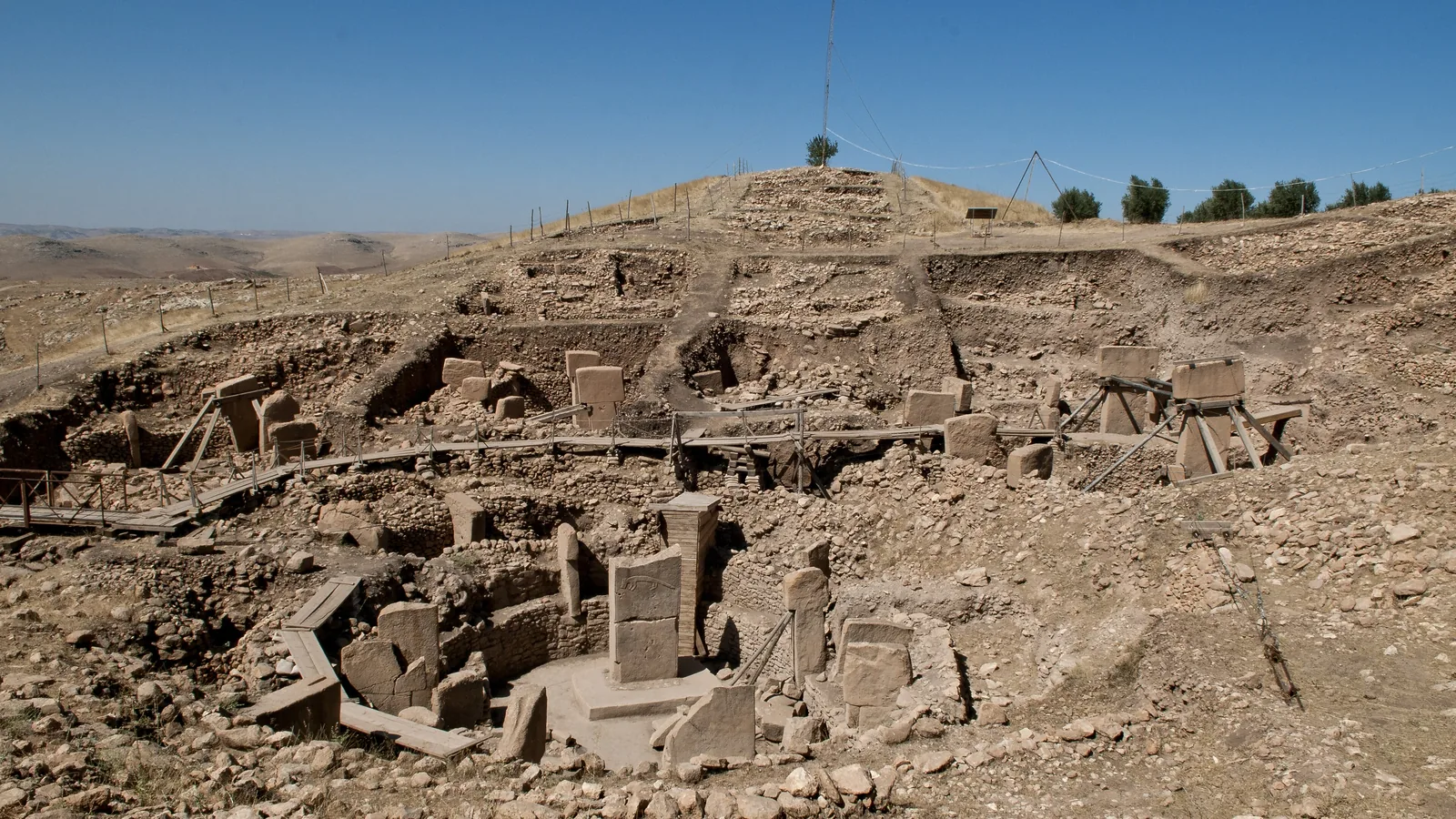

TL;DR — Hunter-gatherers raised Göbekli Tepe’s T-shaped pillar rings about 9500 BC, before farming reached the region; the excavators now call it a settlement with a pronounced ritual side.
Hunter-gatherers of the Pre-Pottery Neolithic built Göbekli Tepe, raising rings of T-shaped limestone pillars on a hilltop in what is now southeastern Turkey from about 9500 BC. The German Archaeological Institute (DAI), which has dug there since 1995, dates the oldest layer to about 9600 to 8800 BC and reports no domesticated plants or animals from the site. Klaus Schmidt, who led the excavation until his death in 2014, read the absence of houses as proof that a temple came before the village. His successors at the DAI describe the hill as a settlement with a pronounced ritual component, after finding hearths, food remains and cisterns. On either reading the pillars stand several centuries before the first domesticated wheat in the region.
Quick facts
- When
- Oldest layer Pre-Pottery Neolithic A, about 9600 to 8800 BC (DAI); Enclosure D built about the mid-10th millennium BC; site abandoned about 8000 BC; surveyed 1963, recognized 1994, excavated from 1995; UNESCO inscription 2018
- Where
- A man-made mound about 15 kilometers northeast of Şanlıurfa in southeastern Turkey, on the highest point of the Germuş range, Upper Mesopotamia
- Who
- Pre-Pottery Neolithic hunter-gatherers; Klaus Schmidt (German Archaeological Institute) excavated 1995 to 2014; Lee Clare and Necmi Karul afterward
- Outcome
- Schmidt read the site as a temple built before farming; the DAI team now describes a settlement with a pronounced ritual component, but the pillars still predate domesticated grain in the region
A hill near Şanlıurfa
Göbekli Tepe is a mound about 15 kilometers northeast of Şanlıurfa, a city in southeastern Turkey, on the highest point of the Germuş range: about 300 meters across, up to 15 meters high and all of it archaeological deposit, by the DAI’s project FAQ. A survey team from the universities of Istanbul and Chicago under Halet Çambel and Robert Braidwood recorded flint tools on the surface in 1963 but, as Andrew Curry wrote in Smithsonian magazine in 2008, took the broken limestone slabs for a medieval cemetery.
Schmidt walked up the hill in October 1994, guided by a local farmer, and recognized the blocks as the T-shaped pillar heads he had excavated at Nevalı Çori, a few kilometers to the north. Digging began in 1995 under the Şanlıurfa Museum, with Harald Hauptmann of the DAI as site director; Schmidt became director in 2006.
Pillars, reliefs and enclosures
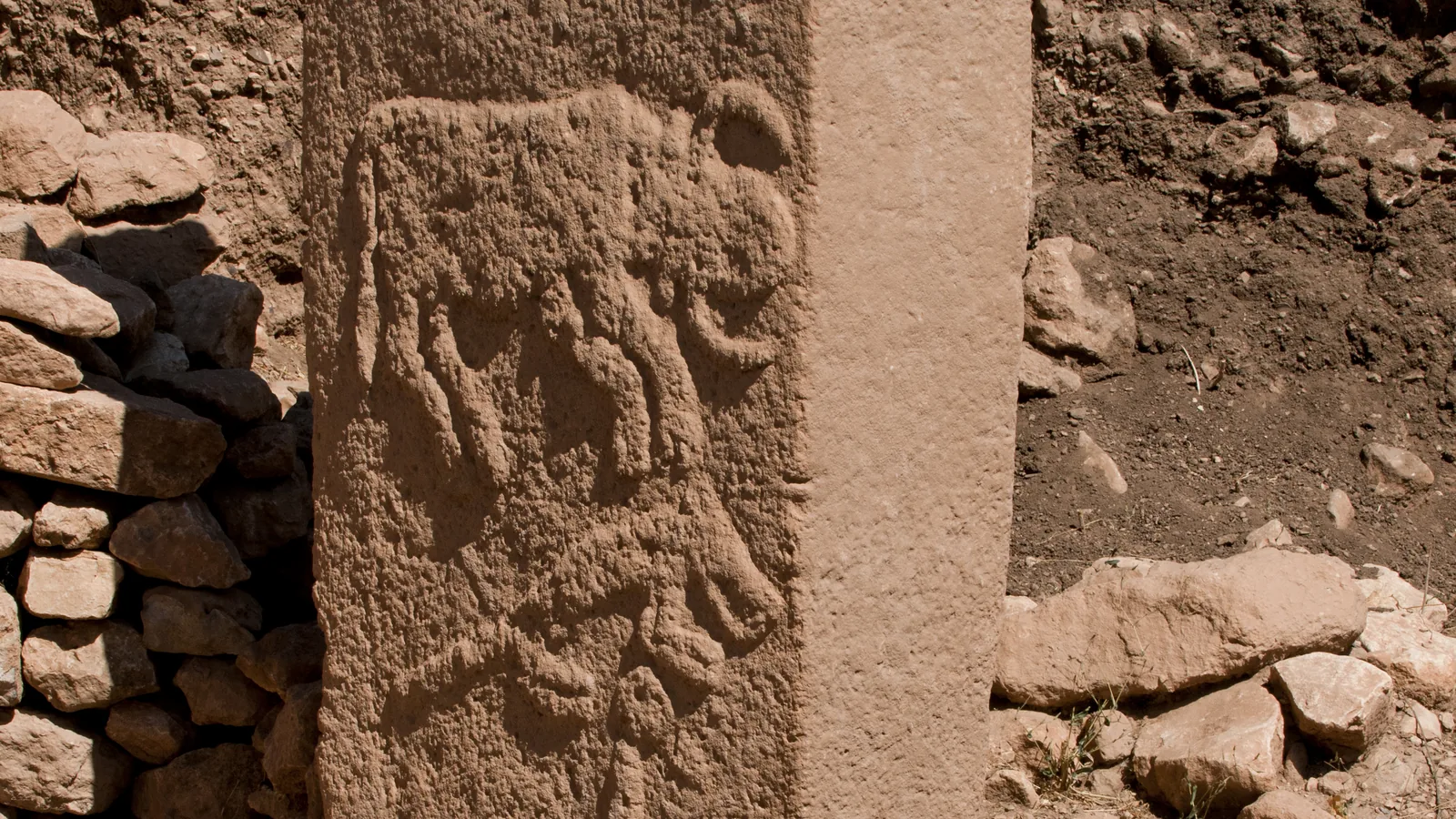
The pillars are T-shaped monoliths of local limestone set in a circle around a central pair more than 5 meters tall; UNESCO gives the tallest as 5.50 meters. Most carry reliefs of wild animals, mainly smaller species, according to the FAQ: birds, foxes, spiders and insects. Several show arms and hands, and two have hands resting on a belt from which a loincloth hangs; the DAI reads them as stylized human figures.
Four large circular buildings, lettered A to D, have been partly excavated. In C and D the floor is the natural rock, smoothed, with the central pillars set in sockets cut into it; B has a lime plaster floor. A fifth, E, kept only its carved foundations, and F, G and H were under excavation when the FAQ was written. Schmidt told Curry in 2008 that his excavation covered less than 5 percent of the site.

How old it is, and what Pre-Pottery Neolithic means
The Pre-Pottery Neolithic is the period when people in the Near East began to settle, and then to farm, but had not yet made pottery vessels. Kathleen Kenyon defined its two stages at Jericho: round buildings in the earlier PPNA, rectangular in the later PPNB. Göbekli Tepe follows the same sequence, Oliver Dietrich of the DAI wrote in 2016: round enclosures in the lower Layer III, small rectangular buildings in Layer II above.
Radiocarbon dates on wall plaster and charcoal put the building of Enclosure D in the middle of the 10th millennium BC; plaster from between Pillars 41 and 42 gave 9745 to 9314 BC. The FAQ sums up the oldest layers as PPNA, about 9600 to 8800 BC, running into early and middle PPNB, about 8800 to 8000 BC, when the site was abandoned. Dietrich’s post states that there are neither domesticated plants nor animals at Göbekli Tepe; Joris Peters of Ludwig Maximilian University in Munich told Smithsonian that every one of more than 100,000 bone fragments he had examined came from a wild animal, gazelle above all.
Schmidt's reading: the temple came first
Schmidt’s team found none of the usual signs of a village, Curry reported: no hearths, houses or trash pits, and none of the clay figurines common at nearby sites of the same age. Standing in one ring 65 feet across, Schmidt said, “This is the first human-built holy place,” and called the hill humanity’s first “cathedral on a hill.” Scholars had long held, in Curry’s summary, that people farmed and settled first and only then could build temples; Schmidt argued it was the other way around, that the labor of raising the pillars laid the groundwork for complex society.
Not every archaeologist accepted a temple. E. B. Banning of the University of Toronto argued in Current Anthropology in 2011 that archaeologists were imposing a modern Western split between sacred and profane on prehistory, and that Göbekli Tepe was a settlement whose buildings were rich in symbols but domestic. Jens Notroff of the DAI answered on the project blog in 2017 that no trace of the period’s known domestic architecture had been found on the hill, and that reading the enclosures as “so fair a house” seemed “not the most convincing interpretation of the available evidence so far.”
What the diggers found after 2014
Schmidt died in 2014. Lee Clare of the DAI became field director, and Necmi Karul of Istanbul University project director in 2019 or 2020, by the DAI’s own pages. The DAI FAQ states that hearths, clay figurines and bone tools had been thought missing, and the site used only seasonally, “perhaps for the celebration of religious festivals,” but that later finds, “for example fire installations, many remnants of consumed foods (like animals and grains), structures interpreted as cisterns to collect water, burials, the fact that many buildings are present,” show that people lived there. Its conclusion is that Göbekli Tepe is interpreted as a “settlement site with a pronounced ritual component.” UNESCO’s 2018 inscription text records the same: “non-monumental structures which appear to stem from domestic buildings.”
Notroff had described the cisterns in 2017 as undated pits on the western slope holding 153 cubic meters in all, on a hilltop whose nearest springs lie about 5 kilometers away. The FAQ also steps back from the word temple, preferring the world’s “oldest so far excavated special buildings with a ritual component,” while allowing that “temple” is “perhaps not entirely wrong.”
The grain on the mountain, and what remains open
The revision left the order of events alone: the pillars came before farming. The FAQ reports that genetic research traced the domestication of einkorn wheat to the vicinity of Karacadağ, a mountain near Göbekli Tepe; as the DAI project summarized the 1997 study, a team from the Norwegian University of Life Sciences (Heun et al., Science 278) identified the site by DNA fingerprinting. Curry reported that at a village 20 miles from the hill, radiocarbon dating put the start of agriculture at about 10,500 years before the present, five centuries after Göbekli Tepe was built.
Karahan Tepe has round-oval buildings with T-pillars that the FAQ compares to it, and since 2021 both belong to the Taş Tepeler project on the region’s early Neolithic. Whether the enclosures had roofs, how long each was used and why rebuilding stopped around 8000 BC are questions the FAQ leaves open. The hunters who cut the pillars did so before anyone in the region grew domesticated grain; that has survived every change of interpretation since 1995.
Key facts
- Göbekli Tepe is a man-made mound about 15 kilometers northeast of Şanlıurfa, Turkey, about 300 meters across and 15 meters high (DAI FAQ).
- The oldest layer belongs to the Pre-Pottery Neolithic A, about 9600 to 8800 BC; Enclosure D’s wall plaster dated to 9745 to 9314 BC (DAI, 2016).
- Central T-pillars stand more than 5 meters tall, up to 5.50 meters (UNESCO); ring pillars reach about 4 meters (DAI).
- Surveyed in 1963 by a team under Halet Çambel and Robert Braidwood; recognized by Klaus Schmidt in October 1994; excavated from 1995; Schmidt died in 2014.
- Enclosures A to D partly excavated, E identified on the western plateau, F, G and H under excavation; Schmidt estimated in 2008 that less than 5 percent of the site had been dug.
- No domesticated plants or animals have been found at the site; gazelle made up over 60 percent of more than 100,000 bone fragments examined by 2008.
- UNESCO inscribed the site in 2018 under criteria (i), (ii) and (iv); since 2021 it is part of the Taş Tepeler project with Karahan Tepe.
FAQ
Who built Göbekli Tepe?
Hunter-gatherers of the Pre-Pottery Neolithic, according to the German Archaeological Institute, which has excavated the site since 1995. No domesticated plants or animals have been found there; the animal bones are wild game, mostly gazelle.
Is Göbekli Tepe the oldest temple in the world?
Klaus Schmidt held that view, Smithsonian reported in 2008; his own words were "the first human-built holy place." The DAI's FAQ prefers the world's "oldest so far excavated special buildings with a ritual component" and, since finding hearths, food remains and cisterns, describes the hill as a settlement with a pronounced ritual component.
How is Göbekli Tepe dated?
By radiocarbon dates on wall plaster and charcoal, and by the types of flint projectile points. Wall plaster from Enclosure D gave 9745 to 9314 BC, and the DAI places the oldest layer in the Pre-Pottery Neolithic A, about 9600 to 8800 BC.
Sources
- German Archaeological Institute, Tepe Telegrams — "FAQ."
- German Archaeological Institute, Tepe Telegrams — Oliver Dietrich, "How old is it? Dating Göbekli Tepe" (June 22, 2016).
- German Archaeological Institute, Tepe Telegrams — Jens Notroff, "A Sanctuary … or so fair a House?" (January 24, 2017).
- German Archaeological Institute, Tepe Telegrams — "Over twenty-five years of research at Göbekli Tepe!" (January 16, 2023).
- German Archaeological Institute, Tepe Telegrams — Oliver Dietrich, "The current distribution of sites with T-shaped pillars" (May 8, 2016).
- German Archaeological Institute, Tepe Telegrams — Oliver Dietrich, "Out for a beer at the dawn of agriculture" (April 24, 2016).
- German Archaeological Institute, Tepe Telegrams — Lee Clare, "Tenth anniversary of the passing of Klaus Schmidt" (July 20, 2024).
- Smithsonian Magazine — Andrew Curry, "Gobekli Tepe: The World's First Temple?" (November 2008).
- UNESCO World Heritage Centre — "Göbekli Tepe."
Cite this article
- APA
- Our Earth's History. (2026, September 21). Who built Göbekli Tepe, and why does it upset the farming-first story? Our Earth's History. https://ourearthshistory.com/west-asia/prehistory/gobekli-tepe-before-farming/
- Chicago
- Our Earth's History. “Who built Göbekli Tepe, and why does it upset the farming-first story?” Our Earth's History, September 21, 2026. https://ourearthshistory.com/west-asia/prehistory/gobekli-tepe-before-farming/.
- MLA
- “Who built Göbekli Tepe, and why does it upset the farming-first story?” Our Earth's History, 21 Sep. 2026, https://ourearthshistory.com/west-asia/prehistory/gobekli-tepe-before-farming/.
Text licensed CC BY-NC-ND 4.0. Found an error? Tell us.