Houses entered from the roof: Çatalhöyük on the Konya plain, 7100 BC
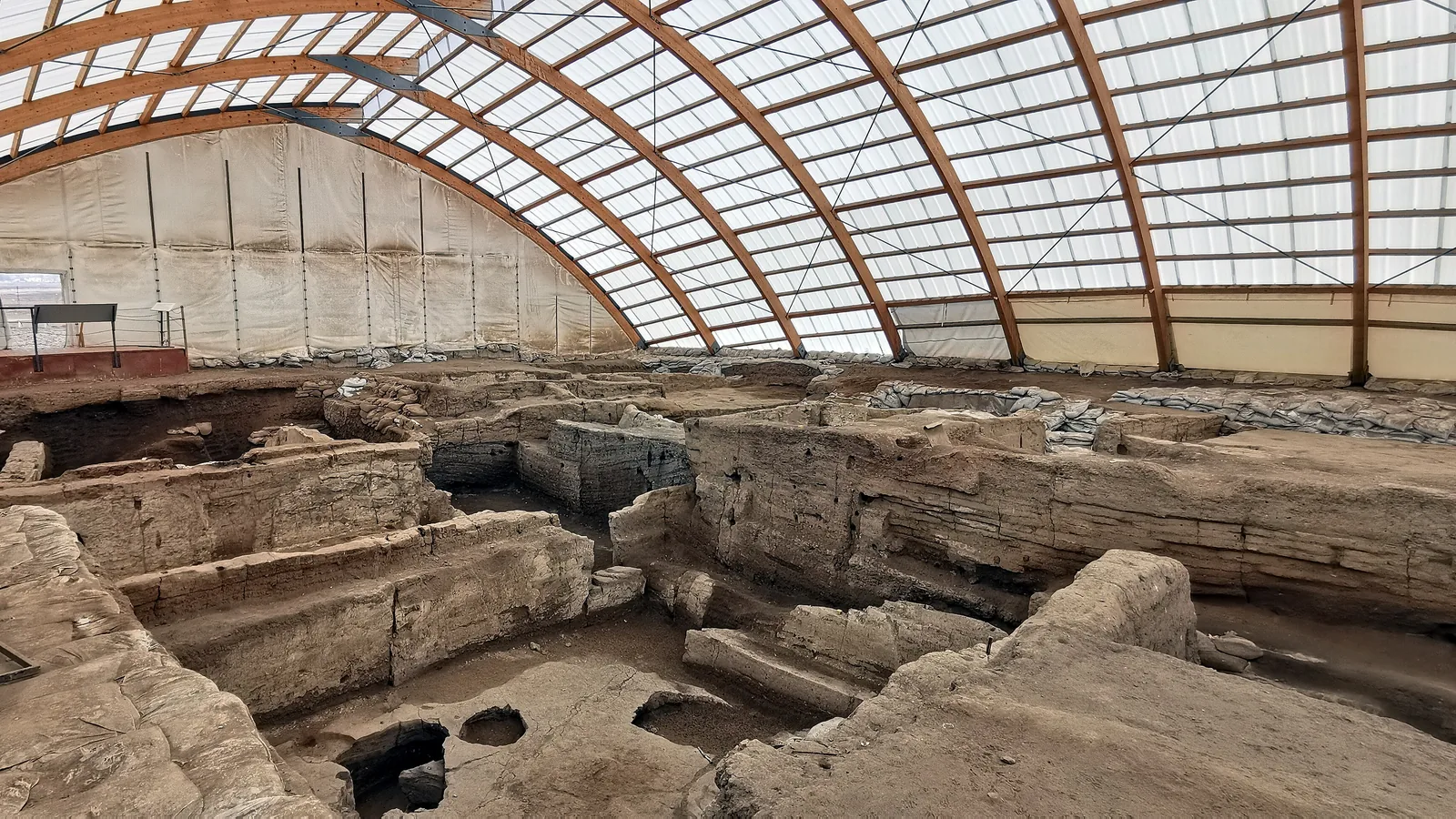

TL;DR — Çatalhöyük’s East Mound, 13 hectares on the Konya plain, was a Neolithic town of mudbrick houses with no streets, entered through the roof, occupied about 7100 to 5950 BC.
Çatalhöyük is a 13-hectare mound of mudbrick houses on the Konya plain of central Turkey, built wall to wall with no streets and entered by ladder through the roof. Radiocarbon dates put the East Mound at about 7100 to 5950 BC, the range given by Reyhan Yaka of Middle East Technical University and colleagues in Current Biology in 2021. James Mellaart dug there from 1961 to 1965 and Ian Hodder from 1993; the last field season was 2017 by Hodder’s own report, while the project’s website gives the end of his permit as 2018. Each house had an oven under the ladder, raised platforms for sleeping and its dead buried beneath those platforms. The project’s website puts the population at its peak at 3500 to 8000 people, and no large public building has been found among the houses.
Quick facts
- When
- East Mound occupied about 7100 to 5950 BC by radiocarbon (Yaka et al., 2021); West Mound about 5900 to 5600 BC (project website); found 1958; dug by James Mellaart 1961 to 1965 and Ian Hodder from 1993, last field season 2017; UNESCO inscription 2012
- Where
- Two mounds on the Konya plain of central Anatolia, in what is now Turkey, about 130 kilometers southwest of the Hasan Dağı volcano
- Who
- Neolithic farmers and herders; James Mellaart (British Institute of Archaeology at Ankara); Ian Hodder (Stanford University) and the Çatalhöyük Research Project; Reyhan Yaka (Middle East Technical University) and colleagues for the ancient DNA
- Outcome
- A 13-hectare settlement of mudbrick houses with no streets, entered by ladder through the roof, with more than 700 individuals buried under house floors; ancient DNA found close kin among only 2 of 10 people buried together
A mound found in 1958
Three British archaeologists, David French, Alan Hall and James Mellaart, came upon the site in 1958, by the project’s own history page. Mellaart’s first season in 1961 ran 39 days and turned up 40 houses along with figurines, pottery and wall paintings; his team came back each summer until 1965, and the mound then lay untouched for about 30 years. Hodder, who had been Mellaart’s student at the University of London, obtained a permit in 1993 and returned with the Mellaarts’ blessing. Stanford’s faculty page calls the work a 25-year project.
A smaller West Mound stands across fields that the project thinks may once have carried the Çarşamba River; its occupation began later than the East Mound’s and outlasted it, with dates of about 5900 to 5600 BC. The whole sequence is more than 2,000 years younger than the pillar enclosures of Göbekli Tepe in southeastern Turkey. UNESCO inscribed the two mounds as a World Heritage Site in 2012.
Inside a house
The project’s architecture page describes the houses as roughly rectangular and packed together, so that people moved about on the roofs and climbed down a wooden ladder through an opening in the ceiling. The central room had an oven below the ladder. Raised platforms along the walls were for sleeping and daily tasks, and the dead were buried beneath them. Side rooms opened off the central room for storage. Walls and floors were coated in white plaster, and on the plaster people painted hunting scenes and geometric patterns.
Mellaart’s 1967 account adds the storerooms: most houses had one, and in some stood grain bins of dried clay about a meter high, filled from the top and emptied through a small hole at floor level so that the grain most exposed to damp was eaten first. He called the more decorated buildings shrines. Yaka’s team wrote that no large public structures had been documented at the site, so that individual houses were the focus of burials and wall paintings as well as of craft, storage and cooking. Houses were continually filled in, often burnt, and rebuilt on the same spot, and the layers of rebuilding raised the mound.

The dead beneath the platforms
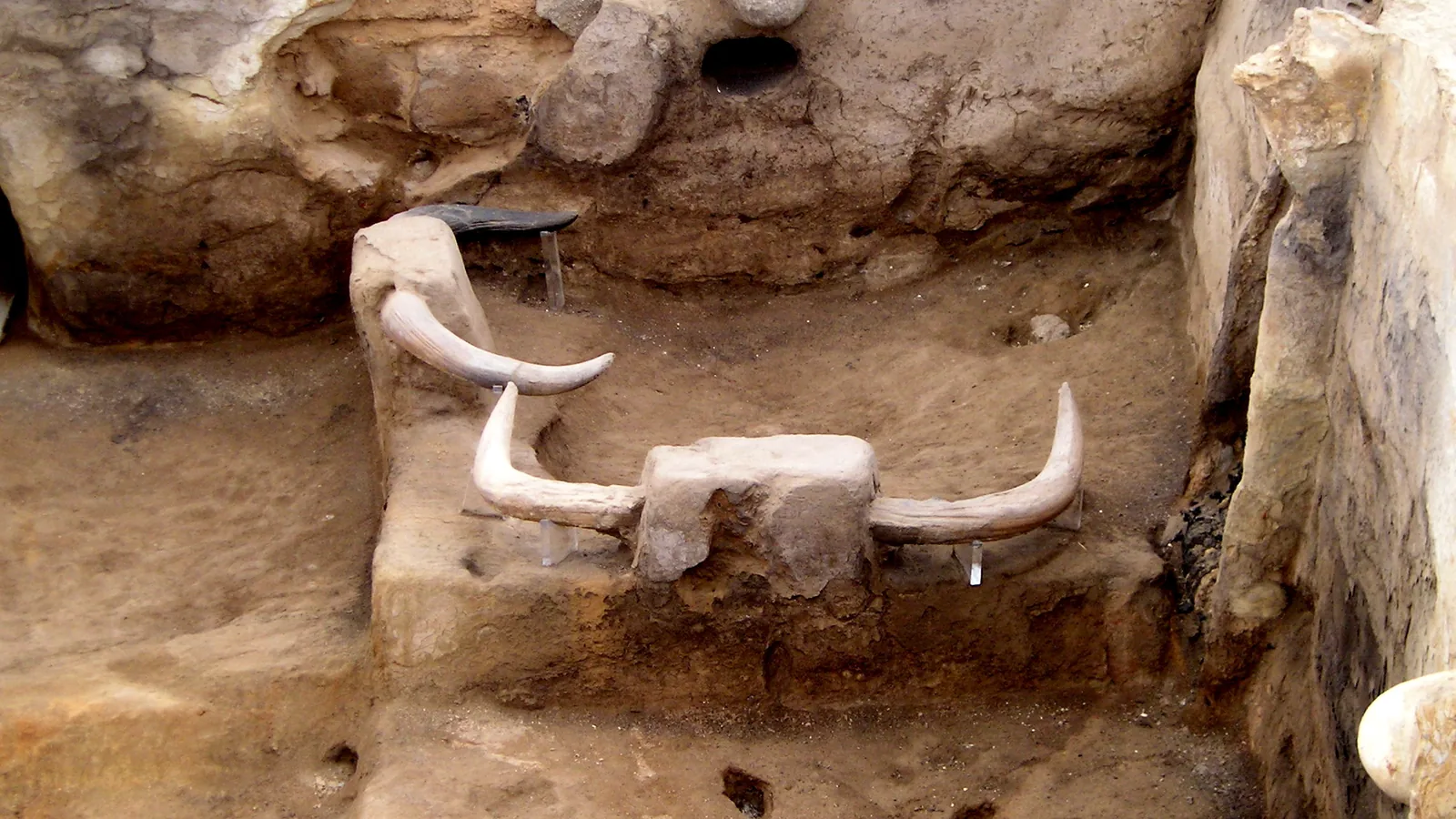
Between 1993 and 2017 the excavation recovered the remains of more than 700 individuals from Neolithic layers, Yaka and colleagues reported. Burial beneath house floors was the dominant rite: 471 people were found as primary burials, most in narrow oval pits under the eastern and northern platforms of the central room, while unborn, newborn and infant children also turned up in side rooms and near ovens. Burial indoors grew rarer toward the end of the East Mound’s occupation and is almost wholly absent from the West Mound.
Hodder’s 2017 report adds a case from the North Area. Under Building 77 the team found that an earlier house, Building 132, had collapsed, that the ground had then been used as a cemetery, and that the burial area of the new house had been laid out exactly over the old graves. “It is almost as if the primary purpose of the house is for the dead rather than for the living!” he wrote.
A painting and a volcano
Mellaart’s team recorded a painting about 3 meters wide across the north and east walls of “shrine” 14 in Level VII, a level dated to 6430 to 6790 BC, in the summary given by Axel K. Schmitt of the University of California, Los Angeles and colleagues in PLOS ONE in 2014. The lower register holds about 80 squares packed like cells in a honeycomb; above it stands a shape its discoverers took for the twin peaks of Hasan Dağı, a volcano about 130 kilometers to the northeast, in eruption. Susan Meece, writing in Anatolian Studies in 2006, read it instead as a leopard skin above a geometric pattern.
Schmitt’s team tested the geology. They found andesitic pumice on the summit of Hasan Dağı and dated it by (U-Th)/He zircon methods to 8.97 ± 0.64 thousand years ago, or 6960 ± 640 BC, an age that overlaps the radiocarbon dates for Level VII. They called it the first evidence of an eruption during the occupation of Çatalhöyük, and set its limit in the same paper: “a residual uncertainty remains regarding the contemporaneity of the painting with the eruption.”
The seated woman, and what Hodder called history houses
In the grain bin of a Level II shrine, A.II.1, Mellaart’s team found a baked clay figure of a woman seated between two felines and shown giving birth. Mellaart called her the enthroned goddess and Mistress of Animals. The project’s page on life at the site says that many people take a mother goddess to have been worshipped at Çatalhöyük because of the many female figurines, and adds that later reinterpretation of the data found male and animal figurines to have been just as common, if not more so.
Hodder’s own summary of the houses came from Mellaart’s “Shrine 10” sequence, a column of buildings that always held many burials. Such a column, he wrote in 2017, is made up of what he called “history houses,” which he defined as “long-lived houses with many rebuilds and many burials.” Who lay together in them was tested in 2021, when Yaka’s team read the genomes of 14 people from the site, all but one of them children or adolescents. Ten of them had been buried in three houses of the mid-7th millennium BC. The team found a single pair of close relatives, two sisters in Building 50, an infant and a child; none of the other pairs tested were closely related, so that, in the paper’s words, “only 2 out of 10 had genetic kin identified.”
Key facts
- The East Mound covers 13 hectares on the Konya plain and dates to about 7100 to 5950 BC (Yaka et al., 2021); the West Mound was occupied about 5900 to 5600 BC (project website).
- Found in 1958 by David French, Alan Hall and James Mellaart; Mellaart’s first season in 1961 lasted 39 days and uncovered 40 houses.
- Ian Hodder held the permit from 1993; his 2017 report calls that year the last excavating season, and the project website gives 2018 as the permit’s end.
- Houses were built with no streets between them; people moved on the roofs and entered by ladder through an opening in the ceiling (project website).
- The project website puts the peak population at 3500 to 8000 people.
- Between 1993 and 2017 the remains of more than 700 individuals were recovered; 471 were primary burials under house floors, including 178 adults and 85 newborns.
- Pumice from the summit of Hasan Dağı dated to 8.97 ± 0.64 thousand years ago, or 6960 ± 640 BC, overlapping Level VII (Schmitt et al., 2014).
- Of 10 people buried together in three houses and tested genetically, only 2, a pair of sisters in Building 50, were close kin (Yaka et al., 2021).
FAQ
How did people get into a house at Çatalhöyük?
By ladder through an opening in the roof. The project's architecture page states that houses were packed together with no streets between them, so people moved around on the roofs and climbed down a wooden ladder into the central room, where the oven stood below the ladder.
Does the Çatalhöyük wall painting show a volcano?
Mellaart read the Level VII mural as a town under an erupting Hasan Dağı; Susan Meece read it in 2006 as a leopard skin over a pattern. Schmitt and colleagues dated pumice from the volcano's summit to 6960 ± 640 BC, which overlaps the painting's level, but wrote that the contemporaneity of the painting with the eruption remained uncertain.
Were the people buried under a house related?
Mostly not, by the ancient DNA read so far. Yaka and colleagues tested 10 people buried together in three houses and found close kin in only 2 of them, a pair of sisters in Building 50; the other pairs tested were not closely related.
Sources
- Çatalhöyük Research Project — "The Site," with the pages "Architecture," "Life at Çatalhöyük," "The Rise and Fall of a Neolithic Town" and "The West Mound."
- Çatalhöyük Research Project — "History of the Excavations" and "UNESCO World Heritage Site."
- Çatalhöyük Research Project — Çatalhöyük 2017 Archive Report, edited by Scott D. Haddow; Ian Hodder, "Introduction: Ending 25 Years of Fieldwork at Çatalhöyük" (PDF).
- Stanford University, Department of Anthropology — "Ian Hodder" (faculty profile).
- Reyhan Yaka et al., "Variable kinship patterns in Neolithic Anatolia revealed by ancient genomes," Current Biology 31 (2021), via PubMed Central.
- Axel K. Schmitt et al., "Identifying the Volcanic Eruption Depicted in a Neolithic Painting at Çatalhöyük, Central Anatolia, Turkey," PLOS ONE 9 (2014), e84711.
- James Mellaart, Çatal Hüyük: A Neolithic Town in Anatolia (Thames and Hudson, 1967), full text on the Internet Archive.
- Craig Cessford, "A new dating sequence for Çatalhöyük," Antiquity 75 (2001), 717–725 (abstract, Cambridge Core).
Cite this article
- APA
- Our Earth's History. (2026, September 22). Houses entered from the roof: Çatalhöyük on the Konya plain, 7100 BC. Our Earth's History. https://ourearthshistory.com/west-asia/prehistory/catalhoyuk-houses-without-streets/
- Chicago
- Our Earth's History. “Houses entered from the roof: Çatalhöyük on the Konya plain, 7100 BC.” Our Earth's History, September 22, 2026. https://ourearthshistory.com/west-asia/prehistory/catalhoyuk-houses-without-streets/.
- MLA
- “Houses entered from the roof: Çatalhöyük on the Konya plain, 7100 BC.” Our Earth's History, 22 Sep. 2026, https://ourearthshistory.com/west-asia/prehistory/catalhoyuk-houses-without-streets/.
Text licensed CC BY-NC-ND 4.0. Found an error? Tell us.