A copper amulet cast by lost wax: Mehrgarh, Pakistan, 6,000 years ago
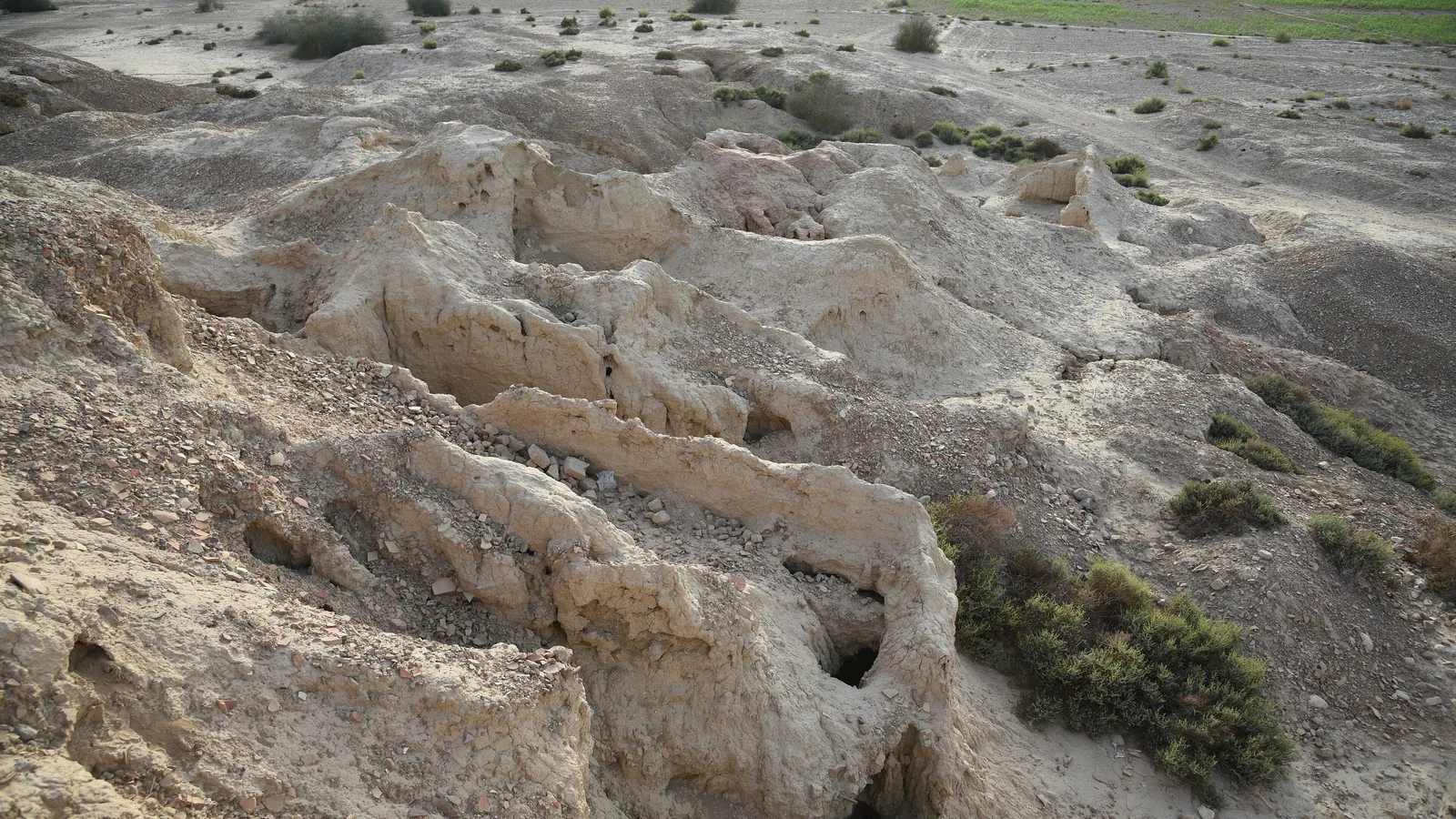

TL;DR — Mehrgarh, below the Bolan Pass, held a Neolithic village whose graves and workshops gave up drilled molars, cotton thread in a copper bead and the oldest known lost-wax casting.
A copper wheel 20 millimeters across, six spokes on a ring, is what M. Thoury and colleagues called in 2016 “the oldest known artefact made by lost-wax casting.” Their paper in Nature Communications described it as “a 6,000-year-old amulet from Mehrgarh (Baluchistan, Pakistan).” It came out of the ground in 1985 on the Kachi plain of what is now Pakistan, where the Indus valley meets the mountains of Balochistan below the Bolan Pass. The French Mission Archéologique de l’Indus opened its first trenches there in November 1974 with the Department of Archaeology of Pakistan, and later seasons produced the earliest known cotton fibers, the earliest known drilled human teeth and workshops for beads, shell and pottery. All of it predates the Indus civilization, which the excavator Jean-François Jarrige dated to 2500 to 1900 BC.
Quick facts
- When
- Aceramic Neolithic levels with drilled molars dated 7,500 to 9,000 years ago (Coppa et al., 2006); cotton thread in a copper bead of the first half of the 6th millennium BC (Liu et al., 2022, citing Moulherat et al., 2002); bead and shell workshops at MR.2 about 4000 to 3500 BC; copper amulet about 6,000 years old (Thoury et al., 2016); first excavation season mid-November 1974 to mid-February 1975
- Where
- The Kachi plain of Balochistan, in what is now Pakistan, at about 150 meters above sea level where the Indus valley meets the Balochistan mountains below the Bolan Pass; an archaeological zone of nearly 200 hectares cut on the north by the Bolan River
- Who
- Jean-François Jarrige (1940 to 2014) and Catherine Jarrige (born 1942) of the Mission Archéologique de l'Indus, with the Department of Archaeology of Pakistan; A. Coppa and colleagues for the teeth; Christophe Moulherat and colleagues for the cotton; M. Thoury and colleagues for the amulet; Massimo Vidale and Jonathan Mark Kenoyer for the workshops
- Outcome
- A stratified sequence from an aceramic Neolithic village to Chalcolithic craft workshops, holding the earliest known lost-wax cast object, the earliest known drilled human teeth and the earliest known cotton fibers, all older than the Indus civilization of 2500 to 1900 BC
The wheel that could not leave its mold
The amulet carries the inventory number MR.85.03.00.01 and was collected in 1985 in the MR2 area. Thoury’s team looked at its shape before its chemistry. The six rods lie on a ring 20 millimeters in diameter, both round in section, and at the hub the spokes were pressed onto one another until they joined. No plane could be cut through such a form without an undercut, so it could not have been pulled from a permanent mold. The model, they wrote, was made in “a wax-type material, that is, easily malleable and fusible,” invested in a clay mold that was heated upside down to run the wax out, then baked harder. Copper poured in took the wax’s place.
The metal was almost pure copper, possibly native copper, with traces of gold, mercury and silver, melted in air above 1,085 °C. Corrosion had turned the piece to cuprous oxide, yet the rod-like pattern of the original casting survived across millimeters. The paper calls the amulet about 6,000 years old, in its own words; its figure caption places the find in levels dated to 4,500 to 3,600 BC, sector X of MR2, Early Chalcolithic, end of period III.
Nine adults, eleven molars
In Nature on April 5, 2006, A. Coppa and nine co-authors, among them Catherine and Jean-François Jarrige, wrote: “Here we describe eleven drilled molar crowns from nine adults discovered in a Neolithic graveyard in Pakistan that dates from 7,500–9,000 years ago.” Earlier evidence of drilling living human teeth, they wrote, had been “limited to isolated cases from less than six millennia ago.” The journal’s summary stated that flint tips “were surprisingly effective” for drilling enamel.
The authors called the practice “a type of proto-dentistry” in an early farming culture. What it was for is not settled; the summary added that, because the drilling exposed sensitive tooth structure, some type of filling may have been involved. The abstract gives neither the graves’ sector numbers nor the season in which they were dug.
Cotton thread inside a copper bead
A copper bead from one of the Neolithic burials held several threads, preserved because corrosion had replaced them with metal salts. Christophe Moulherat, Margareta Tengberg, Jérôme-François Haquet and Benoît Mille published the analysis in the Journal of Archaeological Science in 2002; a summary on Harappa.com carries their identification of the fibers as cotton, genus Gossypium. Preservation of that kind, the summary quotes them as writing, “results exclusively from the corrosion process of copper” and “is rare, especially for periods before the ‘true’ metal ages, for which metal objects are extremely scarce.”
Li Liu of Stanford University and three co-authors, reviewing early cotton in Frontiers in Plant Science in 2022, placed the bead in the Aceramic Neolithic period I at Mehrgarh and its threads “in the first half of the 6th millennium BC,” roughly 6,000 to 5,500 BC, and called them the earliest known evidence for actual cotton fibers. Moulherat’s team could not say whether the plant was domesticated. In the summary’s words, it seemed clear to them that cotton “was already known and exploited for its fibres at this period.”
Workshops on the mound called MR.2
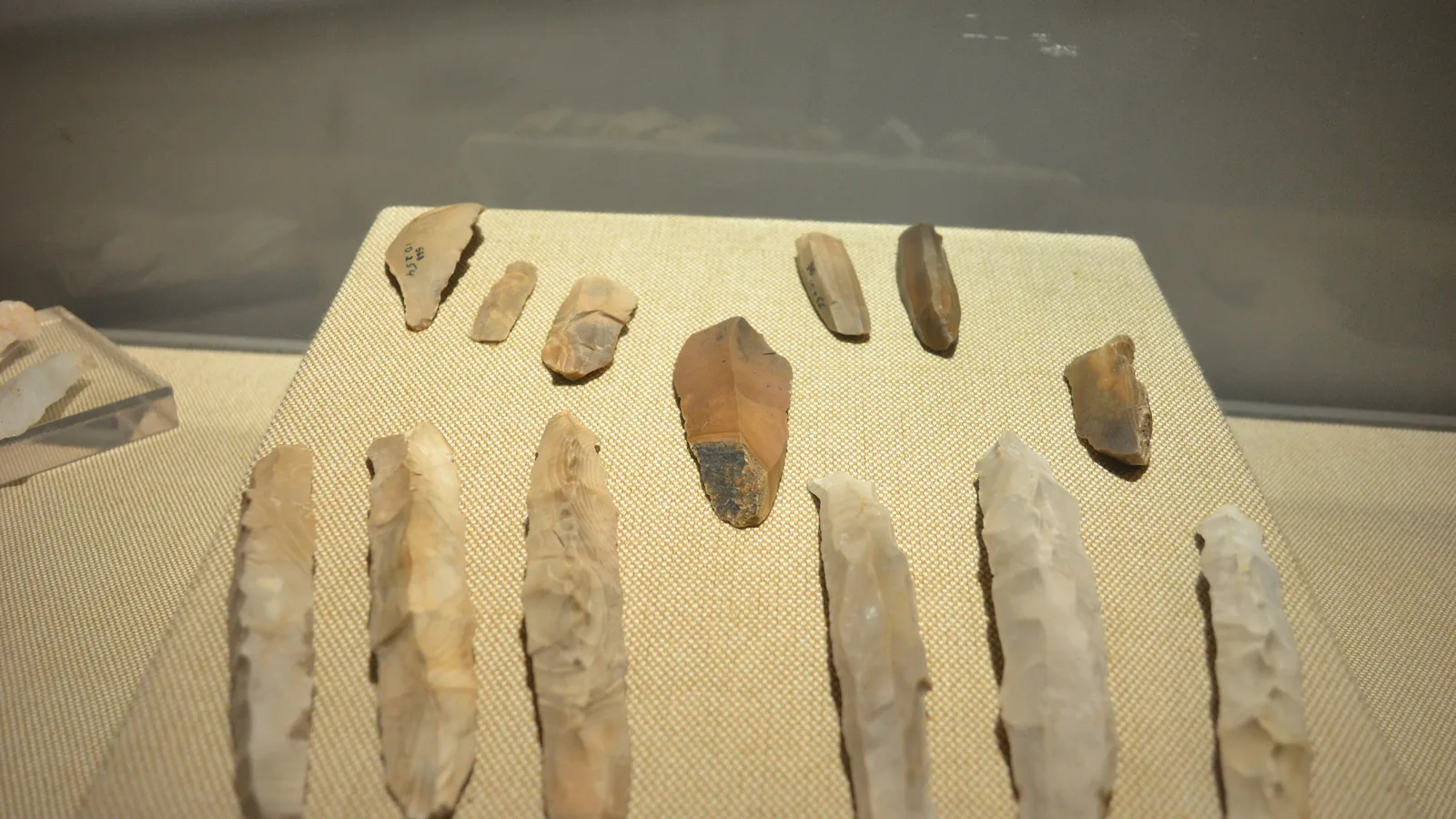
By the fourth millennium BC the settlement had turned to craft on an industrial scale. Massimo Vidale and three colleagues, in a paper on bead-making dedicated to the Jarriges, dated the MR.2 workshop area to roughly 4000 to 3500 BC, the Togau phase of Balochistan. Site MR.2H alone held “not less than 190 bone tools,” mostly cut from the bones of the onager, Equus hemionus, which the authors read as a hide and leather workshop. The field records of MR.2 list pottery workshops with millions of sherds of wheel-made polychrome ware, open-air firing areas and dumps of copper-melting crucibles, plus the lapis lazuli bead area that Vidale’s team studied.
Jonathan Mark Kenoyer’s study of shell at Mehrgarh describes libation vessels cut from the conch Turbinella pyrum, one of them decorated with incised lines filled with vermilion, a spiral around the apex and a double line framing the opening. A specialized shell industry was well documented at Indus sites of 2500 to 1750 BC, he wrote, but its early stages had been unknown until Mehrgarh was dug.

Mud brick beneath the plain
Jarrige’s first report, in Paléorient in 1974, described 13 weeks of work from mid-November 1974 to mid-February 1975 over 1,000 square meters, after the mission had spent 1968 to 1974 at Pirak, 25 kilometers away. In the lowest levels reached that season the team cleared part of a mud-brick structure more than 2.60 meters wide and 1.60 meters high, beside a house whose one excavated room had niches in its walls and complete pots on its floor. The mound that showed above the plain, Jarrige and Monique Lechevallier wrote in 1980, was only the last phase of occupation.
Soundings below the plain found the rest. The archaeological zone covers nearly 200 hectares, they wrote, and the Bolan River had cut a cliff along its north edge that showed the section of an aceramic Neolithic mound, its flanks buried under later silt. The deepest animal bones were all from wild species; in the three upper Neolithic layers domestic species appeared, which they called “une évolution très nette de la chasse vers l’élevage” (literally, “a very clear evolution from hunting toward herding”). Before the site was dug, farming in Balochistan had been thought to begin after 4000 BC with migrants from eastern Iran or Turkmenistan.
The Indus civilization that followed is dated 2500 to 1900 BC in Jarrige’s 1996 paper to the Académie des Inscriptions et Belles-Lettres and 2500 to 1750 BC by Kenoyer. Jean-François Jarrige (1940 to 2014) found Mehrgarh in 1974, directed the Mission Archéologique de l’Indus from 1975 to 2014 and was a director of the Musée Guimet in Paris; the first season at the site ran from mid-November 1974 to mid-February 1975 with the Department of Archaeology of Pakistan.
Key facts
- Mehrgarh lies on the Kachi plain of Balochistan, Pakistan, at about 150 meters above sea level where the Indus valley meets the mountains below the Bolan Pass; the archaeological zone covers nearly 200 hectares (Jarrige and Lechevallier, 1980).
- The wheel-shaped copper amulet MR.85.03.00.01, six spokes on a 20-millimeter ring, was collected in 1985 at MR2 and is the oldest known lost-wax cast object (Thoury et al., 2016).
- The paper calls the amulet about 6,000 years old; its figure caption puts the find in levels dated 4,500 to 3,600 BC.
- Eleven drilled molar crowns from nine adults came from a Neolithic graveyard dated 7,500 to 9,000 years ago (Coppa et al., Nature, 2006).
- Cotton fibers of genus Gossypium survived as mineralized threads inside a copper bead from a Neolithic burial (Moulherat et al., 2002); Liu et al. (2022) place them in Aceramic Neolithic period I, roughly 6,000 to 5,500 BC.
- The MR.2 workshops, about 4000 to 3500 BC, held at least 190 bone tools at MR.2H, pottery workshops with millions of sherds, copper-melting crucibles and a lapis lazuli bead-making area (Vidale et al.).
- Libation vessels of the conch Turbinella pyrum, one filled with vermilion, show shell working before the Indus civilization of 2500 to 1750 BC (Kenoyer).
- The first season ran 13 weeks, mid-November 1974 to mid-February 1975, over 1,000 square meters; Jean-François Jarrige (1940 to 2014) directed the mission from 1975 to 2014.
FAQ
Where is Mehrgarh?
On the Kachi plain of Balochistan in Pakistan, about 150 meters above sea level, at the point where the Indus valley runs up against the Balochistan mountains below the Bolan Pass. The Bolan River cuts through the north edge of the site, and the mission that dug it had worked at Pirak, 25 kilometers away, from 1968 to 1974.
How old are the drilled teeth from Mehrgarh?
Coppa and colleagues wrote in Nature in 2006 that the eleven drilled molar crowns, from nine adults, came from a Neolithic graveyard dated 7,500 to 9,000 years ago. The holes were made with flint tips; the abstract does not settle what the drilling was for.
Is the Mehrgarh amulet really the oldest lost-wax casting?
Thoury and colleagues identified it in 2016 as the oldest known artifact made by lost-wax casting, on the ground that its spoked-wheel shape could not have been withdrawn from a permanent mold. They call it about 6,000 years old; the levels it came from are captioned 4,500 to 3,600 BC.
Sources
- M. Thoury et al. — "High spatial dynamics-photoluminescence imaging reveals the metallurgy of the earliest lost-wax cast object," Nature Communications 7, 13356 (November 15, 2016), open access.
- A. Coppa, L. Bondioli, A. Cucina, D. W. Frayer, C. Jarrige, J.-F. Jarrige, G. Quivron, M. Rossi, M. Vidale and R. Macchiarelli — "Early Neolithic tradition of dentistry," Nature 440 (April 5, 2006), 755–756, abstract.
- Christophe Moulherat, Margareta Tengberg, Jérôme-François Haquet and Benoît Mille — "First Evidence of Cotton at Neolithic Mehrgarh, Pakistan: Analysis of Mineralized Fibres from a Copper Bead" (Journal of Archaeological Science 29, 2002), authors' summary on Harappa.com.
- Li Liu, Maureece J. Levin, Florian Klimscha and Danny Rosenberg — "The earliest cotton fibers and Pan-regional contacts in the Near East," Frontiers in Plant Science 13 (2022), via PubMed Central.
- Massimo Vidale, Maurizio Mariottini, Giancarlo Sidoti and Muhammad Zahir — "Early Evidence of Bead-Making at Mehrgarh, Pakistan: A Tribute to the Scientific Curiosity of Catherine and Jean-François Jarrige," presented with extracts on Harappa.com.
- Jonathan Mark Kenoyer — "Shell Trade and Shell Working During the Neolithic and Early Chalcolithic at Mehrgarh, Pakistan," introduction on Harappa.com.
- Jean-François Jarrige — "Nouvelles recherches archéologiques au Baluchistan. Les fouilles de Mehrgarh, Pakistan," Paléorient 2, no. 2 (1974), 495–498, on Persée (in French).
- Jean-François Jarrige and Monique Lechevallier — "Les fouilles de Mehrgarh, Pakistan: problèmes chronologiques," Paléorient 6 (1980), 253–258, on Persée (in French).
- Jean-François Jarrige — "Les fouilles de Nausharo au Balochistan pakistanais et leur contribution à l'étude de la civilisation de l'Indus," Comptes rendus des séances de l'Académie des Inscriptions et Belles-Lettres 140, no. 3 (1996), 821–878, on Persée (in French).
Cite this article
- APA
- Our Earth's History. (2026, September 22). A copper amulet cast by lost wax: Mehrgarh, Pakistan, 6,000 years ago. Our Earth's History. https://ourearthshistory.com/south-asia/prehistory/mehrgarh-balochistan-drilled-teeth-copper-amulet/
- Chicago
- Our Earth's History. “A copper amulet cast by lost wax: Mehrgarh, Pakistan, 6,000 years ago.” Our Earth's History, September 22, 2026. https://ourearthshistory.com/south-asia/prehistory/mehrgarh-balochistan-drilled-teeth-copper-amulet/.
- MLA
- “A copper amulet cast by lost wax: Mehrgarh, Pakistan, 6,000 years ago.” Our Earth's History, 22 Sep. 2026, https://ourearthshistory.com/south-asia/prehistory/mehrgarh-balochistan-drilled-teeth-copper-amulet/.
Text licensed CC BY-NC-ND 4.0. Found an error? Tell us.