What is painted at Bhimbetka, and how are the paintings dated?
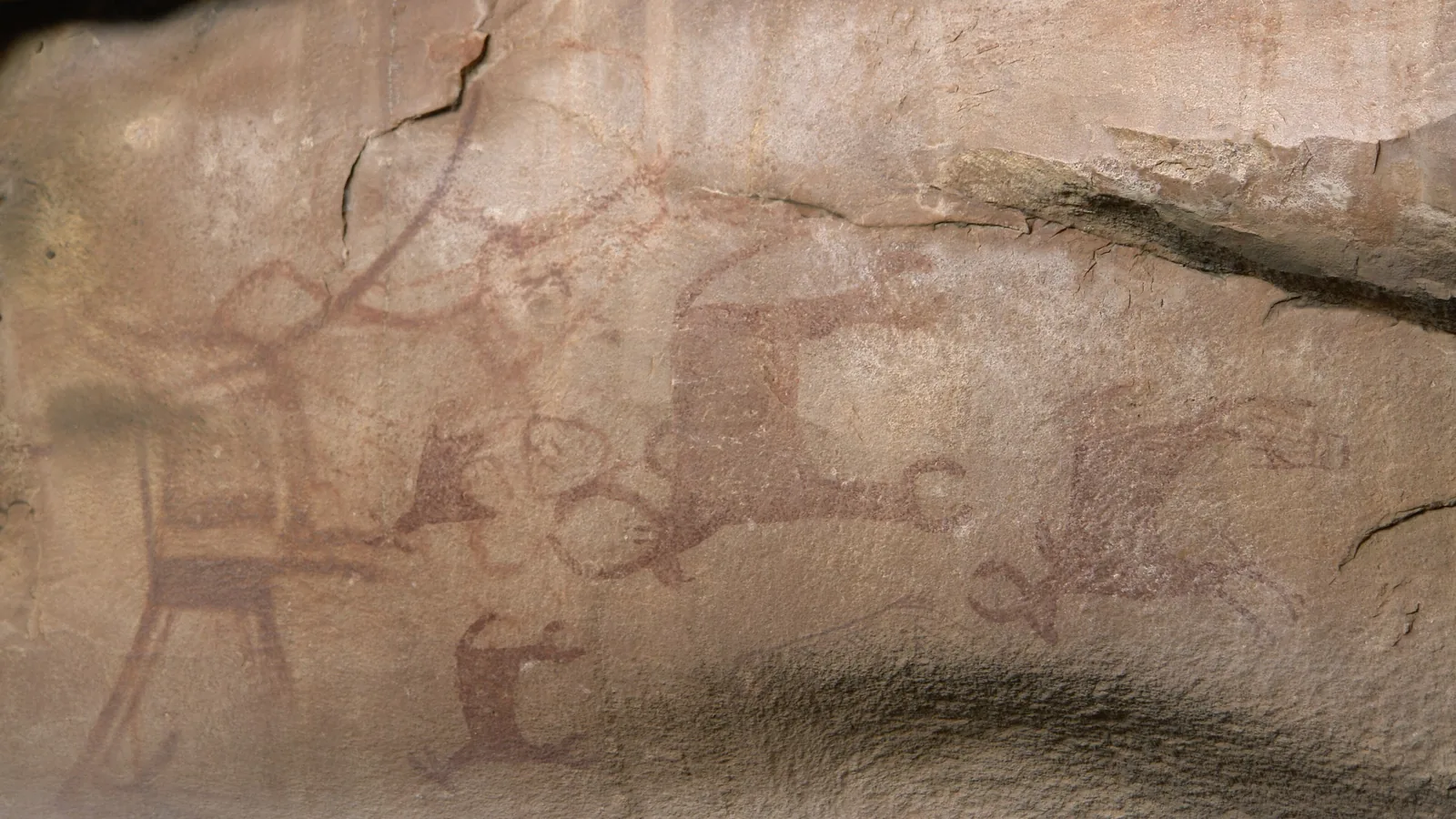

TL;DR — Bhimbetka’s sandstone shelters near Bhopal hold paintings from the Mesolithic to historic times, ordered by overlap, style and weathering; the paint itself has not been directly dated.
The Bhimbetka rock shelters, in sandstone hills 45 kilometers south of Bhopal in central India, hold paintings that run from the Mesolithic period into historic times. Excavations below the walls found deposits from the Acheulian, the early Stone Age, up to the historical period, according to the French prehistorian Jean Clottes. The paintings have been put in order by which figure lies over which, by style and by how far the pigment has weathered. The evaluation that ICOMOS, the advisory body on cultural sites, wrote for UNESCO in 2003 stated that the art “has not been directly dated.” Vishnu Shridhar Wakankar found the shelters in 1957, UNESCO listed them in 2003, and a 2021 report of an Ediacaran fossil on the same sandstone was answered two years later with an identification as a decayed beehive.
Quick facts
- When
- Occupation deposits from the Acheulian onward; paintings from the Mesolithic (roughly 12,000 to 5,000 years ago) to the historic period; discovered 1957; inscribed by UNESCO 2003; fossil claim 2021, refuted 2023
- Where
- Bhimbetka Hill in the Vindhyan Hills, 45 kilometers south of Bhopal, Madhya Pradesh, central India; five clusters of sandstone shelters with 21 villages in the buffer zone
- Who
- Vishnu Shridhar Wakankar (1919 to 1988), who found the shelters; Yashodar Mathpal, who classified the paintings; the Gond, Pradhan and Korku villagers beside the site
- Outcome
- A sequence of paintings placed in order by which figure lies over which, by style and by weathering; ICOMOS wrote in 2003 that the art had not been directly dated
A sandstone hill 45 kilometers from Bhopal
Bhimbetka Hill stands in the Vindhyan Hills on the southern edge of the central Indian plateau, in the state of Madhya Pradesh. The ICOMOS evaluation of March 2003 described “massively sculpted sandstone rock formations” above fairly dense forest, with five clusters of natural shelters inside a property of 1,893 hectares and a buffer zone of 10,280 hectares.
How many shelters there are depends on who is counting. ICOMOS listed “400 painted rock shelters in five clusters,” of which the nomination had documented 133; the Indian government’s tourism portal, Incredible India, says more than 750 shelters on seven hills over 10 kilometers; Clottes wrote of more than 500 painted shelters. Wakankar’s survey of 1972 counted 700 shelters across the wider area, 243 of them in the Bhimbetka group.
Wakankar gets off a train
The shelters were known locally long before archaeologists arrived. ICOMOS noted that Bhimbetka was first mentioned in 1888 as a Buddhist site, on information from local adivasis, the term Indian usage gives to indigenous peoples.
Wakankar, born on May 4, 1919, at Neemuch in Madhya Pradesh, told the interviewer K. L. Kamat how he found the site: “In 1956, I was going from Bhopal to Itarasi by train and felt that the mountains hid great history in them. I got down in the next station and walked up here. The very first cave I entered had paintings in it!” ICOMOS and Clottes both date the discovery to 1957, the year he began work there. He assigned some images to the Mesolithic and even the late Paleolithic, and from 1972 to 1977 he and two colleagues, Misra and Hass, excavated a continuous sequence from the Late Acheulian to the Late Mesolithic. His trench in shelter III F, the Auditorium cave, is kept open for visitors. He received the Padma Shri in 1975 and died in 1988.
What the walls show
The paintings are mostly red and white. ICOMOS summarized them as a record of the forest’s animals and of people’s working and social lives: extinct fauna and mythical creatures, domesticated animals, carts and chariots, Buddhist symbols and inscriptions, processions of men on caparisoned horses and elephants, and battle scenes.
Yashodar Mathpal, who studied most of the shelters, set out nine phases, as summarized by Clottes. The first has large buffaloes, elephants and big cats with no humans. The second has small, lively hunters in groups and deer, in red, white and emerald green, with dancers whose bodies curve in an S. Phase 6 brings humped cattle and carts with yoked oxen, the start of farming life. Phases 7 to 9 have riders on horses and elephants, soldiers with spears, swords and shields, and finally inscriptions. Of 817 human figures Mathpal recorded, 779 were men; of 428 animals, 185 were horses.
The red came from iron oxides such as hematite and the white from a clay like kaolin; green and yellow came from copper minerals and black from manganese or charcoal, according to K. K. Chakravarty and R. G. Bednarik in a 1997 book quoted by Clottes. The color was rubbed on dry or with water, by fingertip, twig, hair brush or spraying from the mouth, with no visible binder.
How the paintings are dated
Clottes called dating the art “a thorny problem.” The scheme most Indian researchers use, he wrote, has three periods: Mesolithic, roughly 12,000 to 5,000 years before present; Chalcolithic, roughly 5,000 to 2,500; and Historical from 2,500 onward. The order rests on three kinds of evidence. First, superimposition: painters kept adding figures over older ones, and ICOMOS recorded up to 15 layers in a single shelter. Second, subject and style: naturalistic wild animals give way to cattle and chariots, then to fighting and to inscriptions that can be read. Third, weathering: Pandey wrote in 1992 that Mesolithic paintings were always patinated, Chalcolithic ones sometimes, historic ones never.
What is missing is a date on the paint. ICOMOS wrote that “absolute dates have not been established” and that the case for a Mesolithic start came from pigment found in Mesolithic excavation layers and from patterns shared with Chalcolithic Malwa pottery. It added that sampling of rock crusts and paint with Australian researchers was under way in 2003. None of the pages read for this article reports a result from that work.
A fossil that turned out to be a beehive
In February 2021 Gregory J. Retallack and four co-authors published “Dickinsonia discovered in India and late Ediacaran biogeography” in Gondwana Research. They reported Dickinsonia tenuis, an organism of the late Ediacaran period, in the Maihar sandstone at the Bhimbetka shelters, and drew conclusions from it about the geography of that time.
Joseph G. Meert, Manoj K. Pandit, Samuel Kwafo and Ananya Singha visited the shelters in December 2022 and posted a preprint on December 16. The “fossil,” they wrote, “resembles decayed parts of modern Apis dorsata (giant honeybees) hives,” and “is not located on a bedding surface and is not a part of the rock.” Their paper appeared in Gondwana Research in May 2023. The question they asked, whether a mark belongs to the rock or sits on it, is the one the painted walls raise too.
The villages beside the rocks
UNESCO listed Bhimbetka in 2003 under two criteria. Criterion (iii) cites “a long interaction between people and the landscape, as demonstrated in the quantity and quality of its rock art.” Criterion (v) ties the site to “a hunting and gathering economy as demonstrated in the rock art and in the relicts of this tradition in the local adivasi villages on the periphery of this site.” Twenty-one villages lie in the buffer zone, and ICOMOS named the Gonds, Pradhans and Korkus, whose house paintings and pottery patterns resemble the images on the rock and who still gather forest food and wild honey.
The evaluators also wrote that no ethnographic work had been done on those villages and recommended deferring the nomination; the World Heritage Committee inscribed the site the same year. Chakravarty and Bednarik warned against reading modern rituals into ancient pictures, and Clottes agreed.
What Bhimbetka shows, then, is a sequence of hunters, herders and horsemen painted over one another on the same walls above Stone Age floors. Their order is read off the walls; their ages in years are inferred, not measured.
Key facts
- Bhimbetka lies in the Vindhyan Hills 45 kilometers south of Bhopal, Madhya Pradesh; the listed property covers 1,893 hectares with a 10,280-hectare buffer zone.
- ICOMOS counted 400 painted shelters in five clusters; the Indian tourism portal says more than 750 shelters on seven hills.
- Vishnu Shridhar Wakankar (1919 to 1988) found the shelters in 1957; excavations from 1972 to 1977 reached Late Acheulian deposits.
- Yashodar Mathpal divided the paintings into nine phases, from large animals without humans to mounted soldiers and inscriptions.
- Pigments were hematite red, kaolin white, copper-mineral green and yellow, and manganese or charcoal black.
- The paintings are ordered by superimposition (up to 15 layers), style and weathering; ICOMOS wrote in 2003 that they had not been directly dated.
- A 2021 report of a Dickinsonia fossil at the site was answered in 2023 by Meert and colleagues, who identified the mark as the remains of a giant honeybee hive.
FAQ
How old are the Bhimbetka paintings?
The earliest are placed in the Mesolithic, roughly 12,000 to 5,000 years before present, on the basis of style, overlap and pigment found in Mesolithic excavation layers. The paint itself has not been directly dated, according to the ICOMOS evaluation of 2003.
Who discovered Bhimbetka?
Vishnu Shridhar Wakankar, an archaeologist from Madhya Pradesh, who said he spotted the hills from a train and walked up to find the first painted cave. ICOMOS dates the discovery to 1957. The site had been mentioned as a Buddhist place in 1888.
Was a Dickinsonia fossil found at Bhimbetka?
No. A 2021 paper in Gondwana Research reported Dickinsonia, an organism of the Ediacaran period, on the sandstone. Meert and colleagues visited in December 2022 and wrote that the mark was waxy material on the rock surface, the decayed remains of a giant honeybee hive.
Sources
- UNESCO World Heritage Centre — "Rock Shelters of Bhimbetka," World Heritage List, dossier 925 (inscribed 2003, criteria iii and v).
- ICOMOS — Advisory Body Evaluation, "Bhimbetka (India), No 925" (March 2003), UNESCO World Heritage Centre document 154601.
- Incredible India, Ministry of Tourism, Government of India — "Bhimbetka Rock Shelters," Bhopal, Madhya Pradesh.
- Bradshaw Foundation, India Rock Art Archive — "Dr V. S. Wakankar, Archaeologist, 1919 to 1988," with an extract from K. L. Kamat, "An Accidental Interview with Wakankar."
- Bradshaw Foundation, India Rock Art Archive — Jean Clottes, "Indian Rock Art" (The Rock Art of Central India).
- Gregory J. Retallack, Neffra A. Matthews, Sharad Master, Ranjit G. Khangar and Merajuddin Khan — "Dickinsonia discovered in India and late Ediacaran biogeography," Gondwana Research 90 (February 2021), 165–170; DOI 10.1016/j.gr.2020.11.008, bibliographic record via Crossref.
- Joseph G. Meert, Manoj K. Pandit, Samuel Kwafo and Ananya Singha — "Stinging News: 'Dickinsonia' discovered in the Upper Vindhyan of India not worth the buzz," EarthArXiv preprint (December 16, 2022; version 4, January 26, 2023), abstract.
- Joseph G. Meert et al. — same title, Gondwana Research 117 (May 2023), 1–7; DOI 10.1016/j.gr.2023.01.003, bibliographic record via Crossref.
Cite this article
- APA
- Our Earth's History. (2026, September 21). What is painted at Bhimbetka, and how are the paintings dated? Our Earth's History. https://ourearthshistory.com/south-asia/prehistory/bhimbetka-rock-shelters-how-dated/
- Chicago
- Our Earth's History. “What is painted at Bhimbetka, and how are the paintings dated?” Our Earth's History, September 21, 2026. https://ourearthshistory.com/south-asia/prehistory/bhimbetka-rock-shelters-how-dated/.
- MLA
- “What is painted at Bhimbetka, and how are the paintings dated?” Our Earth's History, 21 Sep. 2026, https://ourearthshistory.com/south-asia/prehistory/bhimbetka-rock-shelters-how-dated/.
Text licensed CC BY-NC-ND 4.0. Found an error? Tell us.