Stone tools below and above the Toba ash at Jwalapuram, since 2007
.jpg)
TL;DR — Middle Paleolithic tools lie below and above the 74,000-year Toba ash at Jwalapuram, India; a 2025 study of that ash found warming and drying, not a volcanic winter.
“The lower levels of the open-air localities contain a distinct chronostratigraphic marker in the form of a volcanic ash (tephra) layer deposited from the Sumatran Toba supereruption at ca. 74 ka.” The sentence comes from a 2009 paper by Michael Petraglia and 15 colleagues in the Proceedings of the National Academy of Sciences, and the ground is Jwalapuram, a group of excavated sites in the Jurreru River valley of Andhra Pradesh, in southern India. Two years earlier, on July 6, 2007, Petraglia, Ravi Korisettar, Nicole Boivin, Christopher Clarkson and ten others had published “Middle Paleolithic assemblages from the Indian subcontinent before and after the Toba super-eruption” in Science, volume 317. That paper sits behind a paywall, and what follows draws on it only as later papers cite and restate it: stone tools of one Middle Paleolithic kind lay on both sides of the ash. Each part of that story has been re-examined since, last in 2025.
Quick facts
- When
- Toba eruption dated 73.88 ± 0.32 ka (Storey, Roberts and Saidin, 2012) or 75.0 ± 0.9 ka (the age Lane, Chorn and Johnson used in 2013) · Science paper July 6, 2007 · PNAS synthesis 2009 · Lake Malawi ash and replies 2013 · Dhaba 2020 · Retlapalle 2024 · seasonal study of the Jwalapuram ash 2025
- Where
- Jwalapuram, Jurreru River valley, Andhra Pradesh, southern India (Localities 3, 9, 21, 22, 23); Lenggong Valley, Malaysia; Lake Malawi, East Africa; Dhaba, Middle Son valley, Madhya Pradesh; Retlapalle, Gundlakamma basin, Andhra Pradesh
- Who
- Michael Petraglia, Ravi Korisettar, Nicole Boivin, Christopher Clarkson and colleagues; Stanley H. Ambrose; Christine S. Lane, Ben T. Chorn and Thomas C. Johnson; Richard G. Roberts, Michael Storey and Michael Haslam; Devara Anil; Gopesh Jha
- Outcome
- The same Middle Paleolithic tool kinds lie under and over the ash at Jwalapuram (about 74 and 38 ka) and at Dhaba (79.6 ± 3.2 to 65.2 ± 3.1 ka); Lake Malawi sediment shows no cooling at the ash; a 2025 study of six monsoon cycles in the Jwalapuram ash found warming and drying rather than a volcanic winter
Localities 3, 21 and 23 in the Jurreru valley
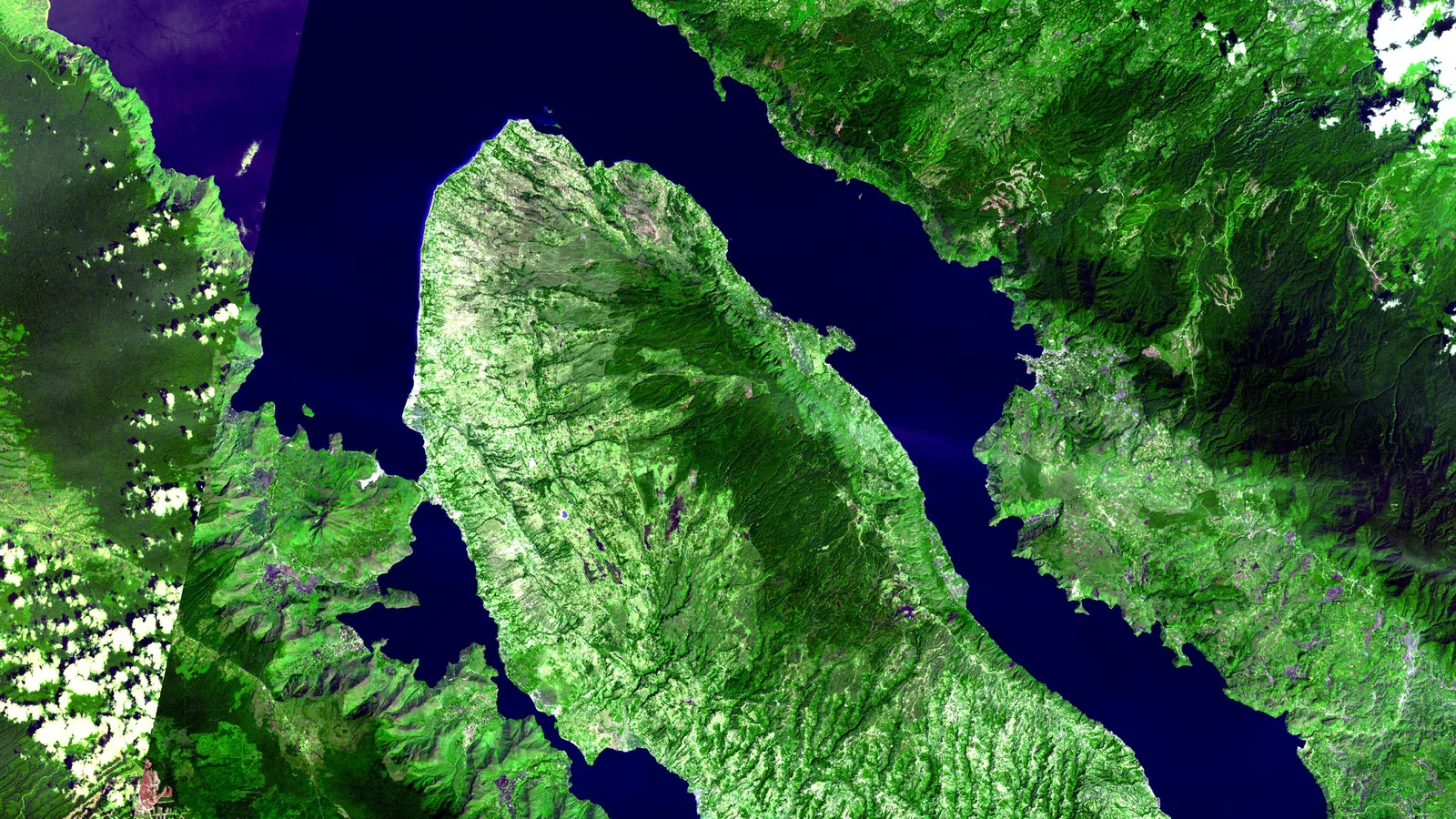
Michael Storey, Richard G. Roberts and Mokhtar Saidin opened a 2012 paper in the same Proceedings with the scale of the event: “The Toba supereruption in Sumatra, ∼74 thousand years (ka) ago, was the largest terrestrial volcanic event of the Quaternary.” They dated it, from sanidine crystals in the Lenggong Valley of Malaysia, at “73.88 ± 0.32 ka (1σ, full external errors).” Gopesh Jha and 18 co-authors, writing in PNAS Nexus in 2025, put the volume at “an estimated 5,300 km3 of pyroclastic material, covering ∼40 million km2 with a layer of Younger Toba Tuff (YTT) exceeding 5 mm.”
Some of that layer settled in the Jurreru valley. The 2009 paper lists three open-air sites, Localities 3, 21 and 23, and one rock shelter, Locality 9, in deposits “spanning the past 78 ka”; Jha’s team gave the occupation as “ranging from ∼77 ka to 11.3 ka.” The open-air tool sets were dated by optically stimulated luminescence (OSL) to about 74 ka below the ash and about 38 ka above it, and the 2009 paper wrote that analysis of them “demonstrates that intersite variability is minor over the period represented.” The first real change came much later: “systematic microblade and backed artifact production” in the lower levels of the Locality 9 rock shelter, which slightly predates 34 ka.
Ambrose, 1998, and a six-year winter
The hypothesis those tools were set against is older than the dig. Stanley H. Ambrose published “Late Pleistocene human population bottlenecks, volcanic winter, and differentiation of modern humans” in the Journal of Human Evolution in 1998. Jha’s 2025 paper summarizes it: “some researchers have proposed that the YTT eruption induced a 6-year-long global ‘volcanic winter’ and even caused a human population bottleneck.” Christine S. Lane, Ben T. Chorn and Thomas C. Johnson, in PNAS in 2013, added that “the genetic data can as easily be explained by other, noncatastrophic factors.” A 2003 paper by F. J. Gathorne-Hardy and W. E. H. Harcourt-Smith in the Journal of Human Evolution put the question in its title: “The super-eruption of Toba, did it cause a human bottleneck?”
Two cores from Lake Malawi, 2013
Lane, Chorn and Johnson found the Toba ash as microscopic glass shards in two sediment cores from Lake Malawi, about 7,300 kilometers from the caldera, a find that “increases the previously known dispersal distance of ash from this supereruption by nearly 3,000 km.” The sediment around the shards showed “no obvious change in composition throughout the 4-cm interval.” Had the region cooled by about 4 °C, as climate models had estimated, the lake should have overturned; it had not. The authors concluded “that the eruption did not significantly impact the climate of East Africa and was not the cause of a human genetic bottleneck at that time.”
Roberts, Storey and Michael Haslam answered in the same journal later in 2013. They accepted the ash but wrote that “we think Lane et al. are premature in extrapolating their environmental findings to all of East Africa,” since Rift Valley lakes had responded to past climate change in converse ways. They also disputed the age Lane’s group had adopted, 75.0 ± 0.9 ka, and held the event “best constrained by the high-precision age of 73.88 ± 0.32 ka.” Lane’s reply gave up neither point: temperature, not rainfall, “was purported to be” the eruption’s main effect, and the two ages “overlap within 2σ uncertainties.”
From Dhaba to Retlapalle, 2020 and 2024
Clarkson, Petraglia and 14 co-authors reported in Nature Communications in 2020 on Dhaba, in the Middle Son River valley of Madhya Pradesh: “An unchanging stone tool industry is found at Dhaba spanning the Toba eruption of ~74 ka (i.e., the Youngest Toba Tuff, YTT) bracketed between ages of 79.6 ± 3.2 and 65.2 ± 3.1 ka, with the introduction of microlithic technology ~48 ka.” The sequence, they wrote, “closely mirrors that at Jwalapuram in southern India.”
A 2024 paper in PLoS One by Devara Anil and six colleagues dated Middle Paleolithic tools at Retlapalle, in the Gundlakamma basin of Andhra Pradesh, to 139 ± 17 ka, and read the record as a culture “showing signs of behavioural resilience to bigger climatic upheaval like ~74 ka Toba super-eruption.” A 2009 paper by Williams, Ambrose and five others in Palaeogeography, Palaeoclimatology, Palaeoecology, and a 2010 comment on it by Haslam and Petraglia, carried the dispute over South Asia’s environment; neither is drawn on here beyond its title.
"Six annual monsoonal cycles" in the ash, 2025
Jha’s team went back to the ash. At the section they call JWP2020 it is divided by six layers of grayish hardpan, crusts that formed after each wet period, and the paper reads the alternation as wet and dry seasons. It states the limit: “While annually resolved chronometric data is beyond the capabilities of current methods,” the stratigraphy indicates that the deposits “likely represent six annual monsoonal cycles.” Geochemistry and stable isotopes through those cycles gave “an initial year of muted cooling following the eruption, followed by a multiyear warming period, and then a year of environmental stabilization.”
The conclusion reads: “Our novel palaeoclimate data do not show any signs of a ‘volcanic winter.’” Weathered tephra and dolomite enrichment were taken “as indicators of warming and aridity after YTT,” and while a couple of years of that would have hurt local ecologies, “near-extinction events seem unlikely.” The ash that Petraglia’s team used as a time marker in 2007 was read in 2025 as six monsoon years, and the paper’s summary of the archaeology that followed states “continuity of Middle Paleolithic populations and no significant changes in technological practices over the period 74–56 ka.”
Key facts
- Petraglia, Korisettar, Boivin, Clarkson and ten others published “Middle Paleolithic assemblages from the Indian subcontinent before and after the Toba super-eruption” in Science 317 on July 6, 2007 (cited in Clarkson 2020 and Lane 2013).
- Storey, Roberts and Saidin dated the eruption to 73.88 ± 0.32 ka from sanidine in the Lenggong Valley, Malaysia, 350 kilometers from the source (PNAS, 2012).
- Lane, Chorn and Johnson used the alternative age of 75.0 ± 0.9 ka; the two “overlap within 2σ uncertainties” (PNAS, 2013).
- Jwalapuram Localities 3, 21 and 23 are open-air sites and Locality 9 a rock shelter, in deposits “spanning the past 78 ka” (Petraglia et al., PNAS, 2009).
- Open-air tool sets below and above the ash were OSL dated to about 74 and 38 ka; “intersite variability is minor” (PNAS, 2009).
- Microblade production at Locality 9 slightly predates 34 ka; three one-meter squares gave more than 53,000 artifacts (PNAS, 2009).
- Toba glass shards in Lake Malawi cores, about 7,300 kilometers from Sumatra, sit in sediment with “no obvious change in composition throughout the 4-cm interval” (Lane et al., 2013).
- At Dhaba, Madhya Pradesh, one tool industry spans 79.6 ± 3.2 to 65.2 ± 3.1 ka, with microliths from about 48 ka (Clarkson et al., Nature Communications, 2020).
FAQ
Did humans survive the Toba eruption in India?
Excavations at Jwalapuram in Andhra Pradesh found Middle Paleolithic stone tools of the same kind below and above the Toba ash, dated by luminescence to about 74 and 38 ka (Petraglia et al., 2007 and 2009). Dhaba in Madhya Pradesh showed an unchanging industry from 79.6 ± 3.2 to 65.2 ± 3.1 ka, one that "strongly resembles stone tool assemblages from the African Middle Stone Age (MSA) and Arabia" (Clarkson et al., 2020).
How old is the Youngest Toba Tuff?
Two argon-argon ages are in use: 73.88 ± 0.32 ka (Storey, Roberts and Saidin, 2012) and 75.0 ± 0.9 ka, the age Lane, Chorn and Johnson adopted in 2013. The difference comes from the standards and calibration models used, and the two overlap within 2σ.
Was there a volcanic winter after Toba?
Lake Malawi sediment shows no temperature or composition change at the ash (Lane et al., 2013). At Jwalapuram, a 2025 study of six monsoon cycles in the ash found a year of muted cooling, then several years of warming and drying, and no sign of a volcanic winter (Jha et al., PNAS Nexus).
Sources
- Petraglia, Clarkson, Boivin, Haslam, Korisettar and eleven others, "Population increase and environmental deterioration correspond with microlithic innovations in South Asia ca. 35,000 years ago," Proceedings of the National Academy of Sciences 106(30), 2009, at PubMed Central.
- Jha, Costa, Tsoupra and sixteen others, "Seasonally resolved stratigraphy at Jwalapuram India shows regional surface warming after the Toba volcanic super-eruption," PNAS Nexus 4(4), 2025, at PubMed Central.
- Storey, Roberts and Saidin, "Astronomically calibrated 40Ar/39Ar age for the Toba supereruption and global synchronization of late Quaternary records," Proceedings of the National Academy of Sciences 109(46), 2012, at PubMed Central.
- Lane, Chorn and Johnson, "Ash from the Toba supereruption in Lake Malawi shows no volcanic winter in East Africa at 75 ka," Proceedings of the National Academy of Sciences 110(20), 2013, at PubMed Central.
- Roberts, Storey and Haslam, "Toba supereruption: Age and impact on East African ecosystems," Proceedings of the National Academy of Sciences 110(33), E3047, 2013, at PubMed Central.
- Lane, Chorn and Johnson, "Reply to Roberts et al.: A subdecadal record of paleoclimate around the Youngest Toba Tuff in Lake Malawi," Proceedings of the National Academy of Sciences 110(33), E3048, 2013, at PubMed Central.
- Clarkson, Harris, Li and thirteen others, "Human occupation of northern India spans the Toba super-eruption ~74,000 years ago," Nature Communications 11, 961, 2020, at PubMed Central.
- Anil, Devi, Jha, Khan, Mahesh, Ajithprasad and Chauhan, "Deep-rooted Indian Middle Palaeolithic: Terminal Middle Pleistocene lithic assemblage from Retlapalle, Andhra Pradesh, India," PLoS One 19(8), 2024, at PubMed Central.
- Clarkson, Petraglia, Korisettar and ten others, "The oldest and longest enduring microlithic sequence in India: 35 000 years of modern human occupation and change at the Jwalapuram Locality 9 rockshelter," Antiquity 83(320), 2009, abstract at Cambridge University Press.
Cite this article
- APA
- Our Earth's History. (2026, September 22). Stone tools below and above the Toba ash at Jwalapuram, since 2007. Our Earth's History. https://ourearthshistory.com/south-asia/prehistory/jwalapuram-toba-ash-74000-years-stone-tools-below-and-above-science-2007/
- Chicago
- Our Earth's History. “Stone tools below and above the Toba ash at Jwalapuram, since 2007.” Our Earth's History, September 22, 2026. https://ourearthshistory.com/south-asia/prehistory/jwalapuram-toba-ash-74000-years-stone-tools-below-and-above-science-2007/.
- MLA
- “Stone tools below and above the Toba ash at Jwalapuram, since 2007.” Our Earth's History, 22 Sep. 2026, https://ourearthshistory.com/south-asia/prehistory/jwalapuram-toba-ash-74000-years-stone-tools-below-and-above-science-2007/.
Text licensed CC BY-NC-ND 4.0. Found an error? Tell us.