What is the oldest known drawing, and who made it?

TL;DR — Nine red ochre lines on a stone flake from Blombos Cave, South Africa, about 73,000 years old, drawn by Homo sapiens. The authors called it the oldest known drawing.
The oldest known drawing is a cross-hatch of nine red ochre lines on a silcrete flake from Blombos Cave, South Africa, about 73,000 years old, made by Homo sapiens. Christopher Henshilwood of the University of Bergen and five co-authors reported it in Nature on September 12, 2018, and wrote that it predated the earliest previously known drawings by at least 30,000 years. The same cave has yielded, each dated separately, engraved ochre of about 77,000 years, shell beads of about 75,000 years and a paint kit of about 100,000 years. Older engraved marks exist elsewhere, so the claim is for a drawing, a design made by applying pigment. The finds are cited as evidence that people in Africa used symbols long before the painted caves of Europe.
Quick facts
- When
- Drawing about 73,000 years old (reported September 12, 2018); engraved ochre about 77,000 (2002); shell beads about 75,000 (2004); ochre kit about 100,000 (found 2008, published 2011)
- Where
- Blombos Cave, a cliff cave on the southern Cape coast near Still Bay, Western Cape, South Africa, about 300 kilometers east of Cape Town
- Who
- Homo sapiens hunter-gatherers; excavations led by Christopher Henshilwood and Karen van Niekerk since 1991; the flake spotted by Luca Pollarolo
- Outcome
- The paper's authors call the flake the oldest known drawing; together with the engraved ochre, beads and paint kit it is cited as evidence that symbolic behavior in Africa predates the European cave art of 40,000 years ago
A small cave on the southern Cape coast
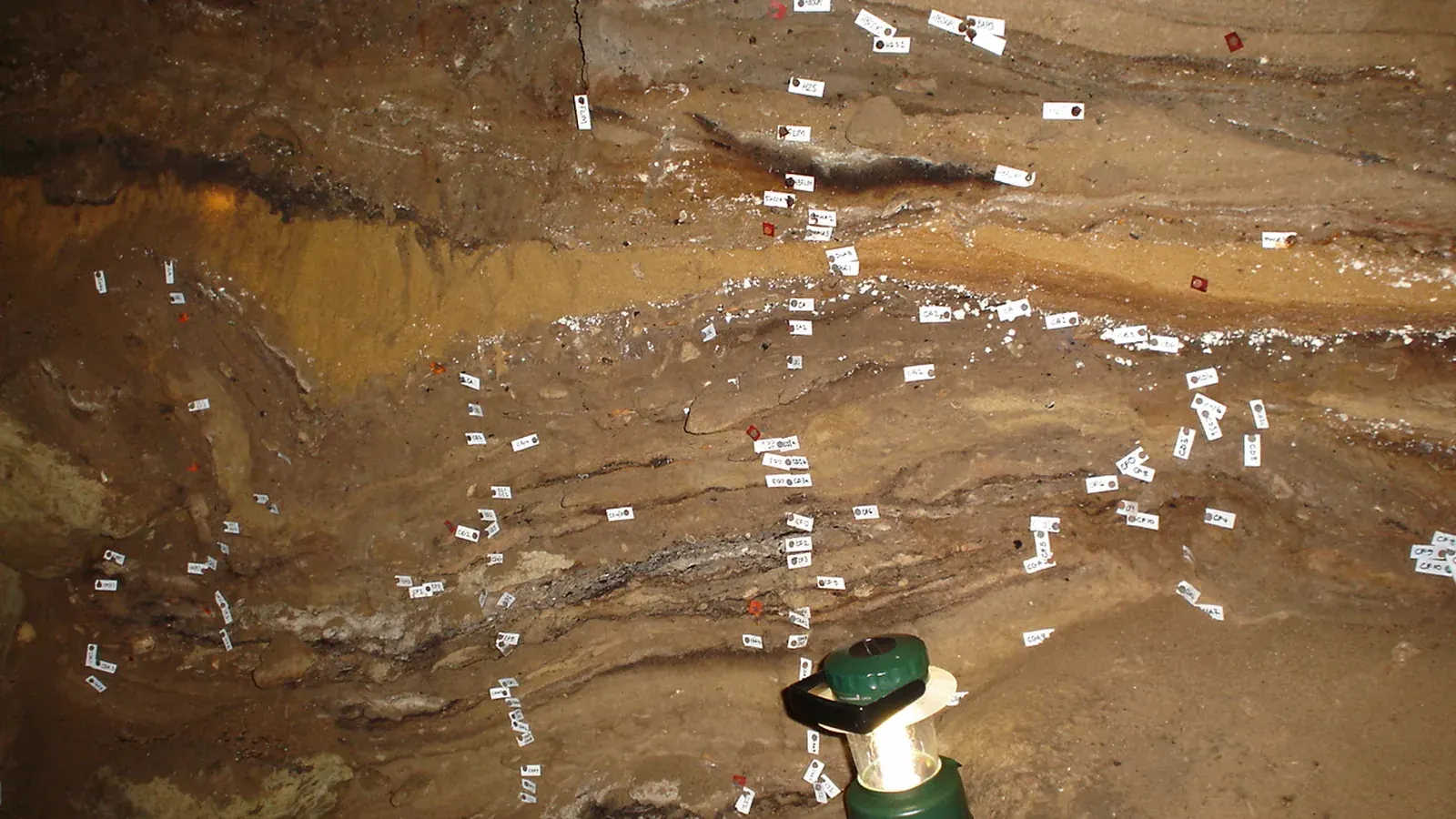
Blombos Cave opens in a cliff on the southern coast of South Africa, near the town of Still Bay in the Western Cape, about 300 kilometers east of Cape Town. Henshilwood and Karen van Niekerk described it in The Conversation in 2018 as a room of about 55 square meters above the Indian Ocean, used by hunter-gatherer groups of 20 to 40 people for a week or two at a time. Excavations under Henshilwood began in 1991; both he and van Niekerk belong to SapienCE, the Centre for Early Sapiens Behaviour at the University of Bergen, founded in 2017.
The Middle Stone Age layers date from about 100,000 to 70,000 years, and thin Later Stone Age layers on top from about 2,000 to 300 years. Between them lies dune sand that sealed the cave about 70,000 years ago, according to the 2004 National Science Foundation release.
The flake and how it was examined
Luca Pollarolo, an honorary research fellow at the University of the Witwatersrand, spotted the drawing while sorting thousands of stone flakes from the dig at the university’s laboratory in Cape Town, according to the Wits and CNRS releases. The flake is silcrete, sand grains cemented by silica, about an inch and a half long. Six roughly parallel straight lines are crossed by three slightly curved ones, and all nine stop dead at the edges, which the authors read as the remains of a larger pattern.
Under Francesco d’Errico at the University of Bordeaux the team examined the piece by microscope and Raman spectroscopy and found red ochre sitting on the stone rather than in it. They reproduced the lines with lumps of ochre and with brushes, and the match, they wrote, was an ochre crayon with a tip one to three millimeters wide, on a surface first smoothed by rubbing. The layer belongs to the Still Bay tool industry, dated to about 73,000 years.
The claim of “oldest” has limits the authors stated. Nature’s editorial listed what came before: shell engravings from Trinil in Java, about 540,000 years old and presumably by Homo erectus, and cave paintings in Spain of about 64,000 years, presumably by Neanderthals. Margaret Conkey of the University of California, Berkeley, told National Geographic that the dating and context were good, but that calling the ochre a “crayon” steered readers toward one reading; the lines might have been a doodle.
The engraved ochre and the beads that came first
In 2002 Henshilwood’s team reported in Science two pieces of red ochre, a few centimeters long, engraved with geometric lines on prepared surfaces. They came from the 1999 and 2000 seasons, and their layer was dated to about 77,000 years. A 2009 study of 13 engraved pieces put the practice between about 100,000 and 75,000 years; Curtis Marean of Arizona State University said further work should rule out scratches left when powder was cut from the ochre.
In 2004 the team reported 41 shells of Nassarius kraussianus, a small estuary snail, from a layer dated by optically stimulated luminescence (OSL) to about 75,000 years. Each had a hole and wear marks in the same position. Henshilwood said the oldest beads known from Africa until then were about 45,000 years old. The 2018 authors pointed to the engraved ochre as the reason to read the flake as a symbol: the same cross-hatch made with different tools on different materials.
A paint kit from 100,000 years ago
In 2008 the excavators uncovered two abalone shells holding a dried red mixture, with grindstones, hammerstones, bone and charcoal beside them. Sand around them was dated by OSL to about 100,000 years. The recipe, published in Science in October 2011, was ochre ground to powder, crushed heated bone, charcoal, stone chips and a liquid, stirred in the shells; the fat came from seal bone, Henshilwood told National Geographic.
What the mixture was for is unknown. The Wits release said it was possibly used for decoration, painting and skin protection, and National Geographic reported that it was not clear what the paint was later used for.
Stone points shaped by pressure
The Still Bay layers also produced bifacial points. In 2010 Vincent Mourre, Paola Villa and Henshilwood reported in Science that at least half of the finished points had been trimmed by pressure flaking, pressing a bone tool against the edge to detach thin flakes, after the silcrete had been heated. The earliest pressure flaking known before then was Solutrean work in France and Spain of about 20,000 years, according to the University of Colorado Boulder release.
What Blombos changed about symbols
Before these finds, the dominant view held that humans were anatomically modern by at least 160,000 years ago but did not behave in modern ways until some event around 40,000 or 50,000 years ago, in the words of the 2004 NSF release. Henshilwood and d’Errico argued instead that symbolic behavior grew gradually in Africa through the Middle Stone Age, and Blombos supplied their case piece by piece: engraved ochre in 2002, beads in 2004, the paint kit in 2011, the drawing in 2018.
Not everyone accepts the whole argument. Nicholas Conard of the University of Tübingen told Science News in 2009 that fully modern behavior, including figurative art, came tens of thousands of years later. Henshilwood himself avoided the word art. “We don’t know that it’s art at all,” he told National Geographic. “We know that it’s a symbol.”
The drawing, then, is nine lines in red on a flake that someone smoothed first, from a layer in which the same pattern was also cut into ochre. That is what the “oldest known drawing” rests on.
Key facts
- Blombos Cave is a cliff cave of about 55 square meters on the southern Cape coast near Still Bay, South Africa, 300 kilometers east of Cape Town.
- Excavations under Christopher Henshilwood began in 1991; the Middle Stone Age layers date from about 100,000 to 70,000 years.
- The drawing is nine red ochre lines on a silcrete flake from a level dated to about 73,000 years, reported in Nature on September 12, 2018.
- Luca Pollarolo of the University of the Witwatersrand found the flake among thousands of others in a Cape Town laboratory.
- Two engraved ochre pieces, about 77,000 years old, were reported in 2002; 41 Nassarius shell beads, about 75,000 years old, in 2004.
- Two abalone shells holding a red ochre mixture, about 100,000 years old, were found in 2008 and published in 2011; their purpose is unknown.
- Still Bay points from Blombos show pressure flaking on heat-treated silcrete, reported in 2010, about 50,000 years before the Solutrean examples.
FAQ
What is the oldest drawing in the world?
A cross-hatch of nine red ochre lines on a silcrete flake from Blombos Cave, South Africa, from a layer dated to about 73,000 years, reported in Nature in 2018. Older engravings exist, including a shell from Trinil, Java, of about 540,000 years.
Who made the Blombos drawing?
Homo sapiens hunter-gatherers who used the cave for short stays. The individual is unknown. The flake was recognized by Luca Pollarolo of the University of the Witwatersrand while sorting flakes from the excavation.
Is the Blombos drawing art?
The authors avoided the word. Henshilwood told National Geographic that the team did not know it was art but did know it was a symbol, because the same pattern was engraved on ochre in the same layers. Margaret Conkey of Berkeley suggested it might be a doodle.
Sources
- Christopher S. Henshilwood et al. — "An abstract drawing from the 73,000-year-old levels at Blombos Cave, South Africa," Nature (September 12, 2018), abstract.
- Nature — editorial, "The earliest known drawing in history sends a message through 73,000 years," Nature 561, 149 (2018).
- The Conversation — Christopher Henshilwood and Karen Loise van Niekerk, "South Africa's Blombos cave is home to the earliest drawing by a human" (September 2018).
- Popular Archaeology — "Scientists Discover Oldest Drawing," from the CNRS and University of the Witwatersrand news releases (September 2018).
- ScienceDaily — CNRS release, "Discovery of the earliest drawing" (September 12, 2018).
- National Geographic — "73,000-Year-Old Doodle May Be World's Oldest Drawing" (September 12, 2018).
- ScienceDaily — University of the Witwatersrand release, "100,000-year-old ochre toolkit and workshop discovered in South Africa" (October 18, 2011).
- National Geographic — "Oldest 'Art Studio' Found; Evidence of Early Chemistry" (October 15, 2011).
- ScienceDaily — National Science Foundation release, "Shell Beads From South African Cave Show Modern Human Behavior 75,000 Years Ago" (April 19, 2004).
- Science News — Bruce Bower, "Engraved pigments point to ancient symbolic tradition" (June 12, 2009).
- The Globe and Mail — Kim Honey, "77,000-year-old abstract art?" (January 11, 2002).
- CU Boulder Today — "Origin of Skillful Stone Tool Sharpening Method Pushed Back More Than 50,000 Years" (October 28, 2010).
- Smithsonian National Museum of Natural History, Human Origins Program — "Blombos Ocher Plaque."
- University of Bergen — "Centre for Early Sapiens Behaviour (SapienCE)."
Cite this article
- APA
- Our Earth's History. (2026, September 20). What is the oldest known drawing, and who made it? Our Earth's History. https://ourearthshistory.com/africa/prehistory/blombos-cave-oldest-drawing/
- Chicago
- Our Earth's History. “What is the oldest known drawing, and who made it?” Our Earth's History, September 20, 2026. https://ourearthshistory.com/africa/prehistory/blombos-cave-oldest-drawing/.
- MLA
- “What is the oldest known drawing, and who made it?” Our Earth's History, 20 Sep. 2026, https://ourearthshistory.com/africa/prehistory/blombos-cave-oldest-drawing/.
Text licensed CC BY-NC-ND 4.0. Found an error? Tell us.