From 195,000 to at least 233,000 years: Omo I and Omo II redated

TL;DR — Omo I and Omo II, found in 1967, were dated to 195 ± 5 kyr in 2005; a 2022 redating of the ash above gives a minimum of 233 ± 22 kyr.
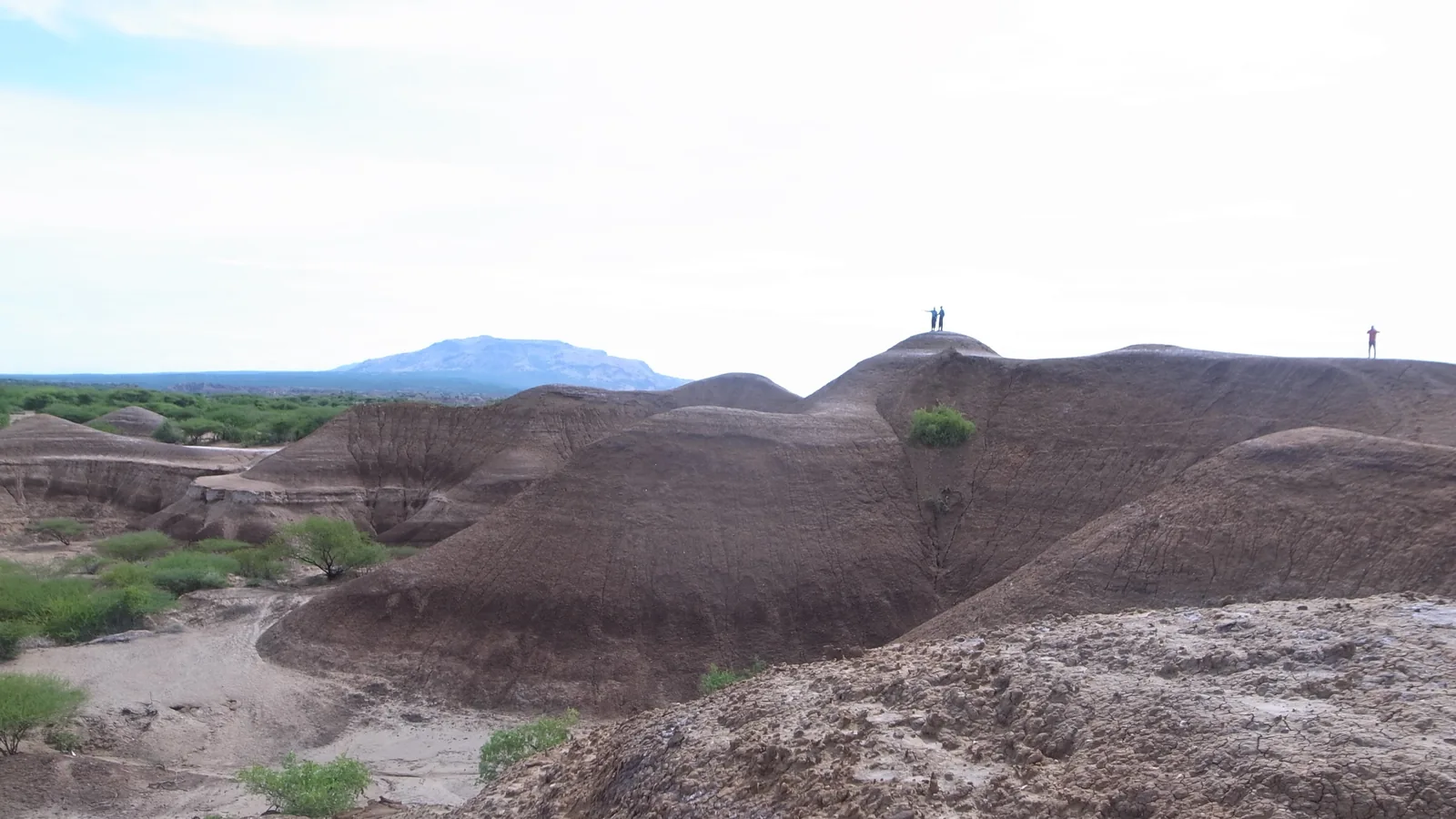
“Cranial and skeletal remains of modern humans, Homo sapiens, were discovered in the Kibish Formation in 1967 by a team from the Kenya National Museums directed by Richard Leakey.” That sentence opens the introduction to a 2008 special issue of the Journal of Human Evolution on the Kibish Formation, in the lower Omo valley of southern Ethiopia. In 2005 Ian McDougall, F. H. Brown and J. G. Fleagle reported in Nature that argon dating placed the two fossils, Omo I and Omo II, at 195 ± 5 kyr, “the earliest well-dated anatomically modern humans yet described.” In the issue of Nature dated January 12, 2022, Céline M. Vidal of the University of Cambridge and 11 co-authors matched the ash bed above the fossils to an eruption of Shala volcano and wrote: “we obtain a new minimum age for the Omo fossils of 233 ± 22 kyr.” The same paper states: “The challenge remains to obtain a robust maximum age for Omo I.”
Quick facts
- When
- 1967 (Omo I and Omo II found) · 2005 (McDougall, Brown and Fleagle publish 195 ± 5 kyr in Nature) · 2008 (Journal of Human Evolution special issue on the Kibish Formation) · January 12, 2022 (Vidal and co-authors publish a minimum age of 233 ± 22 kyr in Nature)
- Where
- Member I of the Kibish Formation, lower Omo valley, southern Ethiopia; Shala volcano in the Main Ethiopian Rift, 350 km to the northeast
- Who
- Richard Leakey and a team from the Kenya National Museums; Ian McDougall, F. H. Brown and J. G. Fleagle; Céline M. Vidal, Clive Oppenheimer and colleagues at the University of Cambridge and Addis Ababa University
- Outcome
- The 2005 argon dates gave a preferred age of 195 ± 5 kyr. In 2022 the KHS Tuff above the fossils was matched to the Qi2 eruption of Shala volcano, dated 233 ± 22 kyr, so the fossils must be at least that old; the maximum age of Omo I remains undetermined
Kamoya's Hominid Site and Paul's Hominid Site, 1967
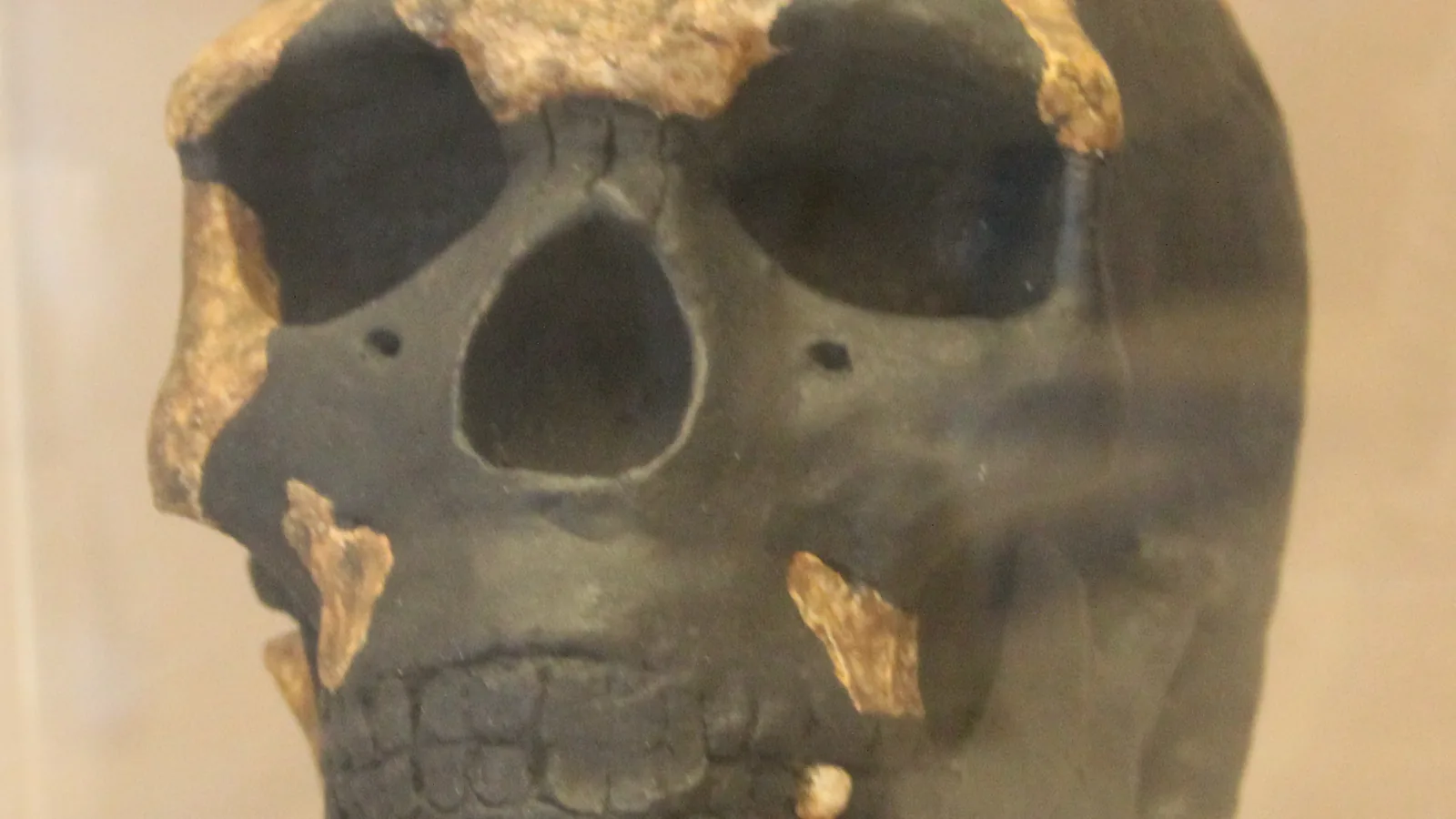
The 2008 introduction, by Fleagle, Z. Assefa, Brown and John Shea, describes the two fossils in one pair of sentences: “Omo I, from Kamoya’s Hominid Site (KHS), consists of much of a skeleton, including most of the cranial vault, parts of the face and mandible, and many postcranial elements. Omo II, from Paul’s Hominid Site (PHS), is a virtually complete calvaria.” A calvaria is a skullcap, the vault without face or jaw.
The levels themselves were disputed. McDougall, Brown and Fleagle wrote in 2005: “we confirm that the Omo I and Omo II hominid fossils are from similar stratigraphic levels in Member I of the Kibish Formation, despite the view that Omo I is more modern in appearance than Omo II.” Vidal and her co-authors place Omo I “at the surface of a siltstone near the top of Member I,” about 1.4 meters below the ash bed named after the same site, the KHS Tuff, which “is demonstrably younger than the fossils.”
Over 100,000 years, or about 130,000
The first published age had a floor and no ceiling. “The available dating techniques suggested a very early age, over 100 ka, for Member I, from which the Omo I and Omo II fossils were recovered,” the 2008 introduction reads. The Smithsonian’s Human Origins Program, on its page for Omo I, gives a rounder figure: “It was originally thought to be about 130,000 years old.”
Doubt followed. “In subsequent decades,” the 2008 introduction states, “the reliability of the dates and the provenance of the Kibish hominids were repeatedly questioned.” Ian Tattersall, in a review printed in the Proceedings of the National Academy of Sciences on September 21, 2009, listed Omo Kibish 1 among very early fossils “redated to 195 Ka,” and added that the few stone tools found with it “have been described as ‘unremarkable.’”
Feldspar from pumice: 195 ± 5 kyr in 2005
The 2005 paper rested on argon-argon dating of feldspar crystals from pumice washed into the Kibish sediments. The abstract gives two brackets: a tuff in Member I below the hominid levels “place[s] an older limit of 198 ± 14 kyr (weighted mean age 196 ± 2 kyr) on the hominids,” and “A younger age limit of 104 ± 7 kyr is provided by feldspars from pumice clasts in a Member III tuff.” Between those brackets the authors chose: “Our preferred estimate of the age of the Kibish hominids is 195 ± 5 kyr.”
Renewed fieldwork added bone. O. M. Pearson, D. F. Royer, F. E. Grine and Fleagle reported in the same 2008 issue finger bones, an ankle bone, two pieces of the left hip and “a portion of the distal diaphysis of the right femur that conjoins with the distal epiphysis recovered in 1967.” Two of the bones disagree about height: “The preserved portion of the left humerus suggests that Omo I was quite tall, perhaps 178–182 cm, but the first metatarsal suggests a shorter stature of 162–173 cm.” The pelvis reads as a young adult, and the authors left the sex undetermined. Three features of the forearm, ankle and thumb, they wrote, “are shared with Neandertals, some early modern humans from Skhul and Qafzeh, and some individuals from the European Gravettian.”
"A new minimum age": Shala volcano and 233 ± 22 kyr
Earlier correlations of the KHS Tuff with other Ethiopian ash layers failed the Cambridge and Addis Ababa team’s comparison of major and trace elements in the glass, “precluding a match.” Their match lay at Shala, “the largest caldera in the central MER” (the Main Ethiopian Rift), where they sampled a more than 20-meter-thick exposure of the Qi2 ignimbrite “southwest of Lake Shala and 350 km northeast of Omo-Kibish.”
The team dated 113 sanidine crystals from two pumice samples; after filtering, 71 remained, and “Combining analyses from both pumice samples yielded a weighted mean of 233 ± 22 kyr at 2σ.” The Nakaa’kire Tuff, inside Member I, had been dated at 197 ± 4 kyr; the paper calls the revised stratigraphy “incompatible” with that age, since the tuff “must therefore be older than 233 ± 22 kyr.” And the model that tied fast deposition at Kibish to Nile floods into the Mediterranean shifted: “Our KHS age is incongruent with the formation of Mediterranean Sapropel S6 at 172 ka, and instead overlaps the timing of the formation of sapropel S8 (217 ka).” Because the ash lies above the fossils, 233 ± 22 kyr is the youngest they can be, which is why the paper calls it a minimum.
Between Herto and Jebel Irhoud
The 2022 paper opens with a count: “Only eight sites in Africa have yielded possible early anatomically modern Homo sapiens fossils from the late Middle Pleistocene (approximately 350–130 thousand years ago (ka)).” The authors accept two Ethiopian finds, Omo I and Herto, as showing “unequivocal modern cranial apomorphies (that is, a tall cranial vault and a chin).” The Herto crania from the Middle Awash were described by T. D. White and colleagues in Nature in 2003 as “Radioisotopically dated to between 160,000 and 154,000 years ago.” Vidal’s team found that the ash above Herto does not correlate with the KHS Tuff, and their result “confirms that the Herto H. sapiens fossils are considerably younger than Omo I at Omo-Kibish.”
In 2017 D. Richter and colleagues reported in Nature that thermoluminescence dating placed the tools and fossils at Jebel Irhoud, Morocco, at “315 ± 34 thousand years ago,” and called those remains “the oldest reported for H. sapiens.” The Kibish paper cites that work but sets no Irhoud number beside Omo I. Nature received the manuscript on March 29, 2021, accepted it on November 23, 2021, and printed it on pages 579 to 583 of the issue dated January 12, 2022.
.jpg)
Key facts
- Omo I and Omo II were found in 1967 in the Kibish Formation, southern Ethiopia, by a team from the Kenya National Museums directed by Richard Leakey (Fleagle et al., 2008).
- Omo I, from Kamoya’s Hominid Site, is much of a skeleton with most of the cranial vault, parts of the face and mandible; Omo II, from Paul’s Hominid Site, is “a virtually complete calvaria” (Fleagle et al., 2008).
- The first estimates were “over 100 ka” (Fleagle et al., 2008) or “about 130,000 years old” (Smithsonian Human Origins Program).
- McDougall, Brown and Fleagle (Nature, 2005) set an older limit of 198 ± 14 kyr (weighted mean 196 ± 2), a younger limit of 104 ± 7 kyr, and a preferred age of 195 ± 5 kyr.
- Pearson, Royer, Grine and Fleagle (2008) estimated Omo I’s height at 178–182 cm from the humerus but 162–173 cm from the first metatarsal, with sex undetermined.
- Vidal et al. (Nature, January 12, 2022) matched the KHS Tuff to the Qi2 eruption of Shala volcano, 350 km northeast of Omo-Kibish, and dated 71 accepted sanidine crystals of 113 to 233 ± 22 kyr at 2σ.
- The paper calls 233 ± 22 kyr a minimum age and states that “The challenge remains to obtain a robust maximum age for Omo I.”
- Herto is dated 160,000–154,000 years (White et al., 2003) and Jebel Irhoud 315 ± 34 thousand years (Richter et al., 2017); the 2022 paper places Omo I above Herto and does not compare it numerically with Irhoud.
FAQ
How old are the Omo Kibish fossils?
At least 233 ± 22 thousand years, according to Vidal and co-authors in Nature (2022), who dated the eruption that produced the ash bed above the fossils. The earlier figure, 195 ± 5 kyr from McDougall, Brown and Fleagle (2005), was a preferred estimate between two brackets. No robust maximum age has been published.
Who found Omo I and Omo II?
A team from the Kenya National Museums directed by Richard Leakey, in 1967, according to the 2008 introduction to the Journal of Human Evolution special issue on the Kibish Formation. The Smithsonian's page says "A team led by Richard Leakey."
Are the Omo fossils the oldest Homo sapiens?
The 2022 Nature paper calls them "the oldest known Homo sapiens from eastern Africa." For Jebel Irhoud in Morocco, Richter and colleagues (2017) reported 315 ± 34 thousand years and called those remains the oldest reported for the species; the 2022 paper does not set the two side by side.
Sources
- Vidal, C. M., Lane, C. S., Asrat, A., Barfod, D. N., Mark, D. F., Tomlinson, E. L., Tadesse, A. Z., Yirgu, G., Deino, A., Hutchison, W., Mounier, A. and Oppenheimer, C., "Age of the oldest known Homo sapiens from eastern Africa," Nature 601, 579–583 (January 12, 2022); open-access full text at PubMed Central, PMC8791829.
- McDougall, I., Brown, F. H. and Fleagle, J. G., "Stratigraphic placement and age of modern humans from Kibish, Ethiopia," Nature 433, 733–736 (2005); abstract via Europe PMC, PMID 15716951.
- Fleagle, J. G., Assefa, Z., Brown, F. H. and Shea, J. J., "Paleoanthropology of the Kibish Formation, southern Ethiopia: Introduction," Journal of Human Evolution 55, 360–365 (2008); abstract via Europe PMC, PMID 18617219.
- Pearson, O. M., Royer, D. F., Grine, F. E. and Fleagle, J. G., "A description of the Omo I postcranial skeleton, including newly discovered fossils," Journal of Human Evolution 55, 421–437 (2008); abstract via Europe PMC, PMID 18691733.
- White, T. D. et al., "Pleistocene Homo sapiens from Middle Awash, Ethiopia," Nature 423, 742–747 (2003); abstract via Europe PMC, PMID 12802332.
- Richter, D. et al., "The age of the hominin fossils from Jebel Irhoud, Morocco, and the origins of the Middle Stone Age," Nature 546, 293–296 (2017); abstract via Europe PMC, DOI 10.1038/nature22335.
- Tattersall, I., "Human origins: Out of Africa," Proceedings of the National Academy of Sciences 106 (38), 16018–16021 (September 21, 2009); open-access full text at PubMed Central, PMC2752574.
- Smithsonian Institution, National Museum of Natural History, Human Origins Program, "Omo I," human fossils page.
Cite this article
- APA
- Our Earth's History. (2026, September 22). From 195,000 to at least 233,000 years: Omo I and Omo II redated. Our Earth's History. https://ourearthshistory.com/africa/prehistory/omo-kibish-1967-leakey-195000-2005-233000-minimum-age-2022/
- Chicago
- Our Earth's History. “From 195,000 to at least 233,000 years: Omo I and Omo II redated.” Our Earth's History, September 22, 2026. https://ourearthshistory.com/africa/prehistory/omo-kibish-1967-leakey-195000-2005-233000-minimum-age-2022/.
- MLA
- “From 195,000 to at least 233,000 years: Omo I and Omo II redated.” Our Earth's History, 22 Sep. 2026, https://ourearthshistory.com/africa/prehistory/omo-kibish-1967-leakey-195000-2005-233000-minimum-age-2022/.
Text licensed CC BY-NC-ND 4.0. Found an error? Tell us.