Three walkers, then five, then two kinds: the Laetoli footprints
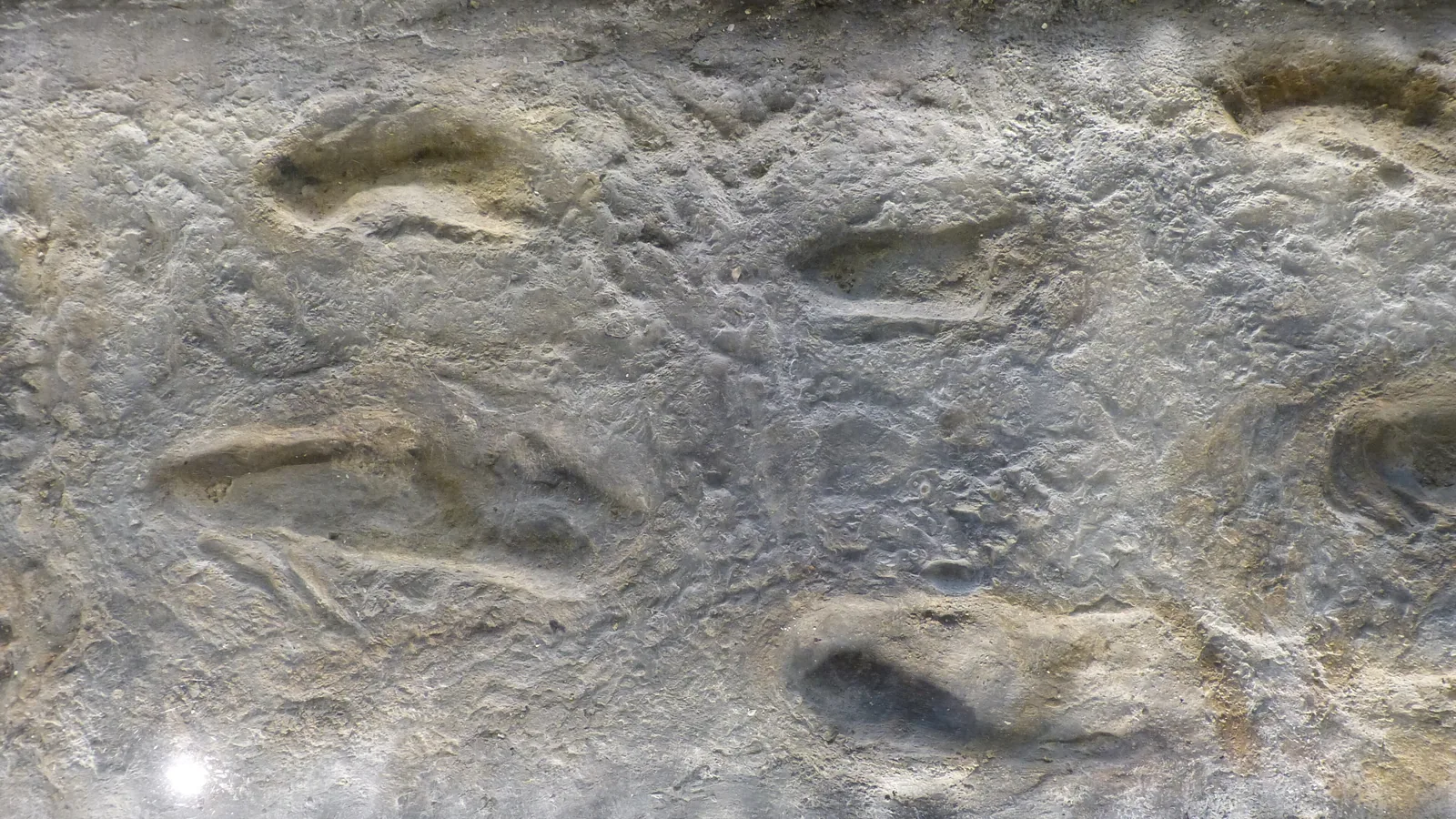

TL;DR — Laetoli’s 3.66-million-year-old footprints were read as three walkers in 1978, at least five after Site S in 2016, and two hominin kinds after Site A was redug in 2019.
The Laetoli hominin trackways, in the words of the 2016 eLife paper, “were found in 1978 at Site G (Locality 8) and were referred to three individuals (G1, G2, G3) of different body size.” The Smithsonian’s Human Origins Program gives the trail as almost 27 meters (88 feet) long with about 70 early human footprints, found after Paul Abell joined Mary Leakey’s team; the Getty Conservation Institute’s project page gives the discovery year as 1977. The prints lie in the Footprint Tuff at Laetoli in northern Tanzania, which the eLife authors date to 3.66 million years ago, citing Alan Deino’s argon dating of 2011. Test pits dug for a museum in 2015 turned up two more walkers, and a second look, in 2019, at five odd prints found in 1976 ended in 2021 with the claim that two different hominins had walked the same ash.
Quick facts
- When
- 1976 (animal tracks; five prints at Site A) · 1978 (hominin trackway at Site G; the Getty page gives 1977) · 1979 (Leakey and Hay in Nature; first reburial) · 1992–1998 (Getty conservation project) · 2015–2016 (Site S found and published in eLife) · 2019–2021 (Site A re-excavated and published in Nature)
- Where
- Laetoli, northern Tanzania; Site G and Site S in Locality 8, about 150 meters apart; Site A in Locality 7; the prints lie in the Footprint Tuff, the lower part of Tuff 7 of the Upper Laetolil Beds
- Who
- Mary Leakey and Richard Hay; Paul Abell; Peter Jones and Philip Leakey; Russell Tuttle; Neville Agnew and Martha Demas of the Getty Conservation Institute; F. Masao and co-authors (eLife, 2016); Ellison McNutt, Jeremy DeSilva and co-authors (Nature, 2021)
- Outcome
- The Site G trail of about 70 prints was read as three individuals, G1 to G3, usually ascribed to Australopithecus afarensis. Site S added S1 and S2 in 2016, for at least five walkers, with S1 estimated at about 165 centimeters. In 2021 the Site A prints were read as hominin rather than bear, and as a second hominin taxon with different feet and gait
Site G, 1978: three walkers in the lower part of Tuff 7
Mary Leakey and Richard Hay reported in Nature on March 1, 1979, that excavation of the Laetolil Beds “has revealed the presence of a large variety of footprints from the Pliocene.” The hominin prints occur, the eLife paper states, “in 10 sublevels within the so-called Footprint Tuff, corresponding to the lower part of Tuff 7 in the Upper Laetolil Beds.” Leakey’s 1981 reading of the trail, as the eLife authors summarize it, had the smallest walker, G1, “side by side on the left of the largest individual, G2, while the intermediate-sized individual, G3, superimposed its feet over those of G2.” The makers are “usually ascribed, not without controversy,” to Australopithecus afarensis, “the only hominin taxon found to date in the Upper Laetoli Beds.” The eLife paper’s table gives mean print lengths of 180 millimeters for G1, 225 for G2 and 209 for G3.
Acacia seeds in the backfill
After recording, the trackway was reburied in 1979. M. R. Bennett and co-authors wrote in PLoS ONE in 2013 that the backfill was “rich in acacia seed, the growth of which provided a clear threat to the conservation of the site leading to its re-excavation in the 1990s.” The Getty page records acacia trees over 2 meters tall by 1985. The Getty Conservation Institute and Tanzania’s Department of Antiquities ran the Hominid Trackway at Laetoli project from 1992 to 1998, with Neville Agnew and Martha Demas as project managers. The work covered condition recording and photogrammetry of the trackway, removal of trees and roots, and a second reburial with a series of geomembranes as barrier layers against roots. The solution, the PLoS ONE authors wrote, “remains an area of continual tension both for the scientific community who are denied access and because of the inability both locally and nationally to derive tourist and cultural value from the site.” Replicas of some of the original casts in the Olduvai exhibition, they added, compensated in part.

Sixty-two test pits and a fourth and fifth walker
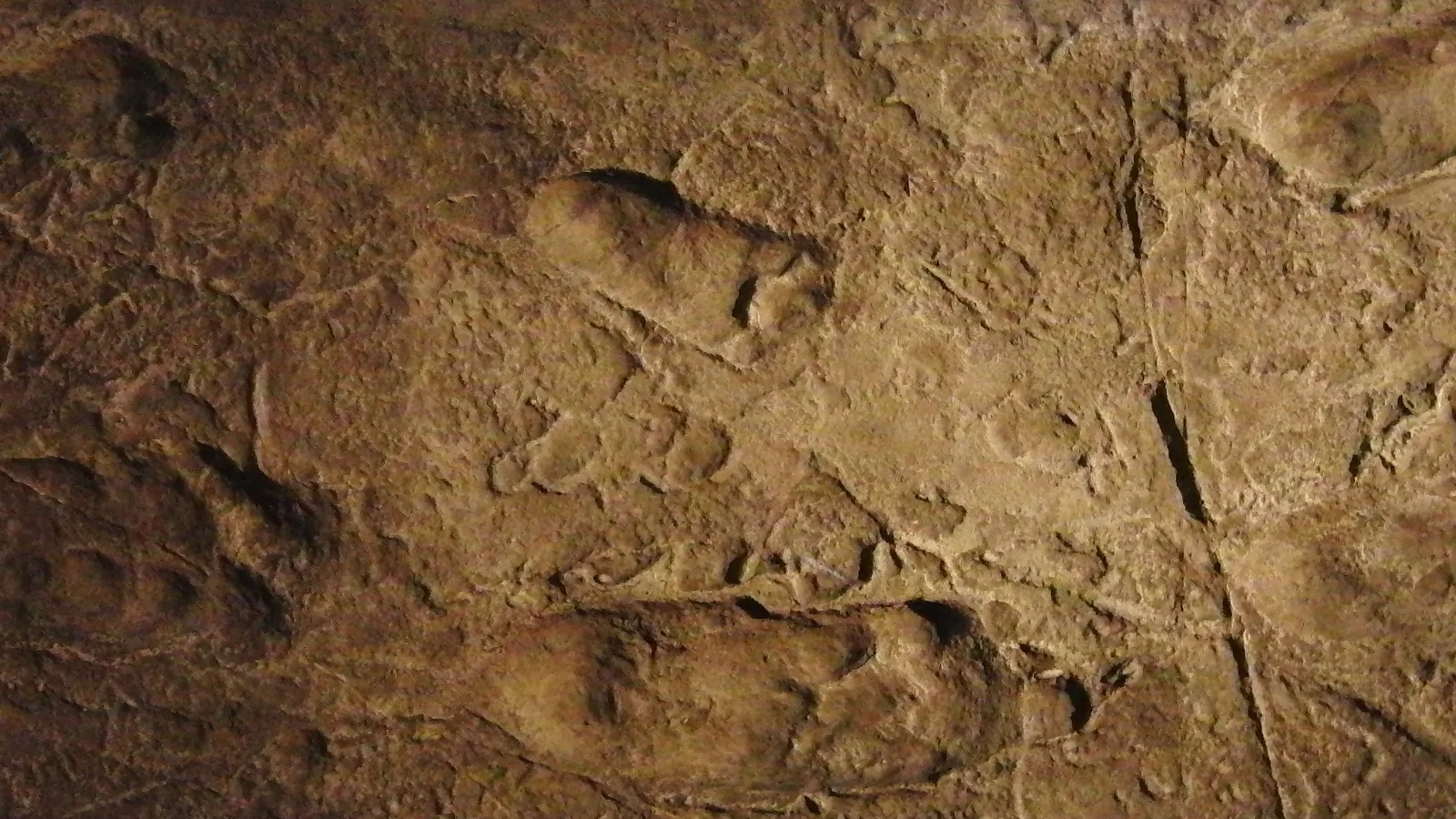
In 2015 a cultural heritage impact assessment for a new field museum put 62 randomly placed test pits, each 2 by 2 meters, into the ground around Locality 8. Three of them, L8, M9 and TP2, about 150 meters south of Site G, held 14 hominin footprints. F. Masao and co-authors read the prints in the three pits as one trackway, S1, about 32 meters long in all and nearly parallel to the Site G trails. At the end of the September 2015 season a single print in the southwest corner of TP2 gave them a second walker, S2. S1’s prints averaged 261 millimeters long with a mean stride of 1,139 millimeters, against 880 for G2, and the authors estimated S1 at about 165 centimeters and 44.7 kilograms, “exceeding G2 by more than 20 cm.” The S2 figures, 146 centimeters and 39.5 kilograms, “must be considered with caution because they are based on a single preserved footprint.” Speed estimates put S1 and G1 to G3 “at similar low speed (about 0.44 to 0.9 m/s, depending on the analysis method).” The paper’s closing scenario was one “in which at least five individuals (G1, G2, G3, S1 and S2) were walking in the same time frame, in the same direction and at a similar moderate speed.” A 2025 paper in Evolutionary Human Sciences went back to G1 and G2 and, from their synchronized leg movements and step lengths, judged them “more likely to be an adult male–female pair than a parent–offspring one.”
"Somewhat shambling": Site A, 1976
Two years before Site G, in 1976, Peter Jones and Philip Leakey found five consecutive bipedal footprints at Site A in Locality 7, an area of 490 square meters with 18,400 animal tracks, dated like Site G to 3.66 million years. Mary Leakey wrote that they indicated “a rolling and probably slow-moving gait, with the hips swivelling at each step,” and Leakey and Hay listed them in 1979 under Hominidae with the note that “the gait was somewhat shambling, with one foot crossing in front of the other.” Once Site G produced unmistakable hominin prints in 1978, the Site A trail lost its standing. The 2021 Nature paper by Ellison McNutt, Jeremy DeSilva and colleagues recounts the doubt: the prints were called “curiously shaped” and “enigmatic,” and Russell Tuttle, after comparing them with the prints of circus-trained bears, wrote that “until detailed, naturalistic biometric and kinesiological studies are performed on bipedal bears and barefoot humans, we will have to defer choosing among the hominid and ursid hypotheses on Laetoli individual A.”
2019: a photograph from 1977 laid beside a new one
In 2019 the McNutt team located, excavated and cleaned the Site A trackway. A photograph of print A3 taken by J. Reader in 1977 was set against one taken by DeSilva in 2019 at the same angle and time of day, and the paper reports “no discernible erosion” since the first excavation. Compared with bear and human prints, the Site A tracks “resemble those of hominins more than ursids,” and their narrow step width, the authors wrote, “corroborates the original interpretation of a small, cross-stepping bipedal hominin.” Against Site G, foot proportions, gait parameters and 3D shapes at Site A “are readily distinguished from those at site G.” The count changed a third time. Three walkers in 1978, at least five in 2016, and, in Nature in 2021, “a minimum of two hominin taxa with different feet and gaits coexisted at Laetoli.”
Key facts
- The Site G hominin trackway at Laetoli, Tanzania, was found in 1978 (the Getty page gives 1977) and was referred to three individuals, G1, G2 and G3 (eLife, 2016; Leakey, 1981).
- The Smithsonian gives the trail as almost 27 meters (88 feet) long with about 70 early human footprints.
- The prints lie in the Footprint Tuff, the lower part of Tuff 7 in the Upper Laetolil Beds, dated to 3.66 million years ago by Alan Deino’s 2011 argon dating, as cited in eLife.
- The trackways are “usually ascribed, not without controversy” to Australopithecus afarensis, the only hominin taxon found in the Upper Laetoli Beds (eLife).
- Reburied in 1979 with backfill rich in acacia seed, the site had trees over 2 meters tall by 1985; the Getty Conservation Institute and Tanzania’s Department of Antiquities ran a conservation project from 1992 to 1998 and reburied the trail with geomembrane barriers (Getty; PLoS ONE, 2013).
- Site S, about 150 meters south of Site G, was found in 2015 in three of 62 test pits and holds 14 hominin prints from two walkers; S1 averaged 261 millimeters per print with a stride of 1,139 millimeters and an estimated stature of about 165 centimeters (eLife, 2016).
- Site A, in Locality 7, holds five prints found in 1976 by Peter Jones and Philip Leakey; Russell Tuttle deferred choosing between hominid and bear (Nature, 2021, citing Tuttle).
- After re-excavation in 2019, McNutt, DeSilva and colleagues concluded in 2021 that the Site A prints are hominin and that “a minimum of two hominin taxa with different feet and gaits coexisted at Laetoli.”
FAQ
How old are the Laetoli footprints?
The eLife paper of 2016 dates the Footprint Tuff to 3.66 million years ago, citing Alan Deino's 2011 argon dating. The Getty Conservation Institute's page rounds this to 3.6 million years. The Site A prints, in a different locality, are given the same 3.66-million-year date in the 2021 Nature paper.
How many individuals made the Laetoli footprints?
The Site G trail was referred to three, G1, G2 and G3. The 2016 eLife paper added S1 and S2 at Site S, for "at least five individuals" walking in the same direction at a similar speed. The 2021 Nature paper reads the five Site A prints as a hominin with different feet and gait from the Site G walkers, which its authors take as a minimum of two hominin taxa.
Can the Laetoli footprints be seen?
The Site G trackway is reburied under geomembrane barrier layers, a step the 2013 PLoS ONE paper describes as denying access to scientists and visitors alike. Replicas of some of the original casts are shown at the Olduvai Gorge Museum, which reopened in October 1998.
Sources
- F. Masao and co-authors, "New footprints from Laetoli (Tanzania) provide evidence for marked body size variation in early hominins," eLife 5:e19568 (2016), full text.
- Smithsonian National Museum of Natural History, Human Origins Program, "Laetoli Footprint Trails."
- Getty Conservation Institute, "Hominid Trackway at Laetoli," project page (1992–1998, completed).
- M. D. Leakey and R. L. Hay, "Pliocene footprints in the Laetolil Beds at Laetoli, northern Tanzania," Nature 278, 317–323 (March 1, 1979), abstract.
- E. G. McNutt, K. Zimmer, J. M. DeSilva and co-authors, "Footprint evidence of early hominin locomotor diversity at Laetoli, Tanzania," Nature 600, 468–471 (2021), full text at PubMed Central, PMC8674131.
- M. R. Bennett and co-authors, "Preserving the impossible: conservation of soft-sediment hominin footprint sites and strategies for three-dimensional digital data capture," PLoS ONE 8(4): e60755 (2013), full text at PubMed Central, PMC3629167.
- "Relationship between trackmakers of the Laetoli footprints from gait synchronization," Evolutionary Human Sciences (2025), doi:10.1017/ehs.2025.10, full text at PubMed Central, PMC12034493.
Cite this article
- APA
- Our Earth's History. (2026, September 22). Three walkers, then five, then two kinds: the Laetoli footprints. Our Earth's History. https://ourearthshistory.com/africa/prehistory/laetoli-footprints-site-g-1978-site-s-2016/
- Chicago
- Our Earth's History. “Three walkers, then five, then two kinds: the Laetoli footprints.” Our Earth's History, September 22, 2026. https://ourearthshistory.com/africa/prehistory/laetoli-footprints-site-g-1978-site-s-2016/.
- MLA
- “Three walkers, then five, then two kinds: the Laetoli footprints.” Our Earth's History, 22 Sep. 2026, https://ourearthshistory.com/africa/prehistory/laetoli-footprints-site-g-1978-site-s-2016/.
Text licensed CC BY-NC-ND 4.0. Found an error? Tell us.