Taung Child: the skull Dart named in Nature on February 7, 1925
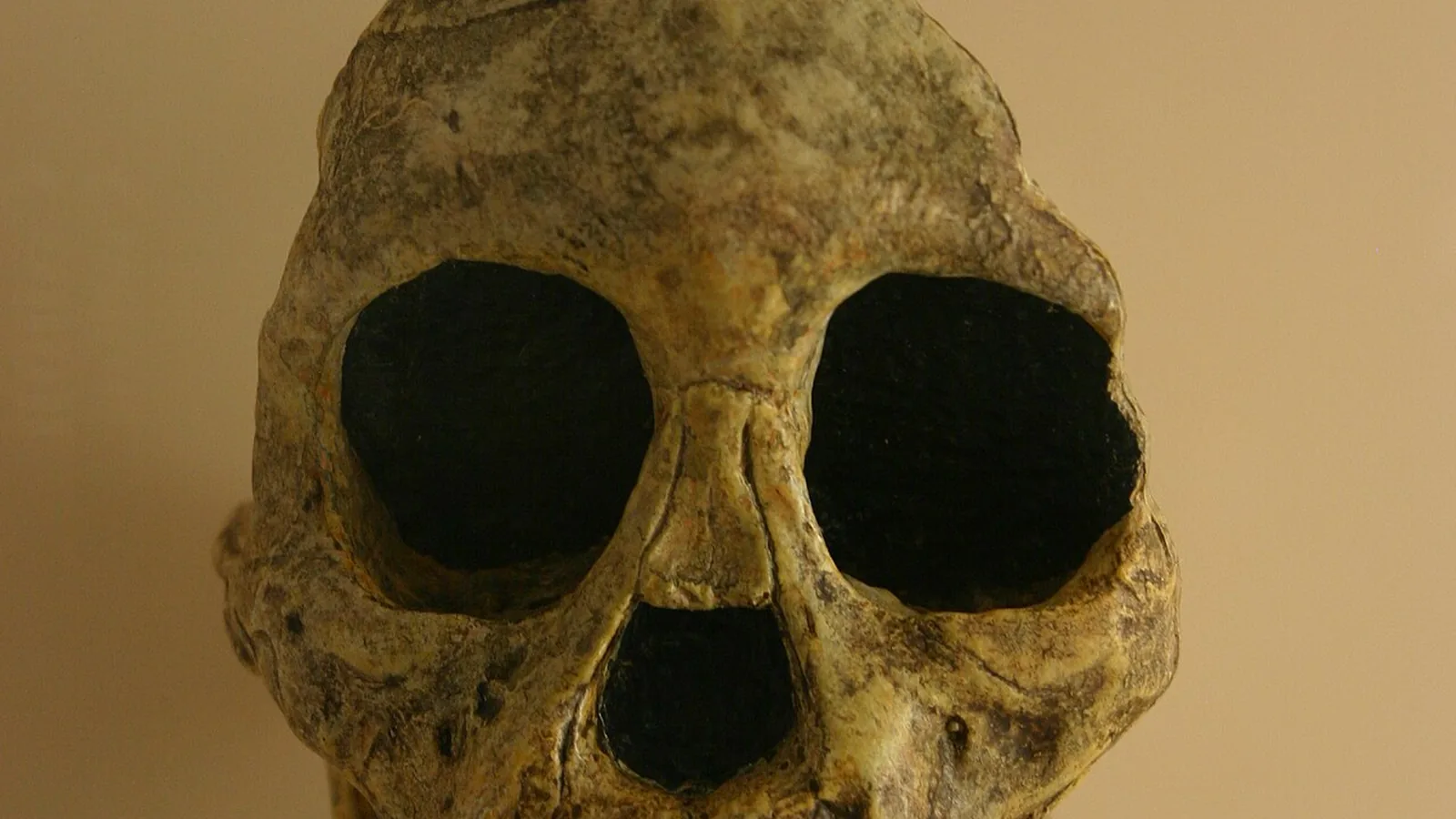

TL;DR — Raymond Dart named a South African quarry skull Australopithecus africanus in Nature on February 7, 1925. International acceptance, Kuljian wrote in 2025, took more than 25 years.
“Towards the close of 1924, Miss Josephine Salmons, student demonstrator of anatomy in the University of the Witwatersrand, brought to me the fossilised skull of a cercopithecid monkey,” Raymond Dart wrote in Nature on February 7, 1925, opening the paper he titled “Australopithecus africanus: The Man-Ape of South Africa.” That monkey skull, Dart wrote, had been “blasted out of the limestone cliff formation . . . at Taungs, which lies 80 miles north of Kimberley on the main line to Rhodesia, in Bechuanaland, by operatives of the Northern Lime Company.” A second skull came out of the same quarry weeks later: a juvenile primate with part of its face, part of a jaw and a natural cast of half its brain in limestone. Dart classified it as a new genus and species, Australopithecus africanus.
Quick facts
- When
- late 1924 (the fossil is blasted from the quarry) · February 7, 1925 (Dart's paper in Nature) · February 14, 1925 (Keith's rebuttal in Nature) · 2006 (Berger's reassessment of orbital damage) · 2025 (the South African Journal of Science centenary issue)
- Where
- the Buxton Limeworks near Taung, Bechuanaland, and the University of the Witwatersrand, Johannesburg
- Who
- Raymond Dart, Josephine Salmons, Robert Young, Arthur Keith, Phillip Tobias, Lee Berger
- Outcome
- Dart named the fossil Australopithecus africanus; Arthur Keith and other European scientists rejected the claim for more than two decades; a century later researchers still disagree on the child's age at death, its brain size and whether an eagle killed it, and a 2025 special issue reopened the question of Dart's own scientific legacy
Josephine Salmons and a blast at Buxton
Salmons’s baboon fossil arrived only a short time before the second skull. Kuljian wrote in a 2025 South African Journal of Science article marking the centenary of Dart’s paper: “Just weeks earlier, Dart had been pleasantly surprised when one of his students in the Department of Anatomy, Josephine Salmons, arrived at class with an ancient baboon fossil.” That fossil pointed Dart and Young, a Wits geology professor, toward the Buxton Limeworks quarry as a source of more finds. A quarry worker made the actual discovery: “In late October or at some point in November 1924, De Bruyn blasted out a fossilised brain cast that he thought might not be from a baboon,” Kuljian wrote. The block passed to the manager and then to Young, who was visiting the site.
A myth of one man, one fossil
Dart’s own Nature paper credited his colleague directly, describing himself as “manipulating the pieces of rock brought back by Prof. Young.” A short item in Nature later that year restated the point: “the limestone block from which Prof R. Dart chiseled out the fossil skull of Australopithecus africanus was brought to him by his colleague Dr. R. B. Young.” Dart’s 1959 memoir, Adventures with the Missing Link, told a different story: two boxes delivered while he waited for wedding guests, with the skull inside one that he opened himself. Kuljian called the discrepancy “the myth of ‘one man, one fossil.’” The Star, a Johannesburg newspaper, headlined a story on February 4, 1925, “Blasted Out: How Professor Young Found the Skull,” and Young wrote to Dart three days later that “the part I played at Buxton in the actual finding of the skull was to select amongst the specimens, the piece of rock containing it from some fragments of rocks and minerals laid aside in the quarry by the quarryman . . . I do not think it of any particular importance who ‘found’ the skull.” Tobias, Dart’s successor, wrote in 1984 and again in 2006 that “history should assign a greater role to R.B. Young in the chain of discovery.”
'Preposterous' in London, 'epoch making' at home
Exactly one week after Dart’s paper appeared, on February 14, 1925, Nature published a rebuttal by Sir Arthur Keith titled “The Fossil Anthropoid Ape from Taungs,” a title later corrected in a published erratum. Kuljian wrote that European scientists were “sceptical of Dart’s claims about Taung at first, even calling Dart’s claims ‘preposterous,’” and that “it took more than 25 years for the international scientific community to accept the significance of the Taung skull.” Reaction in South Africa ran the other way: Jan Smuts, a former prime minister, wrote to Dart calling the discovery “epoch making” and “calculated to concentrate attention on South Africa as the great field for scientific discovery,” Kuljian wrote.
Two numbers with no agreed value
A century of study has not settled how old the Taung child was when it died or how large its brain was. Ralph Holloway measured the endocast in 1970 and produced the figure most cited since, 404 cm³, corroborated by Simon Neubauer’s 2012 digital reconstruction. Dart’s own 1926 estimate was 520 cm³; Keith put the adult figure at 515 to 566 cm³; Grafton Elliot Smith estimated 728 cm³; Solly Zuckerman published 785 cm³ in 1928, a figure McCarthy and Zimel wrote Zuckerman himself judged “ridiculously high.” Age at death shows the same spread: Keith, and later Biggerstaff, put it at four years; Bromage’s work with Dean produced 3.3 years; Conroy and Vannier proposed 3.5; Mann proposed five to seven years. McCarthy and Zimel’s own comparison with the fossil StW 402 produced 3.73 to 3.93 years. A 2025 paper in Ecology and Evolution described the fossil as a young Australopithecus africanus “possibly preyed upon by an eagle 2.5 million years ago in southern Africa.”
A crowned eagle, and a reckoning in 2025
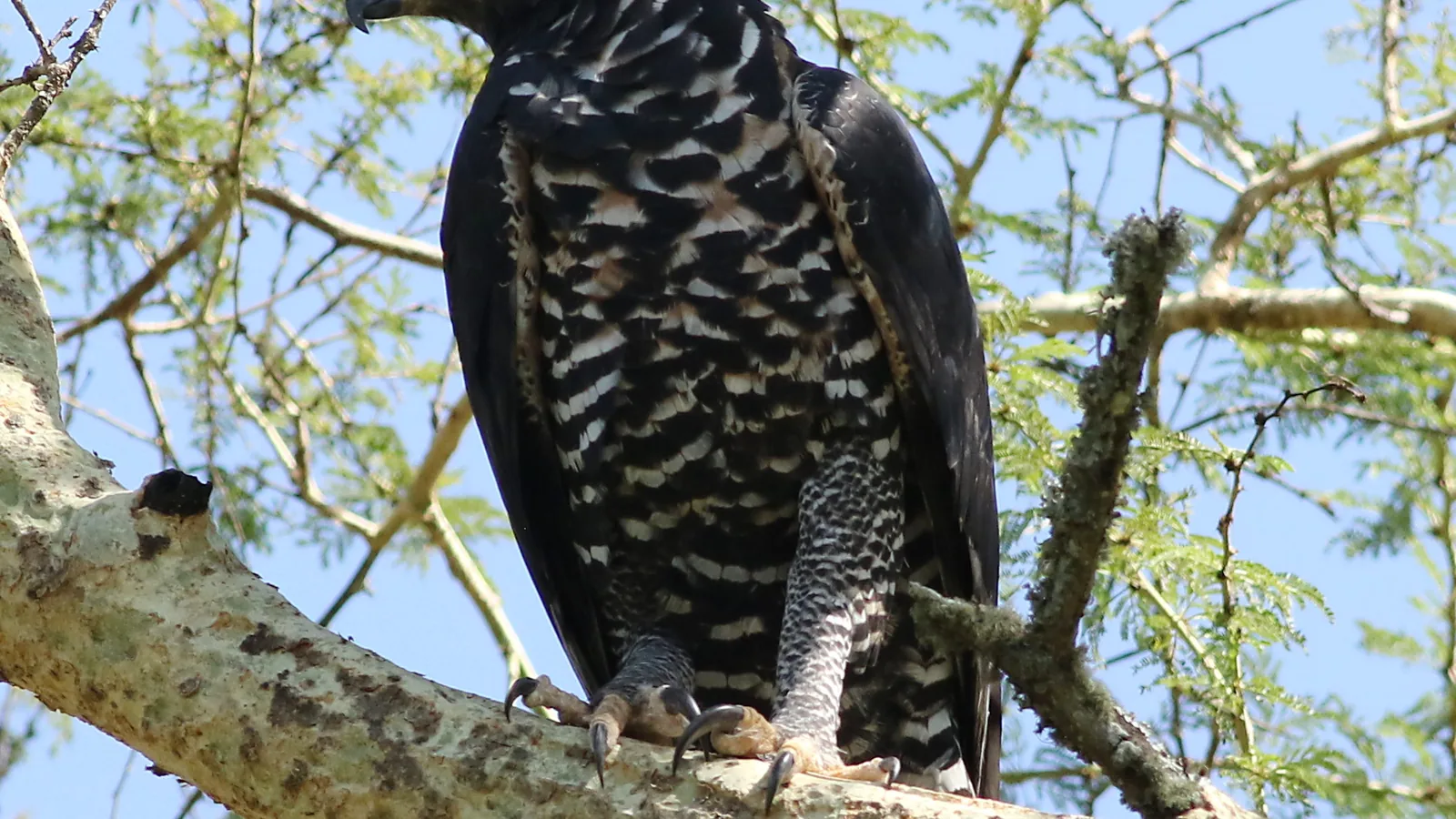
Lee Berger and Ron Clarke proposed in 1995 that a bird of prey killed the Taung child. Sanders, Trapani and Mitani wrote in the Journal of Human Evolution in 2003 that “Berger and Clarke (1995) hypothesized that crowned hawk-eagles or similar large raptors were principally responsible for the accumulation of the late Pliocene fossil fauna from Taung, South Africa, including the type infant skull of Australopithecus africanus.” McGraw, Cooke and Shultz, working from crowned eagle nests in Ivory Coast’s Tai Forest, wrote in 2006 that they “concur with Berger and Clarke . . . that a large raptor could have been responsible for the death of the Taung child.” Berger reexamined the skull that year and reported “previously undescribed damage to the orbital floors that is nearly identical to that seen in the crania of monkeys preyed upon by crowned hawk eagles,” concluding that the evidence “strongly supports the hypothesis that a bird of prey was an accumulating agent at Taung.”
Dart’s record came under scrutiny in the same centenary year. Kuljian wrote that his 1936 expedition to the Kalahari included measurements of the skulls and faces of San people and casts of their features, a record Saul Dubow and Catherine Burns later examined critically. Ackermann, Pickering, Sahle and Schroeder wrote in the introduction to the South African Journal of Science’s 2025 centenary issue that “Kuljian reflects on Raymond Dart’s legacy, how it was shaped and protected by figures such as Phillip Tobias . . . Ackermann et al. focus on the ‘explorer’ myth . . . and show how the discovery and reporting of Dart’s work on the Taung Child fossil was situated and storied within this explorer narrative.”
,_at_Ndumo_Nature_Reserve,_KwaZulu-Natal,_South_Africa_(28947411865).jpg)
Key facts
- Salmons brought a baboon fossil to Dart’s department “weeks” before the second Taung skull surfaced (Kuljian, 2025).
- De Bruyn blasted a “fossilised brain cast” out of the Buxton Limeworks quarry in late October or November 1924 (Kuljian, 2025).
- Robert Young, not Dart, carried the fossil pieces from Taung to Johannesburg; Dart’s own Nature paper credits “the pieces of rock brought back by Prof. Young.”
- Dart published “Australopithecus africanus: The Man-Ape of South Africa” in Nature on February 7, 1925.
- Arthur Keith’s rebuttal, “The Fossil Anthropoid Ape from Taungs,” appeared in Nature exactly one week later, on February 14, 1925.
- Cranial capacity estimates for the adult Taung individual have ranged from 390 to 785 cm³ across studies published between 1925 and 2020.
- Age-at-death estimates range from 3.3 to seven years across published studies; McCarthy and Zimel’s 2020 estimate is 3.73 to 3.93 years.
- Berger reported in 2006 that damage to the skull’s orbital floors “strongly supports the hypothesis that a bird of prey was an accumulating agent at Taung.”
FAQ
Who found the Taung Child fossil?
A quarry worker recorded only by the surname De Bruyn blasted the fossil out of the Buxton Limeworks in late 1924, and Wits geology professor Robert Young carried it to Raymond Dart in Johannesburg. Dart's own 1925 paper credits Young; his 1959 memoir tells a different story that Kuljian called "the myth of 'one man, one fossil.'"
How old was the Taung Child when it died?
No single figure is agreed. Published estimates range from 3.3 years, cited from Bromage's work with Dean, to seven years from Mann, with McCarthy and Zimel's 2020 study proposing 3.73 to 3.93 years based on comparison with the fossil StW 402.
Did an eagle kill the Taung Child?
Lee Berger and Ron Clarke proposed the idea in 1995. Berger's own 2006 reexamination of the skull's orbital floors found damage he wrote "strongly supports the hypothesis," and a 2006 study of crowned eagle nests in Ivory Coast by McGraw, Cooke and Shultz reached the same conclusion.
Sources
- Dart RA, "Australopithecus africanus: The Man-Ape of South Africa," Nature 115, 195-199 (February 7, 1925).
- Kuljian C, "Contesting a legendary legacy: A century of reflection on Raymond Dart and the Taung skull," South African Journal of Science 121(1/2), Art. #18323 (2025).
- Keith A, "The Fossil Anthropoid Ape from Taungs," Nature 115, 234-236 (February 14, 1925).
- McCarthy RC, Zimel E, "Revised estimates of Taung's brain size growth," South African Journal of Science 116(7/8), Art. #5963 (2020).
- Sanders WJ, Trapani J, Mitani JC, "Taphonomic aspects of crowned hawk-eagle predation on monkeys," Journal of Human Evolution 44(1):87-105 (2003).
- McGraw WS, Cooke C, Shultz S, "Primate remains from African crowned eagle nests in Ivory Coast's Tai Forest," American Journal of Physical Anthropology 131(2):151-165 (2006).
- Berger LR, "Brief communication: predatory bird damage to the Taung type-skull of Australopithecus africanus Dart 1925," American Journal of Physical Anthropology 131(2):166-168 (2006).
- "Unveiling the Myth: Harpy Eagle Harpia harpyja Attacks on a Human in the Amazon Forest," Ecology and Evolution (April 2025).
- Ackermann RR, Pickering R, Sahle Y, Schroeder L, "The Taung Child then and now: Commemorating its centenary in a postcolonial age," South African Journal of Science 121(1/2), Art. #20667 (2025).
Cite this article
- APA
- LETTER. (2026, September 28). Taung Child: the skull Dart named in Nature on February 7, 1925. Our Earth's History. https://ourearthshistory.com/africa/prehistory/taung-child-1924-dart-nature-1925-australopithecus-africanus-eagle/
- Chicago
- LETTER. “Taung Child: the skull Dart named in Nature on February 7, 1925.” Our Earth's History, September 28, 2026. https://ourearthshistory.com/africa/prehistory/taung-child-1924-dart-nature-1925-australopithecus-africanus-eagle/.
- MLA
- LETTER. “Taung Child: the skull Dart named in Nature on February 7, 1925.” Our Earth's History, 28 Sep. 2026, https://ourearthshistory.com/africa/prehistory/taung-child-1924-dart-nature-1925-australopithecus-africanus-eagle/.
Text licensed CC BY-NC-ND 4.0. Found an error? Tell us.