A handaxe on the Hantan River bank, 1978: the Jeongok-ri site
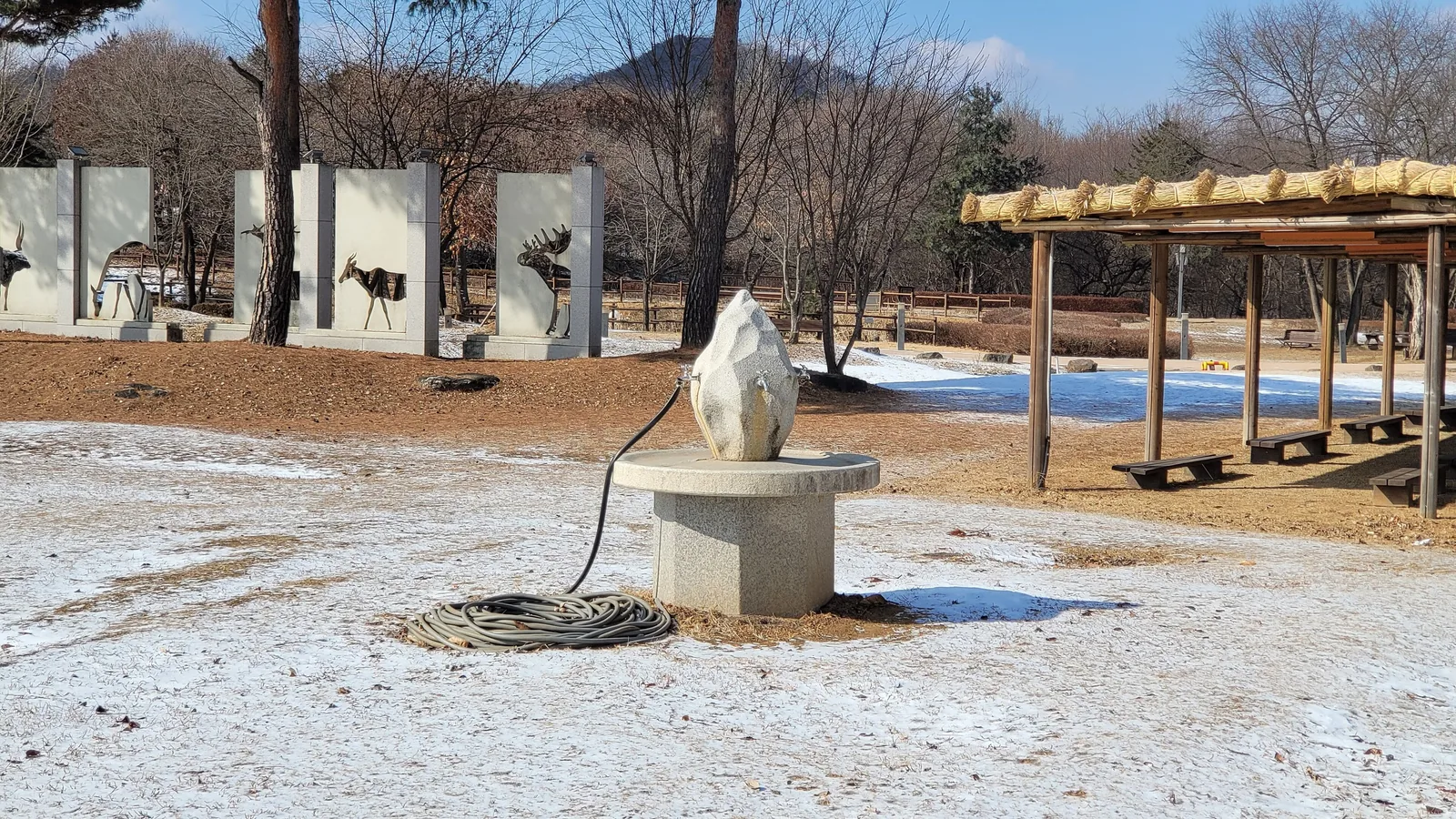

TL;DR — A US soldier, Greg Bowen, picked up a stone handaxe by the Hantan River in 1978; excavation began in 1979, and the site’s age is still disputed.
“The Jeongok-ri Prehistoric Site was first discovered in 1978 along the banks of the Hantangang River by Greg Bowen, a US soldier stationed in Dongducheon,” the Jeongok Prehistory Museum states. The Korea Herald, in a 2022 feature, adds how it happened: “Bowen was out on a date with his future wife when he found a biface handaxe, the stone handaxe which was chipped on both sides of the blades (four sides), in Jeongok-ri located about two hours’ drive north of the capital city Seoul, along Hantan River in Gyeonggi Province.” Kidong Bae’s 2017 handbook chapter uses the older spelling Chŏn’gokni for the same place.
Quick facts
- When
- Found in 1978; excavation began in 1979; designated National Historic Site No. 268 the same year; renamed Yeoncheon Jeongok-ri Site on July 28, 2011
- Where
- The banks of the Hantan River at Jeongok-ri, Yeoncheon County, Gyeonggi Province, South Korea
- Who
- Greg Bowen, a US soldier stationed in Dongducheon; François Bordes; Kim Won-yong of the Seoul National University Museum; Chung Young-hwa of Yeungnam University
- Outcome
- Acheulean-type handaxes and cleavers found for the first time in Northeast Asia, per the Korea Heritage Service; age estimates run from 70,000 to about 400,000 years
From the riverbank to François Bordes
The museum’s English account continues: “Upon his discovery, Bowen sent a report on the discovered stone tool to Professor Francois Bordes, a renowned French prehistoric archeologist, who then introduced to Bowen Professor WongRyong Kim, then curator of the Seoul National University Museum.” The museum’s Korean text names the next step and the scholar who put the tools into print: “영남대학교의 정영화 교수에 의해 아슐리안형 주먹도끼로 학계에 최초로 보고되었다.” Chung Young-hwa of Yeungnam University was the first to report them to the academic world as Acheulean-type handaxes, the tool form known from Africa and Europe.
1979: Historic Site No. 268
Digging started the next year. “Excavations at the Jeongok-ri Prehistoric Site began the year following the site’s discovery, and, the same year, the site was designated as the National Historic Site No. 268 (778,296㎡),” the museum records. The Korea Heritage Service’s panel at the site says it “was excavated and researched several times between 1979 and 1992 following its discovery by American soldiers in 1978,” and notes in Korean that the name changed by public notice on July 28, 2011, from Jeongok-ri Prehistoric Site to Yeoncheon Jeongok-ri Site. The digging did not stop in 1992. The museum counts “more than 20 time excavation surveys” at the site as of 2022, over roughly fifty years.
Burnt wood, wild pig and oak pollen
The heritage panel describes the site as “one of the oldest ruins from the first half of the Old Stone Age found in South Korea.” It lists what else came out of the ground besides stone tools: “The discovery of burnt pieces of wood indicates the possibility that mankind might have used fire at this time. As a result of researching the natural environment the bones of wild pig and pollen from oak trees were found.” The Korean text of the same panel states why the site drew notice: “유럽과 아프리카 지방의 아슐리안 석기 형태를 갖춘 주먹도끼와 박편도끼가 동북아시아에서 처음 발견되어 주목을 받고 있다.” Handaxes and cleavers of the Acheulean form known from Europe and Africa were found here for the first time in Northeast Asia.
The finds went on accumulating along the river. Yongwook Yoo, a professor of archaeology at Chungnam National University, told the Korea Herald that handaxes, cleavers, hunting stones, fist-sized picks, scrapers and notched tools were “unearthed from the sedimentary layer in the Imjin-Hantan River Area near Jeongok-ri between 1979 and 2010,” and the paper puts the count of “Acheulian-like handaxes” at “more than 100.”

"Local technology"
Scholars have since given the Jeongok-ri toolkit a name of its own. Bae’s chapter abstract states: “The Early Paleolithic Age in Korea is often represented by the Chŏn’goknian industry, in which Acheulean-typed bifaces are included along with simple heavy-duty tools such as choppers, and polyhedrals without extensive secondary retouches.” Yoo goes further in separating the Korean tools from their western look-alikes. “Jeongok-ri handaxe was a tool for Hominins on the Korean Peninsula, which was local technology, differentiated from the Acheulean handaxe,” he told the Korea Herald.
Three ages for one site
The heritage panel gives a range: “Its origin is estimated to be between 270,000 to 100,000 years ago.” Bae’s chapter abstract gives an older figure, stating that “the Chŏn’gokni site has been substantiated as the oldest site . . . dated in Korea at about 400,000 BP.” Yoo, citing more recent tests, puts the handaxe far later. “Researchers have debated about the age of the Jeongok-ri handaxe for decades,” the Korea Herald wrote, before quoting him: “There’s some attraction to dating archeological relics blindly old, but I believe the Jeongok-ri handaxe falls somewhere between 70,000 to 40,000 years old.”
Key facts
- Greg Bowen, a US soldier stationed in Dongducheon, found the first handaxe on the Hantan River bank at Jeongok-ri in 1978 (Jeongok Prehistory Museum).
- Bowen sent a report to French archaeologist François Bordes, who put him in touch with Kim Won-yong of the Seoul National University Museum (Jeongok Prehistory Museum).
- Chung Young-hwa of Yeungnam University first reported the tools to scholars as Acheulean-type handaxes (Jeongok Prehistory Museum).
- Excavation began in 1979, and the site became National Historic Site No. 268, covering 778,296 square meters, the same year.
- The site was renamed Yeoncheon Jeongok-ri Site by notice on July 28, 2011 (Korea Heritage Service).
- The museum counts more than 20 excavation surveys as of 2022; Yoo reports more than 100 Acheulian-like handaxes from the area.
- The heritage panel records burnt wood, wild pig bones and oak pollen from the site.
- Age estimates: 270,000 to 100,000 years (Korea Heritage Service), about 400,000 years (Kidong Bae), 70,000 to 40,000 years (Yongwook Yoo).
FAQ
Who found the Jeongok-ri handaxe?
Greg Bowen, a US soldier stationed in Dongducheon, found it on the Hantan River bank in 1978, according to the Jeongok Prehistory Museum. The Korea Herald reports he was on a date with his future wife at the time.
Why is Jeongok-ri important?
The Korea Heritage Service states that handaxes and cleavers of the Acheulean form known from Europe and Africa were found there for the first time in Northeast Asia. Kidong Bae names the Korean Early Paleolithic toolkit the Chŏn'goknian industry after the site.
How old is the Jeongok-ri site?
Sources disagree. The Korea Heritage Service gives 270,000 to 100,000 years; Kidong Bae's 2017 chapter gives about 400,000 years; Yongwook Yoo of Chungnam National University puts the handaxe at 70,000 to 40,000 years.
Sources
- Jeongok Prehistory Museum (Gyeonggi Cultural Foundation), "Jeongok-ri Prehistoric Site Introduction — Excavation History."
- Korea Heritage Service, National Heritage Portal, "Historic Site: Yeoncheon Jeongok-ri Site" listing and on-site panel text.
- The Korea Herald, "[Visual History of Korea] Cutting-edge Stone Age tool Jeongok-ri handaxe of Korea," February 10, 2022.
- Kidong Bae, "Paleolithic Archaeology in Korea," chapter 17 in Handbook of East and Southeast Asian Archaeology, ed. Junko Habu, Peter V. Lape, and John W. Olsen (New York: Springer, 2017), abstract.
Cite this article
- APA
- Our Earth's History. (2026, September 24). A handaxe on the Hantan River bank, 1978: the Jeongok-ri site. Our Earth's History. https://ourearthshistory.com/east-asia/prehistory/jeongok-ri-1978-greg-bowen-hantan-river-handaxe-yeoncheon/
- Chicago
- Our Earth's History. “A handaxe on the Hantan River bank, 1978: the Jeongok-ri site.” Our Earth's History, September 24, 2026. https://ourearthshistory.com/east-asia/prehistory/jeongok-ri-1978-greg-bowen-hantan-river-handaxe-yeoncheon/.
- MLA
- “A handaxe on the Hantan River bank, 1978: the Jeongok-ri site.” Our Earth's History, 24 Sep. 2026, https://ourearthshistory.com/east-asia/prehistory/jeongok-ri-1978-greg-bowen-hantan-river-handaxe-yeoncheon/.
Text licensed CC BY-NC-ND 4.0. Found an error? Tell us.