How do we know people were in Australia 65,000 years ago?
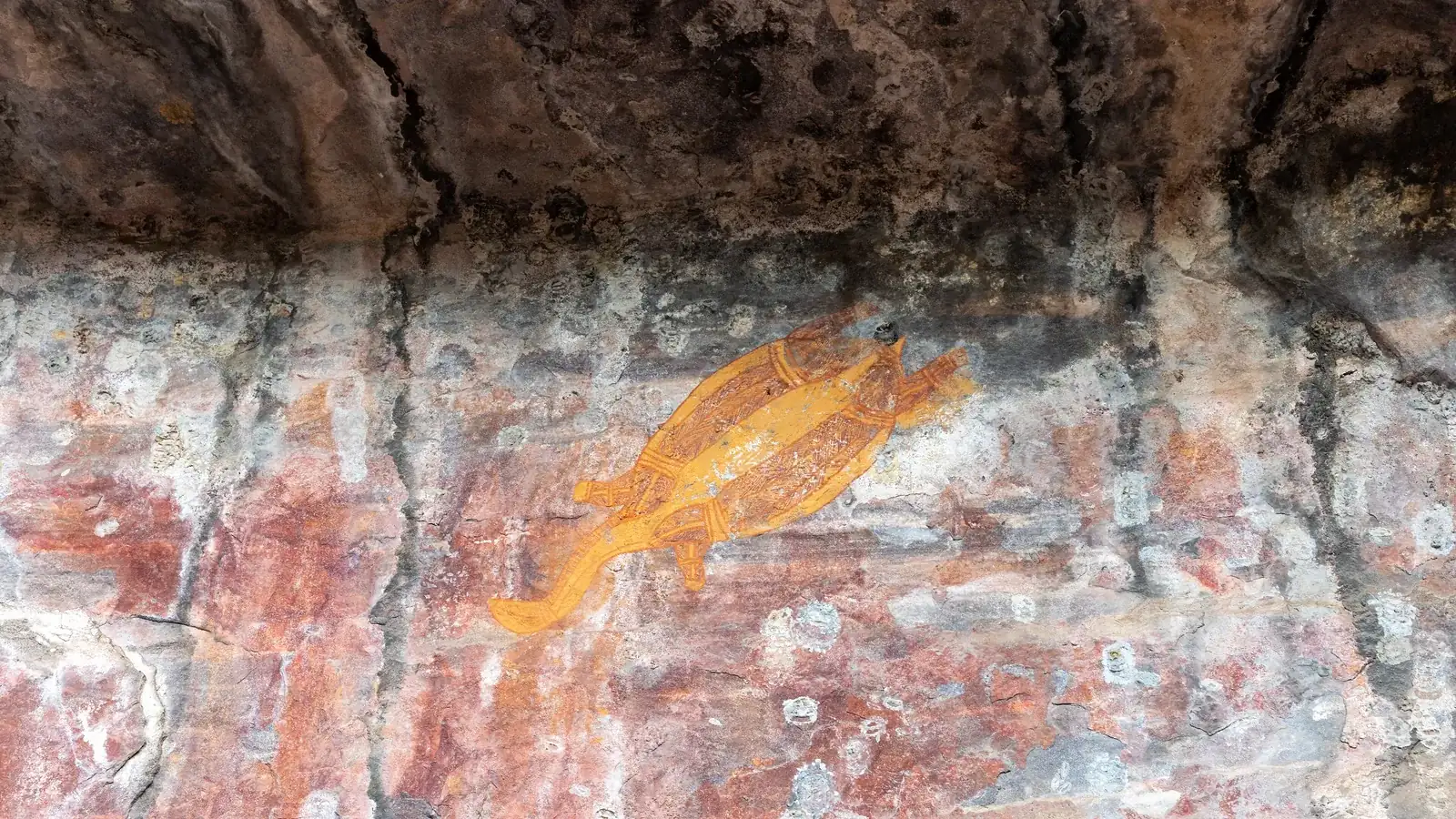
,_Kakadu_National_Park,_Ubirr_Rock_Art_--_2019_--_4169.jpg)
TL;DR — Single sand grains buried with the lowest tools at Madjedbebe were dated to about 65,000 years in 2017; some archaeologists argue the tools sank into older sand.
Sand grains from the lowest tool layer at Madjedbebe, a rock shelter on Mirarr country in Arnhem Land, were dated to about 65,000 years in a 2017 Nature paper. The Mirarr are the Traditional Owners of the site, and the digs of 2012 and 2015 ran under an agreement with the Gundjeihmi Aboriginal Corporation that gave them control over the work. The team led by Chris Clarkson of the University of Queensland recorded more than 10,000 artifacts in that layer, among them ground-edge ax heads, grindstones and ochre. The date rests on optically stimulated luminescence, which measures how long each grain of quartz has been buried. Jim Allen, Jim O’Connell and their co-authors answered in 2018 that the tools could have sunk into older sand, and the argument has not closed.
Quick facts
- When
- Lowest tool layer dated to about 65,000 years (2017); earlier digs 1973 and 1989; excavations 2012 and 2015; critique published 2018
- Where
- Madjedbebe rock shelter on Mirarr country, Arnhem Land, Northern Territory, inside the Jabiluka lease surrounded by Kakadu National Park
- Who
- Mirarr Traditional Owners through the Gundjeihmi Aboriginal Corporation; Chris Clarkson (excavation) and Zenobia Jacobs (dating); Jim Allen and Jim O'Connell (critics)
- Outcome
- More than 10,000 artifacts in the lowest layer, including ground-edge ax heads, grindstones and ochre; the 65,000-year age is accepted by some archaeologists and disputed by others
The shelter and whose country it is
Madjedbebe sits at the foot of the Arnhem Land escarpment on a sandy plain about 300 kilometers east of Darwin, in Australia’s Northern Territory. Kakadu National Park surrounds it. The Mirarr people are its Traditional Owners, and the Gundjeihmi Aboriginal Corporation, which represents them, called the site “Australia’s oldest home” in its 2017 media release. Justin O’Brien, the corporation’s chief executive, said the results “reinforce the need for the highest level of conservation and protection for this site.”
In 1989 Rhys Jones, Bert Roberts and Mike Smith cut a narrow shaft to try a new dating method, and their 1990 paper in Nature put people at the site between 50,000 and 60,000 years ago. Critics answered that the method was untested and that artifacts in loose sand could have been pushed down by termites or by feet. The same objection is still being argued.
What the 2012 and 2015 digs turned up
Clarkson’s team opened 20 square meters and found artifacts in three distinct bands. The lowest lay about 2.6 meters down and held a fireplace. From it came edge-ground ax heads, seed-grinding stones, thin stone points that may have tipped spears, and ochre “crayons” worn down by use. The paints included ground mica, which made them reflect light. The University of Queensland’s release described the ax technology as the oldest known in the world and the seed-grinding tools as the oldest known in Australia.
The team also recorded the position of every stone artifact with a laser total station. If artifacts had sunk through the sand, refitted pieces of the same broken stone should lie far apart. They did not.
How grains of sand give a date
Radiocarbon dating stops working at about 50,000 years, so the lower layers were dated by optically stimulated luminescence, or OSL, under Zenobia Jacobs of the University of Wollongong. Sunlight empties a quartz grain of stored energy. Once the grain is buried, faint natural radiation in the sand refills it at a steady rate. In the laboratory a beam of light makes the grain release that energy as a glow, and the brightness gives the dose it absorbed. Dividing the dose by the yearly dose rate gives the years since the grain last saw daylight.
Earlier OSL work measured grains in groups, which blurred old and young grains together. Jacobs measured thousands of grains one at a time, so a grain that had slipped down from above could be spotted and set aside. Four samples went to the University of Adelaide for a blind test, and the results matched. The Nature paper set the start of occupation at around 65,000 years, with an uncertainty of several thousand years either way, and gave 59,300 years as its conservative minimum. Jacobs told ABC News that artifacts had moved by about 10 to 15 centimeters, not enough to shift them between layers.
Why some archaeologists say the tools sank
In August 2018, O’Connell, Allen and seven co-authors published a review in the Proceedings of the National Academy of Sciences. The sand grains were dated, they wrote, not the tools. Madjedbebe sits in a sand sheet with a wet season, where rain splash, soil creep and termites all move stones downward, and old termite galleries collapse without trace. A 65,000-year age falls 15,000 to 20,000 years before the eight next-oldest sites in Australia, and hundreds of artifacts lie in the layer below, dated older still, which the excavators themselves read as having settled from above. An age over 50,000 years, they concluded, “is unlikely to be valid.”
Ben Marwick and colleagues had already run a trampling experiment in the Madjedbebe sand, published in 2017, and found small movements; the refits pointed the same way. Peter Hiscock of the University of Sydney, who had doubted the 1989 dates, told ABC News the new study persuaded him that people were there by 60,000 years, though he called 65,000 “optimistic.” The critics set their own bar at a second site of similar age in firmer ground, and none has been reported.
The sea that had to be crossed
Whichever date holds, the first people arrived by water. During the ice ages, low seas joined Australia, New Guinea and Tasmania into one landmass called Sahul, and joined Sumatra, Borneo and Java to mainland Asia as Sunda. Deep troughs between the two never dried out; the 2016 genome paper by Anna-Sapfo Malaspinas and colleagues put the trip at eight to 10 island crossings. A 2018 study by Sean Ulm, Michael Bird and colleagues mapped a chain of now-drowned islands off northwest Australia that could be seen from high ground on Timor and Roti, as close as 87 kilometers. Their simulations found that drifting alone rarely made landfall, while modest paddling reached the islands in four to seven days.
What genes and stories add
The Malaspinas study sequenced 83 Aboriginal Australians and 25 Papuans and estimated that their ancestors split from Eurasians 51,000 to 72,000 years ago after a single dispersal out of Africa. Those figures bracket 65,000 years but cannot choose between 50,000 and 65,000. In 2015 the linguist Nick Reid and the geographer Patrick Nunn compared 18 Aboriginal stories of the sea flooding coastal land with the known sea-level curve and argued that the stories recalled the rise that ended at least 6,000 to 7,000 years ago. That is a separate question from first arrival, but it shows memory of country running back further than oral tradition is usually credited with.
The date of 65,000 years, then, comes from single grains of sand measured in a dark room, checked by a second laboratory and tied to the tools by their recorded positions. The dispute is over whether the tools lay with those grains from the start.
Key facts
- Madjedbebe is a rock shelter on Mirarr country in Arnhem Land, Northern Territory, inside the Jabiluka lease and surrounded by Kakadu National Park.
- The 2012 and 2015 excavations ran under an agreement with the Gundjeihmi Aboriginal Corporation that gave the Mirarr control over the dig and its finds.
- A 1990 Nature paper by Roberts, Jones and Smith reported thermoluminescence ages of 50,000 to 60,000 years from the 1989 shaft.
- Clarkson and colleagues reported in Nature on July 20, 2017, that occupation began around 65,000 years ago, with 59,300 years as the conservative minimum.
- The lowest layer held more than 10,000 artifacts, including ground-edge ax heads, seed-grinding stones, stone points and ochre mixed with mica.
- Zenobia Jacobs dated the layers by single-grain optically stimulated luminescence, with four samples checked blind at the University of Adelaide.
- O’Connell, Allen and co-authors wrote in PNAS in 2018 that termites, rain and soil creep could have carried younger tools into older sand.
FAQ
What is Madjedbebe?
A rock shelter at the base of the Arnhem Land escarpment in the Northern Territory, formerly called Malakunanja II, on the country of the Mirarr people. It was excavated in 1973, 1989, 2012 and 2015.
How was the 65,000-year date measured?
By optically stimulated luminescence on single quartz grains from the sand around the tools. The glow each grain releases in the laboratory shows how much radiation it absorbed since burial, and dividing by the yearly dose rate gives the years underground.
Do all archaeologists accept 65,000 years?
No. O'Connell, Allen and co-authors argued in 2018 that the tools could have sunk into older sand and that an age over 50,000 years is unlikely. The excavators answered with refits, a trampling experiment and a blind dating check.
Sources
- Chris Clarkson et al. — "Human occupation of northern Australia by 65,000 years ago," Nature 547 (July 20, 2017), abstract.
- The Conversation — Chris Clarkson, Ben Marwick, Lynley Wallis, Richard Fullagar and Zenobia Jacobs, "Buried tools and pigments tell a new history of humans in Australia for 65,000 years" (July 19, 2017).
- Gundjeihmi Aboriginal Corporation — media release, "Kakadu site of Australia's oldest home" (2017).
- University of Queensland News — "Kakadu find confirms earliest Australian occupation" (July 20, 2017).
- ABC News — Genelle Weule and Felicity James, "Indigenous rock shelter in Top End pushes Australia's human history back to 65,000 years" (July 20, 2017).
- James F. O'Connell, Jim Allen et al. — "When did Homo sapiens first reach Southeast Asia and Sahul?" PNAS 115 (August 6, 2018), PubMed Central copy.
- The Conversation — Alan Cooper, Alan N. Williams and Nigel A. Spooner, "When did Aboriginal people first arrive in Australia?" (August 6, 2018).
- Inside Story — Billy Griffiths, "Digging deeper into a 65,000 year story" (July 28, 2017).
- R. G. Roberts, R. Jones and M. A. Smith — "Thermoluminescence dating of a 50,000-year-old human occupation site in northern Australia," Nature 345 (1990), abstract.
- Anna-Sapfo Malaspinas et al. — "A genomic history of Aboriginal Australia," Nature 538 (2016), author manuscript on PubMed Central.
- The Conversation — Nick Reid and Patrick D. Nunn, "Ancient Aboriginal stories preserve history of a rise in sea level" (January 12, 2015).
- The Conversation — Sean Ulm, Alan Cooper, Michael Bird, Peter Veth, Robin Beaman and Scott Condie, "How to get to Australia … more than 50,000 years ago" (May 20, 2018).
Cite this article
- APA
- Our Earth's History. (2026, September 20). How do we know people were in Australia 65,000 years ago? Our Earth's History. https://ourearthshistory.com/oceania/prehistory/first-australians-65000-years-madjedbebe/
- Chicago
- Our Earth's History. “How do we know people were in Australia 65,000 years ago?” Our Earth's History, September 20, 2026. https://ourearthshistory.com/oceania/prehistory/first-australians-65000-years-madjedbebe/.
- MLA
- “How do we know people were in Australia 65,000 years ago?” Our Earth's History, 20 Sep. 2026, https://ourearthshistory.com/oceania/prehistory/first-australians-65000-years-madjedbebe/.
Text licensed CC BY-NC-ND 4.0. Found an error? Tell us.