Mary Pappin Jr.'s find: 124 Ice Age footprints became 563 by 2007

TL;DR — Mary Pappin Jr. found Ice Age footprints at Willandra Lakes in 2003; a 2006 paper counted at least 124, and Steve Webb’s 2007 follow-up counted 563.
In August 2003 Mary Pappin Jr., a young Mutthi Mutthi woman, found the first human footprints in a hardened clay pan in the Willandra Lakes, western New South Wales. The first scientific report thanked her by name: “In particular, we thank Mary Pappin Jr., who discovered the first footprints during a site survey in August 2003.” That paper, by Steve Webb, Matthew Cupper and Richard Robins, dated the prints to between 19,000 and 23,000 years ago and counted at least 124. By 2007 Webb had reported 563, and each figure in between belongs to its own year and source.
Quick facts
- When
- August 2003 (first footprints found) · December 21, 2005 (first news report) · 2006 (Journal of Human Evolution paper) · 2007 (follow-up paper) · February 3, 2016 (SBS NITV report on the reburied site); the prints are optically dated to 19,000 to 23,000 years ago
- Where
- A clay pan between Lakes Garnpung and Leaghur in the Willandra Lakes Region World Heritage Area, western New South Wales, Australia; Mungo National Park
- Who
- Mary Pappin Jr. (Mutthi Mutthi); Steve Webb (Bond University); Matthew Cupper (University of Melbourne); Richard Robins (University of New England); the Barkindji, Mutthi Mutthi and Ngyiampaa tribal groups; Pintubi trackers from Central Australia; Dan Rosendahl
- Outcome
- The 2006 paper reported at least 124 prints in eight trackways; Webb's 2007 paper reported 563 prints in 23 trackways. The site was reburied and is monitored with GPS and laser scanning
August 2003, between Lakes Garnpung and Leaghur
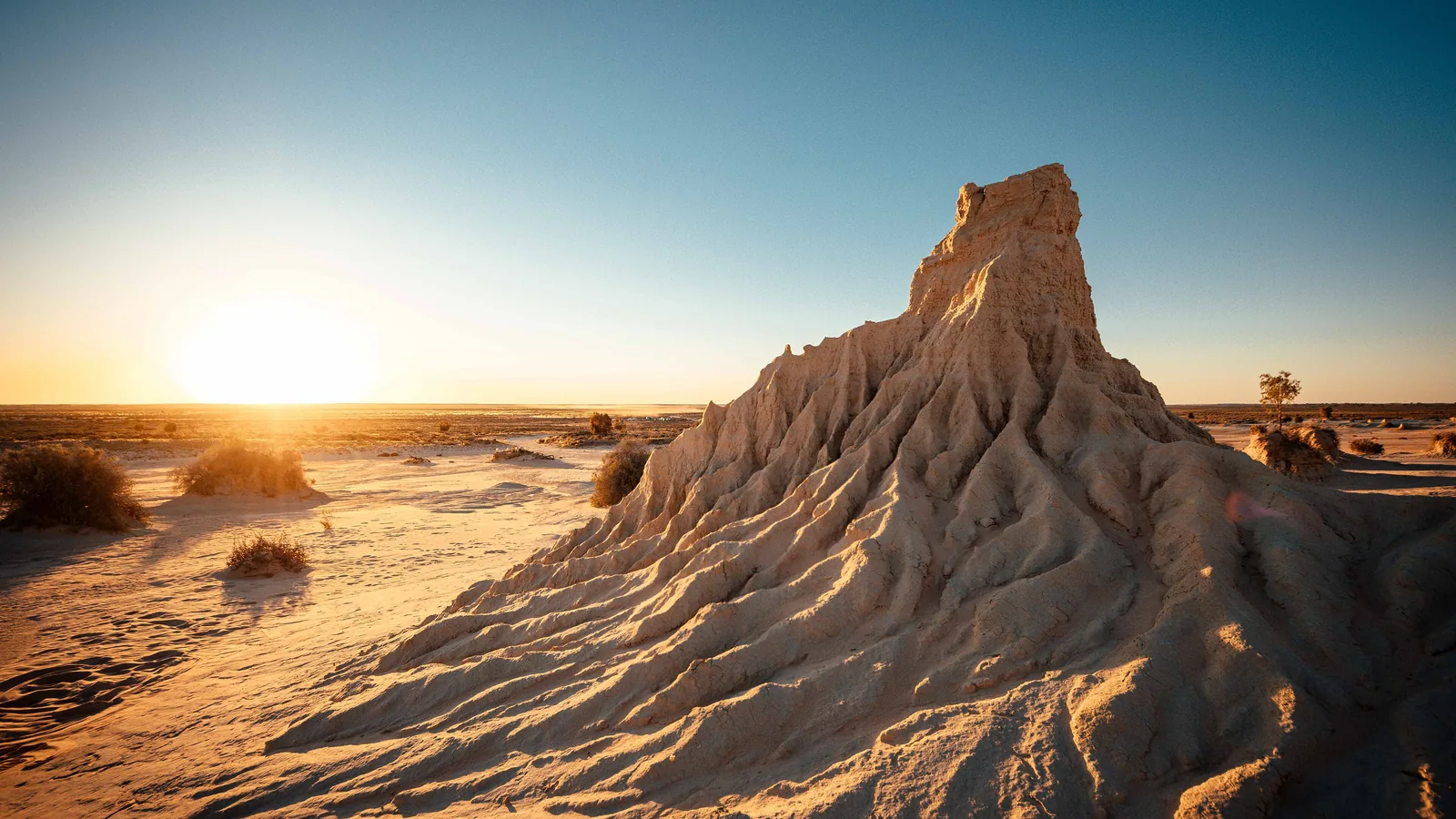
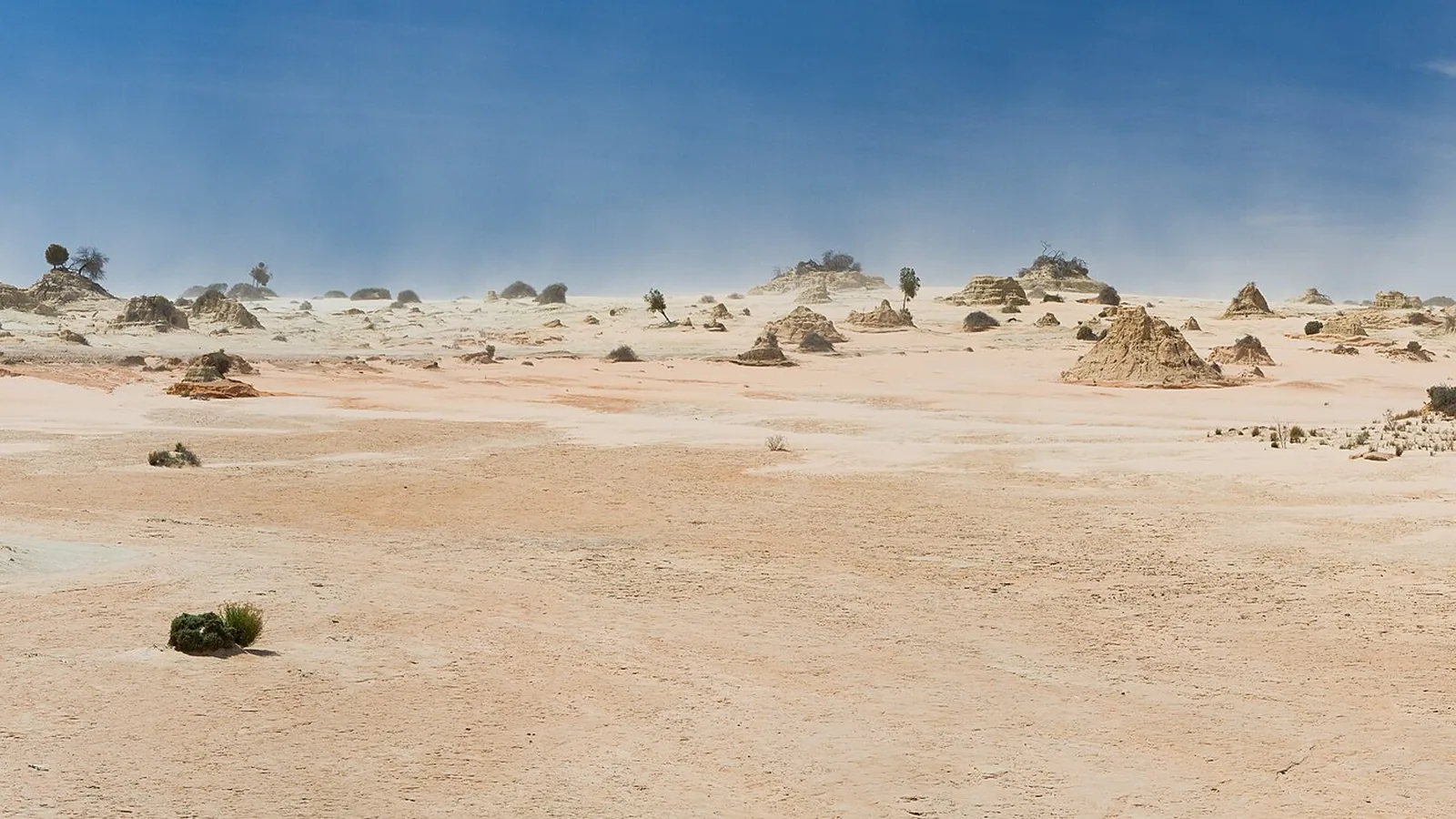
Pappin was exploring the area with Webb, of Bond University, in a project to teach young Aboriginal people archaeology, Cupper told ABC Science in December 2005. The prints lay on a hardpan near the old shoreline of a small dry basin between Lakes Garnpung and Leaghur, one of 19 linked relict basins in the Willandra Lakes system. People had walked across the clay while it was damp. The mud dried, a last film of clay sealed the prints, and dune sand buried the surface until wind stripped much of it away.
The age comes from optically stimulated luminescence, which measures how long grains of quartz sand have been shut away from daylight. Sand beneath the hardpan gave 23,000 years, give or take 1,200; two samples from the dune sand above gave about 19,400 and 19,200 years. The footprints fall between those limits, in a window of at most about 4,000 years when the surface lay open. The 2006 abstract called the site “the largest collection of Pleistocene human footprints in the world,” and the Australian Museum describes it as the world’s largest set of Ice Age footprints.
Webb's tallies and his estimates of speed
On December 21, 2005, before the paper appeared in print, Cupper told ABC Science of “about 450 footprints over 700 square metres or so” and 22 trackways, some up to 20 meters long. The paper, published in the Journal of Human Evolution in April 2006, gave “at least 124 prints” in its abstract. Its main text described at least 123 human prints and two kangaroo hind paw prints; erosion had exposed 89 of the human prints, and the team dug out another 35. Seventy-six of them formed eight trackways.
Webb then opened a further 150 square meters. His 2007 paper in the same journal reported: “The total number of prints has now almost tripled and the number of trackways has risen from eight to 23.” With the new trackway prints and an estimated 200 isolated ones, he gave a total of 563, plus 150 too incomplete to record. A radar survey at the end of 2005 had traced the buried surface 70 meters further east and 40 meters north, room, he estimated, for about 2,000 more prints. The ABC’s Deep Time Australia pages, written with the Mutthi Mutthi Knowledge Holders Patsy Winch nee Kelly and Tanya Charles, give five hundred prints and 25 trackways.
The heights and speeds are Webb and his colleagues’ calculations. In 2006 they multiplied each foot length by 6.585, a ratio taken from 1936 measurements of 162 Central Australian Aboriginal adults; the tallest walker, in trackway 1, came out at about 1.98 meters. For speed they put stride length into an equation built from 12 recreational distance runners and wrote that the results should be read cautiously. The runner in trackway 8 reached about 20 kilometers an hour, while a child in trackway 7 slowed from about five to three.
In 2007 Webb used formulas developed for the Laetoli hominid footprints in northern Tanzania, which combine foot length, stride length and estimated height. His new table gave trackway 8 a speed of 37.3 kilometers an hour. Trackway 4, he wrote, was a one-legged man moving at 21.7 kilometers an hour, “which seems incredible.” Pintubi trackers invited from Central Australia confirmed that its maker had only a right leg, a reading the Barkindji Knowledge Holders Warren Clark and Ivan Johnson also credit to the Pintubi on the Deep Time pages.
Sand and shade cloth over the trackways
Webb’s 2007 paper closed with the site’s fate: “surface weathering has required that the site be buried until these processes are better understood.” It thanked members of the Three Traditional Tribal Groups, who co-manage the World Heritage area, for an active part in the work and for giving “their time and labor during excavation of the site.” The NSW National Parks and Wildlife Service names the groups as the Barkindji, Mutthi Mutthi and Ngyiampaa, identified in 2001 when their role in managing Mungo National Park was formalized; the Australian Museum writes Barkandji/Paakantji and Ngiyampaa. Its exhibition page quotes Leanne Mitchell (Paakantji) saying “It shows we have always been here” in the 2018 film No Distance Between Us.
SBS NITV reported on February 3, 2016, that the prints were kept under sand and shade cloth at an undisclosed spot in Mungo National Park. “Once the footprint is exposed it essentially crumbles and blows away,” said Dan Rosendahl, executive officer of the Willandra Lakes Region World Heritage Area. Since 2006, the report said, the park and several universities had used GPS to fix the prints’ positions and laser scanning to watch for erosion, opening a selection now and then to check for damage. In that February 2016 report Rosendahl said the method was working, and the team was monitoring the site less frequently.

Key facts
- Mary Pappin Jr., of the Mutthi Mutthi people, found the first footprints in August 2003 (Webb, Cupper and Robins, 2006).
- Optically stimulated luminescence dating of sand above and below the clay layer put the prints between 19,000 and 23,000 years ago.
- The 2006 Journal of Human Evolution paper counted at least 124 prints in eight trackways; Cupper had told ABC Science of about 450 in December 2005.
- Webb’s 2007 paper reported 563 prints in 23 trackways, and a radar survey suggested about 2,000 more under the dunes.
- SBS NITV reported in 2016 that the prints were reburied under sand and shade cloth and monitored with GPS and laser scanning.
FAQ
How old are the Willandra Lakes footprints?
Between 19,000 and 23,000 years, from optically stimulated luminescence ages on the sand beneath and above the footprint layer, as reported by Webb, Cupper and Robins in 2006.
How many footprints are there?
It depends on the year. The 2006 paper gave at least 124; Webb's 2007 paper gave 563, plus about 150 incomplete prints. Earlier and later news reports gave about 450 (ABC Science, 2005) and five hundred (ABC Deep Time).
Can visitors see the footprints?
No. SBS NITV reported in 2016 that the prints were reburied under sand and shade cloth at an undisclosed location in Mungo National Park, with only selected prints opened for checks.
Sources
- Steve Webb, Matthew L. Cupper and Richard Robins, "Pleistocene human footprints from the Willandra Lakes, Southeastern Australia," Journal of Human Evolution 50(4) (2006), 405-413, abstract on PubMed (PMID 16343597).
- Bond University Research Repository, full text of Webb, Cupper and Robins (2006), "Pleistocene human footprints from the Willandra Lakes, southeastern Australia."
- Steve Webb, "Further research of the Willandra Lakes fossil footprint site, southeastern Australia," Journal of Human Evolution 52(6) (2007), 711-715.
- ABC Science, Anna Salleh, "Earliest human footprints in Australia" (December 21, 2005).
- SBS NITV, Andrea Booth, "How Australia is protecting 20,000-year-old footprints" (February 3, 2016).
- NSW National Parks and Wildlife Service, "Mungo National Park joint management program."
- Australian Museum, "Mungo footprint mould," Unsettled exhibition.
- ABC News, Deep Time Australia, "Willandra footprints" (Knowledge Holders Patsy Winch nee Kelly and Tanya Charles, Mutthi Mutthi).
- ABC News, Deep Time Australia, "Ice age footprints" (Knowledge Holders Warren Clark and Ivan Johnson, Barkindji).
Cite this article
- APA
- LETTER. (2026, September 28). Mary Pappin Jr.'s find: 124 Ice Age footprints became 563 by 2007. Our Earth's History. https://ourearthshistory.com/oceania/prehistory/willandra-footprints-mary-pappin-2003-ice-age-trackways/
- Chicago
- LETTER. “Mary Pappin Jr.'s find: 124 Ice Age footprints became 563 by 2007.” Our Earth's History, September 28, 2026. https://ourearthshistory.com/oceania/prehistory/willandra-footprints-mary-pappin-2003-ice-age-trackways/.
- MLA
- LETTER. “Mary Pappin Jr.'s find: 124 Ice Age footprints became 563 by 2007.” Our Earth's History, 28 Sep. 2026, https://ourearthshistory.com/oceania/prehistory/willandra-footprints-mary-pappin-2003-ice-age-trackways/.
Text licensed CC BY-NC-ND 4.0. Found an error? Tell us.