Ruppia seeds, pollen, quartz: White Sands footprints at 23,000 years
.JPG)
TL;DR — Ruppia seeds dated the White Sands footprints to about 23,000 to 21,000 years; critics cited reservoir effects, and pollen, quartz and lake mud later gave the same range.
The National Park Service gives calibrated radiocarbon dates of 22,860 (±320) and 21,130 (±250) years ago for the seed layers above and below human footprints at White Sands National Park in New Mexico. The paper behind those dates, by M. R. Bennett and 14 co-authors in Science on September 23, 2021, stated that “multiple in situ human footprints are stratigraphically constrained and bracketed by seed layers that yield calibrated radiocarbon ages between ~23 and 21 thousand years ago.” The seeds came from Ruppia cirrhosa, a plant that grows in water, and that fact drew a published challenge on January 14, 2022. Conifer pollen, quartz grains and lake mud, dated in 2023 and 2025, fell in the same range.
Quick facts
- When
- Footprints dated to between about 23,000 and 21,000 years ago (seed layers at 22,860 and 21,130 calibrated years); dark spots noticed 2006, dug 2009; Science paper September 23, 2021; comment and response January 14, 2022; pollen and luminescence paper October 5, 2023; paleolake study June 18, 2025
- Where
- WHSA Locality 2 on the eastern escarpment of Alkali Flat, the bed of former Lake Otero, Tularosa Basin, White Sands National Park, New Mexico
- Who
- M. R. Bennett and 14 co-authors (2021); Jeff Pigati and Kathleen Springer of the U.S. Geological Survey; critics D. B. Madsen, L. G. Davis, D. Rhode and C. G. Oviatt; V. T. Holliday and six co-authors (2025); mostly teenagers and children who left the prints
- Outcome
- Seed dates were challenged on the ground of reservoir effects; conifer pollen and quartz grains from the same layers gave matching ages in 2023, and 26 radiocarbon dates on lake mud from two other labs gave a span of more than 23.6 thousand to about 17.0 thousand years in 2025
Alkali Flat, 2006 to 2014
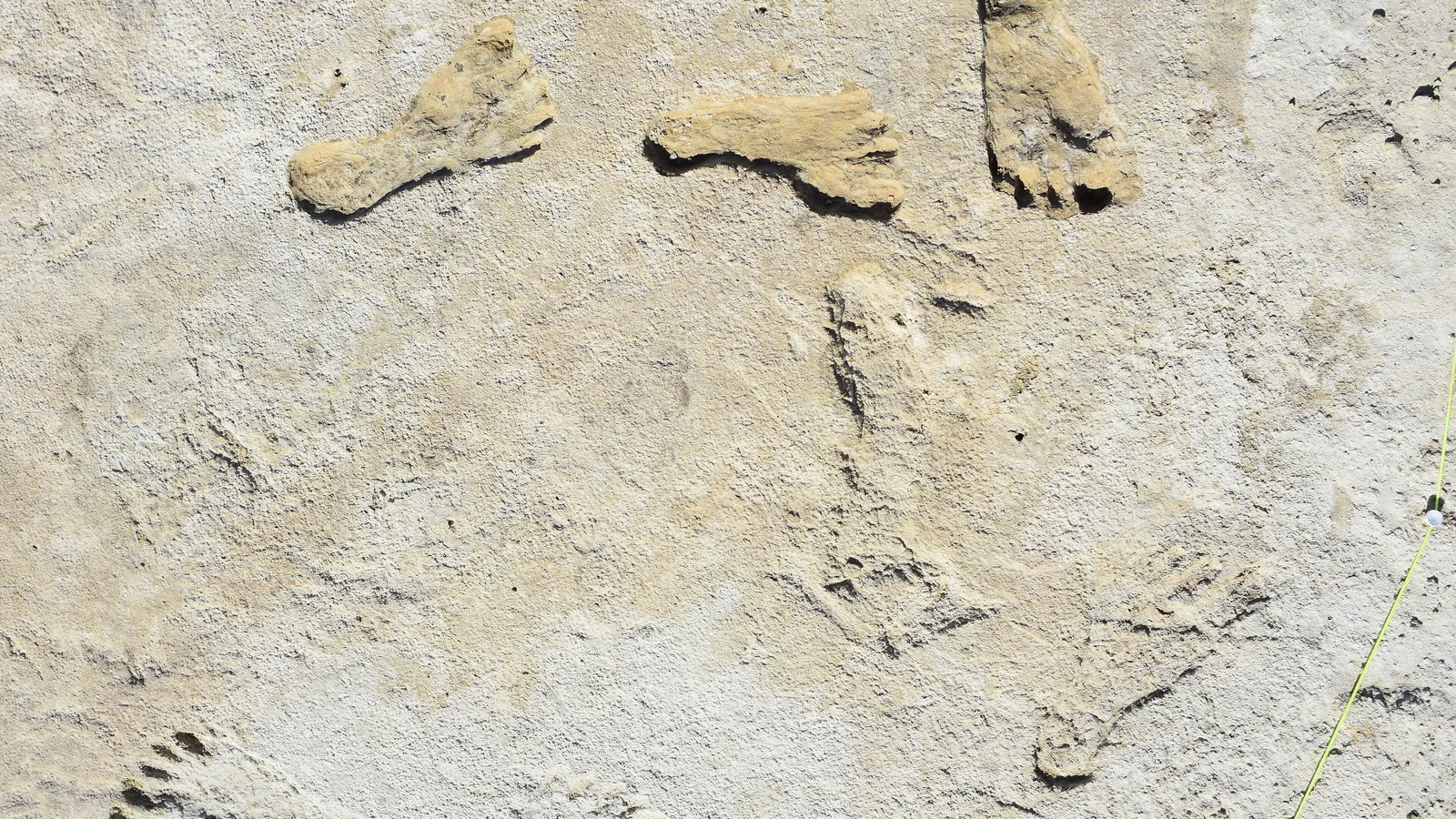
The prints lie in the bed of a vanished lake, Lake Otero, in the Tularosa Basin, at a spot recorded as WHSA Locality 2 on the eastern escarpment of Alkali Flat. For 80 years, the Park Service recounts, only a small collection of fossil footprints was known at White Sands. In 2006 scientists noticed dark spots dotting the lakebed, dug them up in 2009 and found tracks of Harlan’s ground sloth and of humans. During the 2010s dire wolf prints turned up next to seeds dated to more than 18,000 years.
The U.S. Geological Survey (USGS) describes the park as holding the largest known collection of Pleistocene fossil footprints, recognized as a megatracksite since 2014, with Columbian mammoth, saber-toothed cat and dire wolf tracks among them. Since January 2024 a visitor center exhibit has shown cast human footprints; the prints themselves, the park states, are inaccessible to visitors.
Teenagers and children, by stature and walking speed
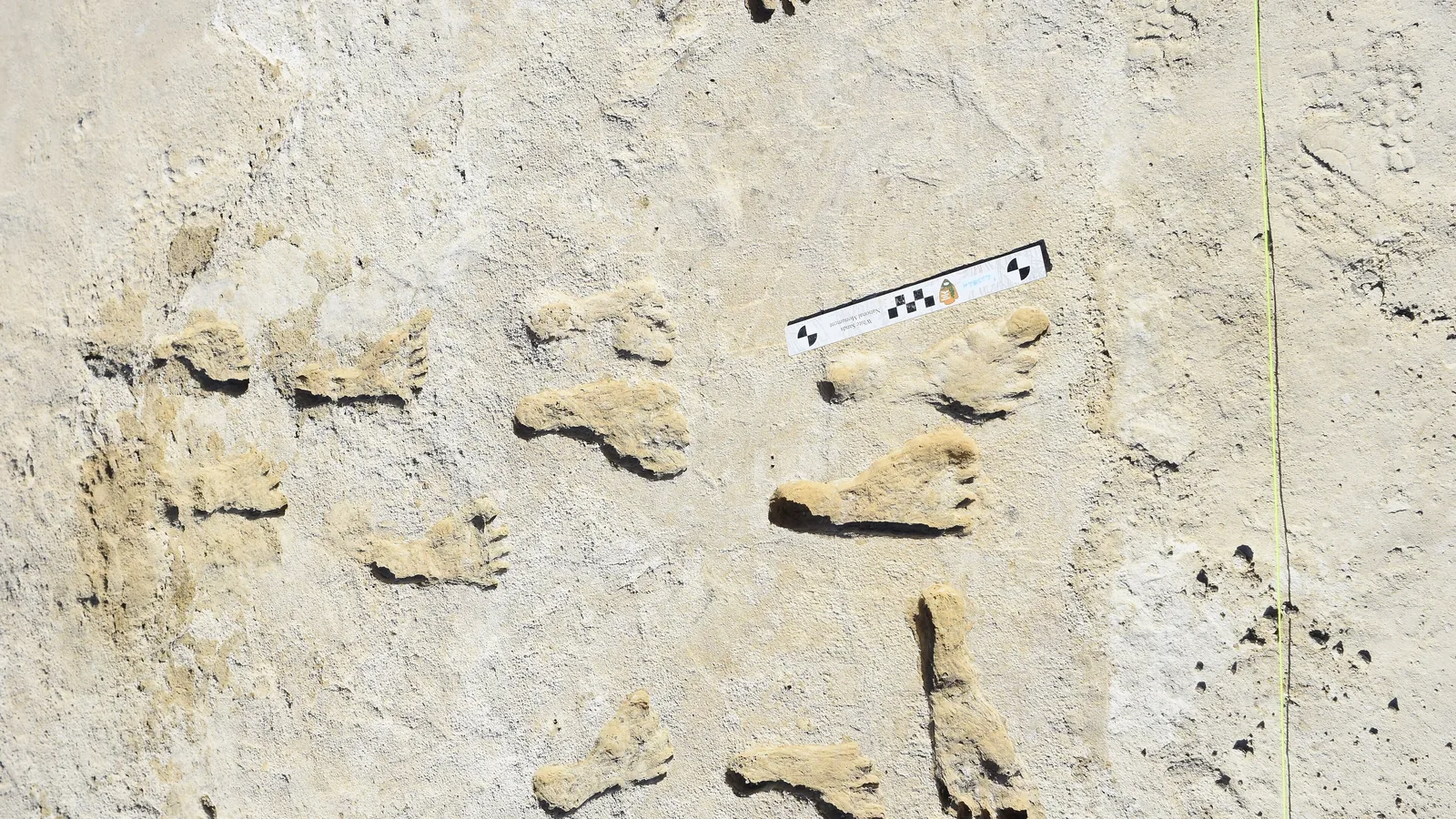
Based on stature and walking speed, the Park Service summarizes, most of the footprints in the 2021 study came from teenagers and children. The paper’s explanation, as the park quotes it: “One hypothesis for this is the division of labor, in which adults are involved in skilled tasks whereas fetching and carrying are delegated to teenagers. Children accompany the teenagers, and collectively they leave a higher number footprints that are preferentially recorded in the fossil record. This pattern is common to all excavated surfaces.” The authors called it a hypothesis; the mud recorded feet, not tasks.
A different paper, by D. Bustos and 14 co-authors in Science Advances on April 25, 2018, described human tracks superimposed in giant ground sloth tracks. That paper had no seed dates; its authors wrote that the tracks “were made sometime before 10 Ka BP and after 15.56 Ka BP.” The 2018 paper does not tie the sloth surface to the layers dated at Locality 2.
.JPG)
"Reservoir effects": the comment of January 14, 2022
On January 14, 2022, Science printed a comment by D. B. Madsen, L. G. Davis, D. Rhode and C. G. Oviatt. “Reservoir effects may have caused radiocarbon ages to appear thousands of years too old. Independent verification of the ages of the footprint horizons is imperative and is possible through other means,” they wrote. USGS itself describes the mechanism: aquatic plants can take up carbon dissolved in the water rather than from the air, “which can potentially cause the measured ages to be too old.” Seeds from such a plant could read older than the feet beside them.
The eight original authors, led by Jeff Pigati and Kathleen Springer of USGS, answered in the same issue. “On the basis of the geologic, hydrologic, stratigraphic, and chronologic evidence, we maintain that the ages are robust and conclude that the footprints date to between ~23,000 and 21,000 years ago,” they wrote. They “were well aware of this possibility, investigated it, and presented several lines of evidence that argued against such a problem,” they added, and took up the four points one by one.
October 5, 2023: 75,000 pollen grains to a sample
Pigati, Springer and nine co-authors published the check in Science on October 5, 2023. They chose conifer pollen because, as the USGS release explains, it comes from land plants and avoids the problem with Ruppia. Each sample took about 75,000 pollen grains, from the exact same layers as the original seeds so that each pair could be compared directly. “In each case, the pollen age was statistically identical to the corresponding seed age,” the release states. Springer said the team had been “confident in our original ages” but “knew that independent chronologic control was critical.”
David Wahl of USGS said the pollen “came from plants typically found in cold and wet glacial conditions.” Quartz grains from the footprint-bearing layers went for optically stimulated luminescence, which dates the last time the grains saw sunlight, and gave a minimum age of about 21,500 years. “With three separate lines of evidence pointing to the same approximate age, it is highly unlikely that they are all incorrect or biased,” USGS stated. The paper’s abstract ends that the framework “is robust” and that humans “were present in North America during the Last Glacial Maximum” (LGM), the cold peak of the last ice age.
Holliday's 26 dates on paleolake Otero, June 18, 2025
A separate team, V. T. Holliday of the University of Arizona and six co-authors, published a third test in Science Advances on June 18, 2025. They traced a previously unrecognized record of paleolake Otero into the track-bearing alluvium and obtained “26 additional radiocarbon dates on palustrine mud determined by two labs independent of the original investigations.” The record, they wrote, “includes the tracks and spans >23.6 thousand years to ~17.0 thousand calibrated years before present.”
The paper also answered the critics’ proposal that Ruppia seeds affected by the hard-water effect (HWE) had clumped into “seed balls” and been pushed by storms up the eastern margin of the lake. Balls of seeds seen in Trench 18-1 were never dated, Holliday’s team wrote, and no dated sample from Stratum 2P came with signs of turbulent water. The critics, they added, “appear to conflate the HWE with water salinity . . . but one does not predict the other. The HWE is a product of alkalinity, not salinity.” The argument has not closed: Madsen, Davis and three co-authors published a further paper in 2025 under the title “Characterizing the American Upper Paleolithic.” The lake study’s own summary, dated June 18, 2025, was that the result provides “another line of evidence further supporting the validity of an LGM age for the tracks.”
Key facts
- The National Park Service gives calibrated radiocarbon dates of 22,860 (±320) and 21,130 (±250) years ago for the seed layers above and below the footprints at WHSA Locality 2.
- Bennett and 14 co-authors published the dates in Science on September 23, 2021; the seeds were from Ruppia cirrhosa, a water plant.
- Dark spots on the lakebed were noticed in 2006 and dug in 2009, yielding Harlan’s ground sloth and human tracks; dire wolf prints found in the 2010s lay next to seeds dated to more than 18,000 years (NPS).
- USGS describes White Sands as a megatracksite since 2014, with Columbian mammoth, saber-toothed cat and dire wolf tracks.
- Most of the prints came from teenagers and children, judged by stature and walking speed (NPS, quoting Bennett et al.).
- Madsen, Davis, Rhode and Oviatt wrote on January 14, 2022, that “Reservoir effects may have caused radiocarbon ages to appear thousands of years too old”; Pigati and seven co-authors replied in the same issue that “the ages are robust.”
- On October 5, 2023, Pigati, Springer and nine co-authors reported conifer pollen ages (about 75,000 grains per sample) statistically identical to the seed ages, and a minimum luminescence age of about 21,500 years for quartz grains (USGS).
- On June 18, 2025, Holliday and six co-authors reported 26 radiocarbon dates on palustrine mud from two independent labs, spanning more than 23.6 thousand to about 17.0 thousand calibrated years before present.
FAQ
How old are the White Sands footprints?
The seed layers above and below them gave calibrated radiocarbon dates of 22,860 (±320) and 21,130 (±250) years ago, according to the National Park Service, and the 2021 Science paper put the prints between about 23,000 and 21,000 years. Pollen and luminescence dating in 2023 gave matching ages.
Why were the White Sands dates disputed?
The dated seeds came from Ruppia cirrhosa, a plant that grows in water. Aquatic plants can take up old carbon dissolved in the water, which can make radiocarbon ages too old. Madsen, Davis, Rhode and Oviatt raised this reservoir effect in Science on January 14, 2022, and asked for independent verification.
Can visitors see the footprints at White Sands National Park?
No. The park states that the footprints are inaccessible to visitors. An exhibit installed in the visitor center in January 2024 shows cast human footprints and explains the trackways.
Sources
- National Park Service, White Sands National Park, "Fossilized Footprints" (discovery history, calibrated dates, teenagers and children, 2024 exhibit).
- U.S. Geological Survey, National News Release, "Fossilized Footprints Reveal Human Habitation of North America Thousands of Years Earlier than Previously Thought," September 23, 2021.
- U.S. Geological Survey, National News Release, "Study confirms age of oldest fossil human footprints in North America," October 5, 2023 (Springer, Pigati and Wahl quoted; pollen and luminescence methods).
- U.S. Geological Survey, "Data release for Independent age estimates resolve the controversy of ancient human footprints at White Sands," October 5, 2023.
- U.S. Geological Survey, Media Library, "Footprints found in White Sands National Park" (National Park Service photograph and caption).
- Europe PMC record, abstract: M. R. Bennett et al., "Evidence of humans in North America during the Last Glacial Maximum," Science 373, no. 6562 (September 23, 2021).
- Europe PMC record, abstract: D. B. Madsen, L. G. Davis, D. Rhode and C. G. Oviatt, "Comment on 'Evidence of humans in North America during the Last Glacial Maximum,'" Science 375, no. 6577 (January 14, 2022).
- Europe PMC record, abstract: J. S. Pigati et al., "Response to Comment on 'Evidence of humans in North America during the Last Glacial Maximum,'" Science 375, no. 6577 (January 14, 2022).
- Europe PMC record, abstract: J. S. Pigati et al., "Independent age estimates resolve the controversy of ancient human footprints at White Sands," Science 382, no. 6666 (October 5, 2023).
- Europe PMC, full text (PMC12175891): V. T. Holliday et al., "Paleolake geochronology supports Last Glacial Maximum (LGM) age for human tracks at White Sands, New Mexico," Science Advances 11, no. 25 (June 18, 2025).
- Europe PMC, full text (PMC5916513): D. Bustos et al., "Footprints preserve terminal Pleistocene hunt? Human-sloth interactions in North America," Science Advances 4, no. 4 (April 25, 2018).
Cite this article
- APA
- Our Earth's History. (2026, September 22). Ruppia seeds, pollen, quartz: White Sands footprints at 23,000 years. Our Earth's History. https://ourearthshistory.com/americas/prehistory/white-sands-footprints-23000-years-ruppia-seeds/
- Chicago
- Our Earth's History. “Ruppia seeds, pollen, quartz: White Sands footprints at 23,000 years.” Our Earth's History, September 22, 2026. https://ourearthshistory.com/americas/prehistory/white-sands-footprints-23000-years-ruppia-seeds/.
- MLA
- “Ruppia seeds, pollen, quartz: White Sands footprints at 23,000 years.” Our Earth's History, 22 Sep. 2026, https://ourearthshistory.com/americas/prehistory/white-sands-footprints-23000-years-ruppia-seeds/.
Text licensed CC BY-NC-ND 4.0. Found an error? Tell us.