Murray Springs, Arizona: a Clovis camp, a mammoth and a black mat

TL;DR — At Murray Springs, Arizona, Clovis hunters killed a mammoth and a dozen bison about 13,000 years ago; a black clay sealed the camp, points and a bone wrench.
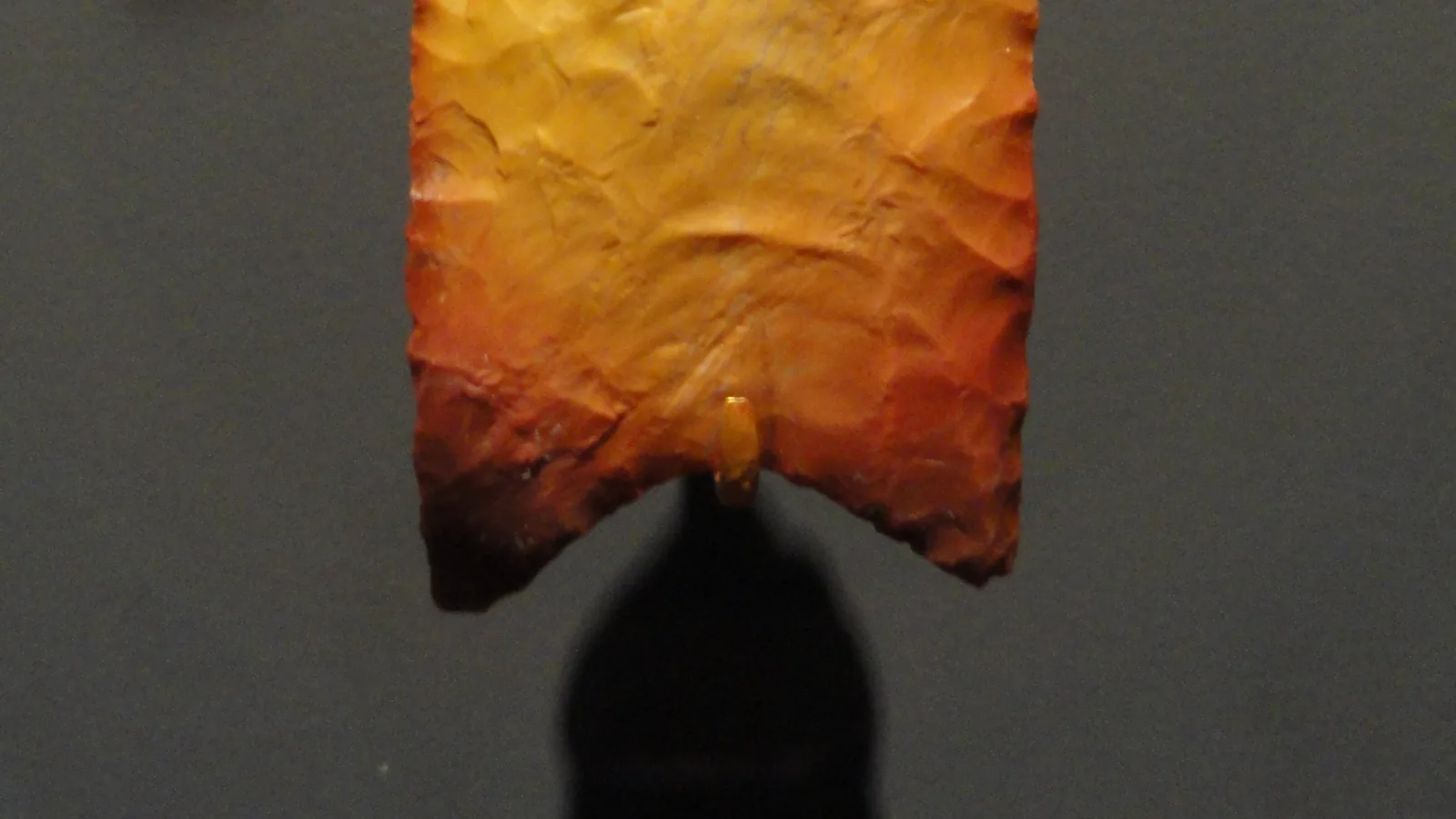
The Murray Springs Clovis Site in Cochise County, southeastern Arizona, holds a 13,000-year-old mammoth kill, a bison kill and the camp of the hunters who made both. The National Historic Landmark nomination of 2012 gives the age as 11,000 radiocarbon years, which calibrates to about 13,000 calendar years, or 11,000 BC. Excavations from 1966 to 1971 found a Clovis spear point and three broken tips beside a young female mammoth, at least 11 bison, thousands of stone flakes and a mammoth-bone tool that the nomination calls a spear shaft-straightening wrench. A black organic clay, the “black mat,” settled over the surface soon afterward. The fluted points that identify these hunters were first defined at Blackwater Draw in New Mexico; later dating has squeezed the Clovis culture into a few centuries and found people in North America before it.
Quick facts
- When
- Clovis about 13,000 years ago (11,050 to 10,800 radiocarbon years BP after the 2007 revision); Murray Springs excavated 1966 to 1971; Blackwater Draw NHL 1961, Lehner 1967, Murray Springs 2012
- Where
- Murray Springs on Curry Draw, Cochise County, southeastern Arizona; Blackwater Draw near Clovis, Roosevelt County, New Mexico; Naco and Lehner in the San Pedro Valley; Gault and the Friedkin site in central Texas
- Who
- Clovis hunters; C. Vance Haynes Jr. and Peter J. Mehringer, who found the Murray Springs bones under the black mat; E. B. Sayles, who located a mammoth tusk there in 1953; Michael R. Waters and Thomas W. Stafford, who redated Clovis in 2007
- Outcome
- One mammoth, at least 11 bison, a camp and a mammoth-bone shaft wrench sealed under a black clay; Clovis dated to a span of a few centuries; sites in Texas, Idaho and New Mexico show people in North America before Clovis
A mammoth 40 feet from a water hole
Around 13,000 years ago, a small group of mammoths was digging holes in a drying creek bed in the San Pedro Valley and sucking muddy water from them. Hunters attacked. A young adult female lay dead on her left side 40 feet from the water hole, with mammoth tracks in the sand between the two. Around her bones lay the point, the three tips, butchering tools and thousands of flakes from resharpening.
Among the footprints lay the bone wrench, 10 inches long and nearly an inch thick, broken in two, the only tool of its kind found in the Americas. The hunters carried the hindquarter to a camp about 100 yards south. Not long after, a herd of bison came to the same water hole, and the hunters killed about a dozen of a larger, now-extinct species. An impact flake, the sliver that snaps off a stone point when it hits bone, was found in the camp and refitted to a point fragment from the bison kill; a second flake from the kill refitted to a fragment from the camp. The nomination counts Murray Springs as one of only three Clovis-age bison kills known.
Black clay over the bones
According to the nomination, the climate then turned abruptly cold, groundwater rose, and algal blooms laid down a black organic clay over the Clovis surfaces between 10,800 and 9,700 radiocarbon years ago. The geologist C. Vance Haynes Jr. wrote in 1987 that artifacts and thousands of waste flakes were found “exactly as they had been left by Clovis people about 13,000 years ago.”
Haynes and Peter J. Mehringer had come to Curry Draw, the arroyo through the site, in the early 1960s, after E. B. Sayles located a mammoth tusk there in 1953. They recognized the black clay that covered mammoth bones and Clovis tools at the Lehner site 10 miles south, and in a side gully found mammoth bone beneath it.
Blackwater Draw and the name Clovis
The points are named for Clovis, New Mexico, and the site outside it, Blackwater Draw. Brendon Asher, director of the landmark and its museum at Eastern New Mexico University, described it in 2018 as “the type site for Clovis chipped stone technology,” the place whose finds first defined the point in the academic literature. The university describes a 640-acre area around a spring-fed Pleistocene lake; the Park Service lists it as designated on January 20, 1961.
The Murray Springs nomination gives the order of discovery. The Clovis fluted point was not told apart from the Folsom point, known since 1927, until 1941, after the 1930s excavations at Blackwater Draw. In 1952 Clovis was accepted as the older type, tied to mammoths where Folsom went with bison. The next intact Clovis sites were in the San Pedro Valley: Naco, dug in 1952, with eight points in one mammoth, and Lehner, dug in 1955 and 1956, with 13 points among a dozen.
Dating a culture to a few centuries
A 2007 study by Michael R. Waters and Thomas W. Stafford Jr. in Science narrowed the span of Clovis. The Clovis complex had been dated between 11,500 and 10,900 radiocarbon years before present, they wrote; adjusted dates and a reevaluation of the record revised the range to 11,050 to 10,800 radiocarbon years BP. In as few as 200 calendar years, they concluded, Clovis technology originated and spread through North America. A 2011 paper by Waters and colleagues gave the calendar equivalent as about 12.8 to 13.1 thousand years ago.
That 2011 paper reported the layer beneath Clovis at the Debra L. Friedkin site in central Texas: 15,528 artifacts defining the Buttermilk Creek Complex, dated between about 13.2 and 15.5 thousand years ago, which the authors wrote “confirms the emerging view that people occupied the Americas before Clovis.” Gault, on the same creek, was described by Texas Beyond History in 2001 as a Clovis base camp with more than 100 incised stones. The older story, from the southern end of the hemisphere, is in the article on Monte Verde.
Older footprints and a comet argument
At White Sands National Park in New Mexico, M. R. Bennett and colleagues reported in Science in 2021 that human footprints lay between seed layers with calibrated radiocarbon ages of about 23,000 to 21,000 years. Because the aquatic seeds could carry an old carbon reservoir effect, J. S. Pigati and colleagues dated pollen from the same horizons and the sediment itself, and wrote in 2023 that the original framework held. At Cooper’s Ferry in western Idaho, Loren G. Davis and colleagues reported in 2019 that people occupied the Columbia River basin from between 16,560 and 15,280 calibrated years ago, using unfluted stemmed points before Clovis.
The black mat itself has drawn an argument. The nomination notes the view that the sudden rise in the water table was due to a catastrophic event such as a comet collision, citing Firestone and others in 2006. That Younger Dryas impact hypothesis is contested: Maarten Blaauw, Vance T. Holliday, Jacquelyn L. Gill and Kathleen Nicoll challenged its age models in PNAS in 2012, and the original authors replied in the same issue.
Murray Springs does not depend on that dispute. One mammoth, a dozen bison and a week’s camp were left on a creek bed in Arizona about 13,000 years ago, and a black clay kept them where they fell.
Key facts
- Murray Springs lies on Curry Draw, about seven miles east of Sierra Vista in Cochise County, Arizona, inside the San Pedro Riparian National Conservation Area (NHL nomination).
- The nomination dates the site to 11,000 radiocarbon years, calibrated to about 13,000 calendar years, or 11,000 BC.
- Finds beside the young female mammoth: one intact Clovis point, three broken tips, butchering tools, thousands of flakes and a 10-inch mammoth-bone shaft wrench, the only one found in the Americas.
- The bison kill held at least 11 animals of an extinct species; two impact flakes refitted to point fragments tie the kill to the camp.
- A black organic clay, dated 10,800 to 9,700 radiocarbon years ago, sealed the surface; 98 percent of artifacts were recovered in place.
- Excavations ran from 1966 to 1971 under C. Vance Haynes Jr.; the finds are at the Arizona State Museum, Tucson.
- Blackwater Draw, the Clovis type site near Clovis, New Mexico, was designated a landmark on January 20, 1961; the Clovis point was separated from Folsom in 1941 and accepted as older in 1952.
- Waters and Stafford (2007) revised the Clovis range to 11,050 to 10,800 radiocarbon years BP; Waters et al. (2011) gave about 12.8 to 13.1 thousand calendar years.
FAQ
What is a Clovis point?
A large fluted stone spear point, named for Clovis, New Mexico, near the Blackwater Draw site where the type was first defined. The Murray Springs nomination records that it was told apart from the Folsom point in 1941 and recognized as older in 1952. Clovis hunters used such points with atlatls, or spear throwers.
How old is the Clovis culture?
Waters and Stafford's 2007 revision in Science put it at 11,050 to 10,800 radiocarbon years before present, a span the authors read as few as 200 calendar years. A 2011 paper by Waters and colleagues gave the calendar equivalent as about 12.8 to 13.1 thousand years ago. The Murray Springs nomination uses about 13,000 years.
Were Clovis people the first Americans?
No. The Buttermilk Creek Complex at the Friedkin site in Texas lies beneath Clovis and dates to about 13.2 to 15.5 thousand years ago; Cooper's Ferry in Idaho was occupied from about 16,000 years ago; footprints at White Sands, New Mexico, date to about 23,000 to 21,000 years ago, an age reaffirmed in 2023.
Sources
- U.S. National Park Service, National Historic Landmark nomination — "Murray Springs Clovis Site," NPS Form 10-900, designated October 16, 2012 (PDF).
- U.S. National Park Service — "List of National Historic Landmarks by State" (Arizona and New Mexico entries).
- Eastern New Mexico University — "Blackwater Draw Site and Museum."
- Eastern New Mexico University, ENMU News — David Aguirre, "Blackwater Draw Director Discusses Significance of Site," March 14, 2018 (interview with Brendon Asher).
- Texas Beyond History (University of Texas at Austin) — "Gault: Clovis Reconsidered" (2001, with later update).
- Europe PMC record — Michael R. Waters and Thomas W. Stafford Jr., "Redefining the age of Clovis: implications for the peopling of the Americas," Science 315 (February 2007), abstract.
- Europe PMC record — Michael R. Waters et al., "The Buttermilk Creek complex and the origins of Clovis at the Debra L. Friedkin site, Texas," Science 331 (March 2011), abstract.
- Europe PMC record — Loren G. Davis et al., "Late Upper Paleolithic occupation at Cooper's Ferry, Idaho, USA, ~16,000 years ago," Science 365 (August 2019), abstract.
- Europe PMC record — Matthew R. Bennett et al., "Evidence of humans in North America during the Last Glacial Maximum," Science 373 (September 23, 2021), abstract.
- Europe PMC record — Jeffrey S. Pigati et al., "Independent age estimates resolve the controversy of ancient human footprints at White Sands," Science 382 (October 5, 2023), abstract.
- U.S. National Park Service, White Sands National Park — "Fossilized Footprints."
- Europe PMC record — Maarten Blaauw, Vance T. Holliday, Jacquelyn L. Gill and Kathleen Nicoll, "Age models and the Younger Dryas Impact Hypothesis," PNAS 109(34), E2240, with author reply (2012), bibliographic record.
Cite this article
- APA
- Our Earth's History. (2026, September 22). Murray Springs, Arizona: a Clovis camp, a mammoth and a black mat. Our Earth's History. https://ourearthshistory.com/americas/prehistory/clovis-points-blackwater-draw-13000-years/
- Chicago
- Our Earth's History. “Murray Springs, Arizona: a Clovis camp, a mammoth and a black mat.” Our Earth's History, September 22, 2026. https://ourearthshistory.com/americas/prehistory/clovis-points-blackwater-draw-13000-years/.
- MLA
- “Murray Springs, Arizona: a Clovis camp, a mammoth and a black mat.” Our Earth's History, 22 Sep. 2026, https://ourearthshistory.com/americas/prehistory/clovis-points-blackwater-draw-13000-years/.
Text licensed CC BY-NC-ND 4.0. Found an error? Tell us.