Fifty tortoise shells and a leopard pelvis: the Hilazon Tachtit grave
.jpg)
TL;DR — A woman buried at Hilazon Tachtit about 12,000 years ago lay with more than 50 tortoise shells and a leopard pelvis; the excavators called it a shaman’s grave.
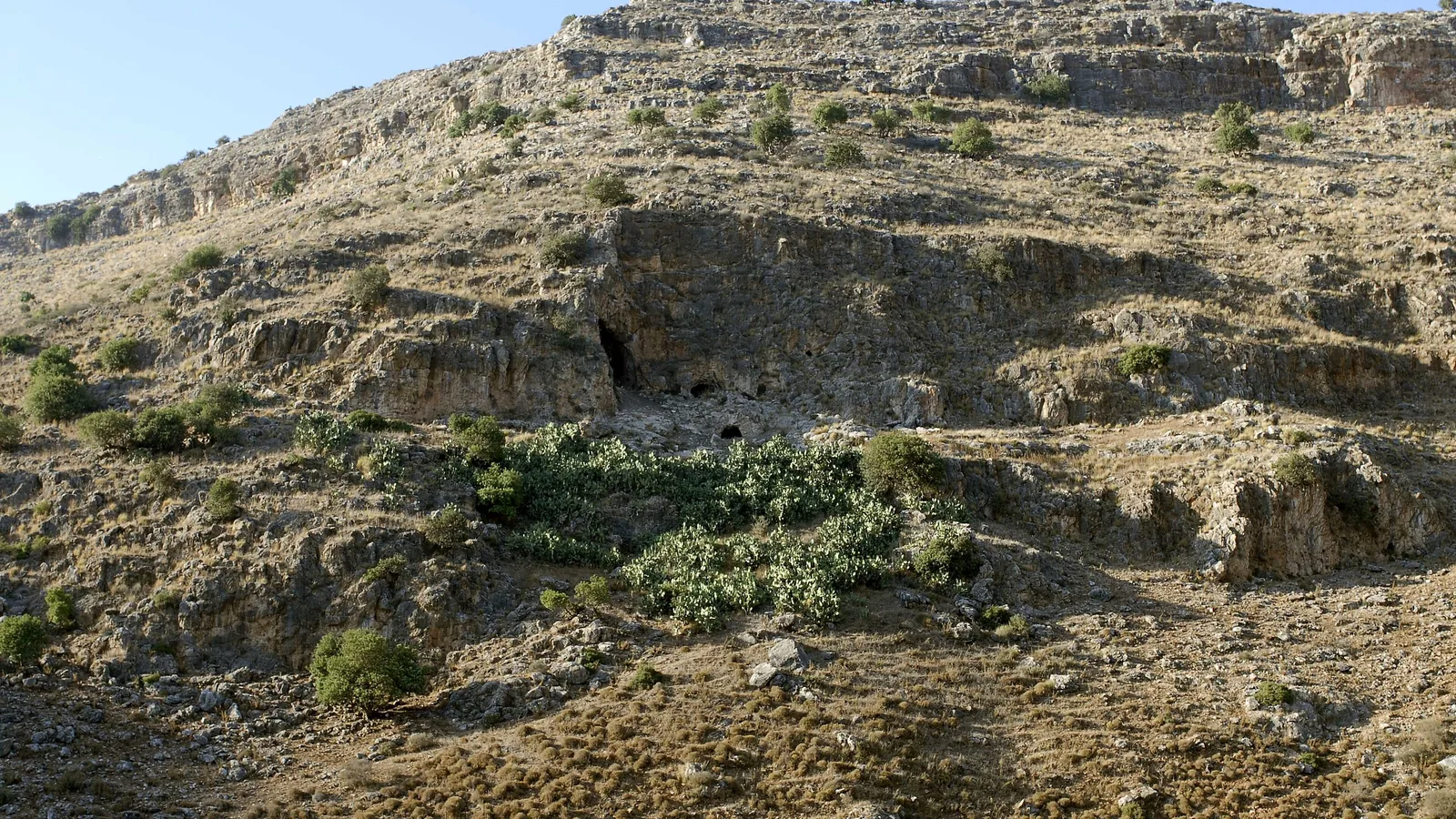
“Hilazon Tachtit is a small cave site in the Galilee region of Israel,” wrote Leore Grosman, Natalie D. Munro and Anna Belfer-Cohen in 2008. Their paper in the Proceedings of the National Academy of Sciences (PNAS) goes on: “Facing east, the cave is located on an escarpment ≈150 m above Nahal (river) Hilazon, 14 km from the Mediterranean shoreline.” The one prehistoric layer inside it dates to 12,400–12,000 cal BP, late in the Natufian period. Grosman and Belfer-Cohen were at the Hebrew University of Jerusalem, Munro at the University of Connecticut; the Hebrew University gives the excavation as 1997–2008. In that layer they found a woman of about 45 in a mud-plastered pit under a triangular slab, with more than 50 complete tortoise shells, the pelvis of a leopard, the wing tip of a golden eagle and the foot of a larger adult. The authors read it as a shaman’s burial and wrote that no standard criteria exist for identifying one.
Quick facts
- When
- 12,400–12,000 cal BP (the single Natufian layer in the cave) · 1997–2008 (excavation, as given by the Hebrew University) · 2008 (PNAS paper on the burial) · 2010 (PNAS paper on feasting) · 2013 (PNAS paper on Raqefet Cave) · October 16, 2019 (PLOS ONE paper on the basalt bowl)
- Where
- Hilazon Tachtit Cave, on an escarpment about 150 meters above Nahal Hilazon in the Galilee region of Israel, 14 kilometers from the Mediterranean shore; Structure A inside the cave
- Who
- Leore Grosman and Anna Belfer-Cohen (Institute of Archaeology, Hebrew University of Jerusalem); Natalie D. Munro (University of Connecticut); Laure Dubreuil (Trent University); Ruth Shahack-Gross; Dani Nadel; a woman of about 45 and about 1.5 meters tall
- Outcome
- The excavators read the grave in Structure A as the burial of a shaman while writing that no standard criteria exist to identify one. The 2010 paper counted 9,669 animal bones in the two structures and estimated that the tortoises alone could feed at least 35 people; the 2019 paper concluded that the basalt bowl was broken on purpose before burial
Twenty-eight individuals in a hollow of 30 square meters
Natufian activity in the cave was confined to a shallow depression in the bedrock at its center, about 30 square meters. The cave “functioned first and foremost as a Natufian burial ground for at least 28 individuals,” the 2008 paper states. The excavators found two round structures of limestone cobbles about one meter across, Structure A and Structure B, and three small burial pits, Pits I to III, up to 80 centimeters deep. The pits held at least 25 people; in Pit III bones had been pushed aside to fit five bodies in. Skulls and long bones were missing from the pits, which the authors read as graves reopened so that those bones could be removed and reburied. Three burials were intact; the one in Structure A predated the structure’s use and was, in the authors’ judgment, the earliest at the site.
Structure A: a pit plastered with mud
That grave sat in an oval basin cut on purpose into the sterile breccia below the Natufian levels. Fourier-transform infrared (FTIR) analysis of the grave walls, by Ruth Shahack-Gross and Grosman, showed that they had been plastered with mud collected just outside the cave, and large limestone slabs lined the floor. A triangular limestone slab measuring 40 by 75 centimeters sealed the top. At the time of burial more than 10 large stones were set directly on the head, pelvis and arms of the body, and their weight later pulled the pelvis away from the spine. The woman lay on her side against the curved southern wall of the pit, her legs splayed and bent inward at the knee.
The woman, and what lay on and around her
Grosman and Belfer-Cohen analyzed the bones. The paper describes “a gracile female, ≈45-years-old and estimated to be 1.5-m tall.” She had lipping on the vertebrae, heavy tooth wear, a fused coccyx and sacrum and deformations of the pelvis and of the lumbar and sacral vertebrae, and the authors wrote that pathologies of this nature “would have affected the woman’s gait (i.e., limping or foot dragging).”
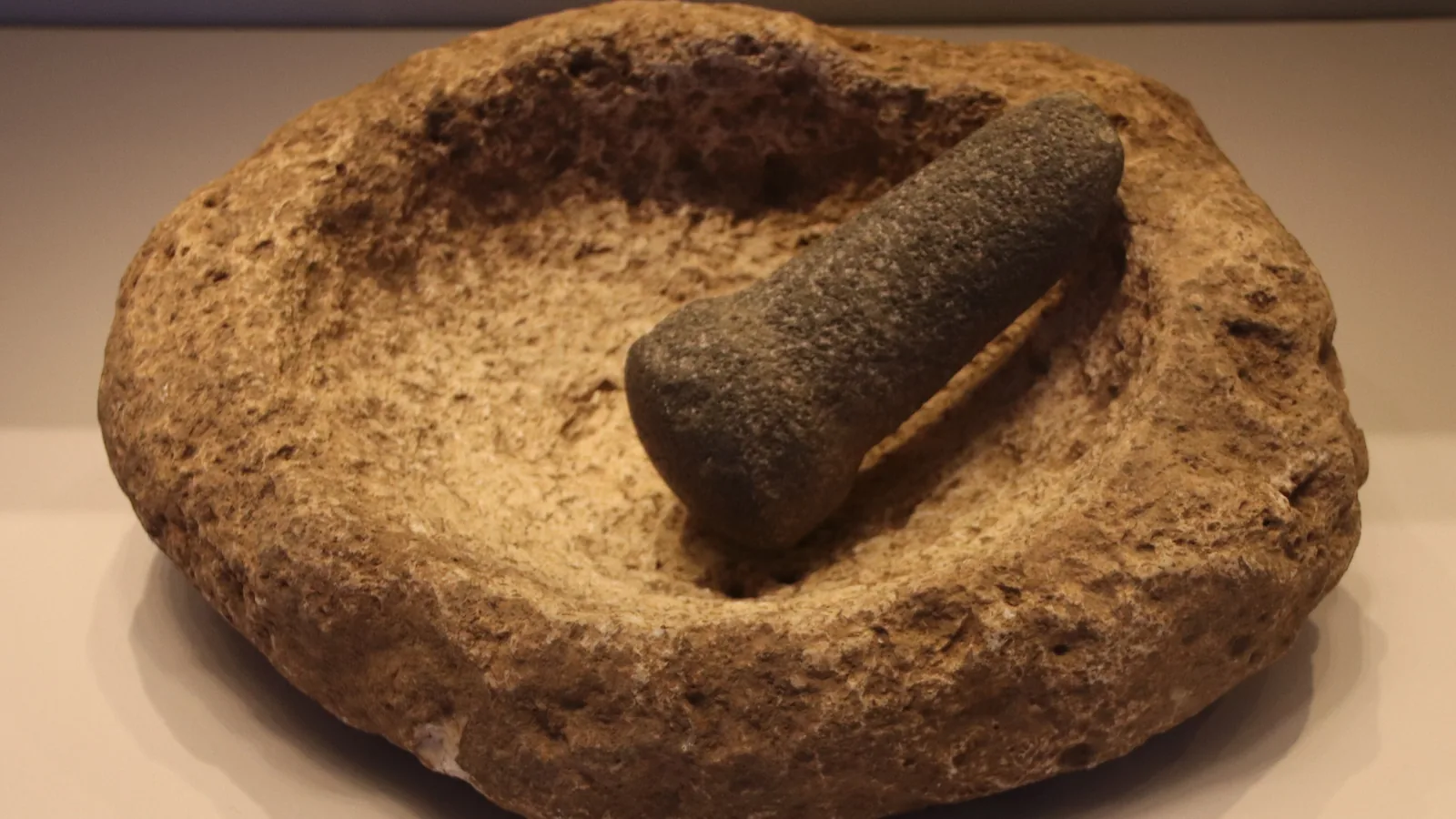
A fragment of a worn basalt bowl, 14 centimeters long, lay above her left leg, and with it a complete, articulated human foot from an adult “substantially larger than the interred woman.” A pointed bone tool lay at right angles to her left tibia, and a round pebble 10 centimeters across at the left of her pelvis. Then the tortoises: “the female was buried with >50 complete tortoise shells,” Mediterranean spur-thighed tortoises, Testudo graeca. Her skull rested on one carapace, three lay directly above her pelvis and two just below it. Two skulls of stone marten, one complete and one the front half, were in the grave, the complete one directly above what the paper calls “the third human foot.” The wing tip of a golden eagle and several articulated tail vertebrae, the only part of an aurochs in the grave, lay with them. The pelvis of a leopard, “an extremely rare animal in Natufian contexts,” lay between two articulated tortoise shells, and the articulated forearm of a wild boar lay along her left upper arm.
"No standard criteria": the shaman reading
The abstract of the 2008 paper states: “The interment rituals and the method used to construct and seal the grave suggest that this is the burial of a shaman, one of the earliest known from the archaeological record.” The authors cited the labor put into the grave, the goods and the woman’s pathologies. They set out the limit of the method in the same paper: “there are no standard criteria to identify a shaman in the archaeological record.” The closest known Natufian domestic site, Hayonim Terrace, is 10 kilometers away.
Other Natufian caves held graves too. A team led by Dani Nadel wrote in PNAS in 2013 that “more than 450 skeletons have been unearthed in sites such as el-Wad Cave and Terrace, Eynan, Hayonim Cave and Terrace, Hilazon Tachtit Cave, Nahal Oren, and Raqefet Cave.” At Raqefet Cave on Mount Carmel that team found impressions of flowering stems, sage among them, lining four graves dated 13,700–11,700 cal BP, and wrote that the only possibly older case was “the questionable use of flowers in the Shanidar IV Neanderthal grave.”
Bones counted in 2010, a bowl reassembled in 2019
In 2010 Munro and Grosman published a second PNAS paper on the fill of the two structures, which held 9,669 identifiable animal bones. Structure B held 112 aurochs bones, 85 percent of all aurochs remains at the site, from at least three animals. Structure A held 5,505 tortoise bones from at least 71 individuals. Of the plastrons, 96.2 percent showed spiral fractures across the five front segments, and four percent of shell segments were burned against 0.4 percent of limb bones, a sign of roasting in the shell. Their estimate followed: “The yield of meat (at least 17 kg) would have been sufficient to feed at least 35 people.” Stone tools followed: 64 percent of the site’s lithics lay in 15 percent of its area. Structure B, they wrote, was “too small even for one person’s needs.”
On October 16, 2019, Laure Dubreuil of Trent University, with Ahiad Ovadia, Shahack-Gross and Grosman, published a study of the basalt fragment in PLOS ONE. They concluded that it had been part of a shallow bowl used for mixing ash or lime with water, that the bowl was then broken on purpose by flaking in several directions, and that the piece was not used again but placed in a cache before the burial. “The broken bowl found in a burial pit at Hilazon Tachtit demonstrates that intentional breakage was also part of burial practices,” they wrote. The journal received the paper on May 15, 2019, and accepted it on September 19.

Key facts
- Hilazon Tachtit Cave faces east on an escarpment about 150 meters above Nahal Hilazon in the Galilee region of Israel, 14 kilometers from the Mediterranean shore (Grosman, Munro and Belfer-Cohen, PNAS 2008).
- The single Natufian layer in the cave dates to 12,400–12,000 cal BP; the cave held at least 28 individuals, at least 25 of them in three pits (PNAS 2008).
- The Hebrew University gives the excavation of the cave as 1997–2008 (faculty page for Leore Grosman).
- The grave in Structure A was cut into sterile breccia, plastered with mud, floored with limestone slabs and sealed with a triangular slab of 40 by 75 centimeters; more than 10 large stones were set on the body (PNAS 2008).
- The skeleton is that of a gracile woman of about 45, about 1.5 meters tall, with a fused coccyx and sacrum and deformations of the pelvis and of the lumbar and sacral vertebrae (PNAS 2008).
- Grave goods: more than 50 complete Testudo graeca shells, a 14-centimeter basalt bowl fragment, an articulated human foot of a larger adult, a bone point, a 10-centimeter pebble, two stone-marten skulls, a golden-eagle wing tip, aurochs tail vertebrae, a wild boar forearm and a leopard pelvis (PNAS 2008).
- The two structures held 9,669 identifiable animal bones: 112 aurochs bones from at least three animals in Structure B and 5,505 tortoise bones from at least 71 individuals in Structure A (Munro and Grosman, PNAS 2010).
- The basalt fragment was part of a bowl used for mixing ash or lime with water, broken on purpose and cached before the burial (Dubreuil and others, PLOS ONE, October 16, 2019).
FAQ
Why is the Hilazon Tachtit burial called a shaman's grave?
Because Grosman, Munro and Belfer-Cohen wrote in 2008 that the grave's construction and sealing, its unusual animal offerings and the woman's skeletal pathologies "suggest that this is the burial of a shaman." The same paper states that "there are no standard criteria to identify a shaman in the archaeological record," so the label is the excavators' reading, not a settled identification.
How many tortoise shells were in the grave?
More than 50 complete shells of the Mediterranean spur-thighed tortoise, Testudo graeca. Her skull rested on one carapace, three lay above her pelvis and two below it. The 2010 paper counted 5,505 tortoise bones from at least 71 individuals in Structure A as a whole and estimated at least 17 kilograms of meat.
When was Hilazon Tachtit excavated?
The Hebrew University of Jerusalem's faculty page for Leore Grosman gives the excavation as 1997–2008. The burial was published in PNAS in 2008, the feasting evidence in PNAS in 2010 and the basalt bowl study in PLOS ONE in 2019.
Sources
- Leore Grosman, Natalie D. Munro and Anna Belfer-Cohen, "A 12,000-year-old Shaman burial from the southern Levant (Israel)," Proceedings of the National Academy of Sciences 105, no. 46 (2008): 17665–17669, full text at PubMed Central (PMC2584673).
- Natalie D. Munro and Leore Grosman, "Early evidence (ca. 12,000 B.P.) for feasting at a burial cave in Israel," Proceedings of the National Academy of Sciences 107, no. 35 (2010): 15362–15366, full text at PubMed Central (PMC2932561).
- Laure Dubreuil, Ahiad Ovadia, Ruth Shahack-Gross and Leore Grosman, "Evidence of ritual breakage of a ground stone tool at the Late Natufian site of Hilazon Tachtit cave (12,000 years ago)," PLOS ONE 14, no. 10 (2019): e0223370, full text at PubMed Central (PMC6795415).
- PLOS ONE, article page for Dubreuil et al., "Evidence of ritual breakage of a ground stone tool at the Late Natufian site of Hilazon Tachtit cave (12,000 years ago)," with the dates received (May 15, 2019), accepted (September 19, 2019) and published (October 16, 2019).
- Dani Nadel and others, "Earliest floral grave lining from 13,700–11,700-y-old Natufian burials at Raqefet Cave, Mt. Carmel, Israel," Proceedings of the National Academy of Sciences 110, no. 29 (2013): 11774–11778, full text at PubMed Central (PMC3718103).
- Hebrew University of Jerusalem, Institute of Archaeology, faculty page for Prof. Leore Grosman (research projects, including "Hilazon Tachtit Cave ... excavated 1997-2008").
Cite this article
- APA
- Our Earth's History. (2026, September 22). Fifty tortoise shells and a leopard pelvis: the Hilazon Tachtit grave. Our Earth's History. https://ourearthshistory.com/west-asia/prehistory/hilazon-tachtit-natufian-burial-12000-years-fifty-tortoise-shells/
- Chicago
- Our Earth's History. “Fifty tortoise shells and a leopard pelvis: the Hilazon Tachtit grave.” Our Earth's History, September 22, 2026. https://ourearthshistory.com/west-asia/prehistory/hilazon-tachtit-natufian-burial-12000-years-fifty-tortoise-shells/.
- MLA
- “Fifty tortoise shells and a leopard pelvis: the Hilazon Tachtit grave.” Our Earth's History, 22 Sep. 2026, https://ourearthshistory.com/west-asia/prehistory/hilazon-tachtit-natufian-burial-12000-years-fifty-tortoise-shells/.
Text licensed CC BY-NC-ND 4.0. Found an error? Tell us.