Twenty-four mud-wasp nests date the Gwion figures to 12,000 years
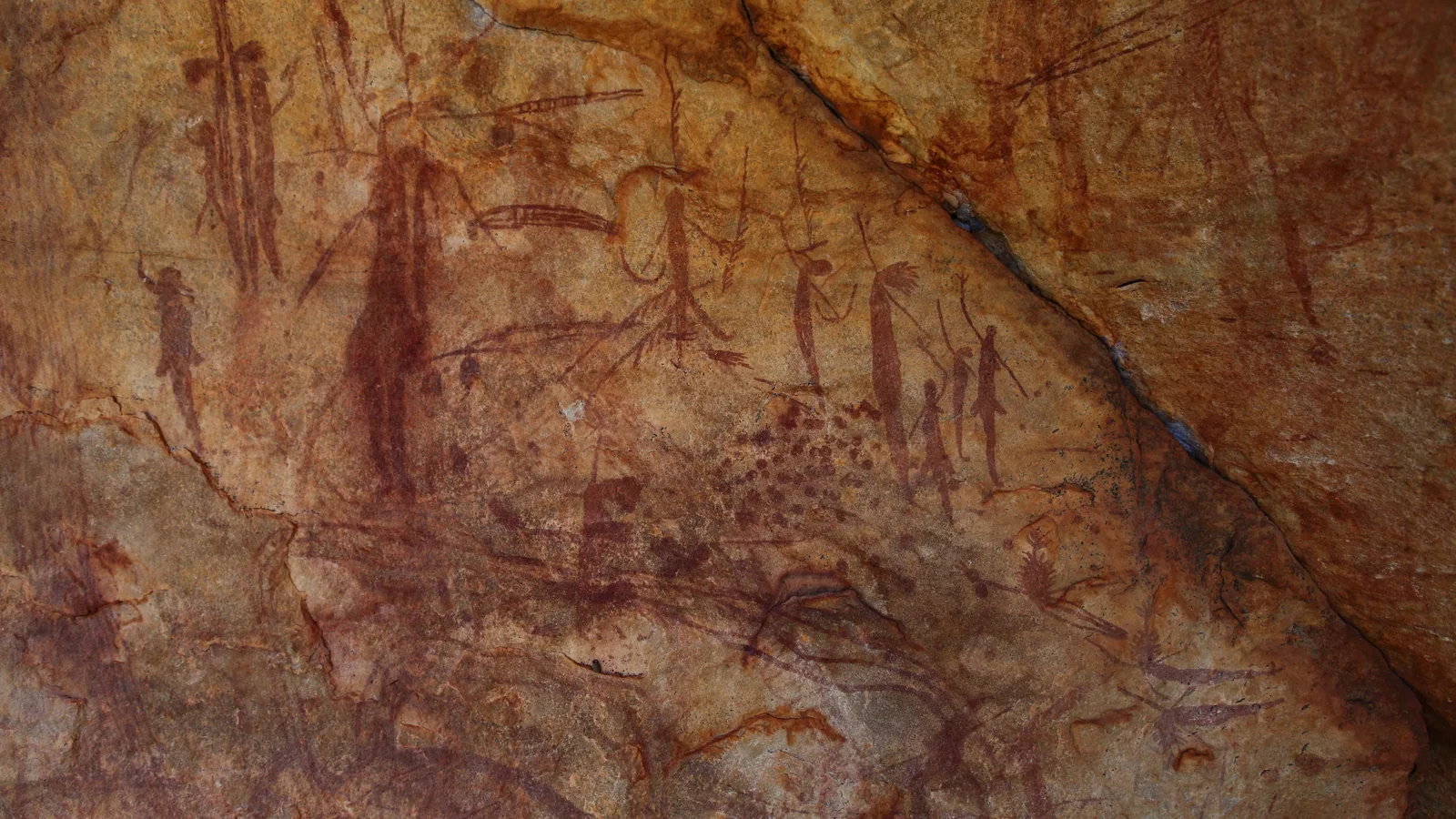
_style,_Mitchell_River_National_Park,_Kimberley.png)
TL;DR — Charcoal from 24 mud-wasp nests puts 21 Gwion figures at 11,500 to 12,700 years old. A kangaroo painting dated in 2021 is older, at 17,500 to 17,100 years.
Radiocarbon dates on 24 mud-wasp nests put 21 Gwion figures in 14 rock shelters of the Kimberley, in Western Australia, at 11,500 to 12,700 years old, Damien Finch and nine co-authors reported in Science Advances on February 5, 2020. The samples were collected between 2015 and 2017 with the consent and participation of Balanggarra Traditional Owners, and at their request the paper withheld the exact locations of the shelters. One nest came out about 4,000 years older than the rest, and the authors wrote that it was “less readily discounted.” In 2021 the same group dated a kangaroo of an earlier style to between 17,500 and 17,100 years.
Quick facts
- When
- Samples collected 2015 to 2017 · Science Advances paper published February 5, 2020 · Nature Human Behaviour paper published February 22, 2021 · Rock Art Dating project (RAD-2) started April 26, 2018
- Where
- Fourteen rock shelters in the Drysdale River and King George River catchments, Kimberley, Western Australia (exact locations withheld at the Traditional Owners' request); the kangaroo painting on the Unghango clan estate, Balanggarra Country, north-east Kimberley
- Who
- Damien Finch, Andrew Gleadow, Janet Hergt and co-authors (University of Melbourne and partners); Balanggarra Traditional Owners and the Balanggarra Aboriginal Corporation; Cissy Gore-Birch, chair of the corporation; Grahame L. Walsh (style sequence, 2000); Ian J. McNiven and Lynette Russell (critique, 1997)
- Outcome
- Most Gwion motifs dated to 11,500 to 12,700 years ago, with one mid-reliability nest at about 16,600 years left unresolved; a kangaroo of an earlier style dated to 17,500 to 17,100 years, the oldest radiometrically dated in situ rock painting reported in Australia
Drysdale River and King George River, 2015 to 2017
The 14 shelters lie in the catchments of the Drysdale River and the King George River in the north Kimberley, as much as 100 kilometers apart. Fieldwork ran under permits from the Kimberley Land Council, the Balanggarra Aboriginal Corporation and the Western Australian Department of Planning, Lands and Heritage; the Australian Research Council and the Kimberley Foundation Australia, since renamed Rock Art Australia, paid for it.
Finch and his co-authors wrote of figures “originally referred to as ‘Bradshaw’ paintings but which are now generally referred to as ‘Gwion’ figures,” and recorded that Traditional Owner groups have their own names for them, among them Gwion Gwion, Kiro Kiro and Kujon.
Charcoal, a reliability score and 255 years of inbuilt age
A nest built over a painting is younger than the painting, so its age is a minimum for the art; a nest that the painter covered is a maximum. Each radiocarbon date on the charcoal inside received a reliability score from 1 to 10, judged on carbon mass, cleaning and pretreatment: 3 or below was low, 8 or above the most robust, and most fell between 4 and 7.
The 12 over-art nests gave median calibrated ages between 4,500 and 12,100 years, except DR006_03 at 16,600 years with a score of 5. Of the six under-art nests, five gave 13,000 to 15,000 years; the sixth, DR013_10-1, gave 6,900 years from 23 micrograms of carbon and a score of 3, and the paper treated it as an outlier. With both outliers removed, the Gwion style fell between 11,850 and 12,810 calibrated years before present, with a median of 12,400, at 95 percent probability.
The charcoal in a nest is older than the nest, because the wasps carry in wood that burned some time before. To measure that “inbuilt age,” the team dated charcoal from nine modern nests: the mean was 255 years, and six of the nine held only modern carbon. Correcting for it, with a tail reaching 4,000 years, moved the range to 11,520 to 12,680 years, with a median of 12,160, which the paper summarized as a narrow window of 11,500 to 12,700 years ago.
"Less readily discounted": motif DR015_07 and the nest at DR006_03
One figure, DR015_07, carried two nests on top of the paint and one beneath it, the only motif bracketed from both sides; the three ages placed it between 11,300 and 13,000 years old at 95 percent probability. The young outlier fell on its low score; the old one did not. Its calibrated age ran from 16,300 to 17,000 years, and the authors wrote that “the other (DR006_03) is of mid-range reliability and less readily discounted.” They left open the possibility that some Gwion motifs were more than 4,000 years older than the 12,000-year window.
Before 2020 the only old minimum age for a figure taken to be Gwion came from Roberts and co-authors in Nature in 1997: 16.4 ± 1.8 thousand years by optically stimulated luminescence on a mud-wasp nest, a date Finch and his co-authors described as “still much debated.” A separate project, reported by J. Ross, K. Westaway, M. Travers, M. J. Morwood and J. Hayward in PLoS One in 2016, wrote that “A complete motif located on the ceiling of a rockshelter returned a minimum age estimate of 16 ± 1 ka,” a motif the authors could not place in any one style.
Grahame Walsh, "pre-Aboriginal" and a paper in Antiquity, 1997
The style sequence in use comes from Grahame L. Walsh, whose 2000 publication Rock Art Australia gives as Bradshaw Art of the Kimberley: a “Bradshaw Period” after an earlier period of stencils, hand prints, fish and macropods that it calls “Naturalistic.” In 1997 Ian J. McNiven and Lynette Russell published “Strange paintings and mystery races: Kimberley rock-art, diffusionism and colonialist constructions of Australia’s Aboriginal past” in Antiquity. Its abstract reads: “According to one published view, the Bradshaws are not so much early Aboriginal as pre-Aboriginal. Issue is taken with that notion, in light of European attitudes to Aboriginal accomplishment over the last two centuries.” McNiven returned to the subject in 2011 in Australian Archaeology under the title “The Bradshaw Debate: Lessons Learned From Critiquing Colonialist Interpretations of Gwion Gwion Rock Paintings of The Kimberley, Western Australia.”
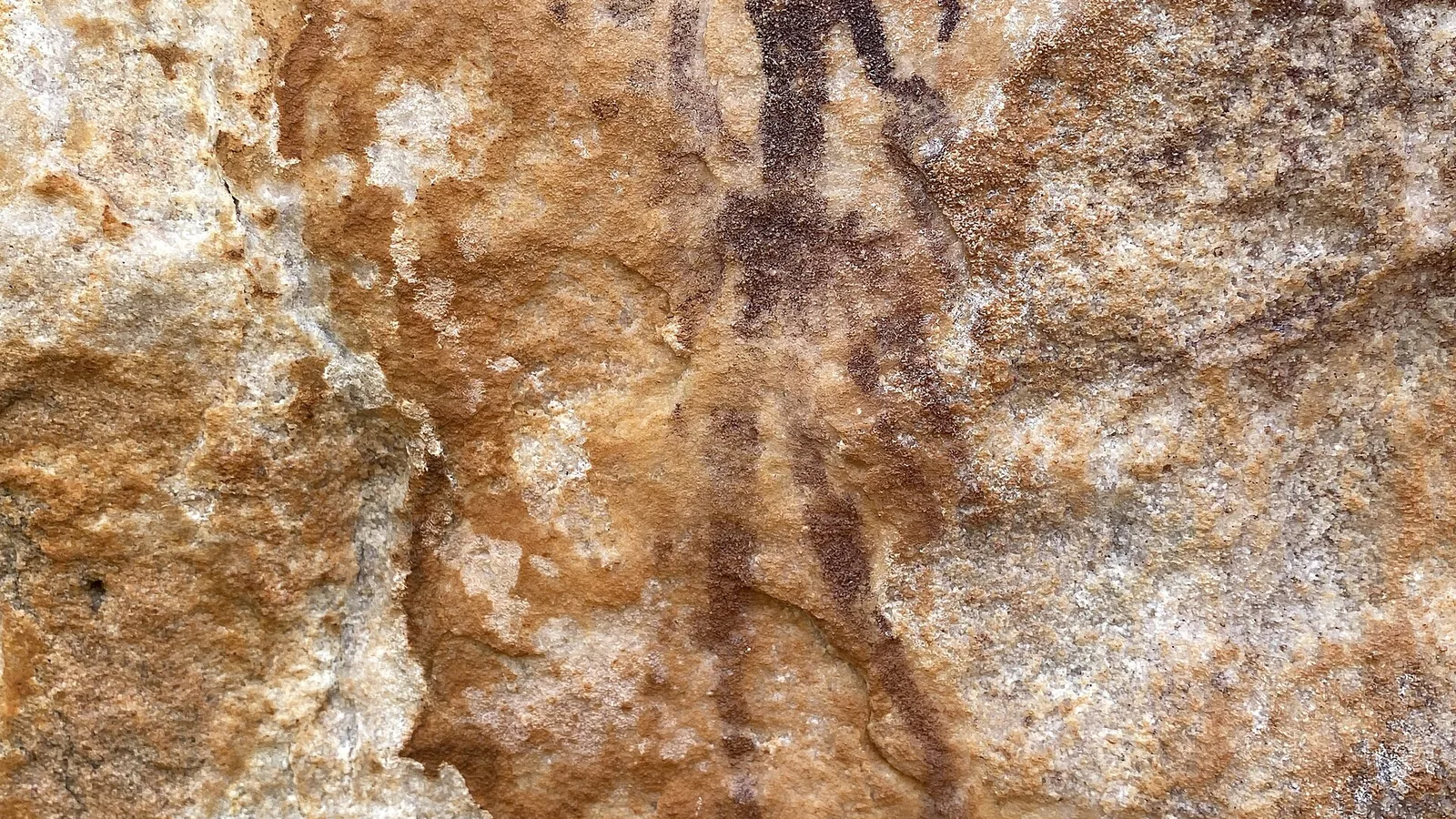

February 22, 2021: a kangaroo at 17,500 to 17,100 years
Finch and the same co-authors published “Ages for Australia’s oldest rock paintings” in Nature Human Behaviour on February 22, 2021; only its abstract and figure captions are open to read. The abstract reads: “we present 27 radiocarbon dates on mud wasp nests that constrain the ages of 16 motifs from this earliest known phase of rock painting in the Australian Kimberley region. These initial results suggest that paintings in this style proliferated between 17,000 and 13,000 years ago.” One painting of a kangaroo “is securely dated to between 17,500 and 17,100 years on the basis of the ages of three overlying and three underlying wasp nests. This is the oldest radiometrically dated in situ rock painting so far reported in Australia.” Rock Art Australia uses the single figure of 17,300 years, as does the caption to the paper’s Figure 4 for motif DR015_10.
Rock Art Australia describes the painting as two meters long, on the Unghango clan estate in Balanggarra Country in the north-east Kimberley. Two projects stood behind it: Rock Art Dating, or RAD-2, ARC Linkage Project LP170100155, which began on April 26, 2018, under Andy Gleadow of the University of Melbourne and combined four dating methods, radiocarbon, luminescence, uranium-series and cosmogenic radionuclides; and Kimberley Visions, ARC Linkage Project LP150100490, a University of Western Australia project of 2016 to 2022 that recorded 1,350 sites with Balanggarra rangers. “The dating of this oldest known painting in an Australian rock shelter holds a great deal of significance for Aboriginal people and Australians and is an important part of Australia’s history,” said Cissy Gore-Birch, chair of the Balanggarra Aboriginal Corporation, of the 2021 result.
Key facts
- Finch and co-authors reported in Science Advances on February 5, 2020, radiocarbon dates on 24 mud-wasp nests over or under 21 Gwion figures in 14 Kimberley rock shelters, sampled 2015 to 2017.
- Balanggarra Traditional Owners consented to and took part in the fieldwork; the shelters’ exact locations were withheld at their request.
- Each date carried a reliability score of 1 to 10; 3 or below was low, 8 or above the most robust, and most fell between 4 and 7.
- Nine modern nests gave a mean inbuilt age of 255 years for their charcoal, and six held only modern carbon.
- Before correction the Gwion style dated to 11,850 to 12,810 calibrated years before present (median 12,400); after correction, 11,520 to 12,680 (median 12,160).
- Motif DR015_07, with two nests above and one below, dated to 11,300 to 13,000 years at 95 percent probability.
- Nest DR006_03, at 16,300 to 17,000 years with a score of 5, was “less readily discounted,” and Roberts and co-authors’ 1997 luminescence date of 16.4 ± 1.8 thousand years was “still much debated.”
- On February 22, 2021, the group dated a kangaroo (motif DR015_10) to 17,500 to 17,100 years from three nests above and three below, “the oldest radiometrically dated in situ rock painting so far reported in Australia.”
FAQ
How old are the Gwion Gwion (Bradshaw) paintings?
The 2020 Science Advances paper by Finch and co-authors dated most Gwion motifs to between 11,500 and 12,700 years ago from 24 mud-wasp nests. One nest at motif DR006_03 gave 16,300 to 17,000 years and was not set aside.
How do mud-wasp nests date rock art?
A nest built over paint is younger than the paint, and a nest the painter covered is older. Charcoal fragments inside the nest are dated by radiocarbon, then corrected for the age the charcoal already had when the wasp collected it, a mean of 255 years in nine modern nests.
What is the oldest dated rock painting in Australia?
A kangaroo in the Kimberley, motif DR015_10, dated in Nature Human Behaviour in 2021 to between 17,500 and 17,100 years, which the paper called "the oldest radiometrically dated in situ rock painting so far reported in Australia." Rock Art Australia gives it as 17,300 years.
Sources
- Damien Finch, Andrew Gleadow, Janet Hergt, Vladimir A. Levchenko, Pauline Heaney, Peter Veth, Sam Harper, Sven Ouzman, Cecilia Myers and Helen Green, "12,000-Year-old Aboriginal rock art from the Kimberley region, Western Australia," Science Advances 6 (6), eaay3922 (February 5, 2020), full text on PubMed Central.
- Damien Finch, Andrew Gleadow, Janet Hergt, Pauline Heaney, Helen Green, Cecilia Myers, Peter Veth, Sam Harper, Sven Ouzman and Vladimir A. Levchenko, "Ages for Australia's oldest rock paintings," Nature Human Behaviour 5, 310–318 (February 22, 2021), abstract and figure captions.
- J. Ross, K. Westaway, M. Travers, M. J. Morwood and J. Hayward, "Into the Past: A Step Towards a Robust Kimberley Rock Art Chronology," PLoS One 11 (8), e0161726 (2016), full text on PubMed Central.
- Rock Art Australia (formerly Kimberley Foundation Australia), "Rock Art Dating" project page (RAD-2, ARC LP170100155): the kangaroo painting, the four dating methods and the statement by Cissy Gore-Birch.
- Rock Art Australia, "Kimberley Visions" project page (ARC LP150100490, 2016 to 2022, University of Western Australia).
- Rock Art Australia, rock art sequence pages "Naturalistic" and "Gwion," adapted from Grahame L. Walsh, Bradshaw Art of the Kimberley (2000).
- Ian J. McNiven and Lynette Russell, "Strange paintings and mystery races: Kimberley rock-art, diffusionism and colonialist constructions of Australia's Aboriginal past," Antiquity 71, 801–809 (1997), abstract (Cambridge Core).
- Ian J. McNiven, "The Bradshaw Debate: Lessons Learned From Critiquing Colonialist Interpretations of Gwion Gwion Rock Paintings of The Kimberley, Western Australia," Australian Archaeology 72 (2011), bibliographic record (Crossref).
Cite this article
- APA
- Our Earth's History. (2026, September 22). Twenty-four mud-wasp nests date the Gwion figures to 12,000 years. Our Earth's History. https://ourearthshistory.com/oceania/prehistory/gwion-gwion-kimberley-rock-art-mud-wasp-nests-12000-years/
- Chicago
- Our Earth's History. “Twenty-four mud-wasp nests date the Gwion figures to 12,000 years.” Our Earth's History, September 22, 2026. https://ourearthshistory.com/oceania/prehistory/gwion-gwion-kimberley-rock-art-mud-wasp-nests-12000-years/.
- MLA
- “Twenty-four mud-wasp nests date the Gwion figures to 12,000 years.” Our Earth's History, 22 Sep. 2026, https://ourearthshistory.com/oceania/prehistory/gwion-gwion-kimberley-rock-art-mud-wasp-nests-12000-years/.
Text licensed CC BY-NC-ND 4.0. Found an error? Tell us.