A 92 mm Diprotodon bone and 49,000 years: Warratyi rock shelter
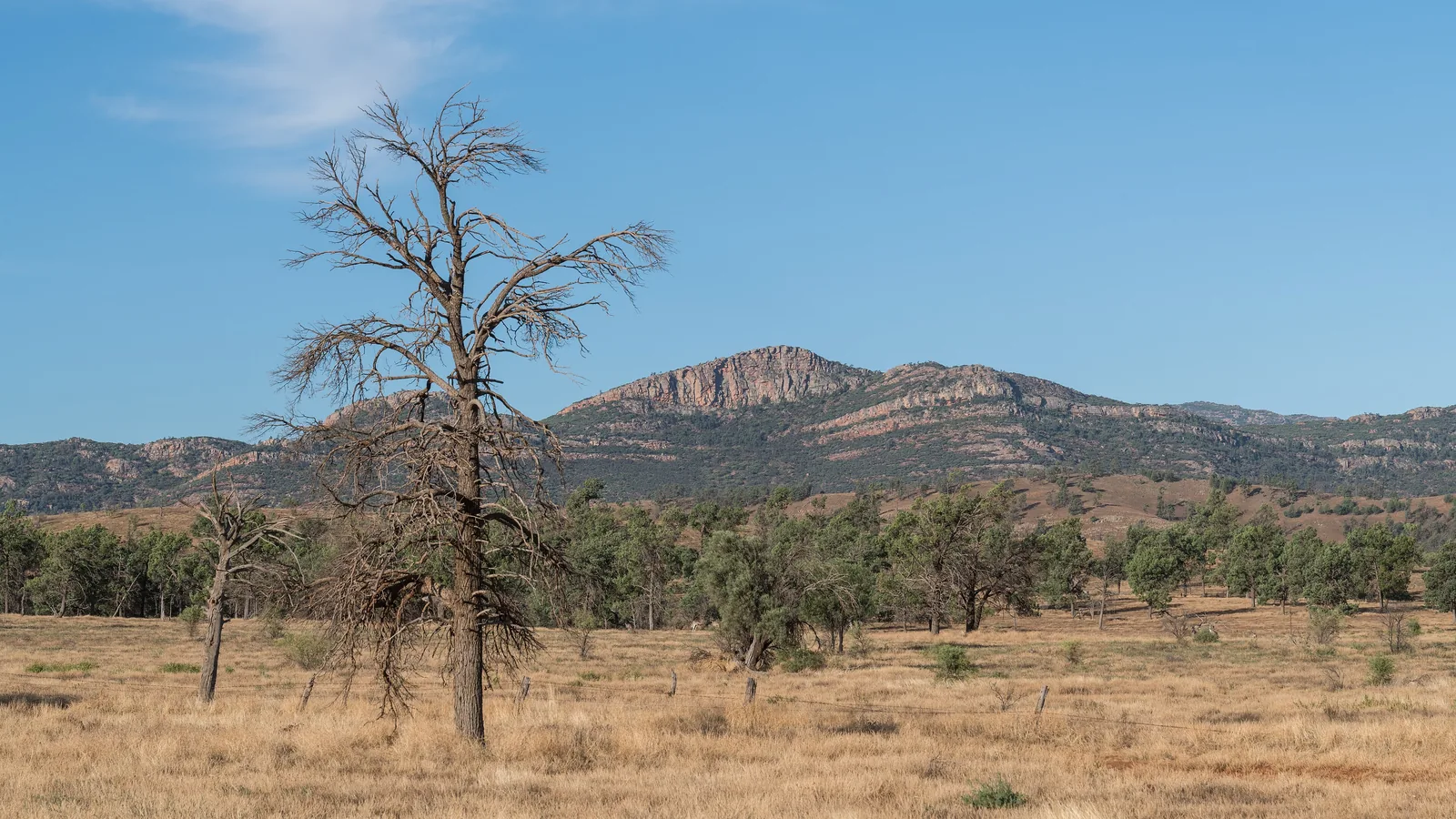

TL;DR — Warratyi rock shelter, on Adnyamathanha country 550 kilometers north of Adelaide, gave dates of about 49,000 years and a 92-millimeter Diprotodon radius in a 2016 Nature paper.
“Here we present evidence from Warratyi rock shelter in the southern interior that shows that humans occupied arid Australia by around 49 ka, 10 thousand years (kyr) earlier than previously reported.” That sentence appeared in Nature on November 2, 2016, over the names of 14 authors led by Giles Hamm of La Trobe University. Four of the 14, Vincent Coulthard, Clifford Coulthard, Sophia Wilton and Duncan Johnston, were listed under the Adnyamathanha Traditional Lands Association. “This site was named Warratyi (Adnyamathanha for emu) rock shelter,” Hamm wrote in the doctoral thesis that holds the full excavation record. The paper’s acknowledgments state that “The fieldwork was undertaken with the approval of Adnyamathanha Traditional Lands Association (ATLA) and the South Australian Department of Aboriginal Affairs and Reconciliation.” The lowest layer gave dates of 46,301 to 49,213 years before present.
Quick facts
- When
- May 2013 (fieldwork) · November 2, 2016 (Nature paper online) · November 4, 2016 (Flinders University report of the Adelaide briefing) · October 10, 2017 (Hamm's thesis declaration) · October 22, 2025 (Archer and co-authors in Royal Society Open Science)
- Where
- Warratyi rock shelter, Yerelina Creek, northern Flinders Ranges, on Adnyamathanha country about 550 kilometers north of Adelaide, South Australia
- Who
- Giles Hamm (La Trobe University); Vincent Coulthard, Clifford Coulthard, Sophia Wilton and Duncan Johnston (Adnyamathanha Traditional Lands Association); Gavin Prideaux and Trevor Worthy (Flinders University); Lee Arnold and Nigel Spooner (University of Adelaide); Vladimir Levchenko (ANSTO); Birgitta Stephenson; Michael Archer (University of New South Wales)
- Outcome
- Emu eggshell from the lowest layer dated to 46,301 to 49,213 years before present; the Nature abstract gave occupation "by around 49 ka." A 92-millimeter partial radius of a juvenile Diprotodon optatum from the same layer was presented as evidence of human-megafauna interaction; a 2025 paper argued it could be a collected fossil
Korrawilya Spring and a shelter 3 kilometers to its east
Survey in the southern Flinders Ranges had produced no site that could date the entry of people into the arid interior. “Advice from Cliff Coulthard suggested that some of the local ranges in the Northern Flinders Ranges contained rich rock art sites that were centred on large spring systems,” Hamm wrote in the thesis, describing Coulthard as “a senior Adnyamathanha elder and cultural teacher.” Reconnaissance on Umberatana Station followed. “After a systematic survey of gorge country surrounding Korrawilya Spring, a single rock shelter located 3 kilometres to the east of Korrawilya was identified.”
The shelter is cut into Ediacaran sandstone and shale of the Wilpena Group, on a slope about 20 meters above Yerelina Creek. It is 12 meters wide, 4.2 meters deep and 1.8 meters at its highest point, with about 40 square meters of floor and one meter of deposit. Goats had churned the top 15 centimeters; below that the only disturbance was a rabbit burrow reaching 60 centimeters. In May 2013 the team dug a one-meter grid split into 25-centimeter quadrats, in 5-centimeter spits, and dry-sieved the sediment through 8, 5 and 2 millimeter mesh.
Emu eggshell at 85 centimeters: the basal dates
Stratigraphic Unit 4, the lowest layer, lay 85 to 90 centimeters down. Spit 17 in Square 2C gave two radiocarbon results on eggshell: sample OZT616, emu shell, at 46,301 to 49,213 years before present at two standard deviations, and sample Wk-37373 at 48,200 years. Hamm labels the second shell only “putative Genyornis/Progura.” Single-grain optical dating of quartz from the same unit, done at the University of Adelaide by Lee Arnold and Nigel Spooner, gave 42.8 ± 2.4 and 43 ± 3.4 thousand years. Hamm wrote that the two radiocarbon results “are likely to be reliable basal dates.” The thesis abstract gives first occupation as 45,000 to 49,000 years before present; the Nature abstract says “by around 49 ka.”
Between about 41,000 and 33,000 years before present, bone and stone in Unit 3 reached their peak; around 35,000 years the record thins and, by the thesis’s account, stays low into Unit 2 at 20,000 to 22,000 years, through growing aridity and the Last Glacial Maximum.
"Dated to at least 44,000 years BP": the Diprotodon radius
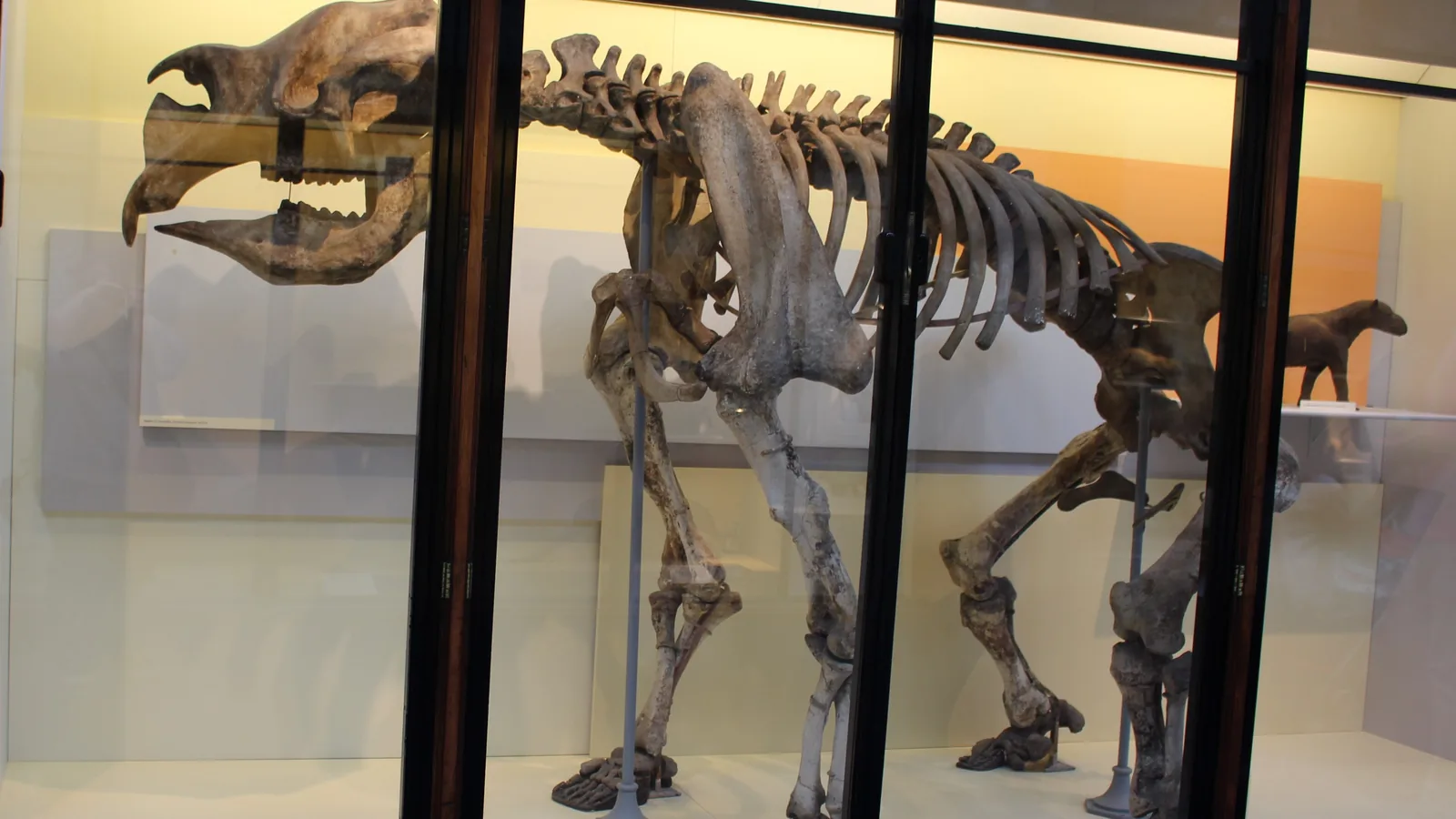
Bone fragment EMU RS-6737-7754 came out of Square 4C, Stratigraphic Unit 4, Quadrat B, Spit 18, in two pieces that fit together, 92 millimeters long and 46 grams. Gavin Prideaux, a paleontologist at Flinders University, set it against three juvenile Diprotodon optatum specimens in the South Australian Museum and identified it as the partial radius of a juvenile. The Nature abstract describes “the only reliably dated, stratified evidence of extinct Australian megafauna, including the giant marsupial Diprotodon optatum, alongside artefacts more than 46 kyr old.” The thesis states: “The Diprotodon bone is located in Analytical Unit D and is dated to at least 44,000 years BP.”
At a South Australian Museum briefing reported by Flinders University on November 4, 2016, Prideaux said: “Humans evidently lived along side these animals and hunted them, so the idea that there wasn’t any interaction between people and these animals is put to bed now by the laboratory evidence.” Trevor Worthy, his Flinders colleague, said the research “removes any doubt that humans reached the furthest and most remote areas of Australia soon after arrival.”

Red ochre at 97.8 percent hematite, and the other firsts
The abstract lists ochre “at or before 49–46 ka,” gypsum pigment “40–33 ka,” bone tools “40–38 ka,” hafted tools “38–35 ka” and backed artifacts “30–24 ka,” “each up to 10 kyr older than any other known occurrence.” One red ochre sample analyzed by Mark Raven of CSIRO measured 97.8 percent hematite, with a chemistry broadly similar to Vukartu, a quarry some 200 kilometers south. The gypsum came as bright white lumps averaging 2 to 5 millimeters, between 20 and 75 centimeters depth. Hamm read them as raw material for kopi, the gypsum paste that the 1924 ethnography of Horne and Aiston ties to mourning ceremonies.
The bone point was ground from the fibula of a macropod the size of a yellow-footed rock wallaby and lay in Square 2C, Spit 14, at 65 to 70 centimeters. Hamm dated it “at least 38,000 to 40,000 years BP.” Residue analysis by Birgitta Stephenson found plant resin on several adze flakes; Hamm suggested it came from the grass tree Xanthorrhoea, fragments of which turned up in the deposit. Of 44 stone artifacts with backing, 13 were backed along a whole margin.
October 22, 2025: fossil collectors or hunters
Michael Archer of the University of New South Wales and 13 co-authors published a review in Royal Society Open Science on October 22, 2025, of the claims that Australia’s First Peoples “killed or butchered” megafauna. On Warratyi they quoted page 46 of the Nature paper’s own supplementary material: “None of these features appear on the Warratyi bone that would support the case for human modification.” The 2016 case rested on stratigraphy, on a shelter too high for a Diprotodon to climb, and on the absence of carnivore chewing. Archer and his co-authors answered that at 46,000 years “the valley floor would probably have been considerably higher than it is now,” and that the fragment “could have been manuported to the rock shelter in the Flinders Ranges, as an intrinsically interesting fossil,” since Diprotodon skeletons of 50,000 to 54,000 years lie exposed at Lake Callabonna, “within 120 km from Warratyi.” Hamm signed the declaration of his thesis on October 10, 2017; the paper that reopened the question of the bone appeared eight years later, on October 22, 2025.
Key facts
- Hamm et al., “Cultural innovation and megafauna interaction in the early settlement of arid Australia,” Nature 539, pp. 280–283, was received May 26, 2016, accepted September 27 and published online November 2, 2016 (Nature).
- Of the 14 authors, four (Vincent Coulthard, Clifford Coulthard, Sophia Wilton, Duncan Johnston) were listed under the Adnyamathanha Traditional Lands Association; the acknowledgments state the fieldwork had ATLA’s approval (Nature).
- Warratyi means emu in Adnyamathanha; the shelter was identified 3 kilometers east of Korrawilya Spring on Umberatana Station after Cliff Coulthard’s advice to look at rock art centered on large springs (Hamm thesis).
- The shelter is 12 meters wide, 4.2 meters deep, 1.8 meters high, with about 40 square meters of floor and about one meter of deposit, 20 meters above Yerelina Creek (Hamm thesis).
- Emu eggshell OZT616 from Stratigraphic Unit 4 dated to 46,301 to 49,213 years before present; shell Wk-37373 to 48,200; optical dates on quartz from the same unit gave 42.8 ± 2.4 and 43 ± 3.4 thousand years (Hamm thesis).
- Diprotodon radius EMU RS-6737-7754, 92 millimeters long and 46 grams in weight, was identified by Gavin Prideaux against South Australian Museum juvenile specimens; the thesis dates it “at least 44,000 years BP,” the Nature abstract puts the layer at “more than 46 kyr” (Hamm thesis; Nature).
- The Nature abstract dates ochre “at or before 49–46 ka,” gypsum pigment “40–33 ka,” bone tools “40–38 ka,” hafted tools “38–35 ka” and backed artifacts “30–24 ka” (Nature).
- Archer and 13 co-authors, Royal Society Open Science, October 22, 2025, quoted the 2016 supplement’s finding of no human modification and proposed that the bone was a collected fossil, with Lake Callabonna’s Diprotodon skeletons within 120 kilometers (PubMed Central).
FAQ
How old is Warratyi rock shelter?
The lowest layer gave a radiocarbon date on emu eggshell of 46,301 to 49,213 years before present and a second eggshell date of 48,200 years. The 2016 Nature abstract summarized this as human occupation of arid Australia "by around 49 ka"; Hamm's thesis gives the first occupation as 45,000 to 49,000 years before present.
What does Warratyi mean?
Hamm's thesis states: "This site was named Warratyi (Adnyamathanha for emu) rock shelter." The Adnyamathanha Traditional Lands Association, which Hamm's thesis describes as the Native Title representative body of the Flinders Ranges, approved the fieldwork and provided four of the paper's co-authors.
Was the Diprotodon at Warratyi hunted by people?
The 2016 paper presented the 92-millimeter juvenile radius as stratified evidence of humans and megafauna together, and Gavin Prideaux said at a 2016 briefing that humans "hunted them." A 2025 review by Michael Archer and 13 co-authors quoted the 2016 supplement's statement that the bone shows no marks of human modification and argued it could have been carried in as a fossil, since Diprotodon skeletons lie exposed at Lake Callabonna within 120 kilometers.
Sources
- Europe PMC (EMBL-EBI), MEDLINE record PMID 27806378: Hamm, G. et al., "Cultural innovation and megafauna interaction in the early settlement of arid Australia," Nature 539 (7628), pp. 280–283, published online November 2, 2016 (abstract, author affiliations, dates).
- Nature, article page for Hamm et al. 2016, doi 10.1038/nature20125: abstract, the 14 authors and their affiliations, received/accepted/published dates and the Acknowledgements (ATLA approval).
- Flinders University, news blog, "Research adds 10,000 years to human life in the Flinders Ranges," November 4, 2016 (Prideaux and Worthy quotations from the SA Museum AusSMC briefing).
- La Trobe University research repository (Figshare), record 21858303: Giles Hamm, "Nature and Timing of Prehistoric Human Occupation in Arid Australia: Evidence from Warratyi Rock Shelter, Northern Flinders Ranges," PhD thesis, doi 10.26181/21858303.v1 (metadata).
- Giles Hamm, PhD thesis, La Trobe University, declaration dated October 10, 2017, full text PDF (351 pages): site description, excavation method, dating tables, the Diprotodon radius, ochre, gypsum, bone point, resin residues and backed artifacts.
- PubMed Central (U.S. National Library of Medicine), PMC12539957: Archer, M. et al., "Australia's First Peoples: hunters of extinct megafauna or Australia's first fossil collectors," Royal Society Open Science 12 (10), 250078, October 22, 2025 (full text).
Cite this article
- APA
- Our Earth's History. (2026, September 22). A 92 mm Diprotodon bone and 49,000 years: Warratyi rock shelter. Our Earth's History. https://ourearthshistory.com/oceania/prehistory/warratyi-rock-shelter-flinders-ranges-49000-years-nature-2016-diprotodon/
- Chicago
- Our Earth's History. “A 92 mm Diprotodon bone and 49,000 years: Warratyi rock shelter.” Our Earth's History, September 22, 2026. https://ourearthshistory.com/oceania/prehistory/warratyi-rock-shelter-flinders-ranges-49000-years-nature-2016-diprotodon/.
- MLA
- “A 92 mm Diprotodon bone and 49,000 years: Warratyi rock shelter.” Our Earth's History, 22 Sep. 2026, https://ourearthshistory.com/oceania/prehistory/warratyi-rock-shelter-flinders-ranges-49000-years-nature-2016-diprotodon/.
Text licensed CC BY-NC-ND 4.0. Found an error? Tell us.