Who painted Chauvet and Lascaux, and how are the paintings dated?
BisonsPoursuivisParDesLions.jpg)
TL;DR — Aurignacian hunters drew Chauvet about 37,000 to 33,500 years ago; Lascaux was painted about 21,500 years ago. Both dates come from radiocarbon on charcoal and bone, and both have moved.
Aurignacian hunters drew Chauvet cave about 37,000 to 33,500 years ago; Lascaux was painted about 21,500 years ago, by people at the turn of the Badegoulian and Magdalenian. Both rest on radiocarbon dates from charcoal and bone, revised again and again since 1951. At Chauvet, in the Ardèche valley of southern France, a model published in 2016 by Anita Quiles and her co-authors combined 259 radiocarbon dates into two visits; at Lascaux, in the Dordogne, the dates have swung between the Magdalenian and the Solutrean for 70 years, and the French Ministry of Culture’s own site gives two answers on one page.
Quick facts
- When
- Chauvet first visit about 37,000 to 33,500 years ago, second 31,000 to 28,000 (Quiles et al. 2016); Lascaux about 21,500 to 21,000 years ago (LAsCO project), or 23,000 by the Ministry's FAQ; Lascaux found September 12, 1940, closed 1963; Chauvet found December 18, 1994, never opened
- Where
- Chauvet, on the Cirque d'Estre near Vallon-Pont-d'Arc in the Ardèche, southern France; Lascaux, on the hill above Montignac in the Vézère valley, Dordogne, southwestern France
- Who
- Aurignacian and Gravettian visitors at Chauvet; at Lascaux, people at the turn of the Badegoulian and Magdalenian; discoverers Jean-Marie Chauvet, Éliette Brunel and Christian Hillaire, and Marcel Ravidat, Jacques Marsal, Georges Agniel and Simon Coencas
- Outcome
- Chauvet's chronology rests on 259 radiocarbon dates modeled in 2016; Lascaux's has been revised four times since W. Frank Libby's 1951 measurement, and the French Ministry of Culture's own site gives two answers
Two discoveries, 54 years apart
On September 12, 1940, Marcel Ravidat, a 17-year-old apprentice mechanic from Montignac, came back to a foxes’ den on the hill above the town with three other boys, Jacques Marsal, Georges Agniel and Simon Coencas. By a homemade lamp the four walked a gallery about 30 meters long to the first paintings. The next day Ravidat went down an 8-meter shaft to the scene of a man facing a bison. Their teacher, Léon Laval, entered on September 18; Henri Breuil saw the cave two days after him.
On Sunday, December 18, 1994, three cavers, Jean-Marie Chauvet, Éliette Brunel and Christian Hillaire, felt a breeze from a small hole at the back of a known cave on the Cirque d’Estre, near Vallon-Pont-d’Arc, and dug through. On the way back Brunel saw a small red ochre mammoth in her headlamp beam and cried out, “They were here!” Jean Clottes, then scientific adviser to the Ministry of Culture, entered on December 29. His report of January 2, 1995, regretted the mistakes made at Lascaux and said: “this cave should not be open to the public. . . . The works of art have only been preserved so well because the cave was hidden.” It has never opened.
What is on the walls
Lascaux holds nearly 2,000 figures, by the Bradshaw Foundation’s count: animals, a single human and abstract signs. Horses lead, 364 of them, then 90 stags; one black bull in the Hall of the Bulls is 5.2 meters long, and reindeer, the painters’ main food, appear nowhere. The Ministry’s page on technique calls painting itself a rare form in Paleolithic caves, with water as the only binder.
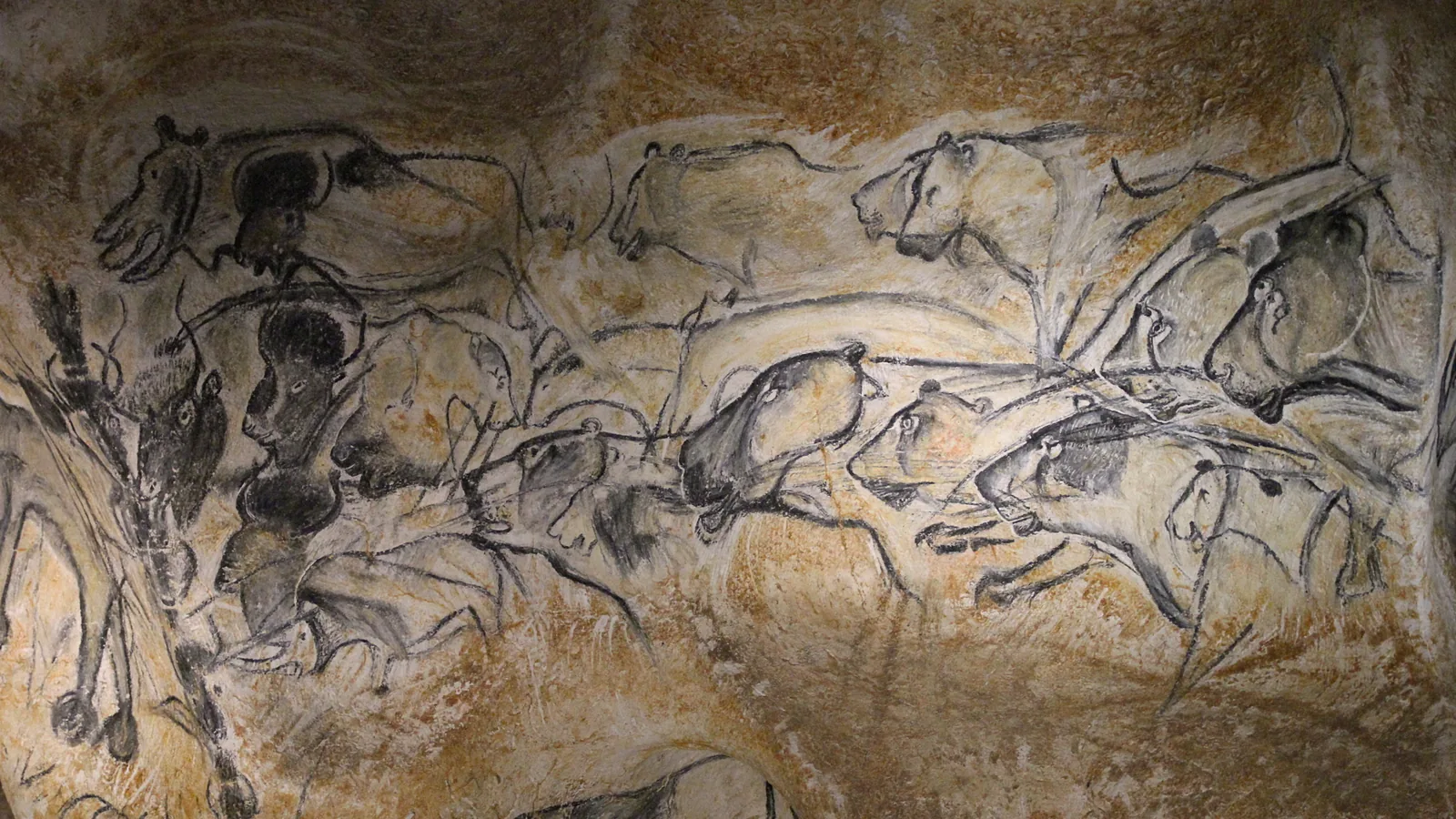
Chauvet is another world. Of 435 animal images counted by the Ministry, mammoths, felines, rhinoceroses and bears make up almost 65 percent of the identifiable species, animals that were not usually hunted. There are red hands, dots made with a paint-covered palm, and in the last chamber a limestone pendant hanging 1.10 meters off the floor that carries, in charcoal, the lower body of a woman beside a bison-headed figure, the “Venus and the Sorcerer.” A study published in INORA in 2001 found that the Venus was drawn first and the others added later, without a line crossing her.
How charcoal gives a date, and why the dates moved
Radiocarbon dating measures the carbon-14 left in something that was once alive. Charcoal or a reindeer bone can be dated; mineral pigment cannot. Chauvet’s black drawings are charcoal, so the drawings themselves were sampled. Lascaux’s paint is mineral, so every date comes from the floor.
That is why Lascaux has moved. In 1951 charcoal from the Shaft went to W. Frank Libby’s laboratory in Chicago, where the method was developed, and came back at about 19,000 years, which placed the cave in the Magdalenian. André Leroi-Gourhan, working from style, tied the paintings to the Solutrean, then accepted a Magdalenian II attribution after Arlette Leroi-Gourhan and Jacques Allain restudied the tools. In 1998 and 2002 accelerator mass spectrometry dated reindeer antler from the excavations of Breuil and Séverin Blanc to 23,500 to 22,000 years ago, at the transition from the Upper Solutrean to the Badegoulian. The Ministry’s page sums up the position as “groups of artefacts with ‘Magdalenian’ characteristics, a ‘Solutrean’ pictorial style, two sets of contradictory dates.”
The LAsCO project (Langlais and Ducasse, coordinators) then dated reindeer bone from the cave’s main sectors and, in the journal PALEO, put the occupation between 21,500 and 21,000 years ago, 1,000 to 1,500 years later than the 1990s dates. The same page’s question-and-answer section still says that Lascaux “dates from 23,000 years ago” and that “the men and women of the prehistoric Solutrean culture” painted it. The two statements sit a few lines apart, unreconciled.
Chauvet's two visits
Chauvet’s first dates surprised. Quiles and her co-authors wrote in Proceedings of the National Academy of Sciences in 2016 that the art had first been assigned to the Solutrean, and that the first measurements on the black drawings came out at about 32,000 to 30,000 radiocarbon years. After critics, among them Christian Züchner in 1996, questioned the early sampling, they built a Bayesian model on more than 350 dates from four methods, 259 of them radiocarbon.
The model found two visits. The first ran from about 37,000 to 33,500 years ago and accounts for nearly all the black drawings and the main hearths; cave bears used the cave until about 33,000 years ago. The second, 31,000 to 28,000 years ago, left torch marks and possibly two drawings. The Ministry’s panel text on the Gallery of the Crosshatching describes about 20 bare footprints over 70 meters under a ceiling 1.20 meters high, read as an adolescent, perhaps a child, who wiped a torch on the wall to mark the way back; the smears are dated to 26,000 years ago. Rockfalls 23,500 and 21,500 years ago then sealed the entrance until 1994, by the 2016 model; UNESCO’s inscription text gives the closure as about 20,000 years ago in one paragraph and “23,000 years” in another.
Lascaux's sickness
Lascaux paid for its visitors. Ravidat and Marsal, guides from 1948, reported green algae in 1958 and 1959. The Bradshaw Foundation’s account of a Paris symposium on the cave, chaired by Clottes, lists the “white disease” from 1955, the “green disease” in 1960, and, after the air-handling machine was replaced in 2000, white organisms from 2001 followed by black ones. UNESCO’s listing records that these threats “had already led, in 1963, to the closure of the cave to the public, its acquisition by the State and the adoption of strict management measures,” and were “renewed during a biological proliferation, in 2000.” In January 2008 the cave was shut for three months even to scientists.
What remains open
Who the painters were, beyond their culture, no page answers, and why they painted has a longer history. Leroi-Gourhan built from statistics a system tying animals and signs to their position in the cave; in the late 1990s Clottes and David Lewis-Williams related the ensembles to shamanism. Norbert Aujoulat found that on every Lascaux panel horses were drawn first, then aurochs, then stags, in the coats of spring, summer and autumn, which he read as a cycle of time.
The dates are firmer than the meanings. Chauvet’s two visits rest on 259 measurements from the drawings, the floor and the bears; Lascaux’s occupation rests on bone and charcoal from the floor, re-dated four times and still described two ways by the same ministry.
Key facts
- Lascaux was found on September 12, 1940, by Marcel Ravidat, Jacques Marsal, Georges Agniel and Simon Coencas; Chauvet on December 18, 1994, by Jean-Marie Chauvet, Éliette Brunel and Christian Hillaire.
- Chauvet was used twice, about 37,000 to 33,500 and 31,000 to 28,000 years ago, by the 2016 Bayesian model of Quiles et al.; nearly all black drawings belong to the first visit. The Ministry’s own summary gives 82 radiocarbon dates, Aurignacian and Gravettian.
- Lascaux’s radiocarbon history: about 19,000 years (Libby, 1951), 21,000 to 18,000 (Glory), 23,500 to 22,000 (AMS, 1998 and 2002), 21,500 to 21,000 (LAsCO, in PALEO).
- The Ministry of Culture’s Lascaux FAQ still gives 23,000 years ago and the Solutrean culture.
- Lascaux holds nearly 2,000 figures, 364 of them horses, and no reindeer; Chauvet has 435 animal images, almost 65 percent mammoths, felines, rhinoceroses and bears.
- Lascaux closed to the public in 1963 after white disease (1955) and green disease (1960); new growths followed the 2000 machine change, and in January 2008 it closed for three months even to scientists.
- Chauvet was never opened; Clottes’s report of January 2, 1995, said it “should not be open to the public.”
FAQ
Who painted the Chauvet cave?
People of the Aurignacian culture, by the French Ministry of Culture's and UNESCO's descriptions, during a first visit about 37,000 to 33,500 years ago; a second group, in the Gravettian, came 31,000 to 28,000 years ago and left torch marks and perhaps two drawings. No individual is known.
How old is Lascaux?
The LAsCO project dated reindeer bone from the cave to 21,500 to 21,000 years ago, at the turn of the Badegoulian and Magdalenian. Earlier measurements gave about 19,000 (1951), 21,000 to 18,000, and 23,500 to 22,000 years (1998 and 2002). The Ministry's own FAQ still answers 23,000 years ago.
Why is Lascaux closed?
Visitors brought fungus and algae, the "white disease" of 1955 and "green disease" of 1960, and the cave closed to the public in 1963. After the ventilation machine was replaced in 2000 new white and then black growths appeared, and in 2008 the cave was closed for three months even to scientists.
Sources
- Ministère de la Culture, Grotte de Lascaux — "The discovery."
- Ministère de la Culture, Grotte de Lascaux — "The four discoverers."
- Ministère de la Culture, Grotte de Lascaux — "Dating the figures at Lascaux."
- Ministère de la Culture, Grotte de Lascaux — "The techniques."
- Ministère de la Culture, Grotte de Lascaux — "Interpretations."
- UNESCO World Heritage Centre — "Prehistoric Sites and Decorated Caves of the Vézère Valley."
- Bradshaw Foundation — "The Lascaux Cave Paintings," with an account of the Paris symposium on Lascaux chaired by Jean Clottes.
- Ministère de la Culture, La grotte Chauvet-Pont d'Arc — "The Discovery."
- Ministère de la Culture, La grotte Chauvet-Pont d'Arc — "Scientific analysis and results" (Jean Clottes's report of January 2, 1995).
- Ministère de la Culture, La grotte Chauvet-Pont d'Arc — "Immediate protection measures."
- Ministère de la Culture, La grotte Chauvet-Pont d'Arc — "The Layout."
- Ministère de la Culture, La grotte Chauvet-Pont d'Arc — "Research in the cave."
- Ministère de la Culture, La grotte Chauvet-Pont d'Arc — Jean Clottes, "Aurignacian cave art."
- Ministère de la Culture, La grotte Chauvet-Pont d'Arc — Carole Fritz and Michel-Alain Garcia, "Human trail."
- Anita Quiles et al. — "A high-precision chronological model for the decorated Upper Paleolithic cave of Chauvet-Pont d'Arc, Ardèche, France," Proceedings of the National Academy of Sciences 113 (2016), via PubMed Central.
- Bradshaw Foundation — "The Chauvet Cave: The Venus and the Sorcerer."
- UNESCO World Heritage Centre — "Decorated Cave of Pont d'Arc, known as Grotte Chauvet-Pont d'Arc, Ardèche."
Cite this article
- APA
- Our Earth's History. (2026, September 21). Who painted Chauvet and Lascaux, and how are the paintings dated? Our Earth's History. https://ourearthshistory.com/europe/prehistory/chauvet-lascaux-cave-paintings-how-dated/
- Chicago
- Our Earth's History. “Who painted Chauvet and Lascaux, and how are the paintings dated?” Our Earth's History, September 21, 2026. https://ourearthshistory.com/europe/prehistory/chauvet-lascaux-cave-paintings-how-dated/.
- MLA
- “Who painted Chauvet and Lascaux, and how are the paintings dated?” Our Earth's History, 21 Sep. 2026, https://ourearthshistory.com/europe/prehistory/chauvet-lascaux-cave-paintings-how-dated/.
Text licensed CC BY-NC-ND 4.0. Found an error? Tell us.