MA-1, the Mal'ta boy: a Hermitage humerus and a 24,000-year genome
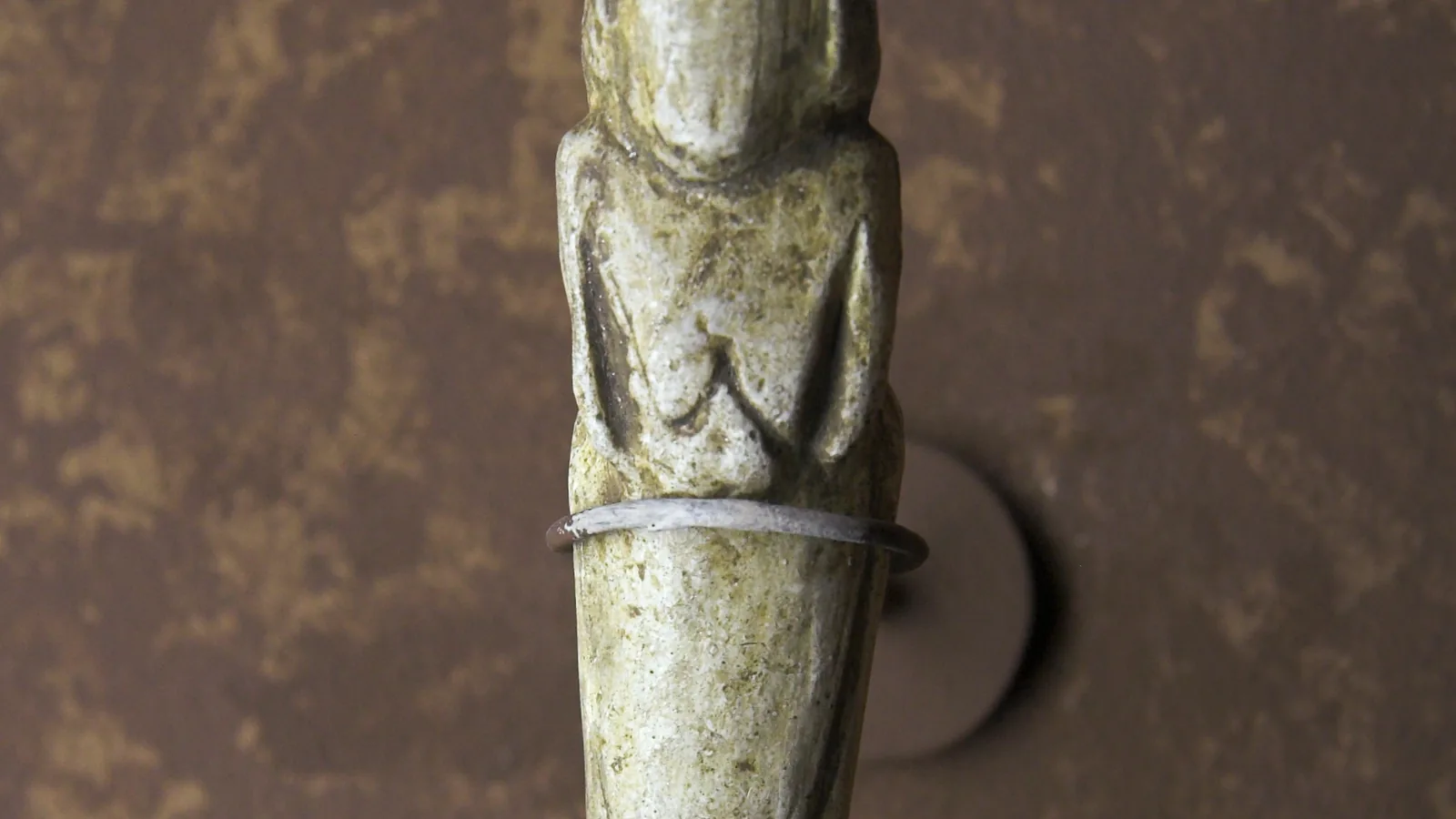
,_cop,_076846.jpg)
TL;DR — A child’s humerus sampled at the Hermitage in 2009 dated to 20,240 ± 60 radiocarbon years and carried a genome between western Eurasians and Native Americans.
“In 2009 we visited Hermitage State Museum in St. Petersburg, Russia, and sampled skeletal remains of a juvenile individual (MA-1) from the Mal’ta Upper Palaeolithic site.” So begins the account by Maanasa Raghavan and her co-authors of the Siberian genome that Nature printed in volume 505 in 2014. The bone, a humerus, came from a child buried at Mal’ta, a site on the Belaya river in south-central Siberia near Lake Baikal that M. M. Gerasimov dug between 1928 and 1958. Accelerator mass spectrometry dating of the sample “produced an age of 20,240 ± 60 14C years before present or 24,423–23,891 calendar years before present.” The genome from the same bone sat, on a principal component plot, between living western Eurasians and Native Americans, and the authors modeled 14 to 38 percent of the ancestry of the Karitiana, a Native American population, as coming from a population like his. That lineage has since been traced at Yana, a site 31,600 years old, at Afontova Gora on the Enisei and at Botai in Kazakhstan.
Quick facts
- When
- Site discovered in 1928 · Gerasimov's excavations 1928–1958 · Gerasimov's report on the burial 1931 · humerus sampled at the Hermitage in 2009 · AMS date 20,240 ± 60 radiocarbon years, or 24,423–23,891 calendar years before present · genome paper in Nature 2014 · Mal'ta Cluster named 2016 · Yana genomes 2019 · Botai and Baikal ANE shares 2020 · Lbova's study of the burial 2021
- Where
- Mal'ta, on the left bank of the Belaya river near Mal'ta village, Usolsky district, Irkutsk region, south-central Siberia near Lake Baikal; State Hermitage Museum, St. Petersburg; Afontova Gora on the Enisei; Yana RHS; Botai, Kazakhstan
- Who
- M. M. Gerasimov (excavator); G. I. Medvedev and E. A. Lipnina (later excavations); Maanasa Raghavan and co-authors (2014 genome); Qiaomei Fu (2016); Martin Sikora (2019); Choongwon Jeong (2020); Liudmila Lbova (2021); François Djindjian and Henri Delporte (Bulletin de la Société préhistorique française)
- Outcome
- MA-1 carried mitochondrial haplogroup U and a basal Y lineage of haplogroup R; on a principal component plot he fell between western Eurasians and Native Americans; Raghavan's team modeled 14 to 38 percent of Karitiana ancestry as coming from a population like his; the lineage was later traced at Yana, Afontova Gora and Botai
1928 to 1958: Gerasimov's seasons on the Belaya
Novosibirsk State University’s “Art of Mal’ta” database places the site: “It is situated on the left side of the river Belaya, near the Mal’ta village of Usolski district, Irkutsk region. The site was discovered in 1928 by M.M. Gerasimov.” The university counts ten field seasons under Gerasimov between 1928 and 1958 and an excavated area of 1,427 square meters. François Djindjian, reviewing a 1997 monograph on the Baikal Paleolithic in the Bulletin de la Société préhistorique française in 2002, counted 11. The two also differ on when work resumed: the university dates the modern stage to 1981 under G. I. Medvedev, Djindjian to 1995.
The university lists 14 levels of cultural deposits dated from 43,000 to 12,000 uncalibrated years, and Liudmila Lbova, writing in Evolutionary Human Sciences in 2021, put the “classic” Mal’ta layer, with its “Gravettian-like” stone industry and some 15 dwelling structures, at 19,000 to 23,000 uncalibrated years before present, in layers 8 and 9. More than 13,000 artifacts came out of the ground, of which Lbova counted more than 850 as wholly unique evidence for Paleolithic culture and art.
Ochre, ivory and a flying bird in a slab-lined grave
Lbova, drawing on Gerasimov’s report of 1931, described the child’s grave: “The children’s skeletons were buried within a slab structure resembling a dug and lined grave… The bottom of the burial was covered with red ochre.” Among the bones lay “fragments of a tiara made from mammoth ivory,” a necklace of 120 bone beads, “a large oval-shaped pendant, a round bone plaque with a zigzag pattern and a sculpture of a flying bird,” and, next to the child, stone tools and “a roughly processed flint knife.” Gerasimov judged the child to be “3–4 years old” and, Lbova wrote, “was firmly convinced that this inventory of artefacts could not belong to the child himself because of his age.” She set a second reading beside his: such a funerary inventory “may well speak of ideas about the afterlife initiation, and the rite of passage into adulthood.”
The age is Gerasimov’s field judgment; Raghavan’s paper calls the individual only a juvenile. Lbova also wrote that the collection holds “the teeth of another child in the burial,” a sentence that leaves open whether the two lay in one grave. Each author counts the site’s ivory figurines differently: Raghavan wrote of “30 anthropomorphic Venus figurines,” Lbova’s text gives 32 in varying states of finish, and her table gives 40 for Mal’ta and the neighboring site of Buret together. Lbova’s plates cite them by Hermitage catalogue number: an adult woman as No. 370/748, two child figurines as Nos. 370/752 and 370/753.
Hermitage, 2009: a humerus, a haplogroup and a date
The mitochondrial DNA from the humerus fell in haplogroup U, “which has also been found at high frequency among Upper Palaeolithic and Mesolithic European hunter-gatherers,” and the Y chromosome in “a basal lineage of haplogroup R.” The Y chromosome is why the juvenile is called a boy. The nuclear genome supplied the sentence the paper is cited for: “In the first two principal components, MA-1 is intermediate between modern western Eurasians and Native Americans, but distant from east Asians.”
"Intermediate between modern western Eurasians and Native Americans"
The authors turned that position into a number, with a warning attached. “Admixture graphs fitted with MixMapper model Karitiana as having 14–38% western Eurasian ancestry and 62–86% east Asian ancestry, but we caution that these estimates assume unadmixed ancestral populations.” Afontova Gora-2, from the Enisei river in south-central Siberia, dated to 17,075–16,750 calendar years before present and “shows close similarity to the genetic profile of MA-1 on a PCA,” which the authors read as a region “continuously occupied by humans throughout the Last Glacial Maximum.”
Three individuals from the Glacial Maximum, and the lineage after 2014
Qiaomei Fu and her co-authors, in a 2016 Nature study of Ice Age Europe, gave the group a name: “The ‘Mal’ta Cluster’ is composed of three individuals from the Glacial Maximum 24,000-17,000 years ago from the Lake Baikal region of Siberia.” The likeness between Mal’ta’s ivory figurines and the Venus figurines of the European Gravettian was an old theme; Henri Delporte had set Mal’ta and Buret beside a female figurine found in 1957 at Krasnii Yar, in the same French bulletin in 1965. Fu’s team found “no genetic connection between them and the Mal’ta1 individual in Siberia” and wrote that “if this similarity is not a coincidence, it reflects diffusion of ideas rather than movements of people.”
Martin Sikora’s 2019 paper in Nature reached further back. The Yana RHS site, at about 70 degrees north, is “dated to 31,600 years cal BP,” and Mal’ta “shares more alleles with Yana than with other west Eurasian hunter-gatherers,” so the Mal’ta lineage, “previously termed ‘Ancestral North Eurasians’ (ANE),” was treated as a descendant of the Ancient North Siberian lineage at Yana. Sikora’s paper puts the Native American share of that lineage at about 40 percent; Raghavan’s 2014 range was 14 to 38 percent, with its stated assumption. Choongwon Jeong’s 2020 paper in Cell followed the same ancestry to Afontova Gora, to the horse-herders of Botai in Kazakhstan and to the Kitoi and Glazkovo peoples west of Lake Baikal, where its share rose “from 6.4% to 20.1%.” Gülşah Merve Kılınç’s 2021 study of 40 later genomes found that populations west of the lake “witnessed major population transformations.” The child came out of the Belaya bank in one of Gerasimov’s seasons between 1928 and 1958; the number attached to his arm bone in 2014 reads “20,240 ± 60 14C years before present.”
Key facts
- Mal’ta lies on the left bank of the Belaya river near Mal’ta village, Usolsky district, Irkutsk region, and was discovered in 1928 by M. M. Gerasimov (Novosibirsk State University).
- Gerasimov’s excavations ran from 1928 to 1958 over 1,427 square meters; the university counts ten field seasons, Djindjian’s 2002 review 11.
- The site holds 14 cultural levels dated from 43,000 to 12,000 uncalibrated years; the “classic” layer with some 15 dwellings dates to 19,000–23,000 uncalibrated years before present (Lbova 2021).
- The child’s grave was slab-lined with a floor of red ochre and held ivory tiara fragments, a necklace of 120 bone beads, a pendant, a zigzag-patterned plaque, a flying-bird sculpture and a flint knife (Gerasimov 1931, as given by Lbova).
- Gerasimov judged the child “3–4 years old”; Raghavan’s 2014 paper calls MA-1 a juvenile.
- The humerus sampled at the Hermitage in 2009 dated to “20,240 ± 60 14C years before present or 24,423–23,891 calendar years before present” (Raghavan 2014).
- MA-1 carried mitochondrial haplogroup U and “a basal lineage of haplogroup R” on the Y chromosome; Karitiana were modeled with 14–38 percent western Eurasian ancestry, on the assumption of unadmixed ancestral populations.
- Fu 2016 defined the “Mal’ta Cluster” as three individuals from 24,000–17,000 years ago; Sikora 2019 tied the lineage to Yana RHS at 31,600 years; Jeong 2020 traced it to Botai and to a rise from 6.4 to 20.1 percent west of Lake Baikal.
FAQ
How old is the Mal'ta boy, MA-1?
Raghavan's 2014 paper gives an AMS radiocarbon date of 20,240 ± 60 radiocarbon years before present, or 24,423–23,891 calendar years before present. The child's age at death, three to four years, is Gerasimov's judgment from the 1931 excavation report; the genome paper says only "juvenile."
What did the Mal'ta genome show about Native American ancestry?
On a principal component plot MA-1 fell between modern western Eurasians and Native Americans and away from east Asians. Raghavan's admixture graphs modeled the Karitiana as having 14–38 percent western Eurasian ancestry, with the caution that the estimate assumes unadmixed ancestral populations. Sikora's 2019 paper puts the share at about 40 percent.
Where are the Mal'ta finds kept?
At the State Hermitage Museum in St. Petersburg, where the humerus was sampled in 2009. Lbova's 2021 paper cites the ivory figurines by Hermitage catalogue numbers, among them No. 370/748 (an adult woman) and Nos. 370/752 and 370/753 (children). Novosibirsk State University's "Art of Mal'ta" site shows most of the collection online.
Sources
- Maanasa Raghavan et al., "Upper Palaeolithic Siberian genome reveals dual ancestry of Native Americans," Nature 505 (2014): 87–91, author manuscript on PubMed Central (PMC4105016): sampling at the Hermitage in 2009, the humerus, the AMS date, haplogroups, principal component analysis, the Karitiana estimate, Afontova Gora-2.
- Liudmila Lbova, "The Siberian Paleolithic site of Mal'ta: a unique source for the study of childhood archaeology," Evolutionary Human Sciences 3 (2021): e9, on PubMed Central (PMC10427291): the burial as described from Gerasimov's 1931 report, the child's age, artifact counts, the classic layer, Hermitage catalogue numbers.
- Novosibirsk State University, Laboratory of Multidisciplinary Researching on Prehistory Art of Eurasia, "Art of Mal'ta" information system: site location, discovery in 1928, ten field seasons, 1,427 square meters, 14 cultural levels, resumption in 1981.
- François Djindjian, review of V. Sitlivy, G. I. Medvedev and E. A. Lipnina, Les civilisations préhistoriques d'Asie Centrale, 1: Le Paléolithique de la rive occidentale du lac Baikal (1997), Bulletin de la Société préhistorique française 99, no. 2 (2002): 394–395, on Persée: 11 seasons, resumption in 1995, 20 radiocarbon dates.
- Qiaomei Fu et al., "The genetic history of Ice Age Europe," Nature 534 (2016): 200–205, author manuscript on PubMed Central (PMC4943878): the Mal'ta Cluster and the absence of a genetic connection to European Venus-figurine makers.
- Martin Sikora et al., "The population history of northeastern Siberia since the Pleistocene," Nature 570 (2019): 182–188, author manuscript on PubMed Central (PMC7617447): Yana RHS at 31,600 years, the Ancestral North Eurasian label, the about 40 percent figure, Mal'ta as a descendant of the Ancient North Siberian lineage.
- Choongwon Jeong et al., "A Dynamic 6,000-Year Genetic History of Eurasia's Eastern Steppe," Cell 183 (2020), on PubMed Central (PMC7664836): ANE at Mal'ta, Afontova Gora and Botai; the 6.4 to 20.1 percent shares west of Lake Baikal.
- Gülşah Merve Kılınç et al., "Human population dynamics and Yersinia pestis in ancient northeast Asia," Science Advances 7, no. 2 (2021): eabc4587, on PubMed Central (PMC7787494): 40 genomes from 16,900 to 550 years ago and the later population turnover west of Lake Baikal.
- Henri Delporte, "La statuette féminine de Krasnii Iar (Sibérie) et le Paléolithique supérieur de Sibérie," Bulletin de la Société préhistorique française 62, no. 1 (1965): 118–129, on Persée: the 1957 Krasnii Yar figurine and Mal'ta and Buret as its Siberian comparisons.
Cite this article
- APA
- Our Earth's History. (2026, September 22). MA-1, the Mal'ta boy: a Hermitage humerus and a 24,000-year genome. Our Earth's History. https://ourearthshistory.com/central-asia/prehistory/malta-boy-ma1-siberia-24000-years-hermitage-2009-nature-2014-humerus/
- Chicago
- Our Earth's History. “MA-1, the Mal'ta boy: a Hermitage humerus and a 24,000-year genome.” Our Earth's History, September 22, 2026. https://ourearthshistory.com/central-asia/prehistory/malta-boy-ma1-siberia-24000-years-hermitage-2009-nature-2014-humerus/.
- MLA
- “MA-1, the Mal'ta boy: a Hermitage humerus and a 24,000-year genome.” Our Earth's History, 22 Sep. 2026, https://ourearthshistory.com/central-asia/prehistory/malta-boy-ma1-siberia-24000-years-hermitage-2009-nature-2014-humerus/.
Text licensed CC BY-NC-ND 4.0. Found an error? Tell us.