Ibex horns around a child's skull, 1938, at Teshik-Tash

TL;DR — In 1938 Alexey Okladnikov found a child’s skeleton ringed by ibex horns at Teshik-Tash. DNA in 2007 and a study in 2012 called the child a Neanderthal; a 2009 study did not.
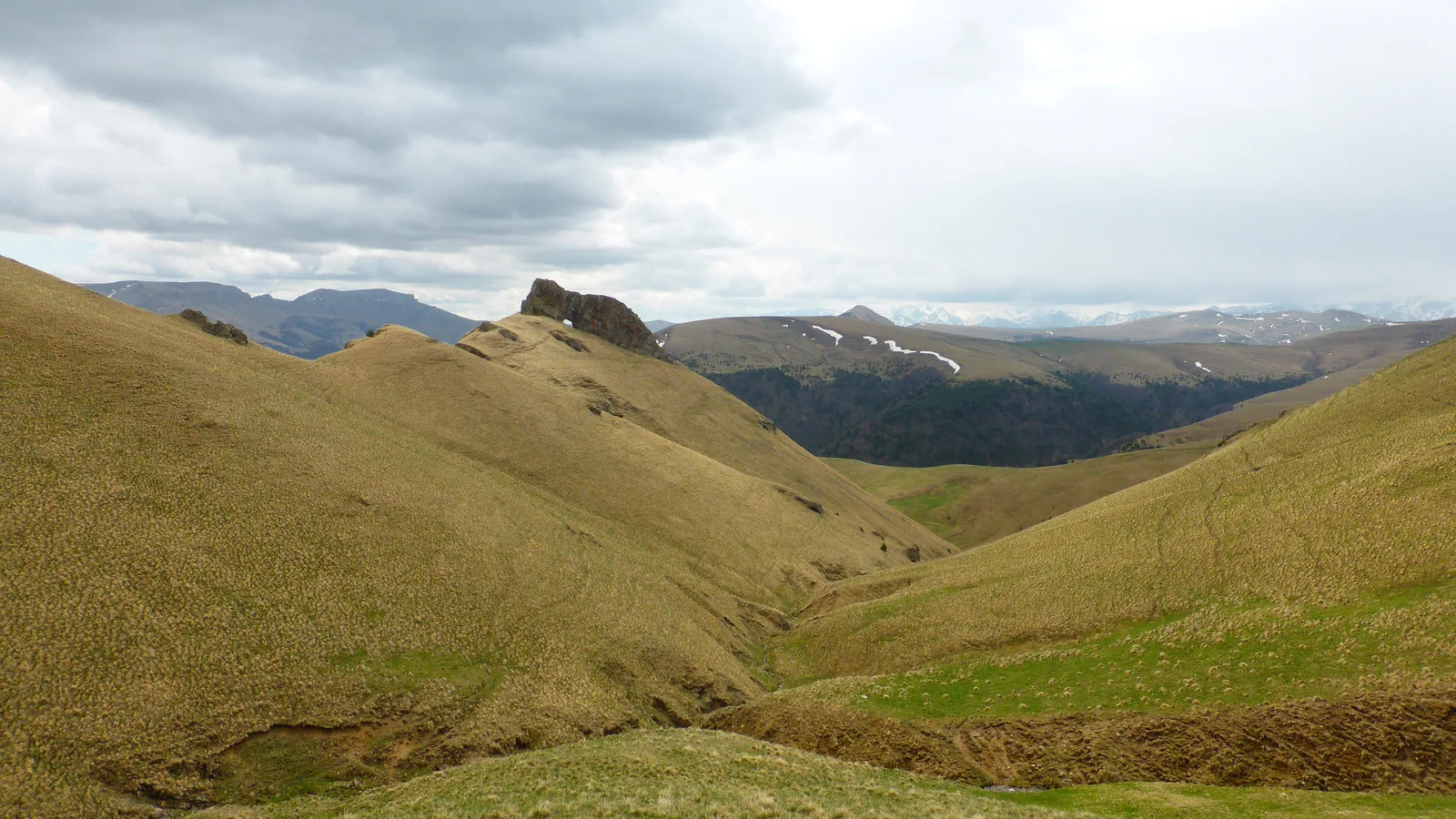
The Smithsonian’s Human Origins Program lists the find in three lines: “Site: Bajsuntau, Uzbekistan,” “Year of Discovery: 1938,” “Discovered by: A. Okladnikov.” Soviet archaeologist Alexey Okladnikov spent that season excavating a Mousterian layer inside Teshik-Tash, a cave in the Baysuntau range of southern Uzbekistan, when his team uncovered the skull and partial skeleton of a child the Smithsonian dates to about 70,000 years old and lists as “about 8-11 years old.” Around the skull, by Okladnikov’s own account, lay a ring of ibex horns. Researchers have since argued over whether the horns were placed on purpose, whether the skeleton belongs to a Neanderthal, and how far east Neanderthals lived.
Quick facts
- When
- 1938 (Smithsonian) or 1938-39 (Uzbek government heritage page), excavation; 2007, mitochondrial DNA study; 2009, cranial reassessment; 2012, frontal bone study
- Where
- Teshik-Tash cave, Baysuntau range, southern Uzbekistan, near the Afghan border
- Who
- Alexey Okladnikov, excavator; Mikhail Gerasimov, facial reconstruction; Johannes Krause and coauthors, Max Planck Institute for Evolutionary Anthropology, 2007 DNA study; Michelle Glantz, Colorado State University, and coauthors, 2009 reassessment; Philipp Gunz and Elena Bulygina, 2012 frontal bone study; Paul Pettitt, University of Bristol, 2002 survey citing Robert Gargett's 1989 skepticism
- Outcome
- Mitochondrial DNA published in 2007 fell within European Neanderthal variation and extended the known Neanderthal range at least 2,000 km further east; a 2009 cranial and mandibular reassessment placed the child closer to modern humans; a 2012 geometric morphometric study of the frontal bone placed it with Neanderthal children and, combined with the DNA, called the Neanderthal identification firm
1938: a skeleton and a circle of horns
Okladnikov’s excavation reached the child’s remains inside cultural layers that also held the bones of wild horses, ibex, deer and bear, along with disc-shaped cores and scrapers, according to the heritage page maintained by Uzbekistan’s Cabinet of Ministers construction and restoration directorate. The same page quotes Okladnikov’s own description of the moment the horns appeared: further digging, he wrote, “revealed an unexpected and truly astonishing picture, the like of which no researcher had yet seen,” with ibex horns “arranged in a circle” around the skull, “according to a definite plan.” Okladnikov concluded that the arrangement proved “reason, a logical plan of action, a whole world of representations” stood behind it. The Smithsonian’s page and the Uzbek page agree that the excavation took place in 1938, though the Uzbek page dates the wider project 1938-39.
A skull with no chin, and a second study with no name
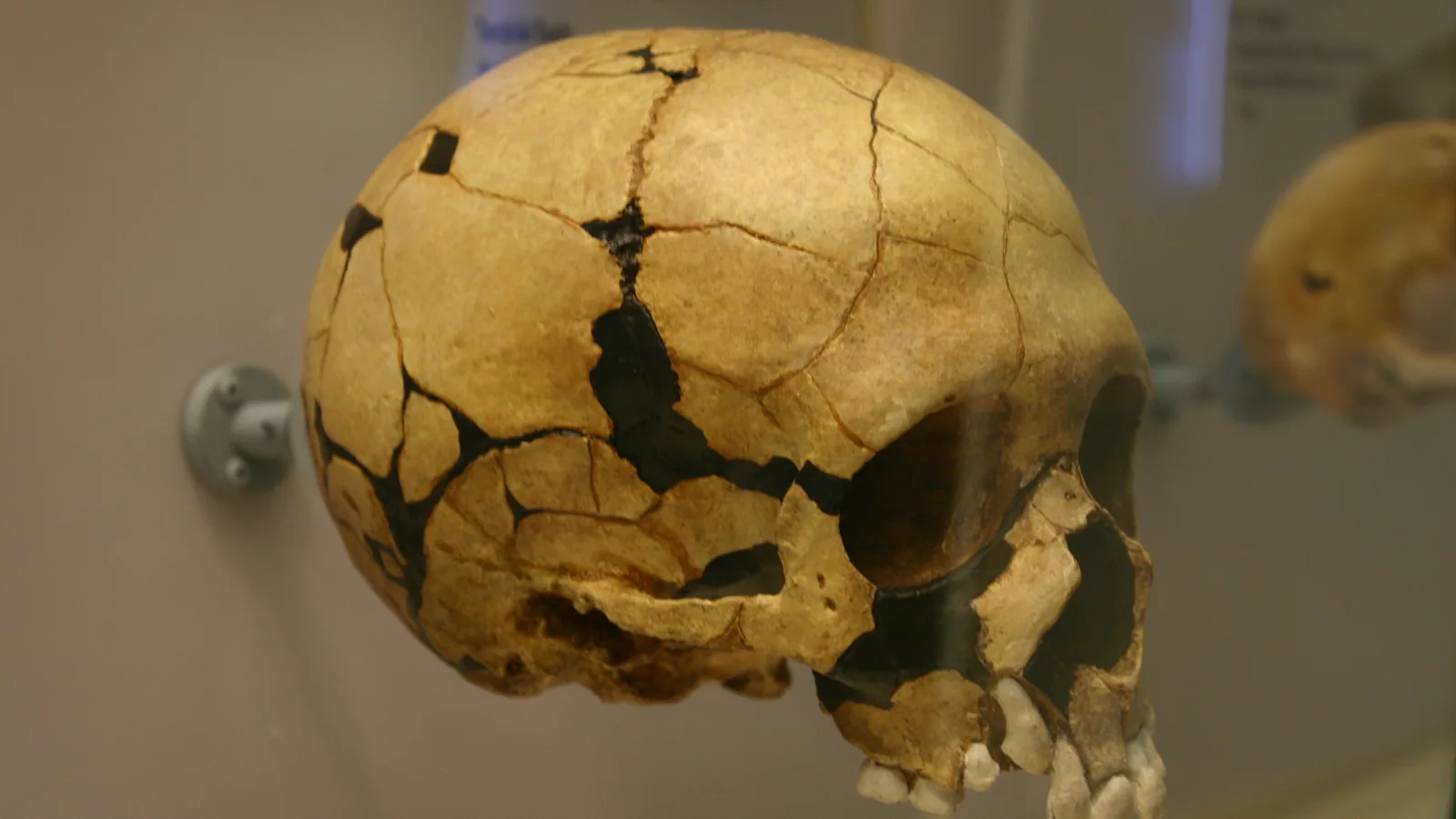
The Uzbek heritage page describes the skull as “quite large (1,490 cubic centimeters),” with a browridge “not too developed,” a projecting nose, and no chin, features it and Okladnikov’s team read as Neanderthal. Age estimates differ by source: the Smithsonian gives “8-11 years old”; Pettitt, citing Gargett’s 1989 study, gives “8-10 year old”; sculptor and anthropologist Mikhail Gerasimov, who reconstructed the child’s face and is quoted on the Uzbek page, put the age at “9-10 years.” Gerasimov also wrote that the child “looks older than his age,” with a build combining “very strong shoulders” and a stoop in the upper torso that he called typical “for Neanderthal forms.” The Uzbek page adds a further claim: the skeleton “was initially considered to belong to a boy,” but “according to later research, it was established that the skeleton belongs to a girl.” The page names no researcher, institution or publication for that reassignment.

"An unconvincing indicator of burial": Gargett and Pettitt
Not every scholar has accepted Okladnikov’s reading of the horns as proof of intent. Paul Pettitt, of the University of Bristol, summarized archaeologist Robert Gargett’s 1989 skepticism in a 2002 survey of Neanderthal burial: “the skeleton of an 8-10 year old boy at Teshik Tash, in Uzbekistan near the Afghan border, is an unconvincing indicator of burial.” The remains, Pettitt wrote, “partial as they are, were recovered from a restricted spatial area and formed along with small limestone eboulis, the well-known ibex horns and a hyaena coprolite,” and “the confined spatial extent and circular shape” of the arrangement made the horns “highly dubious,” since “there are no convincing indications of grave good emplacement.” Pettitt himself stopped short of endorsing Gargett’s broader argument, writing that Gargett “has forwarded a largely unconvincing critique of Neanderthal burial” in general, even while finding the specific taphonomy at Teshik-Tash hard to read as deliberate.
Johannes Krause's team finds Neanderthal DNA, 2007
Johannes Krause and ten coauthors, working mainly out of the Max Planck Institute for Evolutionary Anthropology, addressed a different question in 2007: not whether the child was buried, but how far east Neanderthals had lived. Their paper in Nature states its aim directly: “To determine how far to the east Neanderthals ranged, we determined mitochondrial DNA (mtDNA) sequences from hominid remains found in Uzbekistan and in the Altai region of southern Siberia.” The result, the paper reports, is that “the DNA sequences from these fossils fall within the European Neanderthal mtDNA variation,” so that “the geographic range of Neanderthals is likely to have extended at least 2,000 km further to the east than commonly assumed.” Nature’s editor summary put it more plainly: DNA “confirm that the skeleton of a child recovered in Uzbekistan in the 1930s was of Neanderthal origin.” The sequence was deposited in GenBank under accession number EU078679, and the paper thanks V. M. Kharitonov for the fossil samples.
Two papers, one skull: 2009 and 2012
Two more studies, in the same journal, reached opposite conclusions from the same bones. In 2009 Michelle Glantz, of Colorado State University, with Sheela Athreya and Terrence Ritzman, reexamined the original Russian excavation monograph and found that incomplete evidence at the cranial base and face, plus problems with the skull’s reconstruction, was “making its Neandertal attribution less certain than previously assumed.” Their cranial analysis, they wrote, grouped Teshik-Tash “with Upper Paleolithic modern humans when variables are not size-standardized,” and their mandibular analysis placed it “with recent modern humans” in both raw and standardized data, a result they said “challenge current characterizations of this territory as the eastern boundary of the Neandertal range.” The authors added their own caution: further studies and “additional sub-adult fossil finds from this region are needed” before the pattern could be settled. In 2012 Philipp Gunz and Elena Bulygina applied a geometric morphometric analysis to the frontal bone alone and reported that “the morphology of the frontal bone places the Teshik-Tash child close to other Neanderthal children,” with simulated adult shapes closest to Neanderthal adults. Their paper closed by weighing that result against Krause’s 2007 DNA, the child’s occipital bun and its shovel-shaped upper incisors together: “these independent lines of evidence firmly place Teshik-Tash among Neanderthals.”
Key facts
- Alexey Okladnikov excavated the child’s remains at Teshik-Tash cave, Baysuntau range, southern Uzbekistan, in 1938 (Smithsonian) or 1938-39 (Uzbek heritage page).
- The Smithsonian dates the fossil to about 70,000 years old and describes it as a child “about 8-11 years old.”
- The Uzbek heritage page gives the skull’s volume as 1,490 cubic centimeters, a figure that appears on no other page consulted for this article.
- Age estimates vary by source: 8-11 years (Smithsonian), 8-10 years (Pettitt, citing Gargett 1989), and 9-10 years (Gerasimov, quoted on the Uzbek page).
- Johannes Krause and coauthors published mitochondrial DNA from the child in Nature in 2007, finding it within European Neanderthal variation and extending the known Neanderthal range at least 2,000 km east.
- Michelle Glantz, Sheela Athreya and Terrence Ritzman’s 2009 reassessment in the American Journal of Physical Anthropology placed the cranial and mandibular morphology closer to modern humans than to Neanderthals.
- Philipp Gunz and Elena Bulygina’s 2012 study of the frontal bone, combined with the 2007 DNA, concluded the child belongs among Neanderthals.
- Paul Pettitt’s 2002 survey, citing Robert Gargett’s 1989 critique, called the ibex-horn arrangement “an unconvincing indicator of burial.”
FAQ
Was the Teshik-Tash child a Neanderthal?
Sources disagree. Mitochondrial DNA published by Johannes Krause and coauthors in 2007 fell within European Neanderthal variation, and a 2012 geometric morphometric study of the frontal bone by Philipp Gunz and Elena Bulygina reached the same conclusion. A 2009 cranial and mandibular reassessment by Michelle Glantz and coauthors placed the remains closer to modern humans.
Were the ibex horns found at Teshik-Tash a deliberate burial marker?
Alexey Okladnikov, who excavated the site in 1938, described the horns as arranged in a circle "according to a definite plan." Archaeologist Robert Gargett, in a 1989 critique summarized by Paul Pettitt in 2002, called the arrangement "an unconvincing indicator of burial," noting the bones were found in a restricted area mixed with limestone fragments and hyena droppings.
How old was the Teshik-Tash child?
Estimates differ. The Smithsonian gives 8-11 years, Pettitt's 2002 survey (citing Gargett, 1989) gives 8-10 years, and sculptor Mikhail Gerasimov, quoted on the Uzbek government heritage page, gave 9-10 years.
Sources
- Smithsonian National Museum of Natural History, Human Origins Program — fossil record page, "Teshik-Tash."
- Johannes Krause et al. — "Neanderthals in Central Asia and Siberia," Nature 449 (2007), 902-904, abstract and editor summary.
- Michelle Glantz, Sheela Athreya and Terrence Ritzman — "Is Central Asia the eastern outpost of the Neandertal range? A reassessment of the Teshik-Tash child," American Journal of Physical Anthropology 138(1) (2009): 45-61, abstract via Europe PMC.
- Philipp Gunz and Elena Bulygina — "The Mousterian child from Teshik-Tash is a Neanderthal: A geometric morphometric study of the frontal bone," American Journal of Physical Anthropology 149(3) (2012): 365-379, abstract via Europe PMC.
- Дирекция по строительству, реконструкции и капитальному ремонту объектов Кабинета Министров Республики Узбекистан — heritage page on Teshik-Tash cave.
- Paul B. Pettitt, Department of Archaeology, University of Bristol — "The Neanderthal dead: exploring mortuary variability in Middle Palaeolithic Eurasia," Before Farming 2002/1, article 4, hosted PDF.
Cite this article
- APA
- LETTER. (2026, September 28). Ibex horns around a child's skull, 1938, at Teshik-Tash. Our Earth's History. https://ourearthshistory.com/central-asia/prehistory/teshik-tash-1938-okladnikov-neanderthal-child-uzbekistan/
- Chicago
- LETTER. “Ibex horns around a child's skull, 1938, at Teshik-Tash.” Our Earth's History, September 28, 2026. https://ourearthshistory.com/central-asia/prehistory/teshik-tash-1938-okladnikov-neanderthal-child-uzbekistan/.
- MLA
- LETTER. “Ibex horns around a child's skull, 1938, at Teshik-Tash.” Our Earth's History, 28 Sep. 2026, https://ourearthshistory.com/central-asia/prehistory/teshik-tash-1938-okladnikov-neanderthal-child-uzbekistan/.
Text licensed CC BY-NC-ND 4.0. Found an error? Tell us.