Botai, 3500 BC: mare's milk in the pots, horses that were Przewalski's
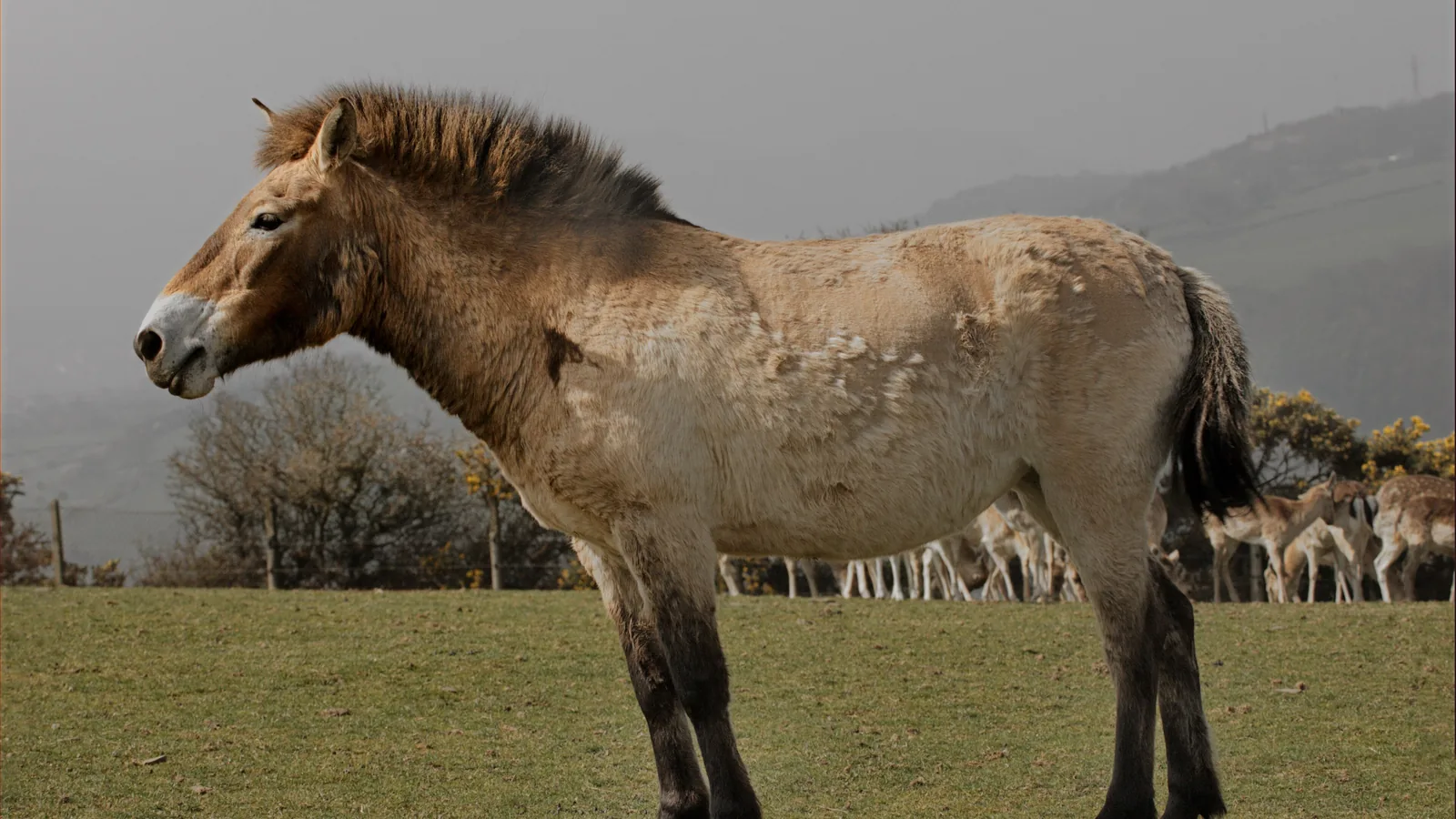

TL;DR — Botai in northern Kazakhstan was named in 2009 as the earliest horse-domestication site; DNA in 2018 made its horses ancestors of Przewalski’s horse, not of modern breeds.
In 2009 Alan Outram of the University of Exeter and colleagues reported in Science “three independent lines of evidence demonstrating domestication in the Eneolithic Botai Culture of Kazakhstan,” at a site dated to about 3500 BC. The abstract listed them: measurements of horse metacarpals that “resemble Bronze Age domestic horses rather than Paleolithic wild horses from the same region,” pathologies showing “that some Botai horses were bridled, perhaps ridden,” and fatty acids in potsherds that revealed “processing of mare’s milk and carcass products in ceramics.” Nine years later a study of ancient genomes, with Outram and the site’s excavator Viktor Zaibert among its authors, reported that the Botai horses were the ancestors of Przewalski’s horse and not of any modern domestic breed. Two papers in 2021 then moved the homeland of modern domestic horses west to the lower Volga and Don, and one of them asked whether the people of Botai had kept horses at all.
Quick facts
- When
- Botai occupied in the 4th millennium BC, about 3500 BC; Outram paper 2009; Gaunitz genome paper 2018; Taylor and Barrón-Ortiz April 2, 2021; Librado paper October 2021; first Przewalski's horses flown to Kazakhstan 2024
- Where
- Botai, on a tributary of the Ishim River in northern Kazakhstan near the Russian border; Altyn Dala (Golden Steppe) State Nature Reserve, Kazakhstan
- Who
- Viktor Zaibert (excavator); Alan Outram (University of Exeter); Charleen Gaunitz and Ludovic Orlando (2018 genomes); Pablo Librado (2021 Nature); William Taylor and Christina Barrón-Ortiz (2021 review); Emmanuelle Casanova (2022 dating); Prague Zoo
- Outcome
- Botai horses identified as ancestors of Przewalski's horse; modern domestic horses traced to the lower Volga-Don and an expansion from about 2000 BC; whether Botai people herded or hunted horses is disputed in print
A village on the Ishim, dated to the fourth millennium BC
Botai lies on a tributary of the Ishim River in northern Kazakhstan, near the border with Russia. William Taylor of the University of Colorado Boulder Museum of Natural History and Christina Barrón-Ortiz of the Royal Alberta Museum, in a 2021 review of the site, described what excavators found there as “a pithouse village along with a massive assemblage composed nearly entirely of horse remains.”
A 2022 radiocarbon study led by Emmanuelle Casanova of the University of Bristol, with Zaibert among its authors, dated fatty acids of horse origin from Botai potsherds and found them “compatible with previous 14C dates at the site,” which had placed Botai in the 4th millennium BC. Taylor and Barrón-Ortiz listed what had made the village a candidate for domestication: horse-bone tools, pithouses filled with decayed plant matter “hypothesized to be horse dung,” postholes read as possible corrals, and loose lower premolars with damage attributed to a bit, “although not in the typical form expected from a metal mouthpiece.”
Bit wear, leg bones and milk fat: the case made in 2009
“Horse domestication revolutionized transport, communications, and warfare in prehistory,” its abstract begins, “yet the identification of early domestication processes has been problematic.” The metacarpal measurements put the Botai animals closer to Bronze Age domestic horses than to Paleolithic wild ones from the same region. The jaws and teeth carried the pathologies read as bit wear. The fats in the pottery were read, by their carbon and hydrogen isotopes, as mare’s milk as well as carcass fat.
Taylor and Barrón-Ortiz later explained the milk argument’s mechanism: horse milk fat and meat fat overlap in carbon values, so the 2009 team used the hydrogen isotope deuterium, which varies with season, to pick out residues from “the summer months, when milking typically occurs.” On that basis the 2009 abstract described “a developed domestic economy” at Botai.
Twenty genomes from Botai and a 2.7 percent share
In 2018 Charleen Gaunitz, Ludovic Orlando and a team of more than 40 authors, Zaibert and Outram among them, published 42 ancient horse genomes in Science, 20 of them from Botai. Compared with 46 genomes already published, the abstract states, “our data indicate that Przewalski’s horses are the feral descendants of horses herded at Botai and not truly wild horses.” Later domestic horses carried almost none of that lineage: “All domestic horses dated from ~4000 years ago to present only show ~2.7% of Botai-related ancestry.”
The paper kept the word “herded” and still called Botai “the earliest archaeological evidence for horse husbandry, ~5500 years ago,” while adding that “the exact nature of early horse domestication remains controversial.” What it removed was the line of descent: a “massive genomic turnover,” in the abstract’s words, separated the Botai stock from the horses that became modern domesticates.
Two papers in 2021: the Volga-Don homeland and the wild-horse hunters
Pablo Librado, Orlando and colleagues used 273 ancient horse genomes in Nature in October 2021 to locate the modern domestic horse’s origin. Their abstract states that “modern domesticated breeds do not descend from the earliest domestic horse lineage . . . at Botai, Central Asia around 3500 BC,” and that the team could “pinpoint the Western Eurasian steppes, especially the lower Volga-Don region, as the homeland of modern domestic horses.” From there, domestic horses “replaced almost all other local populations as they expanded rapidly across Eurasia from about 2000 BC, synchronously with equestrian material culture, including Sintashta spoke-wheeled chariots.” The Pazyryk of the Altai, mounted people of the later steppe, belong to the world after that spread.
Six months earlier, on April 2, 2021, Taylor and Barrón-Ortiz had gone back to the bit wear. They compared the Botai jaws and teeth with wild Pleistocene horses from North America, animals no one had bridled. The damage counted at Botai occurred in “1/9 or 11.1%” of that sample and in 15.3 percent of the North American one, a frequency “commensurate or even below” that of horses with no human contact. They added that bone arrowheads had been found “in direct association with at least some specimens” at Botai, that mass hunting sites also show summer seasonality, and that a study of dental calculus from Botai human remains had found no milk proteins. Their conclusion reads: “this site and its related assemblages appear to be best explained through mass harvesting of wild horses rather than early domestication.” Librado’s abstract, published the same year, still called the Botai animals a “domestic horse lineage.” The two papers disagree in print.
Przewalski's horses on the Golden Steppe, 2024
The animal at the center of the 2018 result lives on. The Prague Zoo, which has kept the International Studbook for Przewalski’s horse since 1959, states on its project page that the world learned of the species in 1881, that it was extinct in the wild by the 1960s, and that the zoo’s breeding program began in 1932. After nine transports to Mongolia between 2011 and 2019, the zoo in 2024 began flying horses to the Altyn Dala, or Golden Steppe, State Nature Reserve in Kazakhstan, “marking the species’ return there for the first time in centuries,” with “approximately 40” to be released over five years.
On June 6, 2024, the University of Exeter reported a new Nature study by 133 researchers from 113 institutions, coordinated from Toulouse, which put the proliferation of domestic horses at about 4,200 years ago. Outram, a senior archaeological author on it, gave the sentence that covers his own 2009 paper: “This work demonstrates that domestication processes can be highly complex and involve multiple phases and multiple lineages of animals. Not all go on to feature in the modern world.” The horses he described in 2009 as bridled and milked are, on the 2018 reading, one of those lineages.
Key facts
- Botai lies on a tributary of the Ishim River in northern Kazakhstan near the Russian border; its faunal assemblage is “composed nearly entirely of horse remains” (Taylor and Barrón-Ortiz, 2021).
- Radiocarbon dates place the site in the 4th millennium BC; direct dating of horse lipids in Botai potsherds in 2022 was “compatible with previous 14C dates at the site” (Casanova et al.).
- Outram et al., Science 2009, claimed domestication about 3500 BC from metacarpal measurements, bit-wear pathologies and mare’s-milk lipids in pottery.
- Gaunitz et al., Science 2018, sequenced 42 ancient horse genomes, 20 from Botai, and found Przewalski’s horses to be “the feral descendants of horses herded at Botai.”
- Domestic horses from about 4,000 years ago to the present carry only about 2.7 percent Botai-related ancestry (Gaunitz et al.).
- Librado et al., Nature 2021, used 273 ancient genomes to place the homeland of modern domestic horses in the lower Volga-Don region, with rapid expansion across Eurasia from about 2000 BC.
- Taylor and Barrón-Ortiz, Scientific Reports 2021, found the “bit wear” frequency at Botai (11.1 percent) at or below that of never-bridled Pleistocene horses in North America (15.3 percent) and concluded that the site is “best explained through mass harvesting of wild horses.”
- Prague Zoo began flying Przewalski’s horses to the Altyn Dala State Nature Reserve in Kazakhstan in 2024, with about 40 to be released over five years.
FAQ
Were the Botai horses domesticated?
The published papers disagree. Outram et al. (2009) and Gaunitz et al. (2018) describe the horses as bridled, milked or herded; Taylor and Barrón-Ortiz (2021) argue that the tooth damage occurs at the same rate in wild horses and that the site is better explained by mass hunting. Librado et al. (2021) still call the Botai animals a domestic lineage.
Are Przewalski's horses descended from Botai horses?
Yes, according to Gaunitz et al. (2018), whose 20 Botai genomes showed that Przewalski's horses are "the feral descendants of horses herded at Botai and not truly wild horses."
Where did modern domestic horses come from, if not Botai?
Librado et al. (2021) located their homeland in the Western Eurasian steppes, especially the lower Volga-Don region, with an expansion across Eurasia from about 2000 BC; a 2024 study reported by the University of Exeter put the proliferation at about 4,200 years ago.
Sources
- Alan K. Outram et al. — "The earliest horse harnessing and milking," Science 323 (2009), pp. 1332–1335, abstract via Europe PMC.
- Charleen Gaunitz et al. — "Ancient genomes revisit the ancestry of domestic and Przewalski's horses," Science 360 (2018), pp. 111–114, abstract via Europe PMC.
- Pablo Librado et al. — "The origins and spread of domestic horses from the Western Eurasian steppes," Nature 598 (October 2021), abstract.
- William T. T. Taylor and Christina I. Barrón-Ortiz — "Rethinking the evidence for early horse domestication at Botai," Scientific Reports 11, 7440 (April 2, 2021), full text.
- Emmanuelle Casanova et al. — "Direct 14C dating of equine products preserved in archaeological pottery vessels from Botai and Bestamak, Kazakhstan," Archaeological and Anthropological Sciences 14, 175 (August 2022), abstract and author list.
- University of Exeter News — Andrew Merrington, "The rise of horsepower 4,200 years ago" (June 6, 2024).
- Prague Zoo — "Return of the wild horses," project page.
Cite this article
- APA
- Our Earth's History. (2026, September 22). Botai, 3500 BC: mare's milk in the pots, horses that were Przewalski's. Our Earth's History. https://ourearthshistory.com/central-asia/prehistory/botai-kazakhstan-3500-bc-horses-przewalski/
- Chicago
- Our Earth's History. “Botai, 3500 BC: mare's milk in the pots, horses that were Przewalski's.” Our Earth's History, September 22, 2026. https://ourearthshistory.com/central-asia/prehistory/botai-kazakhstan-3500-bc-horses-przewalski/.
- MLA
- “Botai, 3500 BC: mare's milk in the pots, horses that were Przewalski's.” Our Earth's History, 22 Sep. 2026, https://ourearthshistory.com/central-asia/prehistory/botai-kazakhstan-3500-bc-horses-przewalski/.
Text licensed CC BY-NC-ND 4.0. Found an error? Tell us.