Varna's Copper Age gold: 270 burials by one count, 315 by another
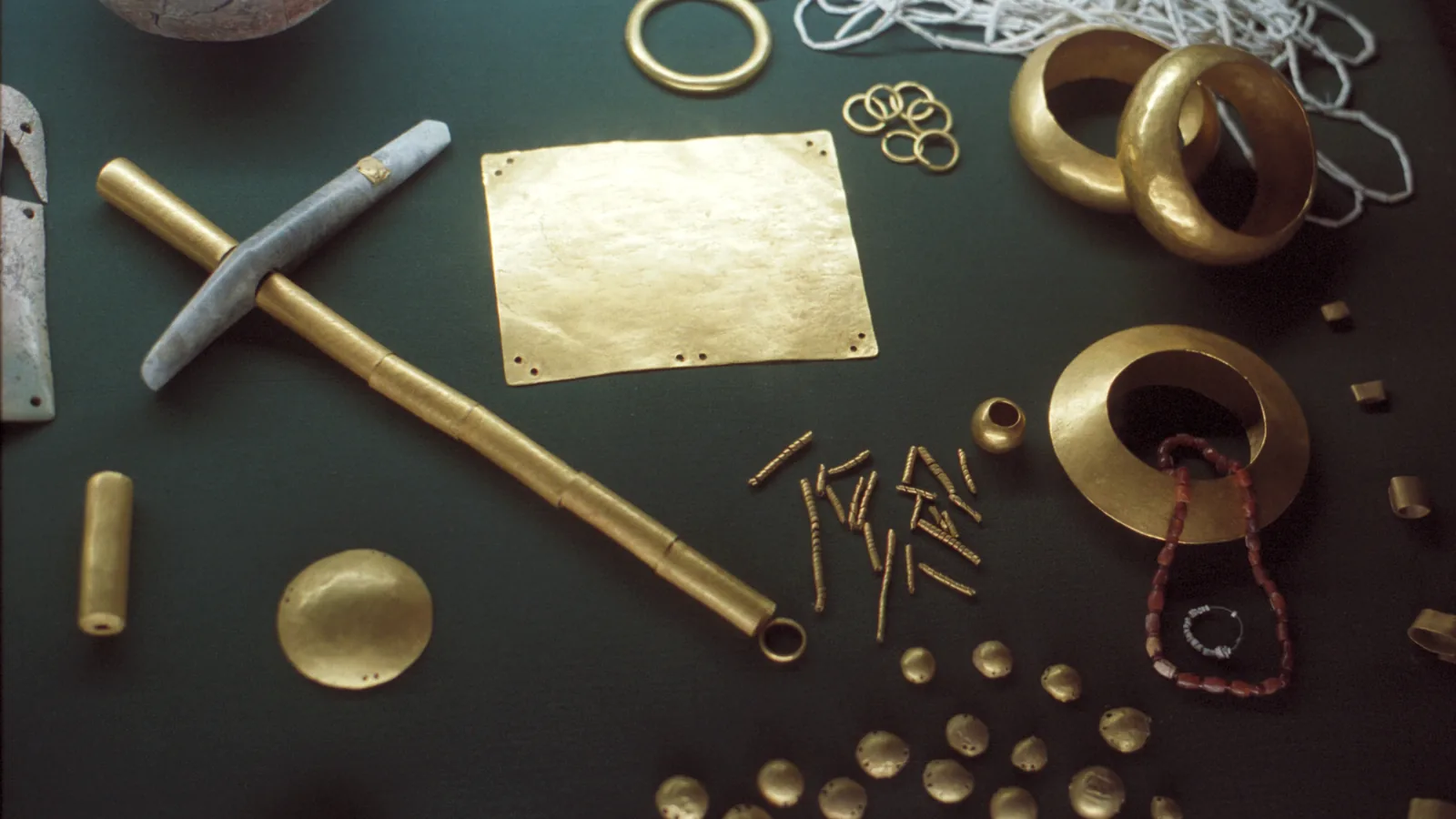

TL;DR — A 1972 trench in Varna, Bulgaria, opened a Copper Age cemetery counted at 270 to 315 graves, its gold concentrated in Grave 43 and in graves without bodies.
“The site was accidentally discovered in October 1972 by the excavator operator Raycho Marinov,” reads the page the Municipality of Varna keeps on its tourism website. The spot lay in the western industrial zone of Varna, on Bulgaria’s Black Sea coast, about half a kilometer from Lake Varna. Excavation ran until 1991 and recovered, in the count of a 2018 radiocarbon paper, “Over 3,000 objects” of gold weighing more than 6 kilograms. Two questions about the cemetery have never settled on one answer: how many graves it held, and when the burials began and ended.
Quick facts
- When
- Found October 1972; excavated 1972 to 1991; burials dated to about 4600 to 4340 cal BC by two radiocarbon models (Krauß et al. 2017; Higham et al. 2018)
- Where
- The western industrial zone of Varna, on the Black Sea coast of Bulgaria, about half a kilometer from Lake Varna
- Who
- Raycho Marinov (excavator operator); Dimitar Zlatarski (Dalgopol Historical Museum); Alexander Minchev; Mihail Lazarov and Ivan Ivanov (excavation directors); Vladimir Slavchev; Thomas Higham; Raiko Krauß
- Outcome
- Over 3,000 gold objects weighing more than 6 kilograms, about a third of the gold from Grave 43 alone; grave counts of 270, 294, 312 and 315 in four publications; two radiocarbon chronologies, one of which calls the other backwards
October 1972: a bracelet in an excavator bucket
Alexander Minchev was 25 in 1972 and newly employed at the museum in Varna. He told Andrew Curry of Smithsonian Magazine, in an article published April 18, 2016, that a call came one morning from a former schoolteacher who ran a small museum in a nearby village. The tourism page names the teacher as Dimitar Zlatarski, creator of the Dalgopol Historical Museum. A former student of his had fished a bracelet out of his excavator bucket while digging trenches for electrical cables, taken the pieces for copper or brass, and kept them in the box his new work boots came in. The first lot weighed 2.2 pounds.
Within weeks the operator led a police officer, two archaeologists and his old teacher back to the trench, where Minchev saw more gold in the loose dirt. “It’s very rare to have just one grave,” Minchev told the magazine. The tourism page gives the directors of the excavation as Mihail Lazarov, from 1972 to 1976, and Ivan Ivanov, from 1972 to 1991. In 1991, the magazine reported, the archaeologist in charge halted the dig so that later researchers could use better techniques and he could finish publishing what had been found.
Gold in a handful of graves
Smithsonian Magazine reported that four graves held three quarters of the cemetery’s gold. A 2017 study led by Raiko Krauß of Tübingen University found that “already one third of all finds originate from the particularly richly furnished Grave 43,” and that a further third was divided among well-furnished symbolic graves and five deposits.
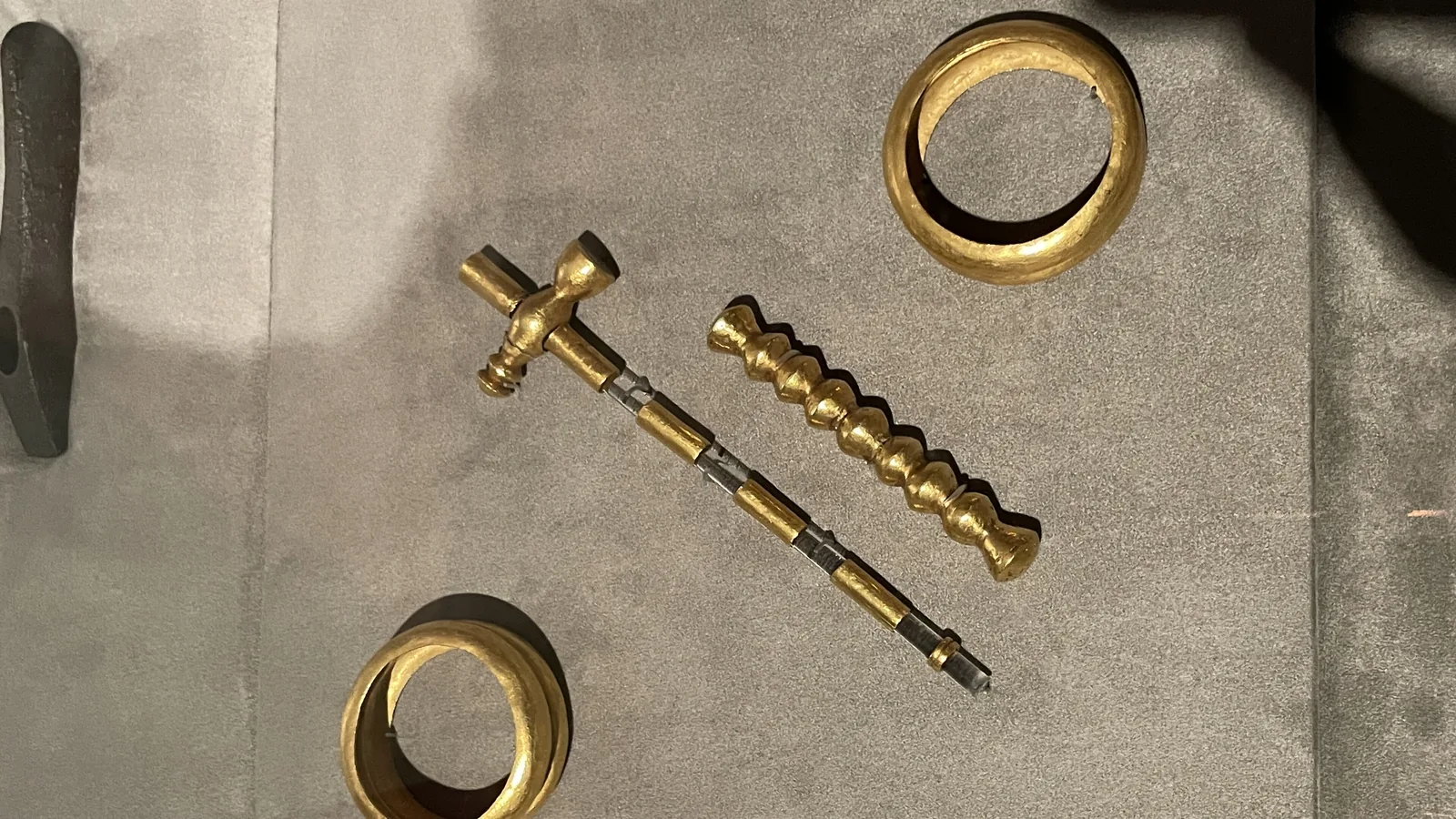
At the Varna Archaeological Museum, Vladimir Slavchev, curator of prehistoric artifacts there, showed Curry a reconstruction of Grave 43 with the original gold laid out as it was found. The magazine listed gold bangles, necklaces of gold beads and heavy gold pendants, pierced gold disks that once hung from clothing, a polished ax with a gold-wrapped handle and a second ax beneath it, a flint blade 16 inches long, and a gold penis sheath. The tourism page goes further: “Grave 43 contained more gold than has been found in the entire rest of the world for that epoch.”
The 2018 paper, by Thomas Higham of the Oxford Radiocarbon Accelerator Unit and three colleagues, counted 49 graves with no human remains. The tourism page calls these symbolic, or empty, graves “the richest in gold artifacts.” One of them, Grave 36, was excavated in the fall of 1974; a Smithsonian caption lists a miniature crown, a scepter, a sickle and two bull figurines among its gold. Three symbolic graves held clay heads. The tourism page describes “masks of unbaked clay,” and the 2018 paper wrote of gold objects placed at the eyes, mouth, nose and ears. Krauß’s group identified the three as Graves 2, 3 and 15 and wrote that computer tomography showed “no evidence for ‘mask graves’ (as was previously assumed),” only round sculpted figures crushed by the pressure of the earth.

"The oldest gold treasure in the world"
The heading of the Varna tourism page reads “The oldest processed gold treasure in the world,” and its text states: “The oldest gold treasure in the world, dating from 4,600 BC to 4,200 BC, was discovered at the site.” The Ministry of Tourism of Bulgaria uses the same phrase on its page for the Archaeological Museum in Varna, “най-старото злато в света” (“the oldest gold in the world”), for more than 3,000 objects and over 6 kilograms of gold dated 4600 to 4200 BC.
The scholarly papers word it more narrowly. The abstract of the 2018 paper, as Cambridge University Press printed it, described “the world’s earliest large-scale assemblage of gold artifacts.” The same paper reported that Ivanov, the excavator, had dated the material to the second half of the fifth millennium cal BC and claimed it was “the earliest evidence for goldwork in the world,” in publications of 1988 and 2000.
Between 270 and 315 graves
The Varna tourism page, which carries no date, states: “A total of 294 graves have been found in the necropolis.” Smithsonian Magazine wrote in April 2016 that Bulgarian archaeologists “spent more than 15 years excavating 312 graves.” The Krauß paper in Documenta Praehistorica, published December 27, 2017, set a cemetery of about 250 years against “the overall sum of 270 burials.” The Higham paper, published online March 1, 2018, stated: “An area of 7500 m2 yielded 315 graves.”
Slavchev was a co-author of both papers. The unexcavated share varies too. The tourism page puts it at about 30 percent of the estimated area, Slavchev told Smithsonian perhaps a third, and the Oxford manuscript of the 2018 paper estimates that the graves “may well have exceeded 350,” with a footnote that about a fifth of the presumed area remains unexcavated. The 2017 paper announced a longer study with a complete catalogue of the excavated graves, submitted to the Eurasia Department of the German Archaeological Institute, and gave no total from it.
Thomas Higham and Raiko Krauß: two chronologies
The first radiocarbon dates came from Higham, John Chapman, Slavchev and four co-authors in the journal Antiquity in 2007. The 2018 abstract summarized that series as 14 AMS dates modeled to about 150 years, around 4600 to 4450 cal BC, with too few paired human and animal dates to test for a marine reservoir effect from the Black Sea.
Krauß and five co-authors took another route in 2017. They ran a correspondence analysis on a new database of all known graves, symbolic burials and deposits, then calibrated it with radiocarbon ages. Their result: “the cemetery begins at 4590 cal BC and ends at 4340 cal BC.” They wrote that Chapman and colleagues had built a chronology “which runs backwards in time,” citing papers of 2006, 2007 and 2008, and proposed two causes: a smoothed stretch of the calibration curve around 4380 cal BC, and an “old-age” radiocarbon effect for Grave 43 itself.
The 2018 paper presented 71 dates from 53 graves and identified a small marine reservoir effect in some individuals. It estimated around two burials a year and placed Varna I toward the beginning of the Bulgarian Late Copper Age, against the view favored among Bulgarian prehistorians that Varna marked a peak followed soon by collapse. Published online by Cambridge University Press on March 1, 2018, its favored model put the start of burials at 4596 to 4516 cal BC and the end at 4427 to 4341 cal BC, at 95.4 percent probability.
Key facts
- Raycho Marinov, an excavator operator, found the site in October 1972 in the western industrial zone of Varna (Municipality of Varna tourism page).
- The first gold brought in weighed 2.2 pounds; excavation lasted until 1991 (Smithsonian Magazine, April 18, 2016).
- The cemetery yielded over 3,000 gold objects weighing more than 6 kilograms (Higham et al. 2018).
- About one third of the gold came from Grave 43, and a further third from well-furnished symbolic graves and deposits (Krauß et al. 2017).
- The 2018 paper counted 49 graves with no human remains; three symbolic graves held clay heads, which Krauß’s group said were not masks.
- Grave counts: 294 (Varna tourism page), 312 (Smithsonian, 2016), 270 burials (Krauß et al., December 2017), 315 (Higham et al., March 2018).
- Radiocarbon models: 4590 to 4340 cal BC (Krauß et al. 2017); start 4596 to 4516 cal BC, end 4427 to 4341 cal BC (Higham et al. 2018).
FAQ
Is the Varna gold the oldest gold in the world?
The Municipality of Varna and the Bulgarian Ministry of Tourism call it the oldest gold in the world. The 2018 radiocarbon paper describes "the world's earliest large-scale assemblage of gold artifacts," and reports that the excavator, Ivan Ivanov, claimed it as the earliest evidence for goldwork.
How many graves are in the Varna necropolis?
The published figures differ: 294 on the Varna tourism page, 312 in Smithsonian Magazine in 2016, 270 burials in Krauß et al. 2017 and 315 in Higham et al. 2018. Part of the cemetery was never excavated.
Where can the Varna gold be seen?
The Municipality of Varna lists the Varna Archaeological Museum and the National Historical Museum in Sofia.
Sources
- Municipality of Varna, official tourism website, "Varna Chalcolithic Necropolis: The oldest processed gold treasure in the world."
- Andrew Curry, "Mystery of the Varna Gold: What Caused These Ancient Societies to Disappear?", Smithsonian Magazine, April 18, 2016.
- Thomas Higham, Vladimir Slavchev, Bisserka Gaydarska and John Chapman, "AMS Dating of the Late Copper Age Varna Cemetery, Bulgaria," Radiocarbon 60, no. 2 (2018), pp. 493–516: abstract and publication record, Cambridge University Press (published online March 1, 2018).
- Higham, Slavchev, Gaydarska and Chapman, "AMS Dating of the Late Copper Age Varna Cemetery, Bulgaria," author manuscript, Oxford University Research Archive.
- Raiko Krauß, Clemens Schmid, David Kirschenheuter, Jonas Abele, Vladimir Slavchev and Bernhard Weninger, "Chronology and development of the Chalcolithic necropolis of Varna I," Documenta Praehistorica 44 (2017), pp. 282–305, University of Ljubljana Press (published December 27, 2017), full text.
- Ministry of Tourism of the Republic of Bulgaria, "Археологически музей – Варна" (Archaeological Museum, Varna).
Cite this article
- APA
- LETTER. (2026, September 28). Varna's Copper Age gold: 270 burials by one count, 315 by another. Our Earth's History. https://ourearthshistory.com/europe/prehistory/varna-necropolis-1972-grave-43-copper-age-gold/
- Chicago
- LETTER. “Varna's Copper Age gold: 270 burials by one count, 315 by another.” Our Earth's History, September 28, 2026. https://ourearthshistory.com/europe/prehistory/varna-necropolis-1972-grave-43-copper-age-gold/.
- MLA
- LETTER. “Varna's Copper Age gold: 270 burials by one count, 315 by another.” Our Earth's History, 28 Sep. 2026, https://ourearthshistory.com/europe/prehistory/varna-necropolis-1972-grave-43-copper-age-gold/.
Text licensed CC BY-NC-ND 4.0. Found an error? Tell us.