July 15, 1968: Mungo Lady, a 40,000-year-old cremation on a dry lake
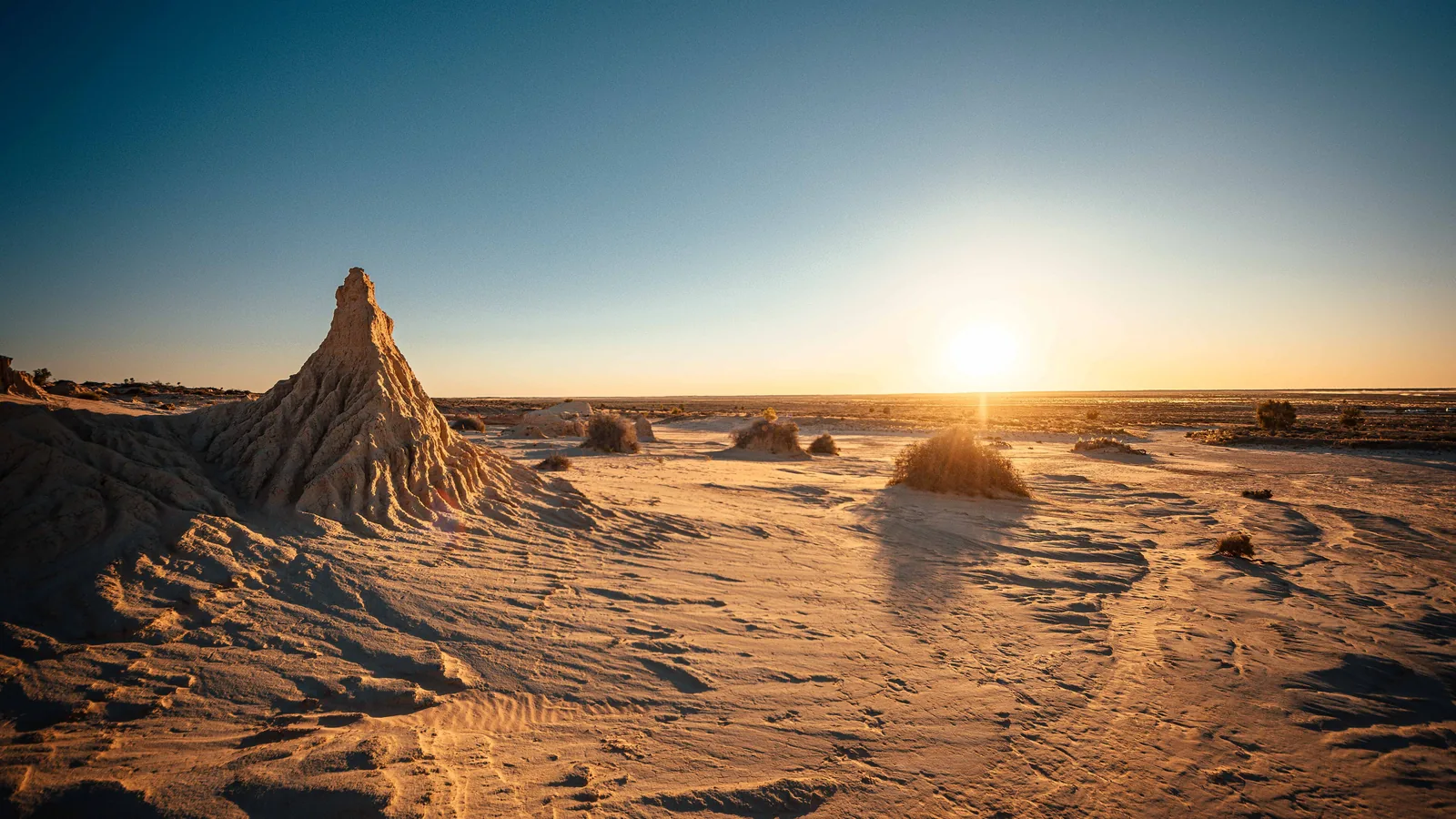

TL;DR — July 15, 1968: Jim Bowler found burnt bones in carbonate on the shore of Lake Mungo. Dated in 2003 to 40,000 years, Mungo Lady was reburied in 2022.
“Returning to camp in the late afternoon, an interesting block of soil carbonate lay exposed on an erosion surface. Nothing special in itself, but this contained a substantial concentration of burnt bones.” That is how the geologist Jim Bowler, writing in The Conversation in 2018, described what he found on the eroding shore of Lake Mungo in western New South Wales on July 15, 1968, a date from his field notes that “was incorrectly reported for a time as July 5.” The bones were the cremated remains of a young woman, later named Mungo Lady. On February 20, 2003, Bowler and six co-authors reported in Nature that “both burials occurred at 40 ± 2 kyr ago,” meaning her cremation and the ochre burial of Mungo Man nearby. Her remains went back to Traditional Owners in 1992, his in 2017, and both were reburied in 2022.
Quick facts
- When
- July 15, 1968 (burnt bones found) · March 1969 (excavation) · 1974 (Mungo Man removed, by Bowler's account) · 1999 (62,000 ± 6,000 years) · February 20, 2003 (40 ± 2 kyr) · 1992 and 2017 (returns) · April 6, 2022 (reburial announced)
- Where
- The eroding shore of Lake Mungo, one of the dry Willandra Lakes in western New South Wales, Australia; Mungo National Park, inside the Willandra Lakes Region World Heritage Area (1981)
- Who
- Jim Bowler (geologist, ANU); Rhys Jones and John Mulvaney (archaeologists); Alan Thorne (physical anthropologist); the Barkindji, Mutthi Mutthi and Ngyiampaa Traditional Owners; Sussan Ley (federal environment minister, 2022)
- Outcome
- Both burials dated to 40 ± 2 kyr by 25 optical ages (Nature, 2003); Mungo Lady returned in 1992, Mungo Man in 2017; 108 ancestors ordered reburied in 2022, with a court challenge continuing in 2025
A block of carbonate, October 1968 to March 1969
Bowler, then at the Australian National University, was studying the dune that rims Lake Mungo, one of the dry Willandra Lakes. His field notes recorded the burnt bones as a probable hearth. He marked the spot and in October 1968 showed photographs at an archaeological seminar at the ANU. It took until March 1969, by his account, to bring soil scientists and archaeologists out to the lake. There the archaeologist Rhys Jones broke away fragments of cemented bone and recognized part of a human cranium. The bones went to Canberra in John Mulvaney’s suitcase, and Alan Thorne, the ANU physical anthropologist, rebuilt the cranium as that of a fully modern young woman: Mungo I, later Mungo Lady. Radiocarbon estimates of the time placed the cremation, in the words of the 2003 Nature abstract, “near 20–26 kyr ago.”
Mungo Man, February 1974
Mungo Man, or Mungo III, came out of the same eroding shoreline in 1974, by Bowler’s own account (other accounts give 1973 or 1975), with Thorne uncovering the skeleton in February of that year. Bowler wrote in 2015 that the body had been laid out in a prepared grave and “anointed by ochre,” and that the raw hematite for the pigment “is unavailable there for several hundred kilometres.” The NSW National Parks and Wildlife Service describes the two as “found resting just meters apart.”
No one had asked Aboriginal people. When the discovery was announced, Bowler wrote, “Aboriginal people expressed anger that this should have been done without the permission of Aboriginal people.” His defense was that the wind would have destroyed the remains within a year. In 1989 a formal accord was signed at Lake Mungo between Aboriginal Elders and scientists. Bowler credited Mungo Lady with stirring women of the three tribal groups into asserting ownership, and named four: Alice Kelly, whom he called “the central pioneering elder,” with Alice Bugmy, Tibby Briar and Elsie Jones.
Two dates for one grave: 62,000 or 40,000 years
In 1999 Thorne and seven co-authors published a direct dating study of the Mungo Man skeleton in the Journal of Human Evolution. Combining uranium-series and electron spin resonance results, they gave “62,000±6000 years” as the best age estimate and concluded that the burial “documents the earliest known human presence on the Australian continent.”
Bowler’s answer came in Nature on February 20, 2003. He and his co-authors listed the earlier estimates for Mungo III, 30,000 years, 42,000 to 45,000 years and 62,000 ± 6,000 years, and then wrote: “Here we report a new series of 25 optical ages showing that both burials occurred at 40 ± 2 kyr ago and that humans were present at Lake Mungo by 50–46 kyr ago.” The optical ages came from the sand around the graves, not the bones. The abstract called Mungo III “the world’s oldest ritual ochre burial” and Mungo I “the first recorded cremation.” The NSW parks service puts the burials at “more than 42,000 years ago.”
Footprints in a dried soak
S. Webb, M. L. Cupper and R. Robins reported in the Journal of Human Evolution in 2006 fossil trackways of human footprints from the Willandra Lakes region, “optically dated to between 19-23 ka and consisting of at least 124 prints,” which they described as “the largest collection of Pleistocene human footprints in the world.” Adults, adolescents and children had crossed the moist surface of an ephemeral soak at the height of the last glacial period. The Willandra Lakes Region joined the World Heritage List in 1981. The older story of first arrival, from the far north, is in the article on Madjedbebe.
Returns: 1992, 2017 and the reburial of 2022
Thorne returned Mungo Lady’s remains to Traditional Owners in 1992. Their role in managing the park was formalized in 2001, when consultation identified three tribal groups, the Barkindji, Mutthi Mutthi and Ngyiampaa, who set up the Aboriginal Advisory Group in 2015. Mungo Man moved from the ANU to the National Museum of Australia in November 2015, and in 2017 an Aboriginal hearse carried his remains into a welcoming ceremony at Lake Mungo. In 2018 Bowler wrote that both lay in storage at the Lake Mungo visitor precinct, with “no monument, no place for respectful gratitude.”
On April 6, 2022, the federal environment minister, Sussan Ley, announced at Mungo National Park that Mungo Man, Mungo Lady and 106 other ancestors, 108 in all, removed from the Willandra Lakes between 1960 and 1980, would be reburied at 26 undisclosed locations in western New South Wales. Heritage NSW had recommended reburial after 162 public submissions, and the Aboriginal Advisory Group had chosen reburial in 2018; its chair, the Mutthi Mutthi elder Patsy Winch, said the government had listened to her people. “I am so angry, and we need it to stop,” said the Paakantyi elder Jennifer Jones, who told ABC News her tribe had been left out of the discussion. The Paakantyi man Michael Young and Jason Kelly, a Mutthi Mutthi man and former Willandra Lakes ranger, wanted a “keeping place” open to descendants and researchers.
ABC News reported on March 19, 2025, that Mungo Man and Mungo Lady had been reburied in 2022 without public notice. Kelly and others had sought an injunction, but before the case was heard they were told the remains were already buried. The reburial of the other 106 ancestors was underway in 2025, in ceremonies held by the three tribal groups, while Kelly’s Federal Court application against the environment minister, Tanya Plibersek, sought to halt it. The Barkindji man Ivan Johnson, of the advisory group, said it had been “50 years to bury our ancestors.” Michael Westaway of the University of Queensland called the reburials “destroying history”; Nicola Stern of La Trobe University said scientists “really need to respect the [traditional owners’] decision.”
Key facts
- Jim Bowler found the burnt bones on July 15, 1968, by his field notes; the site was excavated in March 1969 with Rhys Jones and John Mulvaney present.
- Alan Thorne reconstructed the cranium at the ANU as that of a fully modern young woman, recorded as Mungo I and known as Mungo Lady.
- Mungo Man, or Mungo III, was removed in 1974 by Bowler’s account, from a prepared grave in which the body had been covered with ochre.
- Thorne and co-authors gave Mungo Man a best age of 62,000 ± 6,000 years in 1999, from uranium-series and electron spin resonance dating of the skeleton.
- Bowler and co-authors reported 25 optical ages in Nature on February 20, 2003, showing “both burials occurred at 40 ± 2 kyr ago” and people at Lake Mungo by 50,000 to 46,000 years.
- Human footprint trackways in the Willandra Lakes were optically dated to 19,000 to 23,000 years and number at least 124 prints (Webb, Cupper and Robins, 2006).
- The Willandra Lakes Region joined the World Heritage List in 1981; the Barkindji, Mutthi Mutthi and Ngyiampaa were identified as the Traditional Owner groups in 2001 and formed the Aboriginal Advisory Group in 2015.
- Mungo Lady was returned in 1992 and Mungo Man in 2017; on April 6, 2022, Sussan Ley announced the reburial of 108 ancestors, and ABC News reported in 2025 that Mungo Man and Mungo Lady were reburied that year.
FAQ
How old are Mungo Lady and Mungo Man?
The 2003 Nature paper by Bowler and co-authors dated both burials to 40 ± 2 kyr, or about 40,000 years, from 25 optical ages on the sediment. A 1999 study by Thorne and co-authors had given Mungo Man 62,000 ± 6,000 years. The NSW parks service uses "more than 42,000 years ago."
Who found Mungo Lady?
Jim Bowler, a geologist from the Australian National University, found burnt bones cemented in carbonate on the shore of Lake Mungo on July 15, 1968. Rhys Jones recognized a human cranium among them in March 1969, and Alan Thorne reconstructed it in Canberra.
Where are the remains now?
Mungo Lady was returned to Traditional Owners in 1992 and Mungo Man in 2017. ABC News reported in March 2025 that both had been reburied in 2022 at undisclosed locations, and that the other 106 ancestors were being reburied in the Willandra Lakes region while a Federal Court case brought by Jason Kelly continued.
Sources
- The Conversation — Jim Bowler, "Time to honour a historical legend: 50 years since the discovery of Mungo Lady" (July 5, 2018).
- The Conversation — Jim Bowler, "Mungo Man moves to National Museum, but he's still not home" (November 3, 2015).
- James M. Bowler, Harvey Johnston, Jon M. Olley, John R. Prescott, Richard G. Roberts, Wilfred Shawcross and Nigel A. Spooner — "New ages for human occupation and climatic change at Lake Mungo, Australia," Nature 421 (February 20, 2003), abstract.
- A. Thorne, R. Grün, G. Mortimer, N. A. Spooner, J. J. Simpson, M. McCulloch, L. Taylor and D. Curnoe — "Australia's oldest human remains: age of the Lake Mungo 3 skeleton," Journal of Human Evolution 36 (1999), abstract on PubMed (PMID 10330330).
- S. Webb, M. L. Cupper and R. Robins — "Pleistocene human footprints from the Willandra Lakes, Southeastern Australia," Journal of Human Evolution 50 (2006), abstract on PubMed (PMID 16343597).
- NSW National Parks and Wildlife Service — "Mungo National Park," visitor page.
- NSW National Parks and Wildlife Service — "Mungo National Park joint management program."
- ABC News — Mollie Gorman and Richard Crabtree, "Mungo Man and Mungo Lady to be reburied in unmarked graves in landmark federal decision" (April 6, 2022).
- ABC News — Kirstie Wellauer and ABC Mildura staff, "The complex history of returning Mungo Man and Australia's oldest skeletons to country" (March 19, 2025).
- The Conversation — Michael Westaway and Arthur Durband, "Mungo Man returns home: there is still much he can teach us about ancient Australia" (November 14, 2017).
- The Conversation — Michael Westaway, Doug Williams and Jason Kelly, "Mungo ancestral remains reburial proposal disrespects the Elders' original vision" (August 4, 2021).
Cite this article
- APA
- Our Earth's History. (2026, September 22). July 15, 1968: Mungo Lady, a 40,000-year-old cremation on a dry lake. Our Earth's History. https://ourearthshistory.com/oceania/prehistory/lake-mungo-mungo-lady-1968-cremation-40000-years/
- Chicago
- Our Earth's History. “July 15, 1968: Mungo Lady, a 40,000-year-old cremation on a dry lake.” Our Earth's History, September 22, 2026. https://ourearthshistory.com/oceania/prehistory/lake-mungo-mungo-lady-1968-cremation-40000-years/.
- MLA
- “July 15, 1968: Mungo Lady, a 40,000-year-old cremation on a dry lake.” Our Earth's History, 22 Sep. 2026, https://ourearthshistory.com/oceania/prehistory/lake-mungo-mungo-lady-1968-cremation-40000-years/.
Text licensed CC BY-NC-ND 4.0. Found an error? Tell us.