Reeds, lime plaster and bitumen: the statues buried at 'Ain Ghazal

TL;DR — Two pits of reed-and-plaster statues, made about 6750 to 6500 BC, lay under abandoned houses at ‘Ain Ghazal in Jordan until excavators lifted them in 1983 and 1985.
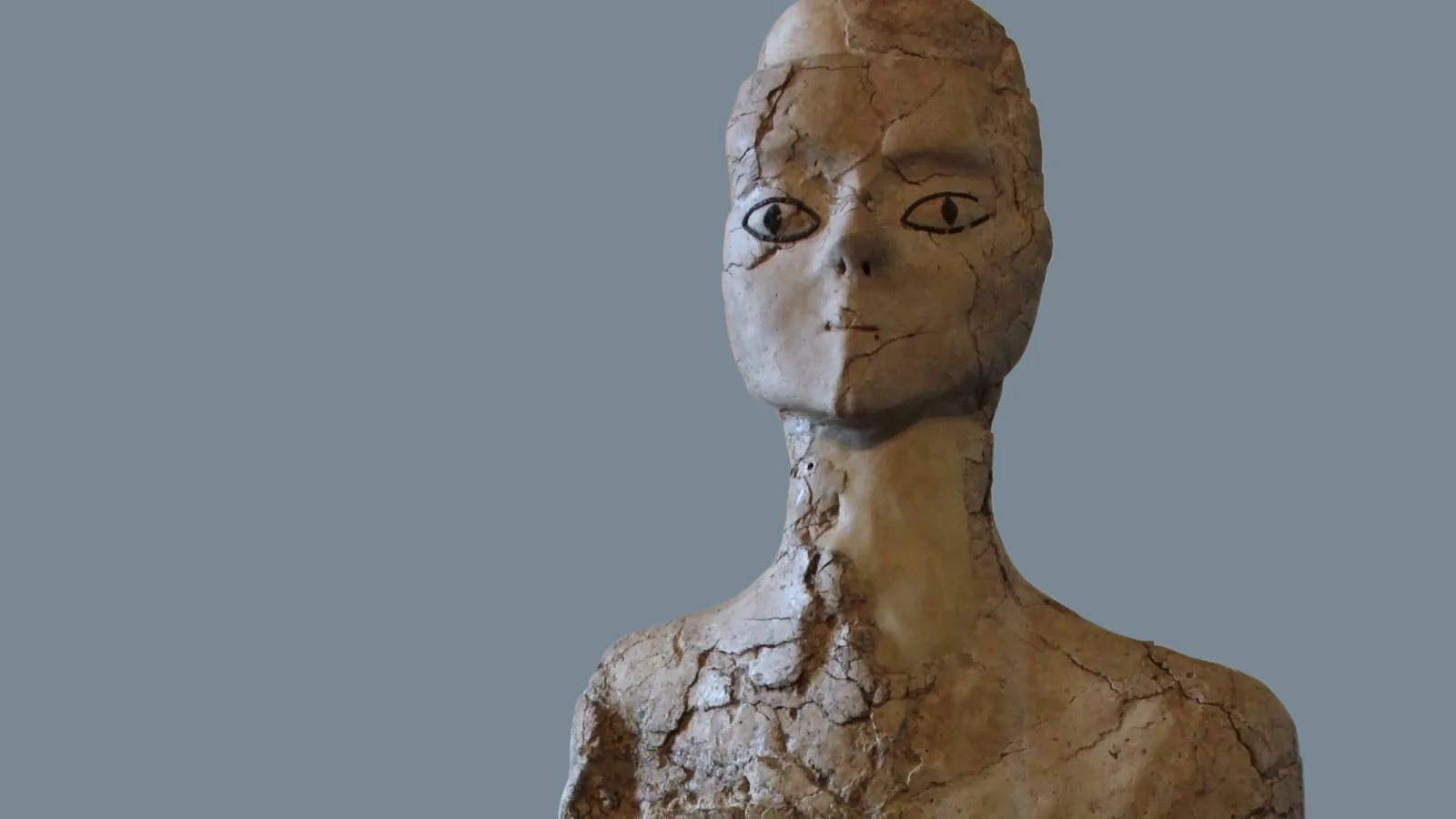
In 1983 an American-Jordanian team at ‘Ain Ghazal, on the northeastern outskirts of Amman, excavated a pit packed with plaster statues and busts; in 1985 it found a second pit with seven more. Denise Schmandt-Besserat of the University of Texas at Austin dates the first cache to 6750 BC, plus or minus 80 years, and the second to about 6570 BC, plus or minus 110 years, both in uncalibrated radiocarbon years. The figures were built on bundles of reeds tied with twine, coated in lime plaster and given eyes ringed with black bitumen. The first cache went to London for conservation; the second spent seven years at the Smithsonian Institution.
Quick facts
- When
- Cache 1 dated 6750 BC, plus or minus 80 years, and Cache 2 about 6570 BC, plus or minus 110 years (uncalibrated radiocarbon, Schmandt-Besserat); caches excavated 1983 and 1985; site dug 1982 to 1998; Sackler Gallery exhibition July 28, 1996, to April 6, 1997
- Where
- 'Ain Ghazal, on the northeastern outskirts of Amman, Jordan, along the Zarqa River
- Who
- An American-Jordanian team directed by Gary O. Rollefson (Whitman College) and Zeidan Kafafi (Yarmouk University); conservator Carol Grissom (Smithsonian Conservation Analytical Laboratory); Denise Schmandt-Besserat (University of Texas at Austin)
- Outcome
- The first cache went to the University of London's Institute of Archaeology with British Museum funding; the second was conserved at the Smithsonian, shown at the Arthur M. Sackler Gallery and returned to Jordan for display on the Citadel in Amman
1983 and 1985: two pits under abandoned houses
Gary O. Rollefson of Whitman College and Zeidan Kafafi of Yarmouk University directed the digging from 1982 to 1998. After the first two seasons Rollefson described a settlement of 9.5 to 10 hectares on the western bank of the Zarqa River, with a smaller ward of 1.0 to 1.5 hectares across the water, and wrote that only Tell Abu Hureyra in northern Syria exceeded it in size. Schmandt-Besserat’s summary of the excavation gives a first settlement about 7250 BC and abandonment about 5000 BC. In 1992 the privately owned land faced sale for development, Rollefson later wrote, and salvage seasons followed from 1993 to 1996.
Schmandt-Besserat writes that the statues “were carefully laid in a pit visibly dug for the sole purpose of their disposal,” beneath the floors of houses that had long been abandoned. Most lay east to west; the busts of the first cache were placed crosswise below the full figures.
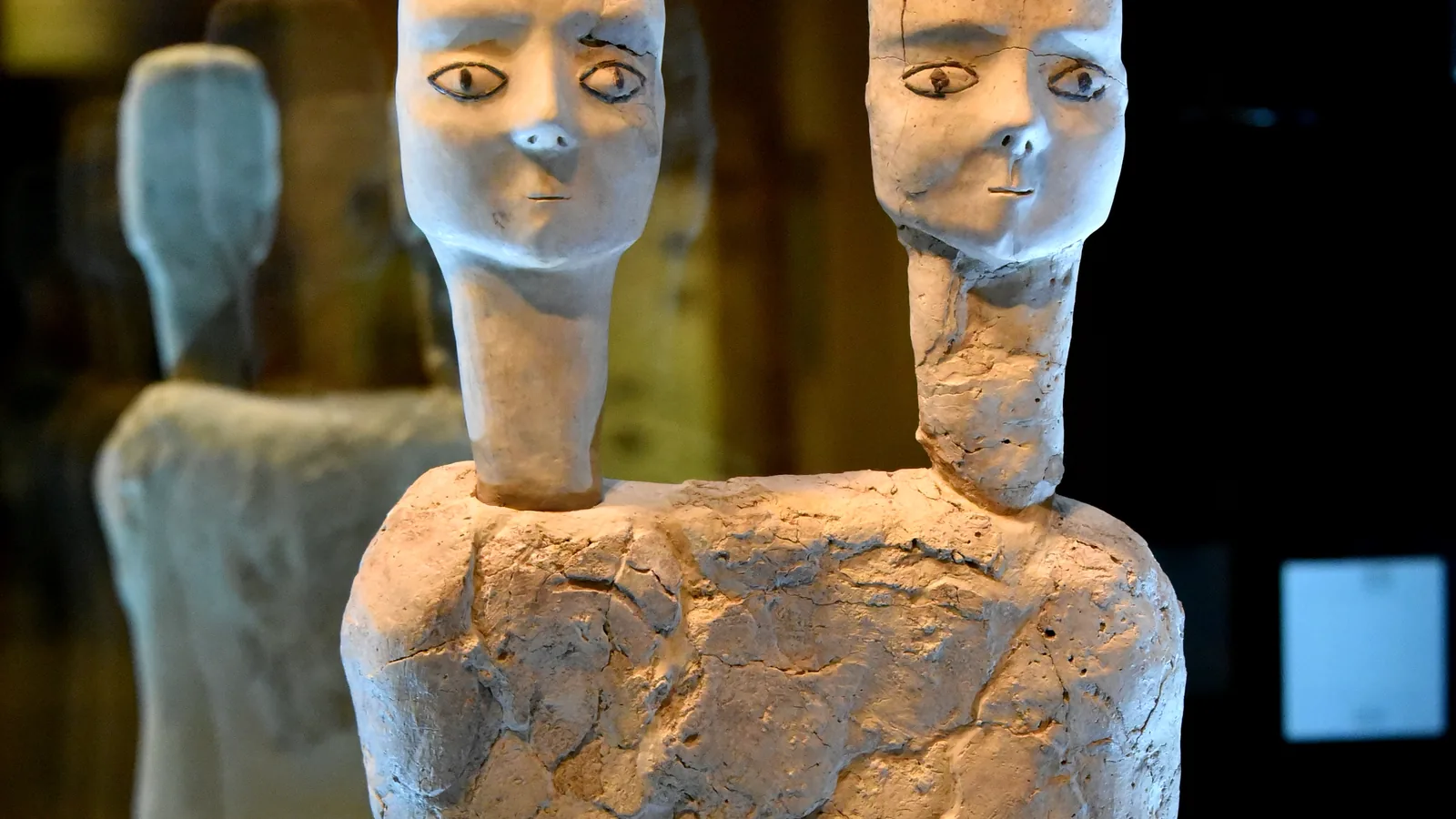
The count for the first cache differs by one. Schmandt-Besserat, citing the conservators, lists 25 pieces: 13 full-size statues and 12 busts with a single head. A 1998 paper in the journal Paléorient by Patricia S. Griffin, Carol A. Grissom and Rollefson states that the deposit was “believed to contain 26 statues fairly equally divided between full figures and busts.” The second cache held two full statues, three busts with two heads each and two fragmentary heads. It had also suffered damage: Schmandt-Besserat notes that it “was severely damaged by bulldozers and might originally have held more pieces.”
The minutes of a talk Grissom gave to the Philosophical Society of Washington on November 1, 1996, record that bulldozing for a new road uncovered artifacts at ‘Ain Ghazal in 1974. The excavation reports give 1983 and 1985 for the two caches.
Reed bundles, twine and a coat of fresh plaster
In Schmandt-Besserat’s description, the “head(s), torso, and legs were built around separate reed bundles bound with twine and covered with a thick layer of fresh plaster,” and the parts were then joined and modeled again at the seams. The reeds rotted away and left only their impressions, but according to the minutes of Grissom’s talk those were enough for a microscope to identify a reed species that still grows near the site.
The same record describes the plaster as roughly one part lime to 9 parts local marl. The lime came from local limestone, recognized by its fossil green algae, burned at more than 600°C; the house walls carried the same plaster. The statues had eyes outlined in black bitumen and traces of red iron oxide pigment, and a mark around the crown of the heads suggested to Grissom that the figures may once have been dressed.
The figures stand 35 to 100 centimeters high but only 5 to 10 centimeters thick, “almost two dimensional,” in Schmandt-Besserat’s words. She describes each eyeball as bulging slightly inside “a deep, oval ridge filled with black bitumen.”
One statue was already badly damaged when it went into the ground. Grissom took this, according to the minutes, as a sign that the figures were relatively old when buried and were not made for burial.
Kenyon, Garstang and the magazine Archaeology: three readings
Schmandt-Besserat sorts the explanations into three. The first, that the statues portrayed venerated ancestors, she credits to Kathleen Kenyon, who excavated similar plaster fragments at Jericho and wrote in 1957; Schmandt-Besserat adds that the ancestor idea “is visibly running out of steam,” citing a 2004 work by Mithen. The second came from the magazine Archaeology, which called the ‘Ain Ghazal figures ghosts. She notes that Babylonian texts on figures used in rituals against ghosts describe small clay figurines, not large statues on reed frames.
The third reading goes back to Garstang, who excavated at Jericho in 1935 and proposed that each of two sets of three figures he found there was a divine triad. The ‘Ain Ghazal caches, with 25 and seven pieces, do not fit that pattern, Schmandt-Besserat writes, but she argues that the two-headed busts and the female figures holding their breasts have parallels in later Near Eastern images of gods, and that these features “make the balance tip in favor of the pantheon theory.” In the same chapter she concludes that whether the statues stood for deities, ancestors or ghosts “is, in fact, almost inconsequential,” and places their importance in their size, which let a whole community see them at once.

"A seven-year process" at the Smithsonian
The Smithsonian’s Museum Conservation Institute records that, because the lime plaster was so fragile, the entire contents of the 1985 pit were wrapped in aluminum foil and polyurethane foam, packed in a wooden crate and sent to the Smithsonian “for a seven-year process of laboratory excavation and conservation treatment.” The block went to the Conservation Analytical Laboratory in Suitland, Maryland, where Grissom worked as senior objects conservator.
The 1983 cache followed a different route. It went to the University of London’s Institute of Archaeology, where the 1998 Paléorient paper describes the work as ongoing and underwritten by the British Museum; Schmandt-Besserat reports three statues and four busts from that cache restored. According to the same paper, treatment of the 1985 cache was completed in 1996, with two figures and three two-headed busts reassembled.
Filming was done on five occasions between 1990 and 1996. On the institute’s account, the statues were then exhibited at the Arthur M. Sackler Gallery and returned to Jordan for display at the Jordanian Archaeological Museum on the Citadel in Amman. The Sackler exhibition, Preserving Ancient Statues from Jordan, opened on July 28, 1996, and closed on April 6, 1997.
Key facts
- ‘Ain Ghazal, near Amman, was excavated from 1982 to 1998 by a team directed by Gary O. Rollefson and Zeidan Kafafi (University of Texas at Austin, Schmandt-Besserat site).
- The first cache of statues was excavated in 1983 and the second in 1985; Schmandt-Besserat dates them to 6750 BC and about 6570 BC in uncalibrated radiocarbon years.
- Schmandt-Besserat counts 25 pieces in the 1983 cache; Griffin, Grissom and Rollefson (Paléorient, 1998) give an estimate of 26.
- The figures were built on reed bundles bound with twine and covered with lime plaster; their eyes were outlined with black bitumen.
- The 1985 cache was shipped in a crate to the Smithsonian for seven years of laboratory excavation and conservation, completed in 1996 (Museum Conservation Institute; Paléorient, 1998).
- The statues were shown at the Arthur M. Sackler Gallery from July 28, 1996, to April 6, 1997, and then returned to Jordan (Museum Conservation Institute).
FAQ
What are the 'Ain Ghazal statues made of?
Lime plaster over bundles of reeds tied with twine. The minutes of Carol Grissom's 1996 talk describe a plaster of about one part lime to 9 parts local marl, with eyes outlined in black bitumen and traces of red iron oxide.
How many 'Ain Ghazal statues were found?
Denise Schmandt-Besserat gives 25 pieces for the 1983 cache and seven for the 1985 cache, 32 in all. A 1998 Paléorient paper estimates the 1983 cache at 26.
What did the 'Ain Ghazal statues represent?
No reading is agreed. Kathleen Kenyon proposed ancestors, the magazine Archaeology called them ghosts, and Garstang proposed gods; Schmandt-Besserat leans toward gods but considers the question less important than their size.
Sources
- Smithsonian Institution, Museum Conservation Institute, "'Ain Ghazal Statues."
- Philosophical Society of Washington (PSW Science), minutes of the 2,064th meeting, November 1, 1996: Carol Grissom, "Preserving Ancient Statues from 'Ain Ghazal, Jordan," recorded by John S. Garavelli.
- Denise Schmandt-Besserat, "'Ain Ghazal 'Monumental' Figures: A Stylistic Analysis," chapter 7.3 in Symbols at 'Ain Ghazal (Ex Oriente, Berlin, 2013), PDF on the author's University of Texas at Austin site.
- Patricia S. Griffin, Carol A. Grissom and G. O. Rollefson, "Three late eighth millennium plastered faces from 'Ain Ghazal, Jordan," Paléorient 24/1 (1998), 59-70, first page and notes, via Persée.
- Denise Schmandt-Besserat, University of Texas at Austin faculty site, "'Ain Ghazal" (excavation summary and chapter abstracts).
- G. O. Rollefson, "Ritual and Ceremony at Neolithic Ain Ghazal (Jordan)," Paléorient 9/2 (1983), 29-38, first page, via Persée.
- G. O. Rollefson, "'Ain Ghazal (Jordan): ritual and ceremony III," Paléorient 24/1 (1998), 43-58, first page, via Persée.
Cite this article
- APA
- LETTER. (2026, September 28). Reeds, lime plaster and bitumen: the statues buried at 'Ain Ghazal. Our Earth's History. https://ourearthshistory.com/west-asia/prehistory/ain-ghazal-plaster-statues-reeds-bitumen/
- Chicago
- LETTER. “Reeds, lime plaster and bitumen: the statues buried at 'Ain Ghazal.” Our Earth's History, September 28, 2026. https://ourearthshistory.com/west-asia/prehistory/ain-ghazal-plaster-statues-reeds-bitumen/.
- MLA
- LETTER. “Reeds, lime plaster and bitumen: the statues buried at 'Ain Ghazal.” Our Earth's History, 28 Sep. 2026, https://ourearthshistory.com/west-asia/prehistory/ain-ghazal-plaster-statues-reeds-bitumen/.
Text licensed CC BY-NC-ND 4.0. Found an error? Tell us.