A cut feature beside the flower burial: Shanidar Cave, 1960 and 2020

TL;DR — Solecki’s 1951 to 1960 trench at Shanidar Cave held 10 Neanderthals; in 2020 a Cambridge team reported an adult buried in a pit beside Shanidar 4, the “flower burial.”
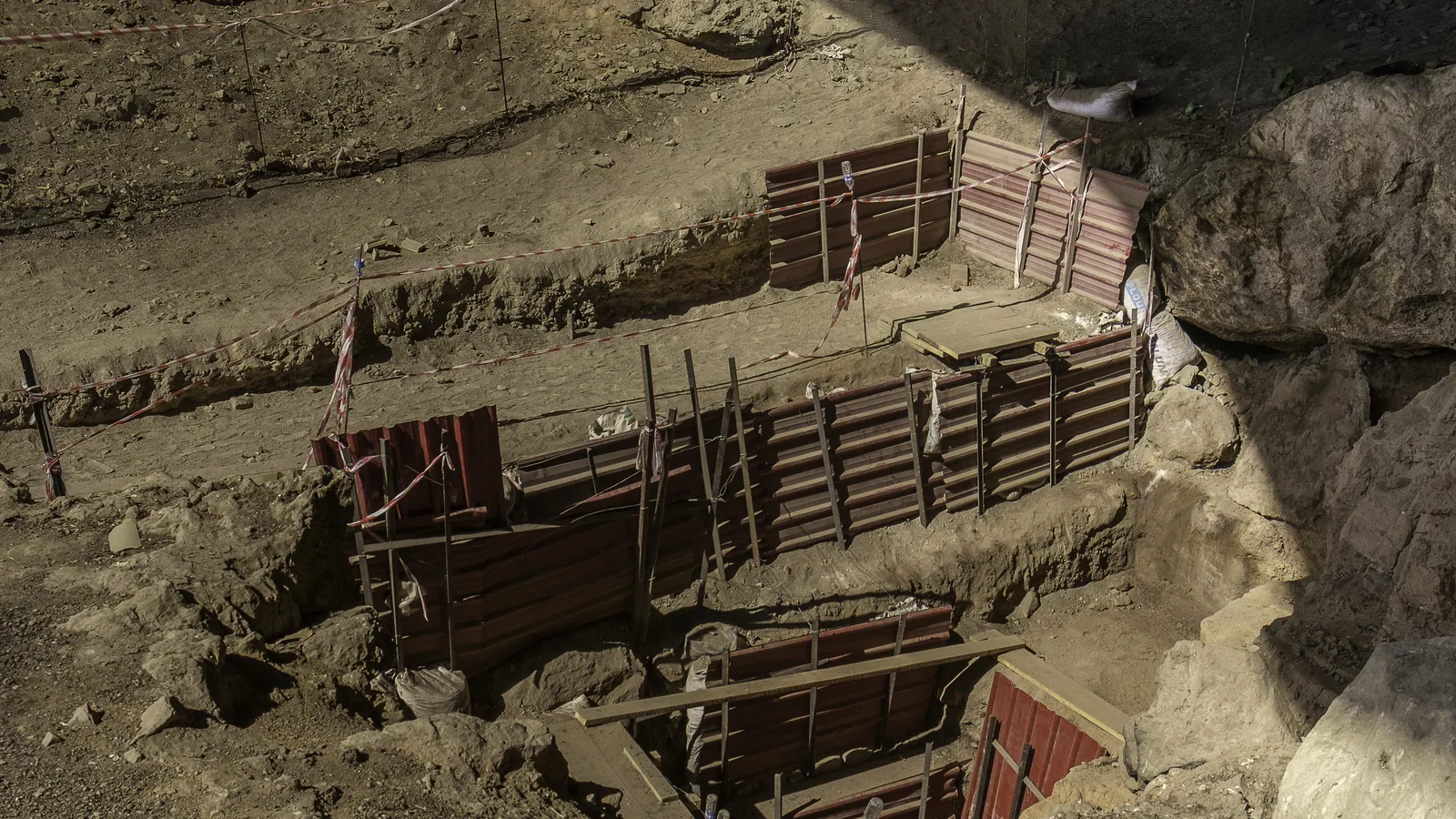
“Between 1951 and 1960, Ralph Solecki dug an approximately 20 × 6m trench, oriented roughly north–south, in the centre of the cave floor. At its deepest point, the trench reached 14m below the ground surface.” So begins the account of the older excavation in a 2020 paper in Antiquity by Emma Pomeroy of the University of Cambridge and nine co-authors. There, “at a depth of 4–7m,” Solecki found “the skeletal remains of 10 Neanderthal men, women and children.” He argued that some had been killed by rocks falling from the cave roof and that others had been buried with formal rites, among them Shanidar 4, whose pollen became the “flower burial.” Between 2015 and 2019 a new team dug into the wall of Solecki’s trench and found another adult, laid in a pit cut into the cave floor just east of the Shanidar 4 spot.
Quick facts
- When
- 1951 to 1960 (Solecki's trench) · 1957 (Shanidar 1 found) · 1960 (Shanidar 4 block removed) · 1962 (block dismantled in the Baghdad Museum) · 1975 (pollen interpretation published) · 1999 (the hypothesis questioned) · 2015 (new excavations begin) · 2017 to 2019 (new remains exposed and recorded) · 2020 (report in Antiquity)
- Where
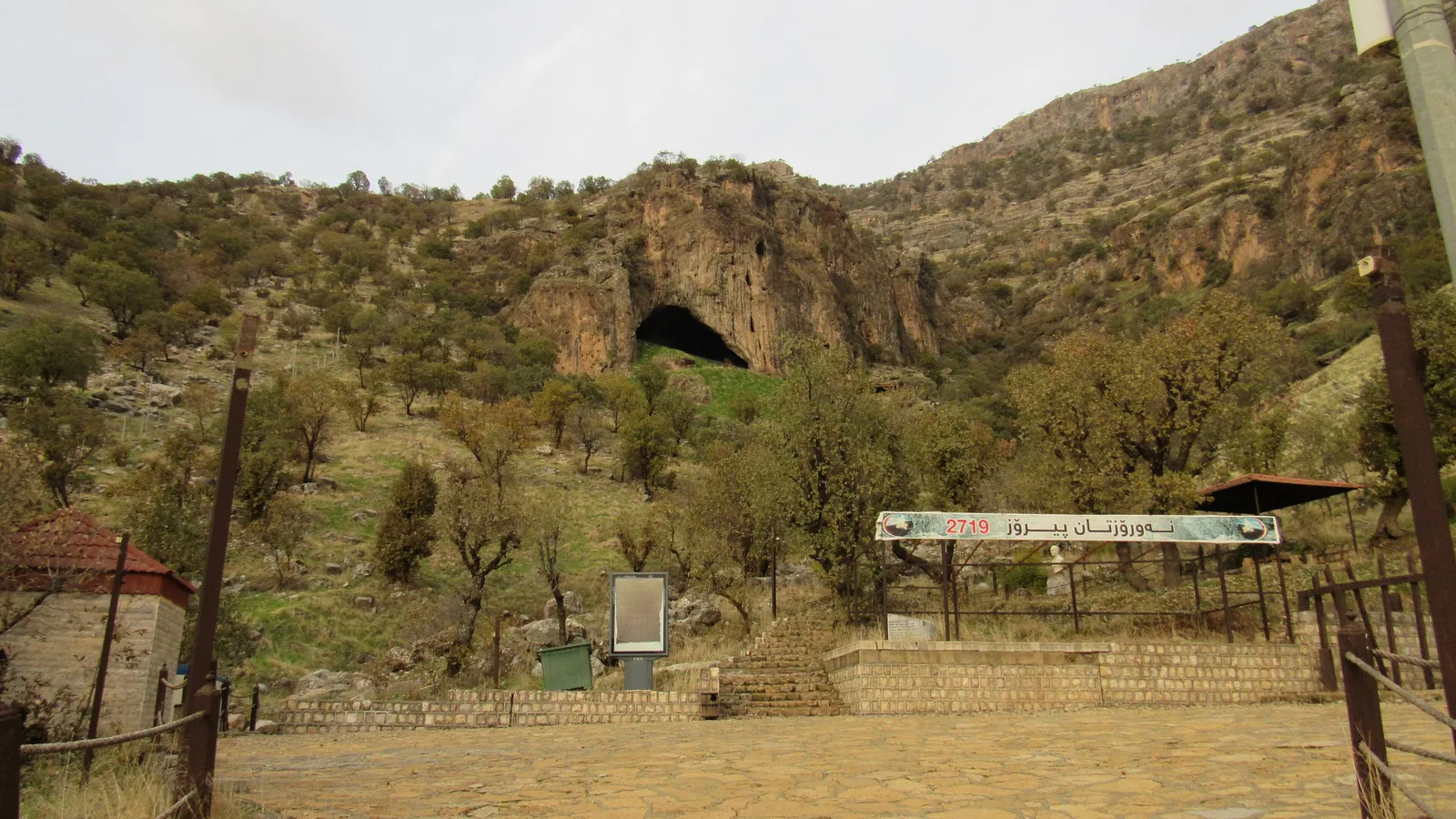
- Shanidar Cave, a south-facing cave about 750 meters above sea level in the foothills of the Baradost Mountains, in what is now Iraqi Kurdistan; the Baghdad Museum
- Who
- Ralph Solecki; T. Dale Stewart; Arlette Leroi-Gourhan; Richard H. Gargett; Jeffrey D. Sommer; Graeme Barker; Emma Pomeroy and the Cambridge-led team; the Kurdistan Regional Government
- Outcome
- Solecki's ten Neanderthals included Shanidar 1, who lived on after a crushing head injury and was deaf in the right ear, and Shanidar 4, the "flower burial." The new team found an articulated adult just east of the Shanidar 4 spot, in what its 2020 report called "a strong case for deliberate burial in a cut feature," with a preliminary date of 70,000 to 60,000 years ago
Ten Neanderthals at four to seven meters
Shanidar Cave opens to the south about 750 meters above sea level in the foothills of the Baradost Mountains, in the northeast of what is now Iraqi Kurdistan. The 2015 report in Antiquity’s Project Gallery gives its position as 36º50’ N, 44º13’ E. The 2020 paper also summarizes work by S.E. Churchill and colleagues in 2009 on Shanidar 3, whose rib carried a puncture wound that “suggests interpersonal violence.”
Shanidar 1, blind in one eye and deaf in the right ear
The individual Solecki found in 1957 and nicknamed “Nandy” is Shanidar 1. The Smithsonian Institution’s Human Origins Program describes a crushing blow to the head in youth that damaged the left eye and the brain area governing the right side of the body, “leading to a withered right arm and possible paralysis that also crippled his right leg.” All the injuries had healed, so none killed him, and the Smithsonian concludes that “he would probably not have been able to survive without the care of his social group.”
In 2017 Erik Trinkaus and Sébastien Villotte added his ears. Both ear canals carried bony growths, and on the right they ran together until they almost closed the canal. “He would therefore have been effectively deaf in his right ear,” they wrote in PLOS ONE, with at least partial conductive hearing loss on the left. Their summary of the rest of the skeleton lists the withered right shoulder and arm, “most likely amputated above the elbow,” a depressed fracture of the left eye socket and injuries to the right knee and foot.
A block on a taxi roof, 1960
Shanidar 4 was not lifted bone by bone. In 1960 the excavators cut out the sediment holding the skeleton as a block about one square meter in area and half a meter deep, cased it in wood and plaster and sent it to the Baghdad Museum to be dug out indoors. It was damaged on the way; the 2020 paper quotes T. Dale Stewart’s 1977 account of its ride “on a taxi roof!” When the museum dismantled it in 1962, it held at least three adults, Shanidar 4, 6 and 8, together with the vertebrae of an infant, Shanidar 9. Because the block had shifted in transit, the paper states, “the precise stratigraphic relationships between the individuals are unknown.”
The flowers came from the dirt around the bones. Clumps of pollen grains in the adjacent sediment “were interpreted as evidence for the intentional placement of flowers with the corpse,” a reading published in 1975 by the palynologist Arlette Leroi-Gourhan and by Solecki himself. The hypothesis, in the 2020 paper’s words, “was subsequently questioned (Gargett 1999; Sommer 1999).” Jeffrey D. Sommer’s alternative, as a 2020 review paper in Revista Brasileira de Farmacognosia summarizes it, was that the pollen “could be due to rodent activity.”
Questioned in 1999, dug again from 2015
The Kurdistan Regional Government asked for new work. The Project Gallery report says the government approached Graeme Barker in 2011; the 2020 paper dates the invitation to 2014. The threat from ISIS delayed fieldwork, and excavation began in 2015 under a project the University of Cambridge’s Department of Archaeology lists as “A reassessment of Neanderthal mortuary behaviour at Shanidar Cave, Iraqi Kurdistan.” In 2015 and 2016 the team recovered articulated leg bones about five meters down that it matched, through archive photographs, to Shanidar 5.
In 2017, in the east face of Solecki’s deep sounding about seven meters below the surface, the diggers exposed cut rib ends, a lumbar neural arch and the bones of a clenched right hand. They lay at almost the same level as, and just east of, the Shanidar 4 spot, and the backfill beside them held a white powder that looked like plaster from the 1960 block. The 2018 season uncovered a skull crushed nearly flat, lying on its left side and facing south, with the left hand beneath it. The right shoulder sat against a triangular stone, the same stone visible behind Stewart’s hand in a 1960 photograph of Shanidar 4. “The individual was probably placed on their back, with the shoulders and head raised, and the head resting on its left side on top of the left hand,” the paper states, a posture that “contrasts with that of Shanidar 4, which was placed in a foetal position on its left side.”
The case for a grave rests on the soil. Thin sections showed two rib fragments resting on an “abrupt truncation contact” between two kinds of sediment, and the deposit above had none of the sorting or layering that water or slope wash would leave, which the authors read as “a singular, rapid-deposition event.” A cut feature is a hole dug into existing ground and then filled, and they wrote that the evidence made “a strong case for deliberate burial in a cut feature.” The layer held no fallen rock, and the bones were complete and still joined. The paper called its luminescence indication of “between 70 000 and 60 000 years ago” preliminary.

September 2019, one individual
In the field the bones had at first looked like two people, and further excavation “conducted during September 2019” led the authors to determine “that all of the hominin remains in the section wall described herein belong to a single individual.” Solecki did not see that result in print. The appendix to the 2020 paper records that he died in March 2019 at the age of 101, after a Columbia University doctorate and a Columbia professorship from 1958 to 1988; his wife Rose Solecki had excavated the nearby Neolithic site of Zawi Chemi Shanidar. Whether flowers went into the new pit was a question the 2020 paper left open: analysis of plant remains and pollen from the fill was, it reported, “underway.”
Key facts
- Ralph Solecki dug a trench about 20 by 6 meters and up to 14 meters deep in the center of Shanidar Cave between 1951 and 1960 (Pomeroy et al., Antiquity 2020).
- The trench produced 10 Neanderthals at a depth of 4 to 7 meters; Solecki read some as rockfall victims and others as formal burials (Antiquity 2020).
- The cave lies about 750 meters above sea level in the Baradost Mountains at 36º50’ N, 44º13’ E (Antiquity Project Gallery 2015).
- Shanidar 1, found in 1957, survived a crushing head blow, a withered right arm and a crippled right leg (Smithsonian Human Origins Program).
- Trinkaus and Villotte found bony growths in both of Shanidar 1’s ear canals and concluded he was “effectively deaf in his right ear” (PLOS ONE 2017).
- Shanidar 4 was removed in 1960 as a block about one square meter and half a meter deep; dismantled in the Baghdad Museum in 1962, it held Shanidar 4, 6, 8 and the infant Shanidar 9 (Antiquity 2020).
- Pollen clumps beside Shanidar 4 were read as placed flowers by Leroi-Gourhan and Solecki in 1975; the reading “was subsequently questioned” by Gargett and Sommer in 1999 (Antiquity 2020).
- Between 2017 and 2019 the new team recorded an articulated adult just east of the Shanidar 4 spot, resting on an “abrupt truncation contact,” with a preliminary date of 70,000 to 60,000 years ago; in September 2019 it was determined to be a single individual (Antiquity 2020).
FAQ
What is the Shanidar "flower burial"?
Shanidar 4, a Neanderthal skeleton removed from Shanidar Cave in 1960 inside a block of sediment. Clumps of pollen in the surrounding dirt were interpreted in 1975, by Arlette Leroi-Gourhan and by Ralph Solecki, as flowers placed with the body. Gargett and Sommer questioned that reading in 1999.
What injuries did Shanidar 1 have?
A crushing blow to the head at a young age, damage to the left eye, a withered right arm, a crippled right leg and a healed fracture in the right foot, all healed before death, according to the Smithsonian. Trinkaus and Villotte reported in 2017 that bony growths had all but closed his right ear canal.
What did the 2020 Antiquity paper find at Shanidar Cave?
An articulated adult Neanderthal lying just east of the spot where Shanidar 4 had been, on a sharp erosion surface that the authors read as the base of a dug pit. They called it "a strong case for deliberate burial in a cut feature" and gave a preliminary date of 70,000 to 60,000 years ago.
Sources
- Emma Pomeroy, Paul Bennett, Chris O. Hunt, Tim Reynolds, Lucy Farr, Marine Frouin, James Holman, Ross Lane, Charles French and Graeme Barker, "New Neanderthal remains associated with the 'flower burial' at Shanidar Cave," Antiquity 94, no. 373 (2020): 11–26, open access (CC BY 4.0), with the appendix on Ralph Solecki.
- Tim Reynolds, William Boismier, Lucy Farr, Chris Hunt, Dlshad Abdulmutalb and Graeme Barker, "New investigations at Shanidar Cave, Iraqi Kurdistan," Antiquity Project Gallery 89, no. 348 (2015).
- Smithsonian Institution, Human Origins Program, "Shanidar 1" (fossil record page: nickname, discovery year, injuries).
- Erik Trinkaus and Sébastien Villotte, "External auditory exostoses and hearing loss in the Shanidar 1 Neandertal," PLOS ONE 12, no. 10 (2017): e0186684, PMC5650169.
- "Paleomedicine and the Evolutionary Context of Medicinal Plant Use," Revista Brasileira de Farmacognosia (2020), PMC7546135 (the paragraph summarizing Sommer 1999 on rodent activity).
- University of Cambridge, Department of Archaeology, research project page "A reassessment of Neanderthal mortuary behaviour at Shanidar Cave, Iraqi Kurdistan."
Cite this article
- APA
- Our Earth's History. (2026, September 22). A cut feature beside the flower burial: Shanidar Cave, 1960 and 2020. Our Earth's History. https://ourearthshistory.com/west-asia/prehistory/shanidar-cave-neanderthal-burials-solecki-2020-antiquity/
- Chicago
- Our Earth's History. “A cut feature beside the flower burial: Shanidar Cave, 1960 and 2020.” Our Earth's History, September 22, 2026. https://ourearthshistory.com/west-asia/prehistory/shanidar-cave-neanderthal-burials-solecki-2020-antiquity/.
- MLA
- “A cut feature beside the flower burial: Shanidar Cave, 1960 and 2020.” Our Earth's History, 22 Sep. 2026, https://ourearthshistory.com/west-asia/prehistory/shanidar-cave-neanderthal-burials-solecki-2020-antiquity/.
Text licensed CC BY-NC-ND 4.0. Found an error? Tell us.