Why can't anyone read the Indus script?
TL;DR — The texts are too short, no bilingual text exists, and no one knows what language they encoded. Some linguists doubt that the signs encode language at all.
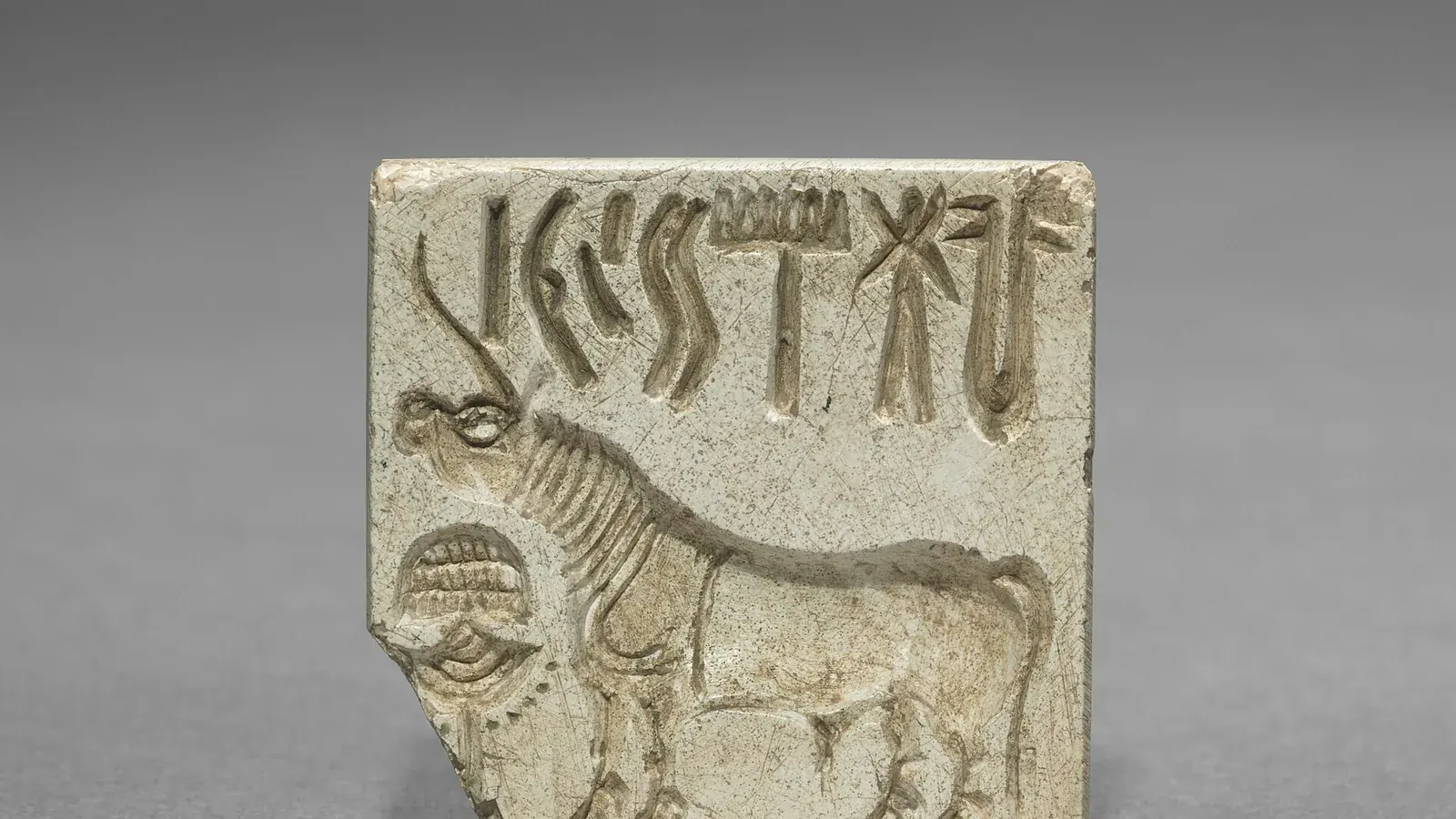
No one can read the Indus script because the surviving texts are short, no bilingual text has been found, and the language behind the signs is unknown. The signs were cut into stamp seals and other small objects in the cities of the Indus valley, in what is now Pakistan and northwest India, between about 2600 and 1900 BC. About 4,000 inscriptions are known, and the average one holds five signs. Since the first seal came to light in the 1870s, more than a hundred decipherments have appeared in print, and none has convinced the field. Since 2004 the field has also argued over whether the signs encoded speech at all.
Quick facts
- When
- About 2600–1900 BC (urban period) · first seal found 1872–73 · 2004–10 script debate · January 27, 2025 prize
- Where
- Indus valley cities such as Harappa, Mohenjo-daro and Dholavira, in what is now Pakistan and northwest India
- Who
- Iravatham Mahadevan and Asko Parpola (Dravidian readings); Farmer, Sproat and Witzel (not a script); Rajesh Rao and Nisha Yadav (statistics)
- Outcome
- About 4,000 short inscriptions, no bilingual text, no accepted decipherment; a $1 million prize offered by Tamil Nadu in 2025
What the inscriptions look like
Most Indus texts sit on square stamp seals cut from steatite, about an inch (2.5 centimeters) on a side. A line of signs runs along the top, and an animal fills the field below, most often the one-horned creature that excavators called the unicorn. Signs also appear on pottery, copper tablets, bangles and ivory, and on a three-meter board found in the ruins of Dholavira. Cristian Violatti’s 2015 survey for World History Encyclopedia counts finds from about 60 sites. The writing generally ran from right to left, a direction inferred from pottery on which one sign overwrites the one to its left.
Three obstacles: short texts, no bilingual, unknown language
Egyptian hieroglyphs opened because the Rosetta Stone carried the same decree in Greek; no such object exists for the Indus signs. Iravatham Mahadevan of the Indus Research Centre in Chennai, who compiled the standard concordance of the texts in 1977, wrote that no bilingual inscription had come to light.
The second obstacle is length. Rajesh P. N. Rao of the University of Washington and his co-authors put the average text at five signs and the longest on a single surface at 17. World History Encyclopedia gives 26 signs as the maximum and Archaeology News gives 34; neither says how it counted. Short texts starve pattern analysis, which looks for the same sign string in different settings.
The third obstacle is the language. The Finnish Indologist Asko Parpola, Mahadevan and, in the 1960s, a Soviet team under Yuri Knorozov argued for an early form of Dravidian, the family that includes Tamil. Others have proposed early Indo-Aryan, Sumerian or a lost language. Without an anchor any reading can be made to fit, which is how, by Farmer’s count, more than a hundred decipherments reached print since 1877.
How many signs there are
Even the sign count is disputed. Mahadevan’s 1977 concordance lists 417 distinct signs, Parpola’s 1994 list has 398 signs and 1,839 variants, and a 1999 catalog cited by Farmer’s group, which splits variants more finely, exceeds 600. A count near 400 is too many for an alphabet and too few for a Chinese-style set of word signs, which is why Parpola read the system as logosyllabic, part word signs and part syllables. Nisha Yadav of the Tata Institute of Fundamental Research in Mumbai found that 67 signs account for about 80 percent of the written script.
The argument that it is not a script
In 2004 Steve Farmer, an independent researcher, Richard Sproat, a linguist, and Michael Witzel, a Sanskrit scholar at Harvard, published “The Collapse of the Indus-Script Thesis” in the Electronic Journal of Vedic Studies. Their case rested on absence. Every civilization known to have written on perishable materials, they wrote, also left long texts on pots, walls or stone; the Indus left none, and John Marshall’s suggestion in the late 1920s that its books had rotted away had no support. High-frequency signs rarely repeated inside a single text, as they should if signs stood for sounds. The signs, they wrote, were closer to the emblem systems of Near Eastern religion and politics than to writing.
The reply came in Science in 2009. Rao, with Yadav, Mahadevan and others, measured the conditional entropy of the sign sequences, a statistic of how predictable the next sign is given the last one, and found that the Indus texts fell in the range of natural languages. Sproat answered in Computational Linguistics in 2010 that the test was useless. Rao’s group answered him in the same journal with seven language-like traits, among them a fixed direction, ligatures and positional grammar, and stated the limit of their method: barring a full decipherment, they wrote, neither thesis can be proved.
What people have tried, including the 2025 prize
Knorozov’s group and Parpola’s both claimed in the late 1960s that computer analysis of sign positions proved a Dravidian language. Parpola later described those early reports as “premature and incautious,” and in 1994 he published Deciphering the Indus Script, which offers readings of selected signs, the fish sign among them, as Dravidian words.
On January 27, 2025, M. K. Stalin, chief minister of the Indian state of Tamil Nadu, announced a prize of $1 million for anyone who deciphered the script “to the satisfaction of archaeological experts.” The announcement followed a study by K. Rajan of Pondicherry University and R. Sivananthan of the state archaeology department, who compared graffiti on some 15,000 potsherds from 140 sites in Tamil Nadu with 4,000 Indus texts and reported that about 60 percent of the signs matched in shape, a comparison the authors described as one of shapes only. Rao told the BBC that he received emails every week from people who said they had solved it, and that the case was not closed.
What would settle it
The two camps agree on what evidence would end the argument, and neither has it. Farmer’s group named the missing marker: a text of real length on a durable object, of the kind every literate civilization left on pots or stone. Rao’s group set the bar at a full decipherment, since statistics can raise the odds of language but cannot prove it. Until a spade turns up a long inscription or a bilingual seal, the Indus signs stay what they have been since the 1870s: about 4,000 short lines that look like writing and read as nothing.
Key facts
- Indus cities flourished about 2600–1900 BC in what is now Pakistan and northwest India; inscribed objects come from some 60 sites.
- About 4,000 inscriptions survive, mostly on steatite stamp seals about an inch square.
- The average text has five signs; the longest on a single surface has 17 (Rao et al. 2010; Farmer, Sproat and Witzel 2004).
- Sign counts range from 398 (Parpola, 1994) and 417 (Mahadevan, 1977) to more than 600 in a 1999 catalog that splits variants.
- No bilingual inscription has been found; more than a hundred decipherments have been published since 1877, none accepted.
- Farmer, Sproat and Witzel argued in 2004 that the signs never encoded language; Rao and colleagues answered with entropy statistics in Science in 2009.
- On January 27, 2025, Tamil Nadu offered $1 million for a decipherment accepted by archaeological experts.
FAQ
What is the Indus script?
A set of about 400 signs used in the Indus valley cities between about 2600 and 1900 BC, found mostly on small stone stamp seals in lines averaging five signs. No reading has been accepted.
Is the Indus script really writing?
Farmer, Sproat and Witzel argued in 2004 that the signs were nonlinguistic symbols, citing the absence of long texts. Rao and colleagues answered in 2009 and 2010 that the sequences have the entropy and structure of language. Neither side claims proof.
Has anyone won the $1 million Indus script prize?
The prize was announced on January 27, 2025, for a decipherment accepted by archaeological experts. The Smithsonian's report three days later recorded no accepted claim, and the debate over the script remains unresolved.
Sources
- World History Encyclopedia — Cristian Violatti, "Indus Script" (2015).
- Smithsonian Magazine — Eli Wizevich, "Officials Are Offering $1 Million to Anyone Who Can Decode This Ancient Script" (January 30, 2025).
- Archaeology News Online Magazine — Dario Radley, "$1 million prize offered to decipher 5,300-year-old Indus Valley script" (January 27, 2025).
- Harappa.com — Iravatham Mahadevan, "An Encyclopaedia of the Indus Script," review of Asko Parpola's Deciphering the Indus Script (1997).
- Steve Farmer, Richard Sproat and Michael Witzel — "The Collapse of the Indus-Script Thesis," Electronic Journal of Vedic Studies 11-2 (2004), PDF.
- Rajesh P. N. Rao et al. — "Entropy, the Indus Script, and Language: A Reply to R. Sproat," Computational Linguistics 36(4) (2010), PDF.
Cite this article
- APA
- Our Earth's History. (2026, September 19). Why can't anyone read the Indus script? Our Earth's History. https://ourearthshistory.com/south-asia/ancient/why-indus-script-still-undeciphered/
- Chicago
- Our Earth's History. “Why can't anyone read the Indus script?” Our Earth's History, September 19, 2026. https://ourearthshistory.com/south-asia/ancient/why-indus-script-still-undeciphered/.
- MLA
- “Why can't anyone read the Indus script?” Our Earth's History, 19 Sep. 2026, https://ourearthshistory.com/south-asia/ancient/why-indus-script-still-undeciphered/.
Text licensed CC BY-NC-ND 4.0. Found an error? Tell us.