Sixty-one samples, one genome: the Rakhigarhi woman I6113
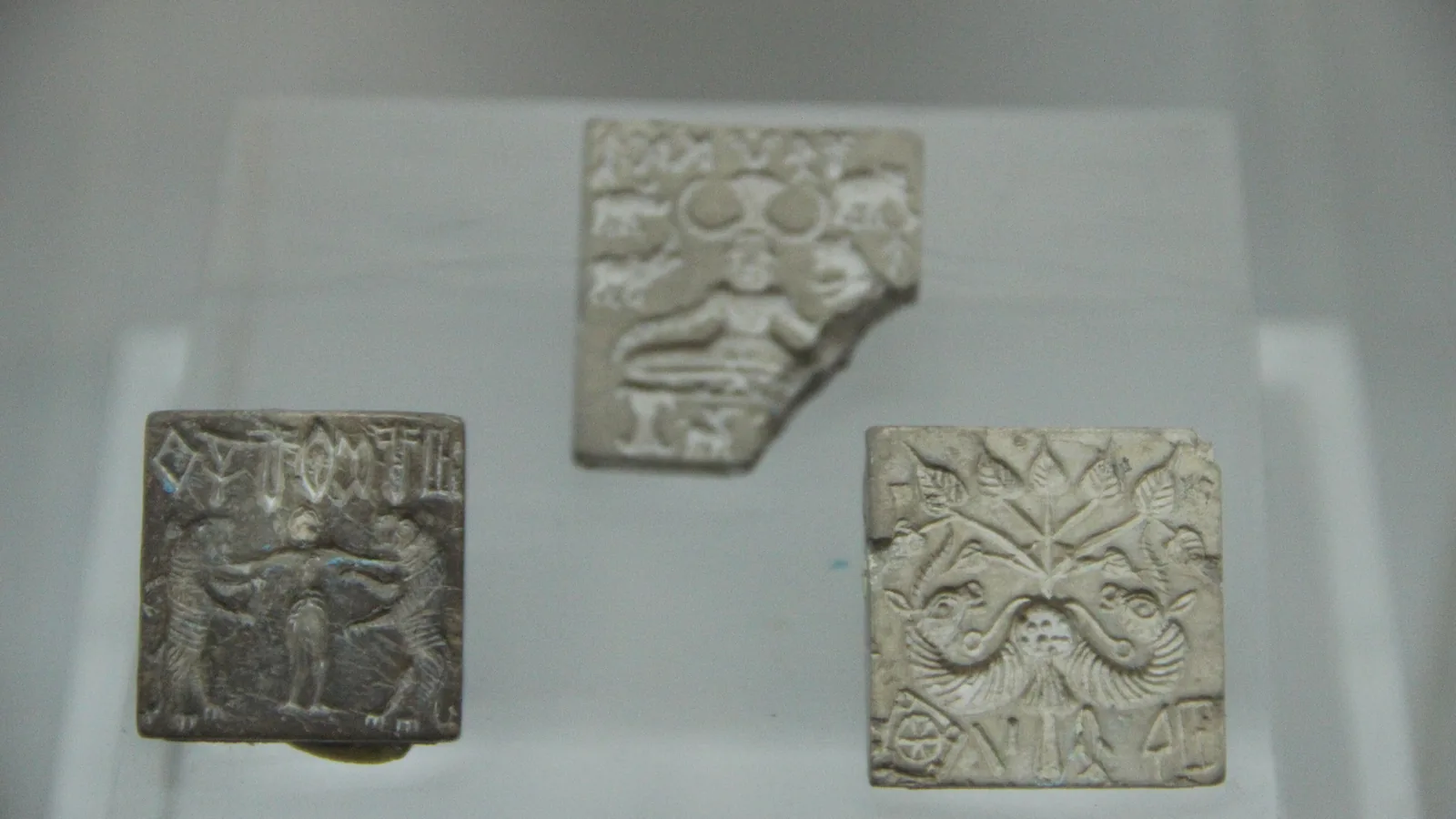
.jpg)
TL;DR — Sixty-one skeletal samples from the Rakhigarhi cemetery yielded one usable genome: I6113, a woman with no Steppe pastoralist and no Anatolian farmer ancestry.
“We report an ancient genome from the Indus Valley Civilization (IVC),” the abstract opens. “The individual we sequenced fits as a mixture of people related to ancient Iranians (the largest component) and Southeast Asian hunter-gatherers. . . . These individuals had little if any Steppe pastoralist-derived ancestry, showing it was not ubiquitous in northwest South Asia during the IVC as it is today.” Cell published the paper online on September 5, 2019. Its joint first authors were Vasant Shinde, of the Deccan College Post-Graduate and Research Institute in Pune, and Vagheesh Narasimhan, of Harvard Medical School; David Reich was the corresponding author. The individual, cataloged as I6113, was a woman buried at Rakhigarhi in Haryana, the only one of 61 sampled skeletons whose DNA could be read.
Quick facts
- When
- ASI excavations 1997–2000; Deccan College cemetery seasons 2013–2016; memorandum of understanding with Harvard Medical School, February 2016; Cell paper published online September 5, 2019; Science paper published September 6, 2019
- Where
- Rakhigarhi, Haryana, India: the town mound and the cemetery about 1 km to its west, trenches RGR 7.1, 7.2 and 7.3
- Who
- Vasant Shinde (Deccan College Post-Graduate and Research Institute, Pune) and Vagheesh Narasimhan (Harvard Medical School), joint first authors; David Reich, corresponding author; the buried woman cataloged as I6113 (RGR7.3, BR-01, HS-02)
- Outcome
- Of 61 skeletal samples and 251 libraries, one individual gave usable data. I6113 carried mitochondrial haplogroup U2b2 and fit a two-way mixture of Iranian-related and hunter-gatherer ancestry, with no Steppe pastoralist and no Anatolian farmer component. The 12 individuals of the same profile were renamed the IVC Cline, and the sequences were deposited as PRJEB34154
Rakhigarhi, 550 hectares, and a cemetery a kilometer west
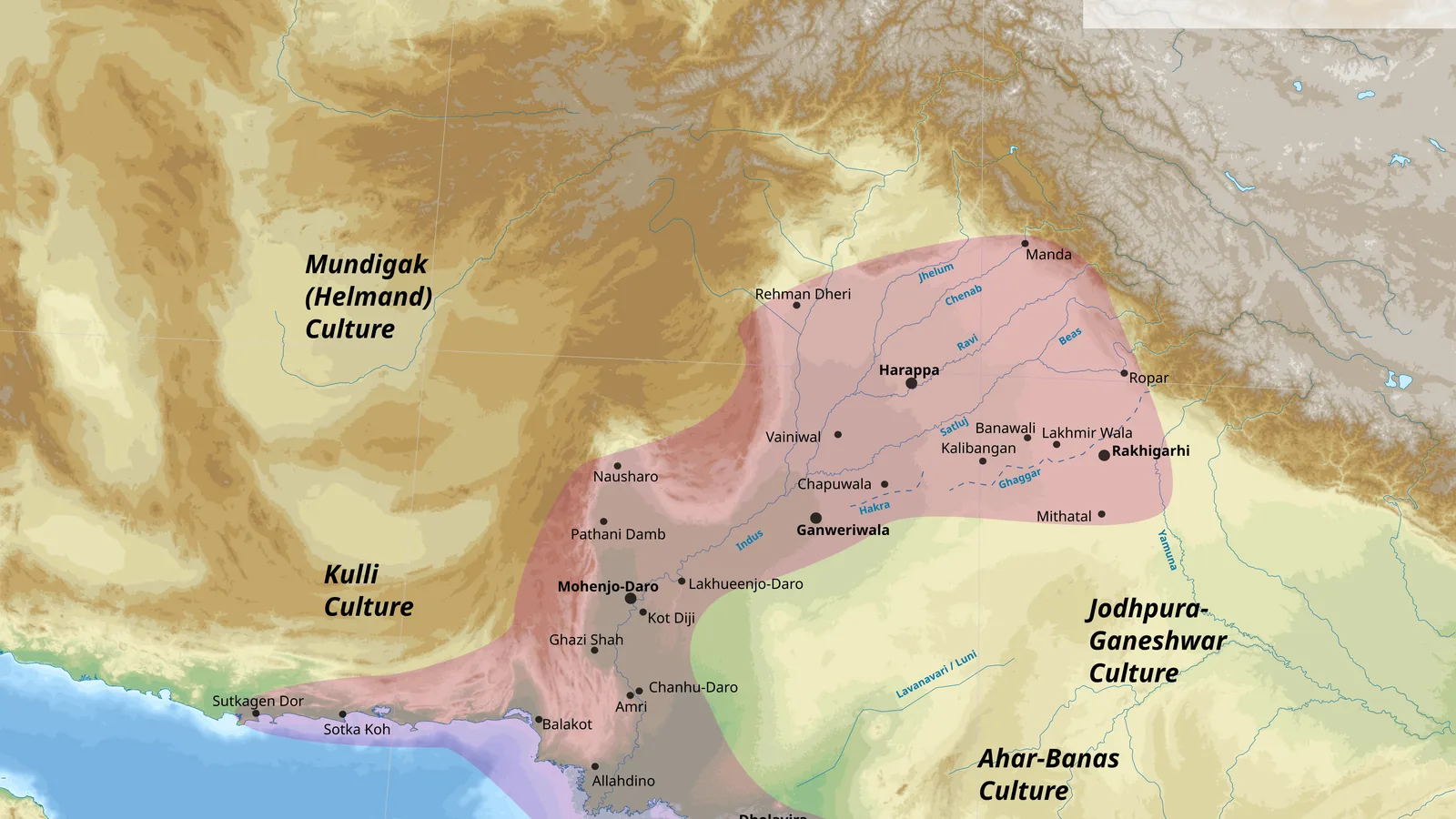
Rakhigarhi is one of the five largest settlements of the Harappan civilization, whose mature phase ran from 2600 to 1900 BC, with Harappa, Mohenjo-daro, Dholavira and Ganweriwala. The Cell paper calls it the largest known site of that civilization, 550 hectares.
Work by the Archaeological Survey of India between 1997 and 2000, reported by Amarendra Nath in the journal Puratattva, uncovered a well-built road, a drainage system and a large rainwater storage facility; the survey called Rakhigarhi the provincial capital of the eastern Harappan region. In the cemetery area the survey opened only 11 graves. A team led by Shinde returned for three seasons between 2013 and 2016 under license F/15/1/2010 EE. The 2014–15 season found six burials in a 10 by 10 m trench in sector RGR 7.2; the 2015–16 season found 36 more in a 20 by 20 m trench there, and 11 in two trenches in the southern sector RGR 7.3.
Powder from 61 skeletal samples
One of those southern burials was I6113, whose field codes were RGR7.3, BR-01 and HS-02. The Cell authors write that in dedicated clean rooms they obtained “powder from 61 skeletal samples from the Rakhigarhi cemetery, which lies ~1 km west of the ancient town.” Those samples produced 251 sequencing libraries. One individual came through.
For I6113 alone the team built 108 libraries in five extractions, 27 double-stranded and 81 single-stranded. The double-stranded set came from powder taken from the otic capsule and the semicircular canals of the petrous bone, the dense part of the temporal bone. Forty from one extraction were dropped for contamination and low coverage. Merging the remaining 68 gave data at 208,111 positions in the genome; restricting the reads to those carrying the cytosine-to-thymine damage typical of ancient DNA left 31,760. The ratio of X to Y chromosome sequences identified the individual as female, which agreed with the reading of the bones. A memorandum of understanding between the Deccan College and Harvard Medical School had been signed in February 2016. A 2023 review in Genes, by Shinde with Niraj Rai and three colleagues, cites the protective suits worn at the trench as a way of keeping modern DNA off the bone.
Five attempts at a radiocarbon date, all of them failed
No date of her own exists. “There is insufficient collagen preservation for the human bones at Rakhigarhi cemetery to allow Accelerator Mass Spectrometry radiocarbon dating,” the paper states, and it lists five attempts on skeletal elements from I6113. Its age rests on the grave goods and on seven charcoal samples from the town mound, at depths of 9 to 23 m, dated between 2800 and 2300 BC.
"Little if any Steppe pastoralist-derived ancestry"
Her mitochondrial consensus sequence belonged to haplogroup U2b2, which the Cell authors describe as absent from data on about 400 ancient Central Asians and today “nearly exclusive to South Asia.” In principal component analysis she fell on a gradient already known from 11 outliers at two sites outside the Indus world: three at Gonur in what is now Turkmenistan and eight at Shahr-i-Sokhta in eastern Iran. Neither she nor they carried Anatolian farmer-related ancestry of the seventh millennium BC, which later farming populations of the Iranian plateau at Hajji Firuz and Tepe Hissar did carry.
Two models fit her ancestry and no others. One combines Iranian-related herders of the western Zagros with Andamanese hunter-gatherers, 73 plus or minus 6 percent Iranian-related, at p = 0.103; the other substitutes East Siberian hunter-gatherers and gives 63 plus or minus 6 percent, at p = 0.24. She forms a single genetic clade with the 11 outliers at p = 0.42, and the Cell authors renamed the group of 12 the IVC Cline. They set a limit on what one burial can carry: “a single sample,” or even the gradient of 12 likely IVC samples, “cannot fully characterize a cosmopolitan ancient civilization.” On language, the authors argue that the near-absence of Anatolian farmer ancestry in this group weakens the Anatolian hypothesis, which routes Indo-European speech into South Asia with farming by way of the Iranian plateau.
.svg)
September 6, 2019: 523 ancient genomes in Science
The companion paper appeared a day later. “By sequencing 523 ancient humans,” its abstract states, “we show that the primary source of ancestry in modern South Asians is a prehistoric genetic gradient between people related to early hunter-gatherers of Iran and southeast Asia.” It dates the three Gonur outliers to 2500–2000 BC and the eight from Shahr-i-Sokhta to 3300–2000 BC, and puts the mixture that formed their profile at 5400–3700 BC. Three observations there argue that such people moved out of the Indus region rather than into it: only 11 of 44 well-sequenced individuals at those two sites had the profile; three of the Shahr-i-Sokhta outliers were buried with Baluchistan-style goods; and the Andamanese-related ancestry they share with I6113 is missing from their non-outlier neighbors.
Narasimhan and his coauthors trace the same gradient into a Steppe Cline after 2000 BC and a Modern Indian Cline, and estimate that Ancestral South Indians drew at least 55 percent of their ancestry from it, Ancestral North Indians about 70 percent. Their DATES estimate puts the mixture that made the Ancestral South Indians at 107 plus or minus 11 generations back, a 95 percent interval of 1700 to 400 BC, after the decline of the Indus cities. “Most of the Steppe ancestry in South Asia derives from males,” that paper adds. The reads from the one Rakhigarhi woman went into the European Nucleotide Archive under accession PRJEB34154, released with the Cell paper on September 5, 2019.
Key facts
- Cell published “An Ancient Harappan Genome Lacks Ancestry from Steppe Pastoralists or Iranian Farmers” online on September 5, 2019, with Vasant Shinde and Vagheesh Narasimhan as joint first authors and David Reich as corresponding author.
- Powder from 61 skeletal samples at the Rakhigarhi cemetery gave 251 libraries; one individual, I6113, produced usable data (Cell, 2019).
- I6113 carried the field codes RGR7.3, BR-01 and HS-02, and the X to Y chromosome ratio identified her as female (Cell, 2019).
- 108 libraries from five extractions were built for her; 68 were merged, giving 208,111 SNPs and 31,760 after damage filtering (Cell, 2019).
- Five radiocarbon attempts on her skeletal elements failed for want of collagen; seven charcoal samples from the town mound date to 2800–2300 BC (Cell, 2019).
- Two qpAdm models fit: Iranian-related plus Andamanese hunter-gatherer at 73 ± 6 percent, p = 0.103, or Iranian-related plus East Siberian hunter-gatherer at 63 ± 6 percent, p = 0.24 (Cell, 2019).
- The Science paper of September 6, 2019 reports 523 ancient genomes and places the Gonur outliers at 2500–2000 BC and the Shahr-i-Sokhta outliers at 3300–2000 BC.
- The Archaeological Survey of India worked at Rakhigarhi between 1997 and 2000 and opened 11 graves in the cemetery; Deccan College dug three further seasons between 2013 and 2016 (PLOS ONE, 2018).
FAQ
How many Rakhigarhi skeletons produced ancient DNA?
One. The Cell team took powder from 61 skeletal samples from the cemetery and built 251 libraries from them, and only the individual cataloged as I6113 yielded data good enough to analyze.
What ancestry did the Rakhigarhi genome carry?
A two-way mixture of Iranian-related ancestry, the larger part, with hunter-gatherer ancestry related to Andamanese or East Siberian populations. The paper found no Steppe pastoralist ancestry and no Anatolian farmer ancestry, and her mitochondrial haplogroup was U2b2.
Why is the Rakhigarhi burial not radiocarbon dated?
Collagen does not survive in the human bone at that cemetery. Five attempts on elements from I6113 failed. The burial is dated by its grave goods and by seven charcoal samples from the town mound that returned dates of 2800–2300 BC.
Sources
- Shinde V, Narasimhan VM, Rohland N, et al., "An Ancient Harappan Genome Lacks Ancestry from Steppe Pastoralists or Iranian Farmers," Cell 179(3):729–735.e10 (2019), PMC6800651. Full text read as PubMed Central XML.
- Narasimhan VM, Patterson N, Moorjani P, et al., "The Formation of Human Populations in South and Central Asia," Science 365(6457):eaat7487 (2019), PMC6822619. Full text read as PubMed Central XML.
- Shinde VS, Kim YJ, Woo EJ, et al., "Archaeological and anthropological studies on the Harappan cemetery of Rakhigarhi, India," PLOS ONE 13(2):e0192299 (2018), PMC5821334, open access.
- Dalal V, Pasupuleti N, Chaubey G, Rai N, Shinde V, "Advancements and Challenges in Ancient DNA Research: Bridging the Global North-South Divide," Genes 14(2):479 (2023), PMC9956214, open access.
- Deccan College Post-Graduate and Research Institute, Pune, Department of Archaeology: departmental profile page listing the institute's excavated sites.
- Deccan College Post-Graduate and Research Institute, Pune, Department of Archaeology: departmental history page.
- Europe PMC search service (European Bioinformatics Institute), used to confirm the bibliographic details, PubMed Central identifiers and author lists of the four papers above.
Cite this article
- APA
- Our Earth's History. (2026, September 22). Sixty-one samples, one genome: the Rakhigarhi woman I6113. Our Earth's History. https://ourearthshistory.com/south-asia/ancient/rakhigarhi-i6113-cell-2019-one-genome-from-sixty-one-samples/
- Chicago
- Our Earth's History. “Sixty-one samples, one genome: the Rakhigarhi woman I6113.” Our Earth's History, September 22, 2026. https://ourearthshistory.com/south-asia/ancient/rakhigarhi-i6113-cell-2019-one-genome-from-sixty-one-samples/.
- MLA
- “Sixty-one samples, one genome: the Rakhigarhi woman I6113.” Our Earth's History, 22 Sep. 2026, https://ourearthshistory.com/south-asia/ancient/rakhigarhi-i6113-cell-2019-one-genome-from-sixty-one-samples/.
Text licensed CC BY-NC-ND 4.0. Found an error? Tell us.