Terracotta Army: how many soldiers? Three pits, three kinds of count

TL;DR — The museum’s density estimates for three pits total 7,372; papers say about 7,000 or more than 8,000, and over 2,000 were excavated by 2019.
In March 1974 farmers of Xiyang village, in the Lintong district of Xi’an, dug a well and turned up fragments of pottery figures. That is the account of the Emperor Qinshihuang’s Mausoleum Site Museum, which runs the site; a 2007 science summary from SLAC National Accelerator Laboratory at Stanford puts the number of farmers at nine, a figure the museum does not give. After more than a year of survey and trial digging, archaeologists confirmed a large pit of figures, now called Pit 1. Two more pits were found in 1976. The museum publishes a number for each pit, research papers print totals that disagree with each other and with the museum’s sum, and the count of figures actually excavated is far smaller than any of them.
Quick facts
- When
- March 1974 (fragments found during well digging; Pit 1 confirmed after more than a year of survey) · April 1976 (Pit 2 found) · May 1976 (Pit 3 found) · 244–237 BC and 231–227 BC (dates inscribed on weapons from Pit 1)
- Where
- Xiyang village, Lintong district of Xi'an, at the mausoleum of the First Emperor of Qin, in what is now Shaanxi province, China
- Who
- Farmers of Xiyang village; the Emperor Qinshihuang's Mausoleum Site Museum; researchers from University College London and the museum; the chancellor Lü Buwei, named on halberd inscriptions
- Outcome
- The museum estimates about 6,000 figures and horses in Pit 1, more than 1,300 in Pit 2 and 72 in Pit 3; published totals range from about 7,000 to more than 8,000; a 2019 paper counted over two thousand warriors excavated
March 1974 to May 1976: three pits
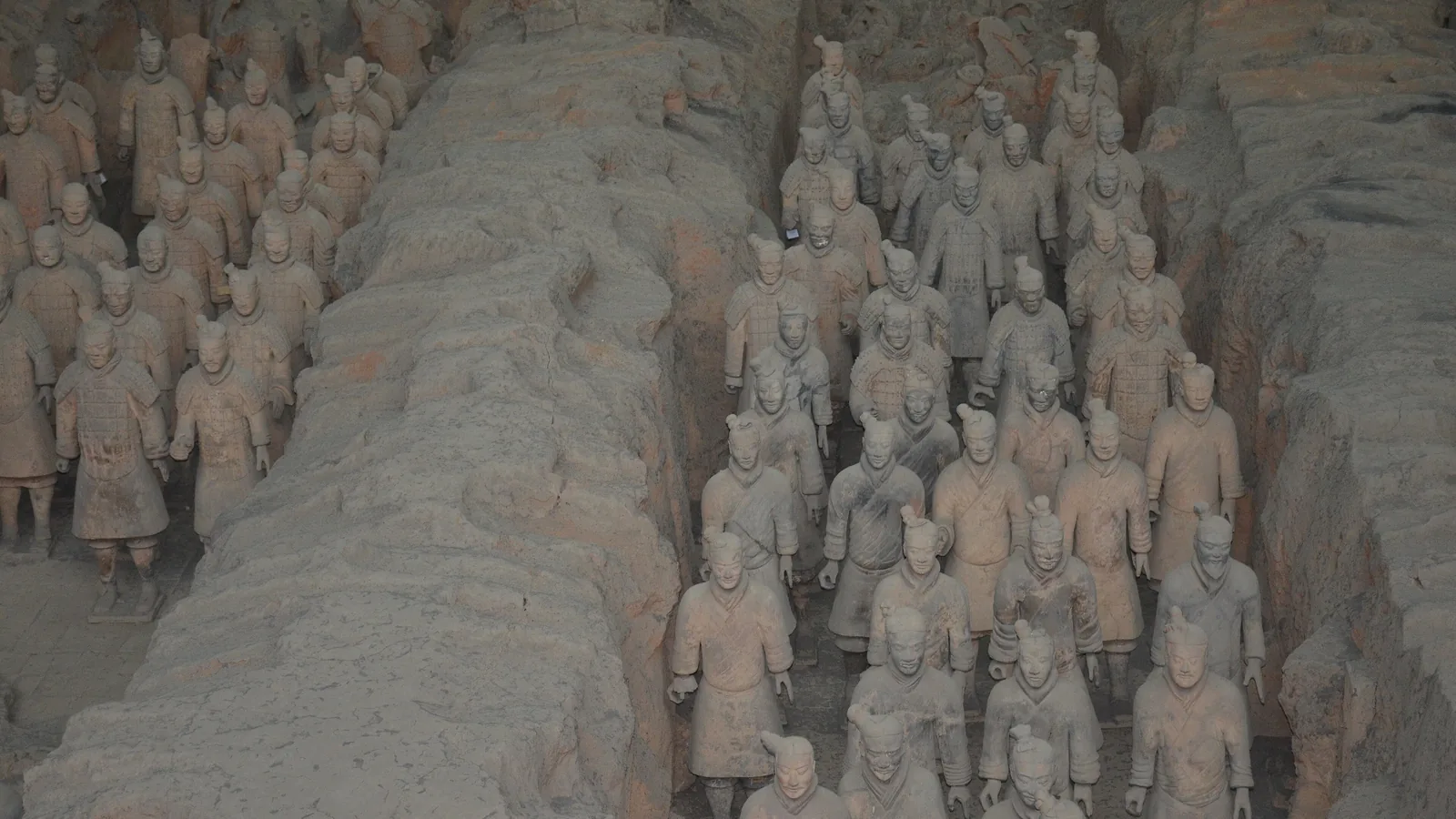
Pit 1 measures 230 meters from east to west and 62 meters from north to south, lies 4.5 to 6.5 meters below the present ground surface and covers 14,260 square meters, according to the museum. In April 1976 a second pit was found 20 meters north of the east end of Pit 1. The museum gives Pit 2 an L-shaped plan, 124 by 98 meters and about 6,000 square meters, and calls it the richest of the pits, with the widest range of troop types.
A third pit turned up in May 1976, 25 meters north of the west end of Pit 1. It is far smaller: 28.8 by 24.57 meters, 520 square meters, entered by a sloping ramp on the east. The museum’s page records the view that Pit 3 was the headquarters commanding the other two, known in ancient times as a junmu (军幕).
The three pits are only part of the burial ground. The museum puts the core area of the mausoleum at about 56.25 square kilometers, including the earthen mound, building sites and other pits, two of which hold museums of acrobat figures and civil official figures. Patrick Quinn of University College London (UCL) and three co-authors studied two fragments of “terracotta acrobat” statues from one of these, pit K9901.
Estimates by density, and three totals
For Pit 1 the museum uses the word 推算, a calculated estimate. Its page states that the figure was reached “根据试掘已出土陶俑、陶马的排列密度” (from the density of arrangement of the pottery figures and horses already unearthed in trial excavation), and the result is about 6,000 figures and horses, with a large quantity of bronze weapons. For Pit 2 the museum infers more than 1,300 figures and horses from its trial excavation. For Pit 3 it gives 72, without the language of estimation.
Added together, the museum’s three numbers make 7,372. Published research rounds differently. Quinn and his co-authors, two of them from the museum, wrote in Antiquity in 2017 that the army comprises “around 7000 individually crafted, life-sized ceramic warriors, generals and horses” in three underground pits. A 2022 paper in Heritage Science by Li Xiaoxi and colleagues opens with “more than 8000 terracotta warriors and horses,” and the SLAC summary of 2007 also gives more than 8,000. All of these totals include horses, and none is a count of excavated objects.
1,087 warriors from the front of Pit 1
Counting begins at the east end of Pit 1. Xiuzhen Li of the museum and colleagues at UCL wrote in 2016 that “some 1087 terracotta soldiers were excavated in the front, easternmost portion of Pit 1.” Of those 1,087, they found 283 that bear marks: 57 stamped, 109 with incised names, 157 with incised numbers and one painted.
A 2019 paper in Scientific Reports, led by Marcos Martinón-Torres, gave the wider figure: “Over two thousand ceramic warriors have been excavated so far, and it is estimated that several thousand more remain buried.” The same paper listed what the partial excavation of Pit 1 had yielded in weapons: more than 80 ferrules, over 260 crossbow triggers and as many as 40,000 arrowheads, usually in bundles of 100, each bundle once the contents of one warrior’s quiver. A 2018 study in Heritage Science, working from over 200 triggers recovered from Pit 1, found three marks painted in black, the characters jia (甲), wu (武) and jiu (九), and identified the ink as soot-based.

Lü Buwei on the halberds
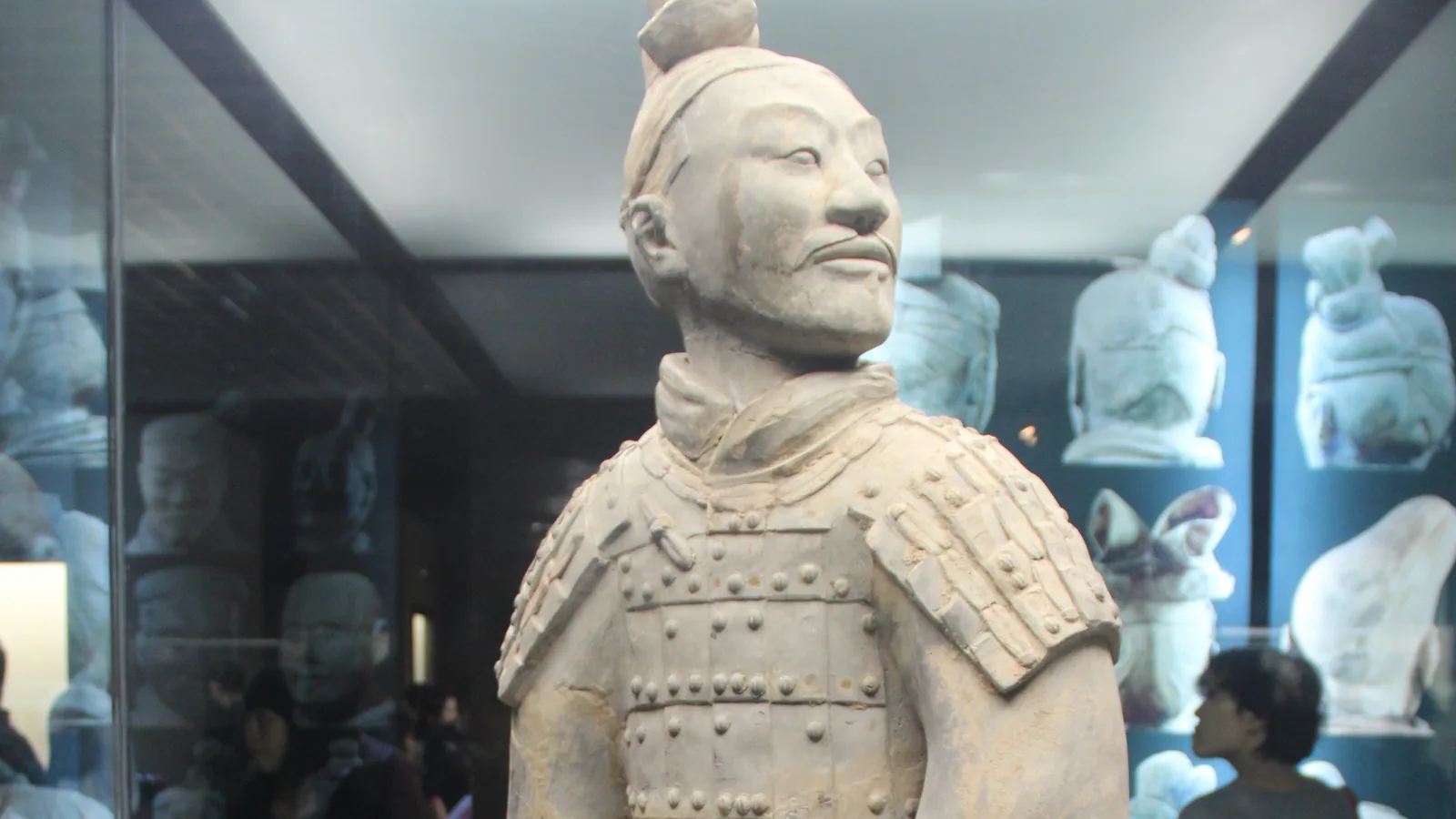
The longer inscriptions on the bronze weapons carry dates. Li and her co-authors read the regnal years on seven halberds and found that all fell between 244 and 237 BC, before the unification of 221 BC. The chancellor Lü Buwei is named on every one of them except the latest, marked for the 10th regnal year, 237 BC. The authors wrote that this “correlates nicely” with the date of his fall from power.
The 16 lances from the front of Pit 1 tell a later story. Their inscriptions date them to the 15th through 19th regnal years, 231 to 227 BC, and name no chancellor at all, only an official of the Sigong workshop and a worker. A chancellor’s name returned on a weapon of 209 BC, the first year of the Second Emperor: Li Si, Lü Buwei’s successor, with a new workshop called Yueyang. That weapon was found elsewhere, not at the mausoleum.
"Should therefore be abandoned": chromium and mercury
For about 40 years a theory held that Qin workshops had coated bronze weapons with chromium to stop rust. The 2019 paper traced it to a 1983 article by R. Han, Z. Ma, Z. Wang and J. Ke in Ziran kexueshi yanjiu, and tested it. The chromium on the blades, the authors found, had come from lacquer buried next to them, after burial. “The chromium anti-rust treatment theory should therefore be abandoned,” they wrote. They put the good preservation down to the moderately alkaline soil, its very fine particles and the composition of the bronze.
The emperor’s own tomb has not been excavated. A 2020 Scientific Reports paper by Zhao Guangyu, Zhang Weixing of the museum and others gives the base of the mound as about 380 by 330 meters, its height about 50 meters, and, from ground radar and gravimeter surveys, the underground palace as about 140 by 110 by 30 meters. The paper describes the historian Sima Qian as reporting that the tomb chamber held large amounts of liquid mercury, presumably forming rivers and lakes on a map of China. Taking the average mercury in the mound’s soil, 190 parts per billion, the authors reached about 1 ton; their laser-radar readings of mercury in the air pointed to about 1 ton as well. Claims that surface mercury traces the map underground “would be unwarranted,” they wrote, and on the chamber itself: “Current understanding is that the chamber has never been opened/looted.”
Key facts
- Farmers of Xiyang village, Lintong district of Xi’an, found fragments of figures while digging a well in March 1974 (museum); SLAC’s 2007 summary says nine farmers.
- Pit 1: 230 by 62 meters, 14,260 square meters; the museum estimates about 6,000 figures and horses from their density in trial excavation.
- Pit 2, found in April 1976: about 6,000 square meters, more than 1,300 figures and horses by the museum’s estimate.
- Pit 3, found in May 1976: 520 square meters, 72 figures and horses (museum).
- Published totals: “around 7000” (Quinn and others, Antiquity, 2017); “more than 8000” (Li Xiaoxi and others, Heritage Science, 2022).
- Li and others (2016) studied 1,087 soldiers excavated at the east end of Pit 1, 283 of them with marks; the 2019 Scientific Reports paper put the excavated total at over two thousand.
- Halberd inscriptions date to 244–237 BC and name Lü Buwei except on the latest; lance inscriptions date to 231–227 BC and name no chancellor.
- The 2019 paper rejected the chromium anti-rust theory; the 2020 paper estimated about 1 ton of mercury in the mound and reported the tomb chamber unopened.
FAQ
How many soldiers are in the Terracotta Army?
No count of every figure exists, because the pits have not been fully excavated. The museum estimates about 6,000 figures and horses in Pit 1, more than 1,300 in Pit 2 and 72 in Pit 3, which add up to 7,372. Antiquity (2017) gives about 7,000 and Heritage Science (2022) more than 8,000.
How many Terracotta Army figures have been excavated?
A 2019 paper in Scientific Reports stated that over two thousand ceramic warriors had been excavated, with several thousand more estimated to remain buried. A 2016 study examined 1,087 soldiers excavated at the east end of Pit 1.
Were the Terracotta Army weapons coated with chromium?
No. The 2019 Scientific Reports study found that the chromium on the bronze weapons came from lacquer after burial and concluded that the anti-rust coating theory should be abandoned. It attributed the preservation to the alkaline, fine-grained soil and the bronze itself.
Sources
- Emperor Qinshihuang's Mausoleum Site Museum, official website, "一号坑" (Pit 1).
- Emperor Qinshihuang's Mausoleum Site Museum, official website, "二号坑" (Pit 2) and "三号坑" (Pit 3).
- Emperor Qinshihuang's Mausoleum Site Museum, official website, "秦陵" (Qin mausoleum).
- Patrick Sean Quinn, Shangxin Zhang, Yin Xia and Xiuzhen Li, "Building the Terracotta Army: ceramic craft technology and production at Qin Shihuang's mausoleum complex," Antiquity 91 (358), 2017. UCL Discovery postprint.
- Xiuzhen Li, Andrew Bevan, Marcos Martinón-Torres, Yin Xia and Kun Zhao, "Marking Practices and the Making of the Qin Terracotta Army," Journal of Anthropological Archaeology 42 (2016), 169–183. UCL Discovery postprint.
- Xiuzhen Li, Andrew Bevan, Marcos Martinón-Torres, Patrick Quinn and Yin Xia, "Ink marks, bronze crossbows and their implications for the Qin Terracotta Army," Heritage Science 6, 58 (2018).
- Marcos Martinón-Torres and others, "Surface chromium on Terracotta Army bronze weapons is neither an ancient anti-rust treatment nor the reason for their good preservation," Scientific Reports 9, 5509 (2019).
- Guangyu Zhao, Weixing Zhang, Zheng Duan, Ming Lian, Ningbin Hou and others, "Mercury as a Geophysical Tracer Gas – Emissions from the Emperor Qin Tomb in Xi'an Studied by Laser Radar," Scientific Reports 10, 10414 (2020). PubMed Central.
- Xiaoxi Li, Wendi Yu, Desheng Lan, Jing Zhao and others, "Analysis of newly discovered substances on the vulnerable Emperor Qin Shihuang's Terracotta Army figures," Heritage Science 10, 72 (2022).
- SLAC National Accelerator Laboratory, Stanford Synchrotron Radiation Lightsource, science highlight "Ancient Warriors and the Origin of Chinese Purple" (March 2007), summarizing Z. Liu and others, Journal of Archaeological Science (2007).
Cite this article
- APA
- Song Letter. (2026, November 9). Terracotta Army: how many soldiers? Three pits, three kinds of count. Our Earth's History. https://ourearthshistory.com/east-asia/classical/terracotta-army-how-many-soldiers-pits-1974/
- Chicago
- Song Letter. “Terracotta Army: how many soldiers? Three pits, three kinds of count.” Our Earth's History, November 9, 2026. https://ourearthshistory.com/east-asia/classical/terracotta-army-how-many-soldiers-pits-1974/.
- MLA
- Song Letter. “Terracotta Army: how many soldiers? Three pits, three kinds of count.” Our Earth's History, 9 Nov. 2026, https://ourearthshistory.com/east-asia/classical/terracotta-army-how-many-soldiers-pits-1974/.
Get the week in history
One email a week: the new articles, and what was happening elsewhere at the same moment. Free, no ads, unsubscribe any time. How we handle your email.
Text licensed CC BY-NC-ND 4.0. Found an error? Tell us.